Stuart Axten

376 posts

Stuart Axten

Stuart Axten

@StuartAxtenPE

Depute Headteacher @Harlaw_Academy | Lifelong learner & advocate of values-driven education & leadership |

Scotland, United Kingdom Beigetreten Ekim 2017
523 Folgt286 Follower
Stuart Axten retweetet
Adam Boxer
Adam Boxer@adamboxer1·
Reading education blogs changed my practice, so I always want to try take the opportunity to share the love. Here are a few free blogs I've read recently that I thought were super, please share if you can! I work at a school that doesn't have merit points or rewards or anything like that, so this piece by @msrebeccabirch on intrinsic motivation really appealed to me: rebeccabirch.substack.com/p/on-chasing-t… We are in the midst of an SEND crisis, and part of the problem is outlined by @head_teach: that some schools have astonishingly higher numbers of students with SEND than others: matthewevanseducation.substack.com/p/magnetic-sch… @joel120193 is smashing out hit after hit on his blog, and this piece on the sheer amount of things teachers have to do resonated: joel120193.substack.com/p/the-60-minut… @mpershan wrote a typically scholarly, wide-ranging and sophisticated piece on implicit vs explicit learning, the memorisation of maths facts and much more. pershmail.substack.com/p/understandin… Next up are two posts on AI: @alex_crossman has written an excellent piece on the risks of AI to education. Our job is to get students' thinking hard, and AI's job is to get people thinking less hard. These aren't compatible, and we need to pull the brakes hard. powerfulknowledge.substack.com/p/its-time-to-… Whilst not strictly about education, Gary Marcus's entry here about the security risks of OpenClaw and other weird things is vital if we are to take internet and AI security seriously. garymarcus.substack.com/p/openclaw-aka… Of course, I've been blogging too, and you can check out my entries here: carouselteachlearnlead.substack.com As stated at the outset, please share if you can!
English

1
72
232
28.5K
Stuart Axten retweetet
Lee Woods
Lee Woods@LeeWoods0722·
Most school leaders are not chasing perfection. They are chasing progress. Quietly. Relentlessly. Under pressure. That is why Better by Atul Gawande resonates so deeply with leadership in schools. It is not about brilliance. It is about systems, habits and the discipline of improvement. In surgery, failure costs lives. In education, it costs opportunity. The lesson is the same in both fields: Care is not enough. Systems matter. That simple truth sits at the heart of Better: A Surgeon’s Notes on Performance by Atul Gawande. Although written through the lens of medicine, it may be one of the most quietly powerful leadership books a leader can read. Because it strips performance back to its essentials. Not vision statements. Not slogans. But habits, systems, humility and the relentless pursuit of improvement. In schools, as in surgery, we often celebrate individual excellence. The outstanding teacher. The inspirational leader. The charismatic head. Gawande dismantles this myth with precision. He shows that even the most talented professionals fail without: •Clear systems •Consistent routines •Feedback that is acted upon •A culture that allows challenge and learning The lesson is uncomfortable but necessary. Performance does not improve because people care more. It improves because systems make the right actions more likely and the wrong ones harder to repeat. One of Gawande’s central arguments is that improvement rarely comes from dramatic breakthroughs. It comes from marginal gains applied consistently. This is profoundly relevant to school leadership. Better attendance rarely comes from one assembly. Better behaviour rarely comes from one policy rewrite. Better teaching rarely comes from one INSET day. It comes from leaders who: •Clarify expectations •Remove ambiguity •Build routines that survive pressure •Accept that good intentions are not enough In Gawande’s world, checklists save lives. In ours, systems save learning time. Perhaps the most striking section of Better is Gawande’s exploration of coaching. Even elite surgeons, at the top of their profession, actively seek feedback from others who can see what they cannot. This is where leadership in schools is often tested. Senior leaders are expected to have answers. Yet the most effective leaders are those who remain open to scrutiny. The parallel is clear. Schools improve fastest when leaders: Invite challenge rather than defend practice Use evidence to refine decisions Model learning rather than certainty Leadership is not diminished by coaching. It is strengthened by it. What makes Better resonate so strongly with education is its realism. Gawande does not argue that failure can be eliminated. He argues that it can be reduced. He does not promise excellence overnight. He commits to progress, relentlessly pursued. This mirrors the reality of schools. We work in complex systems, serving diverse communities, under constant pressure. Improvement is rarely neat. But it is possible. The leaders who make the biggest difference are those who ask, repeatedly: What worked today? What did not? What one thing can we do better tomorrow? That mindset is not glamorous. It is transformative. Better is not a book about medicine. It is a book about responsibility. Responsibility to design systems that protect people. Responsibility to reflect honestly on performance. Responsibility to keep improving even when progress feels slow. For school leaders, that message could not be more relevant. Because the work is not about being flawless. It is about being better. Every day.
Lee Woods tweet media
English
11
65
270
91.5K
Stuart Axten
Stuart Axten@StuartAxtenPE·
@StuartLock @neilhumphreyUoM Does the paper outline the impact on the students that don’t misbehave and are exposed to the behaviours of those that want to cause disruption in classes? I know exclusions don’t work, but without proper funding for these “alternative provisions”, what chance do schools have?
English
0
0
4
233
Stuart Lock
Stuart Lock@StuartLock·
Anyone who works in a secondary school will know that this isn't true. I don't know of a school that could do this even if it wanted to: theguardian.com/education/2025…
English
8
9
55
31.7K
Stuart Axten retweetet
Michael Chiles 🌍
Michael Chiles 🌍@m_chiles·
***ASSESSMENT*** Assessment is the bridge between teaching and learning. When effective it provides rich information to determine how much and how well students have learnt the intended curriculum. In classrooms, assessment is an integral part of teaching. All interactions with students during a lesson are a potential opportunity to gather information to monitor students success against the intended curriculum aims. What are we doing Longdendale High School? Thread /1
Michael Chiles 🌍 tweet media
English
2
22
96
8.5K
Stuart Axten retweetet
Doug Lemov
Doug Lemov@Doug_Lemov·
As a coach (or a leader) it is harder & harder to build exceptional team culture. Fewer people are inclined to subordinate--even temporarily--individual desires & goals to team goals. People have less faith in institutions & authorities. They are more likely to leave than persist if unhappy. There are a dozen reasons. And one thing this tells us, ironically, is that the competitive advantage you gain from the outcome is all the bigger if you can be the one to build & sustain an exceptional culture.
English
6
16
86
12.3K
Stuart Axten retweetet
Tim Surma
Tim Surma@timsurma·
Proud to tell the world that our open access book "Developing Curriculum for Deep Thinking: The Knowledge Revival" is released. Freely available to anyone passionate about curriculum design and the teaching of complex cognitive skills. Grateful to work with such amazing people!
Tim Surma tweet media
English
11
156
482
69K
Stuart Axten retweetet
Brian Mendler
Brian Mendler@BrianMendler·
Teachers with few behavior issues have the following in common: 1. Rarely gets offended 2. Starts every day with a clean slate 3. Talks w/ kids before/after class 4. Considers de-escalation a win 5. Doesn't need the last word Add yours 👇 #teacher #teachers #TeachingStrategies
English
108
221
1.5K
159.9K
Stuart Axten
Stuart Axten@StuartAxtenPE·
An exciting opportunity to lead a passionate team and make a lasting impact at @harlaw_academy. A school with a diverse community of wonderful young people and a chance to be part of an exciting project of transformation. Please share with your networks @STEMscotland @STEMedscot
Stuart Axten tweet media
English
1
0
2
248
Stuart Axten retweetet
Carl Hendrick
Carl Hendrick@C_Hendrick·
How learning happens in seven general principles ⬇️ 1. Working Memory Capacity is Limited: Our working memory, responsible for holding and processing information in real-time, has a limited capacity. This limitation means that when learners are exposed to large amounts of new information simultaneously, they may struggle to process it effectively. Focusing attention is essential because distractions or overload can lead to cognitive strain, reducing the ability to learn. Teachers can support this by breaking information into manageable chunks, allowing students to engage deeply with smaller parts before moving on to the next concept. 2. We Learn Through Meaning and What We Already Know: Learning is enhanced when new information connects to existing knowledge. When learners relate new content to things they already understand, they create a stronger foundation for retention and comprehension. This process, known as schema-building, helps students make sense of complex ideas by fitting them into an established framework. Teachers can facilitate this by introducing new concepts through familiar examples or linking them to relevant prior knowledge, making learning more meaningful and long-lasting. 3. Novices Think Differently Than Experts: Novices often approach tasks with means-end analysis or trial-and-error methods or simple strategies because they lack the knowledge to recognize patterns or apply sophisticated approaches. In contrast, experts draw on rich mental models, using prior experiences and refined techniques to solve problems more efficiently. This difference means that novices need structured guidance to develop these mental models over time. Teachers can help by gradually introducing students to expert strategies, enabling them to progress from basic skills to more advanced understanding. 4. To Remember, We Need to Forget: Storage strength is the measure of how well information is embedded in long-term memory, indicating its durability over time. Retrieval strength is the ease with which information can be accessed from memory at a given moment, which fluctuates based on recent use and context. Unlike storage strength, retrieval strength is influenced by context and interference from other information. To remember something long-term, it’s essential to boost its retrieval strength, which can be achieved by actively retrieving the information. Unlike passive studying, retrieval requires you to recall the item on your own, strengthening memory more effectively, especially when the retrieval is challenging. This principle explains why strategies like interleaving (alternating topics) and spacing (spreading out sessions) are so effective. By allowing time for slight forgetting, these methods make retrieval harder, ultimately enhancing memory retention. This “adaptive forgetting” is crucial for retaining core concepts. 5. Learning ≠ Performance: A high test score or good performance in the classroom doesn’t necessarily mean that true learning has occurred. Learners might perform well temporarily by memorizing facts or rehearsing specific methods without understanding the underlying concepts. This principle highlights the difference between short-term performance and deep, long-term learning. Effective assessment should look beyond scores to evaluate true comprehension. The rate of assessment matters which is why regular checking for understanding is so important. Teachers can use open-ended questions, application tasks, and reflective discussions to gauge whether students genuinely understand the material. 6. Achievement Leads to Motivation: Success in learning (however small) can foster a positive cycle of confidence, self-efficacy, and motivation. When students achieve their goals, even in small steps, they are more likely to believe in their ability to succeed in future learning tasks. This sense of accomplishment encourages them to take on new challenges and persist through difficulties. Teachers can support this cycle by setting attainable goals, providing regular feedback, and celebrating incremental progress to reinforce students’ confidence and motivation. 7. Learners Are Bad at Knowing How to Learn: Many students are unaware of effective learning strategies, often relying on passive techniques like re-reading, highlighting, or cramming. These methods feel productive in the short term but are less effective for long-term retention. Evidence-based strategies like retrieval practice, spaced learning, and interleaving have been shown to improve memory and understanding, but students may need guidance to adopt these methods. Teachers can enhance learning outcomes by teaching students about these techniques and encouraging their use, helping students develop more efficient and powerful study habits. (Thanks to @MrAlexKoks for the design)
Carl Hendrick tweet media
English
10
211
594
95K
Stuart Axten retweetet
Peps
Peps@PepsMccrea·
Routines are valuable, but only once they have become automated. Until then, we must treat them as an investment: ↓
Peps tweet media
English
3
47
167
20.4K
Stuart Axten retweetet
Impact
Impact@ImpactWales·
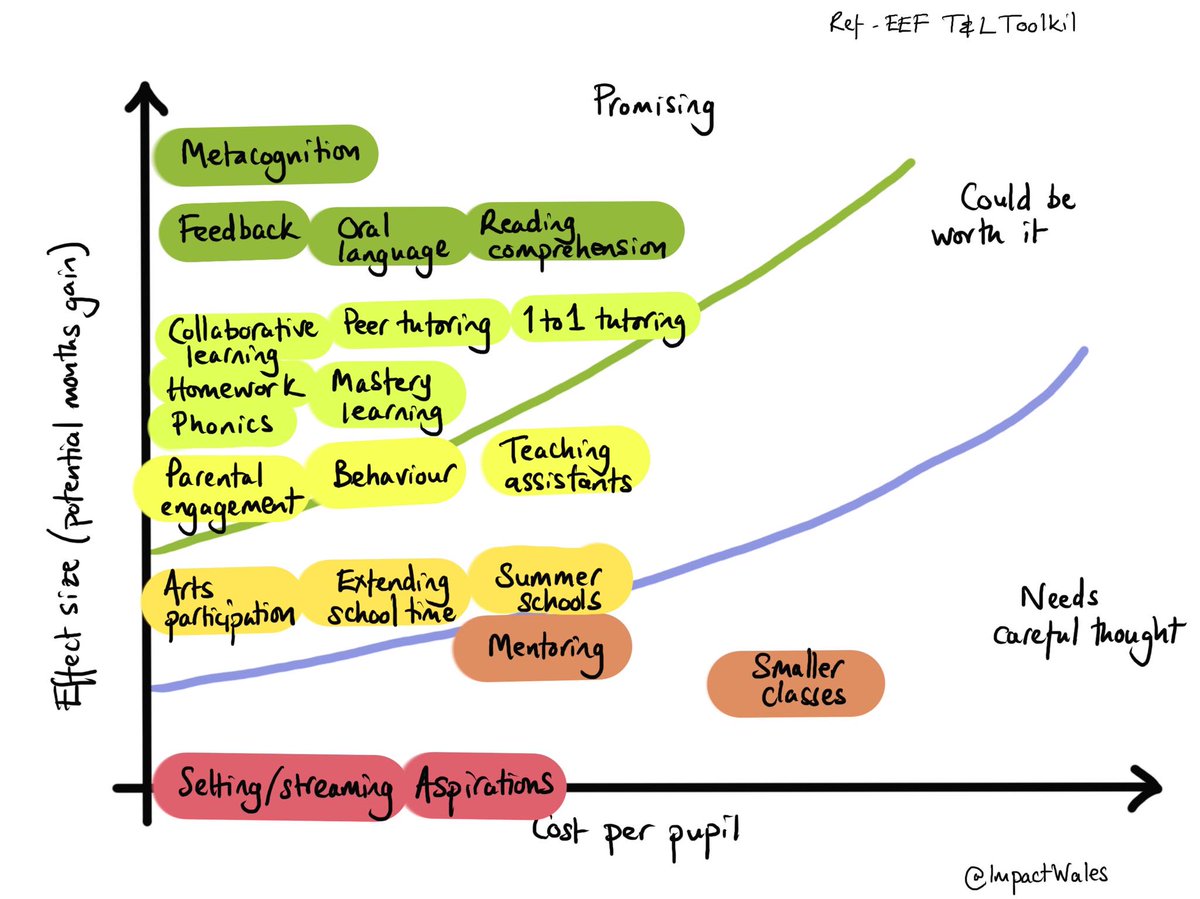
Which of these strategies are you using with your pupils? You can find further information about them on our website impact.wales or from the @EducEndowFoundn teaching & learning toolkit.
Impact tweet media
English
0
8
20
6.3K