Ted Merz

3.4K posts

Ted Merz banner
Ted Merz

Ted Merz

@TedMerz

Founder Principals Media. Storyteller, Media consulting, Startup advisor, Angel investor. Former Global Head of News Product at Bloomberg.


New York City Beigetreten Ekim 2008
6K Folgt3.7K Follower
Ted Merz
Ted Merz@TedMerz·
@SenSanders the lighting , staging and set up are just fabulous. immediate meme material
English
0
0
3
32
Sen. Bernie Sanders
Sen. Bernie Sanders@SenSanders·
I spoke to Anthropic’s AI agent Claude about AI collecting massive amounts of personal data and how that information is being used to violate our privacy rights. What an AI agent says about the dangers of AI is shocking and should wake us up.
English
1.1K
2.7K
16.8K
3.5M
Ted Merz
Ted Merz@TedMerz·
Former Goldman CEO Lloyd Blankfein's response to the Wall Street Journal about whether he has seen the three most famous recent films about Wall Street.
Ted Merz tweet media
English
0
0
2
163
Jessica Livingston
Jessica Livingston@jesslivingston·
Paul Graham is back in the latest Social Radars, talking about what went on behind the scenes in the early days of YC. If you like the fly-on-the-wallness of Social Radars interviews, this is the most fly-on-the-wall of all. pod.link/1677066062/epi…
English
15
27
342
85.9K
Ted Merz
Ted Merz@TedMerz·
@TrungTPhan Have you started a spreadsheet tracking CEOs who have eaten their own product yet? It's becoming the ice bucket challenge of 2026 (which btw how weird was that that become a thing everyone had to do )
English
6
0
109
35.6K
Trung Phan
Trung Phan@TrungTPhan·
Costco CEO Ron Vachris did the “CEO eats his own product” challenge by destroying a hot dog (and confirms the Costco hot dog combo is staying at $1.50 forever). Legend.
English
1.1K
2.5K
41.3K
3.4M
Tom Bruni, CPA, CMT
Tom Bruni, CPA, CMT@BruniCharting·
After four transformative years at @Stocktwits, my role was eliminated on Friday as part of a company restructuring. I’m incredibly proud of what we built, from launching a newsroom that reaches millions to representing the voice of retail investors on global stages and in the media. I’ll look back on this chapter fondly. Thank you to @howardlindzon and the team for the opportunity to help evolve such an influential platform during this "golden age" of retail investing. What’s next? I’m a dual-certified (CPA/CMT) leader looking for my next challenge in the financial media or fintech space. I specialize in bridging the gap between deep market analysis and retail investor engagement. I am exploring full-time and contract opportunities where I can lead or contribute to: - Content Strategy & Editorial Operations - Market Insights & Research - Growth-Focused Media Products If you’re building something in this space or just want to catch up, reach out here or at business@tombruni.com.
Tom Bruni, CPA, CMT tweet media
English
22
4
72
10.3K
Ted Merz
Ted Merz@TedMerz·
@TechLayoffLover brutal. feel for the guy. hard to believe this won't have big political fallout as it widens
English
0
0
0
37
Tech Layoff Tracker
Tech Layoff Tracker@TechLayoffLover·
A buddy from college hit me up last night out of nowhere. Dude was a senior product manager at Google. Pulled $320k+ TC no problem. House in Austin, three young kids, wife who stepped back from her career to handle the family chaos. Got cut in the latest restructure wave. Now he's watching the savings bleed out at $5,800+ a month just to keep the lights on and the kids fed. Mortgage, daycare for the toddler, school supplies, two car notes, health insurance COBRA kicking in soon. He crunched the numbers stone-cold: maybe four months before it's game over. He was always the loud one in the group—bragging about the stock grants, the remote flex, how Big Tech was bulletproof forever. Last night on the call he was quiet. Shaky. Admitted he's waking up at 3 a.m. staring at the ceiling thinking about what happens when the account hits zero. He's blasting applications. 250+ out the door. A couple recruiter DMs that fizzle. Screens that end with "we'll be in touch" and then silence. The market is ice-cold and every job posting gets 500+ applicants overnight. He said flat-out: "We thought we had it figured out. House, kids' college funds starting, vacations planned. Now I'm refreshing job boards at midnight wondering if we'll have to move in with my in-laws." You never think it'll be you. Until the access gets revoked, the calendar turns into a ghost town, and the mortgage statement shows up anyway. If you're still collecting fat TC at a FAANG or big tech shop thinking the golden handcuffs and network will always catch you… wake the fuck up. The runway disappears faster than you expect. DMs open if you're in the same spiral or watching someone you know crack under it. No judgment. Just real talk.
English
276
198
1.9K
412.3K
Ashley Mayer
Ashley Mayer@ashleymayer·
The jury is out on introspection, but we do know that men love to talk about Great Men.
English
12
2
78
3.9K
Ted Merz
Ted Merz@TedMerz·
When my dad was discharged from the Navy at the end of World War II, he took the train from California first to Chicago, then to Newark, then down to the Jersey Shore. His family had no idea he was heading home much less exactly when he would arrive. He got off the train carrying a heavy seabag and walked to the Allenhurst Beach Club, where he knew everyone would be because it was a Sunday afternoon. He said that it was a complete surprise when he arrived, still in uniform. Dad’s appearance temporarily interrupted the championship match of the annual shuffleboard tournament. His father ended up winning the men’s competition, while his sister won the women's side, narrowly beating out his mother, who came in second. It's great family lore but also a time capsule of a story. That kind of surprise homecoming that creates an indelible memory would never happen in today's era of instant communications. It's a reminder of how much technological change has occured in the span of one person's life. And what we've gained and also what we've lost.
English
1
1
7
252
Fredrik Hjelm
Fredrik Hjelm@FredrikHjelm4·
Sweden: we are a high-tax socialist country, everyone contributes, we take care of each other The income tax story is real. Starts at 30%, hits 55% at the top, add employer social fees at 31.4% and you're north of 65% fully loaded on senior salaries Also Sweden: >inheritance tax abolished 2004 >gift tax abolished 2004 >wealth tax abolished 2007 >property tax capped at $900/year regardless of what your home is worth >no tax on unrealized gains >borrow against your holdco personally and live on the loan tax free >capital gains at 20-30%, only when you actually take money out >ISK accounts (think Roth IRA but works for unlisted assets too, no capital gains tax on the inside) I spent years believing the story. Running a company and making some money changed it The big families didn't build dynasties despite the tax system. They built it, across Social Democrat and centre-right governments alike, because the rules never changed when the party did I ran the California comparison. Top income is similar pain, roughly 50% combined. But California taxes capital gains as ordinary income, around 37% combined. Federal estate tax hits 40% above $14M. Sweden is more capital-friendly than California in almost every category that matters for building generational wealth The story Sweden tells about itself is not the real story. It punishes labor and protects capital, same as everywhere else. Just with better parental leave so nobody complains Look, the low capital taxes are actually good policy. Abolishing inheritance tax brought capital back and the data supports it. But the gap between how labor and capital get taxed is hard to justify on fairness grounds. A flatter, more harmonized rate between the two would be simpler and more honest It would also save the country billions of hours in admin overhead, for individuals navigating the rules and for the civil services enforcing them Why not just do a flat level across? Seems easier
Stockholm, Sweden 🇸🇪 English
77
28
531
179.3K
Ted Merz
Ted Merz@TedMerz·
fantastic perspective
Fredrik Hjelm@FredrikHjelm4

Sweden: we are a high-tax socialist country, everyone contributes, we take care of each other The income tax story is real. Starts at 30%, hits 55% at the top, add employer social fees at 31.4% and you're north of 65% fully loaded on senior salaries Also Sweden: >inheritance tax abolished 2004 >gift tax abolished 2004 >wealth tax abolished 2007 >property tax capped at $900/year regardless of what your home is worth >no tax on unrealized gains >borrow against your holdco personally and live on the loan tax free >capital gains at 20-30%, only when you actually take money out >ISK accounts (think Roth IRA but works for unlisted assets too, no capital gains tax on the inside) I spent years believing the story. Running a company and making some money changed it The big families didn't build dynasties despite the tax system. They built it, across Social Democrat and centre-right governments alike, because the rules never changed when the party did I ran the California comparison. Top income is similar pain, roughly 50% combined. But California taxes capital gains as ordinary income, around 37% combined. Federal estate tax hits 40% above $14M. Sweden is more capital-friendly than California in almost every category that matters for building generational wealth The story Sweden tells about itself is not the real story. It punishes labor and protects capital, same as everywhere else. Just with better parental leave so nobody complains Look, the low capital taxes are actually good policy. Abolishing inheritance tax brought capital back and the data supports it. But the gap between how labor and capital get taxed is hard to justify on fairness grounds. A flatter, more harmonized rate between the two would be simpler and more honest It would also save the country billions of hours in admin overhead, for individuals navigating the rules and for the civil services enforcing them Why not just do a flat level across? Seems easier

English
0
0
1
166
Ted Merz
Ted Merz@TedMerz·
The signal to noise ratio in Substack at this time is high. I wish this feature existed so it could be more easily mined.
Ted Merz tweet media
English
0
0
1
150
Ted Merz
Ted Merz@TedMerz·
An observation about a hospital in America I visited. The beds are high tech, with alarms to detect patients getting out of bed. But if you ask for an extra blanket it's hard to get one.
English
0
0
1
147
Ted Merz
Ted Merz@TedMerz·
It's wild how accurate the headcount numbers on LinkedIn are for most companies. Data which is otherwise not released. It's a good example of a long term trend which is the unanticipated benefits of alternative data sets and how they gradually make it harder for companies to control their own narratives.
English
0
0
1
143
Ted Merz
Ted Merz@TedMerz·
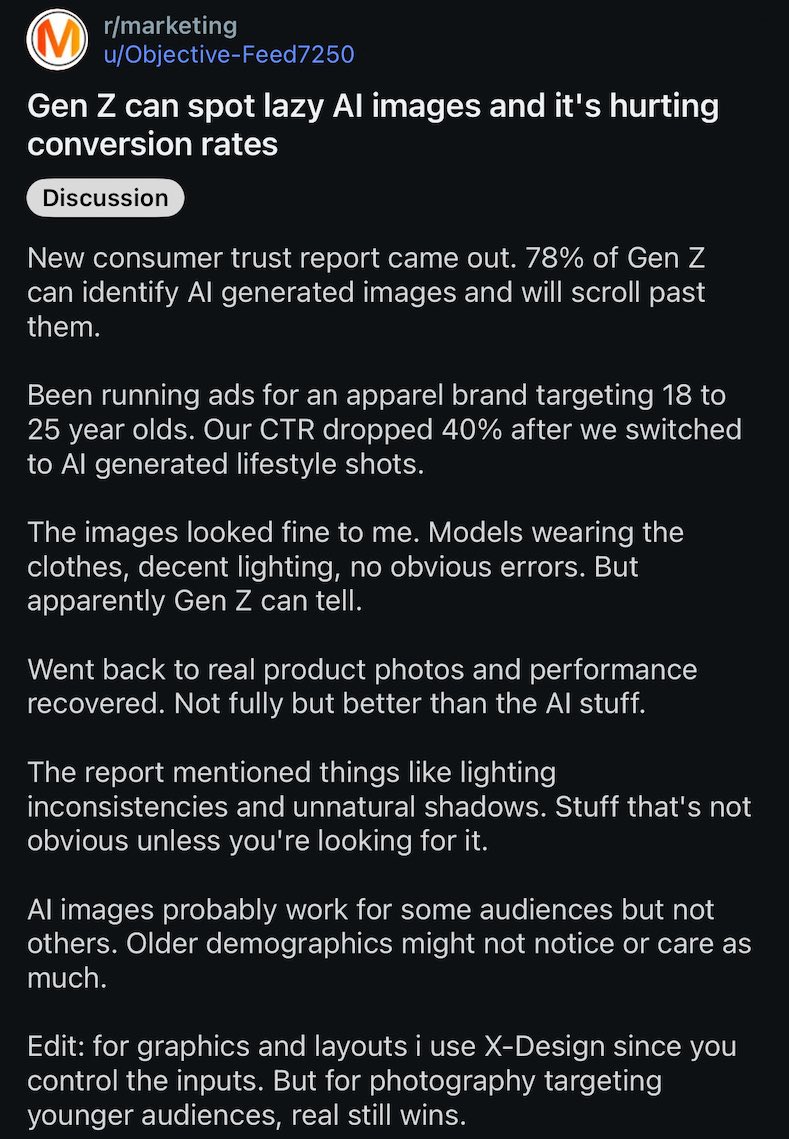
@bearlyai @TrungTPhan wonder what the percentages would be for millennials and Gen x and boomers. Do they have less of an ability to spot fake?
English
11
1
618
42.5K
Bearly AI
Bearly AI@bearlyai·
78% Gen-Z can spot AI-generated images and it hurts conversion (one marketer saw click-through-rates fall 40% when it tried AI-generated lifestyle images)
Bearly AI tweet media
English
231
1.1K
13.4K
958K
Ted Merz
Ted Merz@TedMerz·
@lulumeservey good take. also a better explanation for how to connect with people than just "networking"
English
0
0
1
130
Lulu Cheng Meservey
Lulu Cheng Meservey@lulumeservey·
If you want to win someone over (recruit, sales prospect, investor etc) Convince them you belong to the same group, and the rest takes care of itself In-group preference is one of the most powerful forces in human behavior People will funnel resources to members of their group, even if it means everyone gets less in absolute terms Other perks for group members: - actions are judged more moral - persuasion is more effective - memories of events are distorted in their favor (!) - attacks actually strengthen cohesion and loyalty Group belonging is so strong that it can even be triggered arbitrarily. People assigned to a group *at random* will still favor members of their group in these ways
English
42
33
946
54.1K
Geitner Simmons
Geitner Simmons@GeitnerSimmons·
My son provided a remarkable moment when he and I recently visited Paris's Père Lachaise Cemetery, burial site for figures including Oscar Wilde and Jim Morrison We visited Frederic Chopin's impressive, well-tended grave and as we exited, my son pointed to a nearby grave that's largely overgrown, without items of veneration such as we saw at Chopin's grave My son explained that this was the burial site of Gustave Charpentier (pictured below), a composer who was at the pinnacle of Parisian musical culture at the turn of the 20th century. His 1900 opera "Louise" portrayed working-class life in Montmartre, used dramatic allegorical figures, and was greatly celebrated, my son explained The contrast between the two burial sites (one well kept and much visited, the other far less so) was striking. Curious differing trajectories of artistic fame
Geitner Simmons tweet media
English
3
2
22
3.5K
Ted Merz retweetet
Anish Moonka
Anish Moonka@AnishA_Moonka·
June 1983. A 28-year-old Steve Jobs walks into a design conference in Aspen, Colorado. He asks the room who owns a personal computer. Nobody raises their hand. He says “Uh-oh.” Then he spends the next 55 minutes describing the next four decades of technology. Jobs told the audience Apple’s strategy was to “put an incredibly great computer in a book that you can carry around with you, that you can learn how to use in 20 minutes… with a radio link in it so you don’t have to hook up to anything.” That’s an iPhone. In 1983. The Mac hadn’t even shipped yet. He described an MIT project that sent a camera truck down every street in Aspen, photographed every intersection, and built a virtual walkthrough on a computer screen. Google Street View launched 24 years later. He said office networking was about 5 years away and home networking 10 to 15 years out. The web went mainstream in the mid-90s, about 12 years later. Dead on. He described software being sent electronically over phone lines, with free previews and credit card payment. That’s the App Store, 25 years before it launched. He even compared it to the music industry and said software needed “the equivalent of a radio station” for free sampling. Apple built the iTunes Music Store 20 years later. The AI prediction is the one that hits different now. Near the end, Jobs talked about machines that could capture a person’s “underlying spirit” or “way of looking at the world,” so that after they died, you could ask the machine questions and maybe get answers. He said 50 to 100 years. ChatGPT arrived in about 40. The weird part is this speech was lost for nearly 30 years. The full hour-long recording only surfaced in 2012 when a blogger got a cassette tape from someone who attended the original conference. The Steve Jobs Archive didn’t release actual video footage until July 2024. His timelines were consistently too fast. He wanted the “computer in a book” within the 1980s. Apple’s first attempt was the Macintosh Portable in 1989, which weighed 16 pounds and cost $6,500. The iPad arrived in 2010, 27 years late. He guessed voice recognition was about a decade away. Siri launched in 2011, nearly 30 years later. The vision was right every time. The clock was wrong every time. Apple was doing about $1 billion a year in revenue when Jobs gave this talk, with under 5,000 employees. Today it’s worth $3.7 trillion.
English
105
1.5K
7.3K
1.1M
Ted Merz
Ted Merz@TedMerz·
worth reading
Steven Fiorillo@stevenfiorillo

My post on Friday regarding the estate tax proposal in New York got 600,000+ views, so clearly this struck a nerve. Some individuals asked me to back up what I said so I am going to discuss what happens when states push tax policy past the breaking point. Here is what the data shows and it’s worse than most people realize. According to IRS migration data, New York has lost $111 billion in net adjusted gross income over the last decade from residents moving to other states. That’s not hypothetical, that’s $111 billion in taxable income that used to fund schools, subways, police, and infrastructure that is now funding those things in Florida and Texas rather than New York. California lost $102 billion over the same period. Florida gained $196 billion. Texas gained $54 billion. That’s not a coincidence, it’s a pattern. Between 2018 and 2024, 561 companies relocated their headquarters across the country. The San Francisco Bay Area lost 156 corporate headquarters. Los Angeles lost 106. New York City lost 27. Meanwhile Dallas alone gained 100, Austin gained 81, and Nashville gained 35. This didn’t come to a halt in 2025 or 2026. Palantir $PLTR which was the largest publicly traded company in Colorado, announced in February that it was moving its headquarters from Denver to Miami. It was PLTR’s second move in six years after leaving Silicon Valley in 2020. The governor of Colorado said he found out through a social media post. ExxonMobil’s $XOM board unanimously recommended that shareholders approve reincorporating the company from New Jersey to Texas after 144 years at the vote in May. Exxon has physically operated out of Texas since 1989, and its CEO said Texas has created a policy environment that allows them to maximize shareholder value. Chevron $CVX completed its move from California to Houston. In-N-Out Burger is opening a 100,000-square-foot eastern headquarters near Nashville and is leaving California. These aren’t outliers anymore as this is becoming the new normal. It’s not just corporate headquarters moving. Entire financial ecosystems are relocating. Citadel, one of the most profitable hedge funds in the world, moved its headquarters from Chicago to Miami in 2022 and has been building out aggressively ever since. They’re constructing a massive new waterfront headquarters in Miami’s Brickell financial district. Elliott Management moved to West Palm Beach. Carl Icahn moved Icahn Enterprises from New York to Sunny Isles Beach. Cathie Wood’s ARK Investment Management relocated to St. Petersburg. Goldman Sachs $GS is building a $500 million campus in Dallas designed to house over 5,000 employees. JPMorgan Chase $JPM and Wells Fargo $WFC have both invested hundreds of millions into massive new campuses in the Dallas-Fort Worth area. Wells Fargo is also moving its wealth management division from San Francisco to West Palm Beach. NYSE Texas a reincorporation of the 143-year old Chicago Stock Exchange officially launched in Dallas in early 2025. The Texas Stock Exchange which is a brand new national securities exchange backed by over $160 million from BlackRock $BLK , Citadel Securities, and Charles Schwab $SCHW is set to begin trading by the end of this year. Nasdaq has also expanded its Texas presence with operations in Irving. When you have that level of financial infrastructure being built in a single metro area, that’s not a trend it’s an ecosystem being constructed from scratch to compete directly with New York. Each of these moves represents not just a company but thousands of high-paying jobs, billions in local economic activity, and a signal to every other firm still on the fence that states with competitive rather than restrictive policy are creating enticing operating environments. Currently over 1 million residents have left New York for other states since 2020 according to the latest Census estimates. International immigration has partially offset the population headcount, but it hasn’t replaced the tax base. The people leaving earn significantly more on average than the people arriving. Almost 1,700 millionaires changed their address out of New York in 2024 alone. Millionaires paid 44.6% of all personal income tax collected in the state last year. The proposed response to this fragility is to drop the estate tax threshold from $7.1 million to $750,000, raise the top rate to 50%, add a new 2% income tax surcharge on millionaires, increase corporate taxes, and add a capital gains surcharge. Under these proposals, the combined federal, state, and city top marginal rate on high earners in New York City would approach 54%. That’s a policy framework that ignores everything the last decade of data has told us. The Dallas mayor just publicly predicted an “avalanche” of NYC financial firms heading to Texas under these policies. Florida realtors are seeing a surge of inquiries from wealthy New Yorkers. Cities like Miami, Austin, and Nashville are building entire ecosystems including schools, cultural centers, and financial services clusters which are designed specifically to attract the people New York is pushing out. Ken Griffin and Stephen Ross just launched a $10 million campaign called “Ambitious Accelerated” to recruit more businesses to what they’re calling Florida’s “Tech Gold Coast.” They’re not waiting for New York to figure it out. They’re actively recruiting our talent, our capital, and our tax base. That’s what makes this moment so critical. We are in the middle of the most competitive environment for jobs, businesses, and investment that this country has ever seen. States are actively building infrastructure to attract employers and high earners. This is the time to compete, not to double down on the same policy approach that has been pushing wealth and businesses to lower-tax states for a decade. Texas entered its latest legislative session with a $24 billion surplus while having no personal or corporate income tax. Think about that for a moment, no personal or corporate income tax and they have a $24 billion surplus. Florida added more new businesses than any other state in 2024, with over 266,000 formed in a single year. These states didn’t create an attractive business landscape out of thin air. They made deliberate policy choices to create environments where businesses want to operate, where employers want to hire, and where working people can actually build something without the ground shifting underneath them every budget cycle. This matters because of what it means for everyday people. When a company relocates its headquarters, it doesn’t just move a sign, the entire company leaves, from the executive team to the support staff. It doesn’t stop there because that's only internal. Externally, all of the trades that may do work for the company will no longer receive those phone calls. The restaurants will no longer see those repeat customers. The tax revenue from those paychecks won’t be collected, and future job growth in the community from that company will cease to exist. When Dallas gained 100 corporate headquarters over six years, that meant tens of thousands of new jobs, new residents spending money, new homes being purchased, new small businesses opening to serve those people. That’s how local economies actually grow. That’s how neighborhoods stay alive, and when a corporate headquarters leaves a city, the exact opposite happens. The jobs thin out, the spending dries up, the small businesses that depended on that foot traffic start closing, and the tax base that funded public services shrinks. New York has every natural advantage in the world. The talent, infrastructure, culture, and institutions are all here, but it won’t be enough if the policy environment drives away the employers and investors who create opportunities for everyone else. The states that are growing right now aren’t growing by accident. They made a decision to be competitive. They kept tax burdens manageable, they created regulatory clarity for businesses, and they built an environment where employers want to expand and hire. New York has every tool to do the same thing. The question is whether the people making the decisions recognize that we’re in a competition and right now, we’re not acting like it. Here’s the part nobody in Albany wants to hear. The people who leave don’t just take their tax returns with them. They take their fundraising networks, philanthropy, job creation, and spending to a new economy. A city that once attracted the world’s most ambitious people risks becoming a place they leave once they’ve made it, or worse, a place they never lay down roots. That’s not ideology. It’s an economic reality that the IRS, Census, and corporate relocation data have been telling us. I said it in my first post, and I’ll say it again. When you tax people past the point where the math makes sense, they leave. When they leave, the burden falls on everyone who doesn’t have the resources to relocate. It’s time to take a common-sense approach to policy and make the great state of New York competitive again. New York has a decision to make. Either it continues down this path and alienates more taxpayers or it becomes more competitive. I love this state, but I am extremely worried for it’s future. We should be building a thriving ecosystem with an abundance of opportunities for New Yorkers, but instead we are pushing entrepreneurs and businesses to states that are more competitive with policy. Is this really the path we want to take not only for the current residents but for the next generation? @amitisinvesting @basispointpod @chamath @Jason @BillAckman @kevinolearytv @patrickbetdavid @PBDsPodcast

English
0
0
1
344
Ted Merz
Ted Merz@TedMerz·
@hitsamty the way he plugs a16z in the last 30 seconds is a thing of marketing beauty
English
0
0
0
205