Transportation Inst

4.5K posts

Transportation Inst banner
Transportation Inst

Transportation Inst

@Trans_Inst

Transportation Institute's mission is to develop and study programs and policies to maintain and strengthen the U.S.-Flag Merchant Marine.

Camp Springs, MD Beigetreten Mart 2016
475 Folgt762 Follower
Transportation Inst retweetet
Trailer Bridge
Trailer Bridge@TrailerBridge·
Why does Puerto Rico’s supply chain remain stable during global shipping volatility? The Jones Act helps ensure dedicated service, consistent capacity, and long-term investment in vessels serving the island. Read more: hubs.ly/Q046WVM20 #JonesAct #PuertoRico
Trailer Bridge tweet media
English
1
1
4
66
Transportation Inst retweetet
Sal Mercogliano (WGOW Shipping) 🚢⚓🐪🚒🏴‍☠️
The problem with this @DominicJPino is you are focusing the blame on the wrong thing. It is not the Jones Act that caused the decline in US shipbuilding since World War Two. Instead, it is the Jones Act that has kept that little vestige that is left. If you want to be accurate, here are the top 10 reasons that US shipping and shipbuilding have declined: 1️⃣Ships Sales Act of 1946 provides Allied merchant fleets with 1113 surplus ships from the US when we could have used the opportunity to jam our shipyards with orders. 2⃣The US assists Liberia in the creation of a ship registry akin to Panama. The latter was used to avoid Neutrality Laws and ship aid - particularly 100 octane gas - to the UK. Liberia, as one of the few independent states in Africa needed economic support. 3️⃣Marshall Plan of 1949 provides loans to counties to rebuild critical infrastructure, including shipyards. Many of which adopt the pre-fabrication method of the US 4⃣US set up the Military Sea Transportation Service in 1949 (now Military Sealift Command) to handle sealift for the Dept of Defense, thereby reducing its level of dependency on the US merchant marine. 5⃣New cargo handling technologies are introduced, but a few - LASH, SeaBee, Roll-on/Roll-off - are not commercially viable and lead to the demise of some key shipping companies. 6️⃣ Federal-Aid Highway Act of 1956 leads to the creation of the Interstate Highway System. This reduces the need for coastal (cabotage) shipping as cargo shifts to trucks. 7⃣The introduction of DC8 and 707 in 1958 shifted the movement of people from rail and ship to plane. This opened up cargo capacity on the nation's rail system. 8⃣Colonial Pipeline 1962 saw a massive reduction in the number of product tankers needed from the Gulf of Mexico to the US East Coast 9⃣Vietnam War demonstrated the utility of the containership (see The Box) but the failure to invest a new program to sponsor ship construction until the MMA 1970, allowed Europe and Japan - using some of those protectionist methods you oppose - to surpass the US. 🔟The 1980s saw the end of construction differentials under the Merchant Marine Act of 1936. This witnessed the end of ship construction for ships in the international trade as the US Navy wanted to ship construction of their 600-ship Navy exclusively into private yards, but the end of the Cold War saw US yards lose not just commercial, but also military business. You will note that the Jones Act does not make the list, because it actually preserves the vestiges of US shipbuilding. I would also note that when the US decided in the 1980s to divest itself of commercial shipbuilding, at the time Europe, Japan and Korea built the overwhelming majority of the world's ships. In 2024, China builds 51% with expectations that 2025, that number rose to 63%.
English
9
37
232
4.5K
Transportation Inst retweetet
Mike Schuler
Mike Schuler@MikeSchuler·
Argus: Early Jones Act waiver fixtures are coming in well above recent domestic benchmarks, signaling a sharp rise in U.S. coastwise shipping costs as foreign-flag tonnage now enters the market. argusmedia.com/en/news-and-in…
English
4
9
49
72.1K
Transportation Inst retweetet
Aaron Klein
Aaron Klein@Aarondklein·
@neeratanden @jbarro Jones Act waiver “impact” on the cost of gas is < 1/3 of a penny. What’s progressive about the policy of cabotage is creating American industry, jobs, and lowering the costs for military. Do you favor allowing Emirates Air to fly domestic routes @jbarro ?
Aaron Klein tweet media
English
1
3
6
580
Transportation Inst retweetet
M.E.B.A.
M.E.B.A.@MEBAUNION·
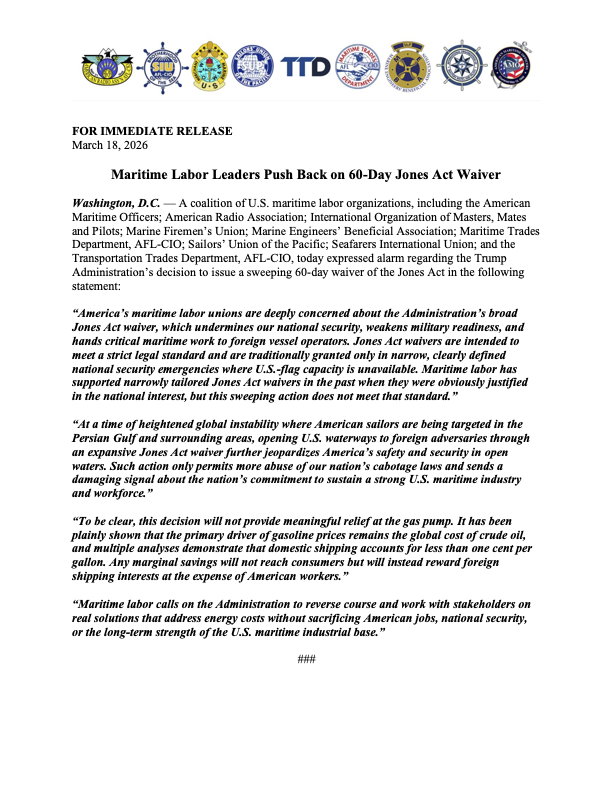
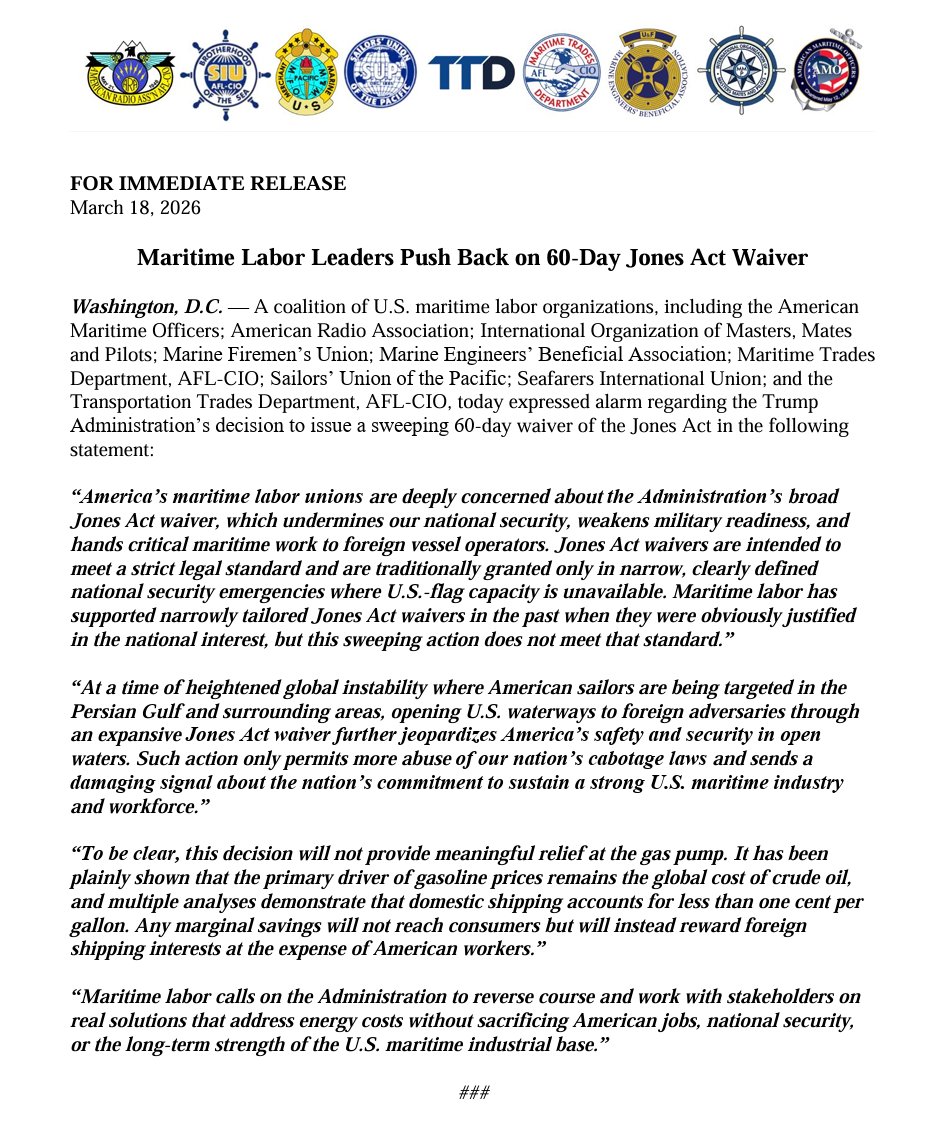
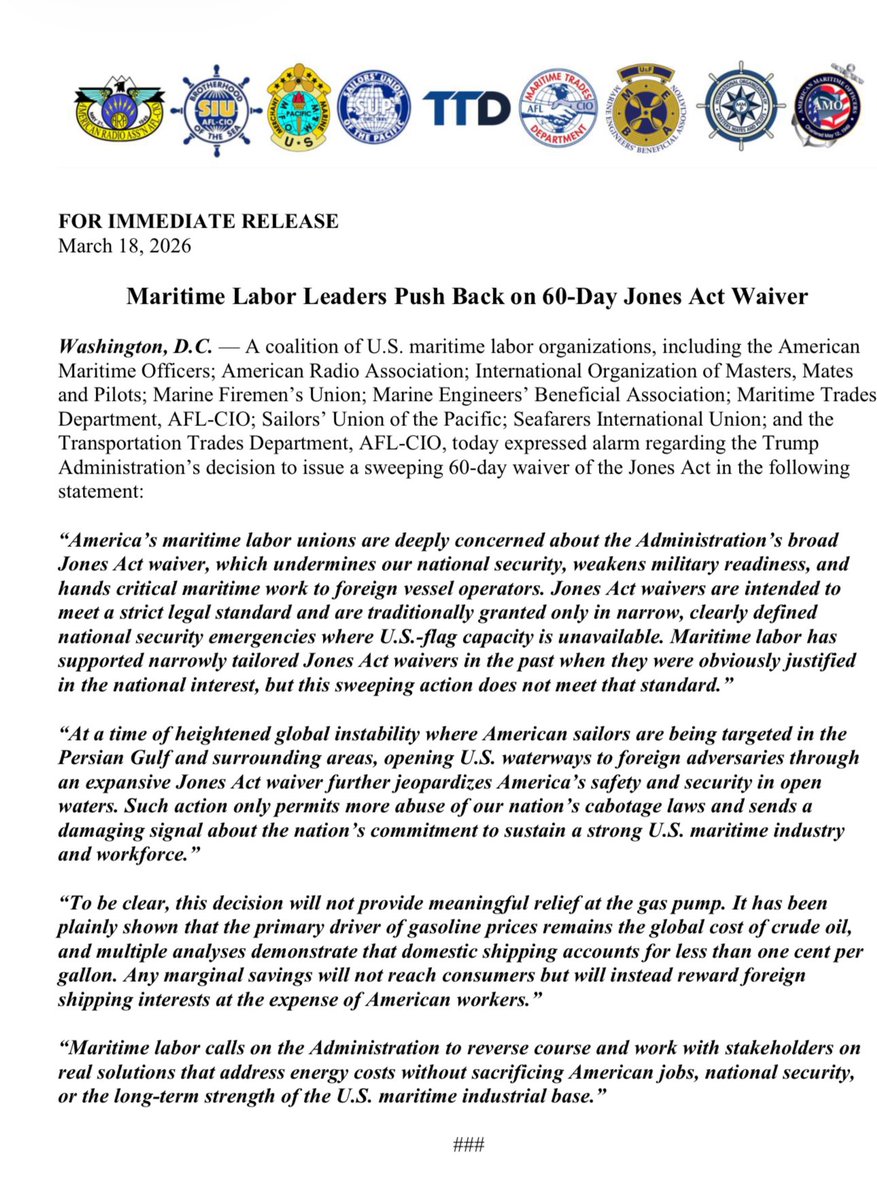
M.E.B.A. joins fellow maritime unions in expressing alarm over Trump's sweeping 60-day #JonesAct waiver. This action undermines national security, weakens military readiness, and will not provide meaningful relief at the gas pump. We call on the Administration to reverse course.
M.E.B.A. tweet media
English
4
3
6
415
Transportation Inst retweetet
Az
Az@Azuziel·
Waving the jones act will do nothing for fuel costs.
Az tweet media
English
1
1
4
108
Transportation Inst retweetet
Mike Schuler
Mike Schuler@MikeSchuler·
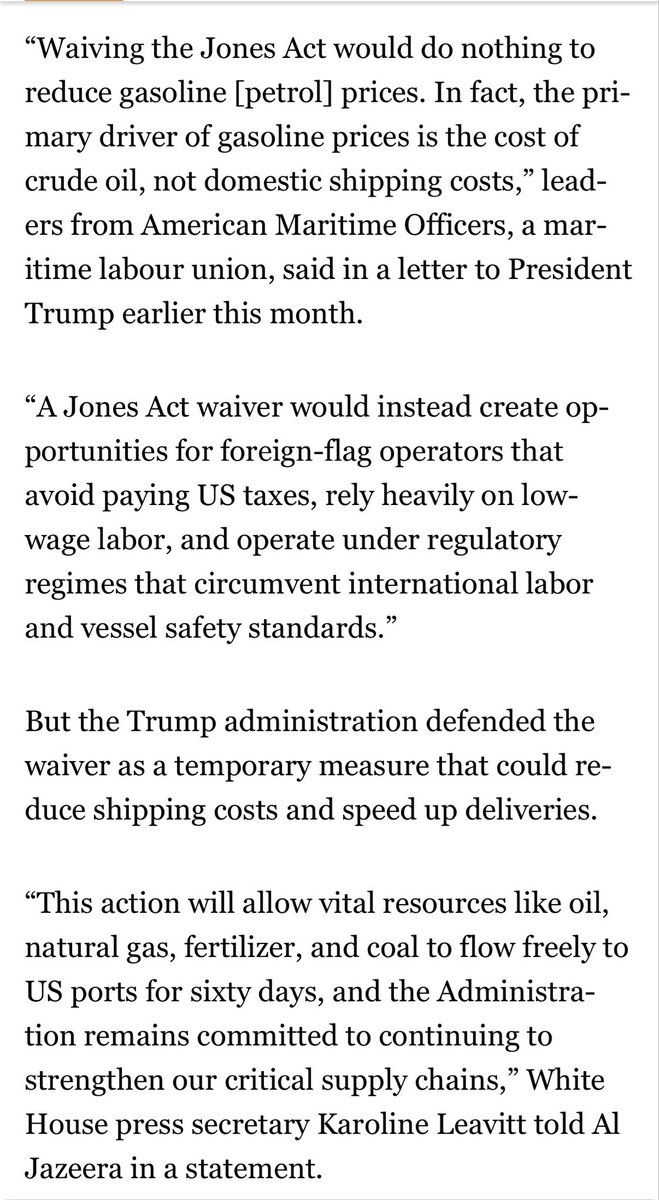
Trump just waived the Jones Act for 60 days. Shipping interests say it won’t help
English
1
2
7
1.3K
Transportation Inst retweetet
U.S. Coast Guard
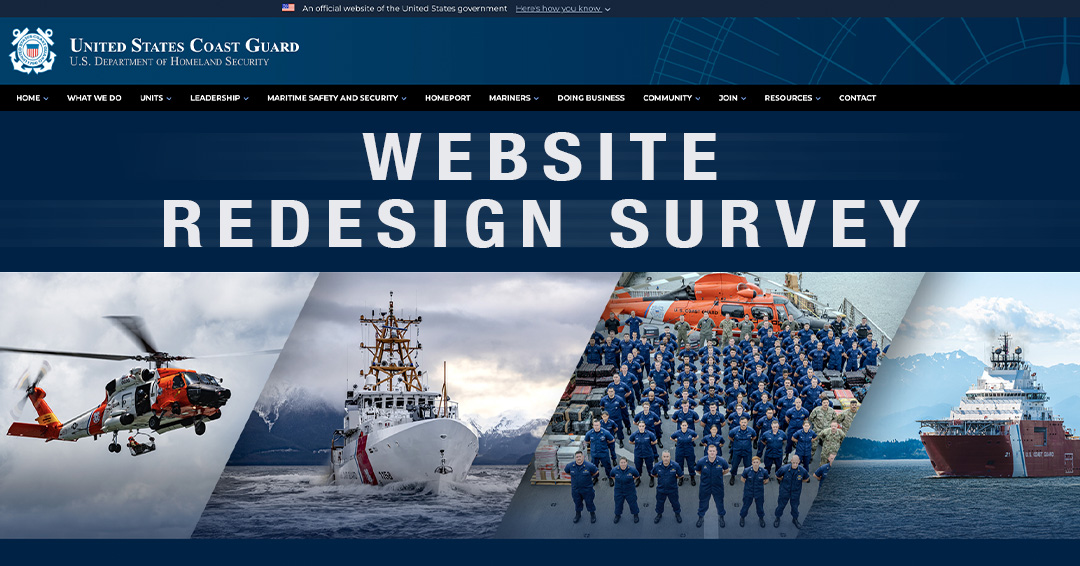
To better serve you on land, at sea, and online, we're transforming our website. From mariners to future recruits to those seeking Coast Guard assistance, your feedback is critical. Help us build a better U.S. Coast Guard website by taking our 4-minute survey. bit.ly/4unCxLN
U.S. Coast Guard tweet media
English
7
35
109
5.1K
Transportation Inst retweetet
USTRANSCOM
USTRANSCOM@US_TRANSCOM·
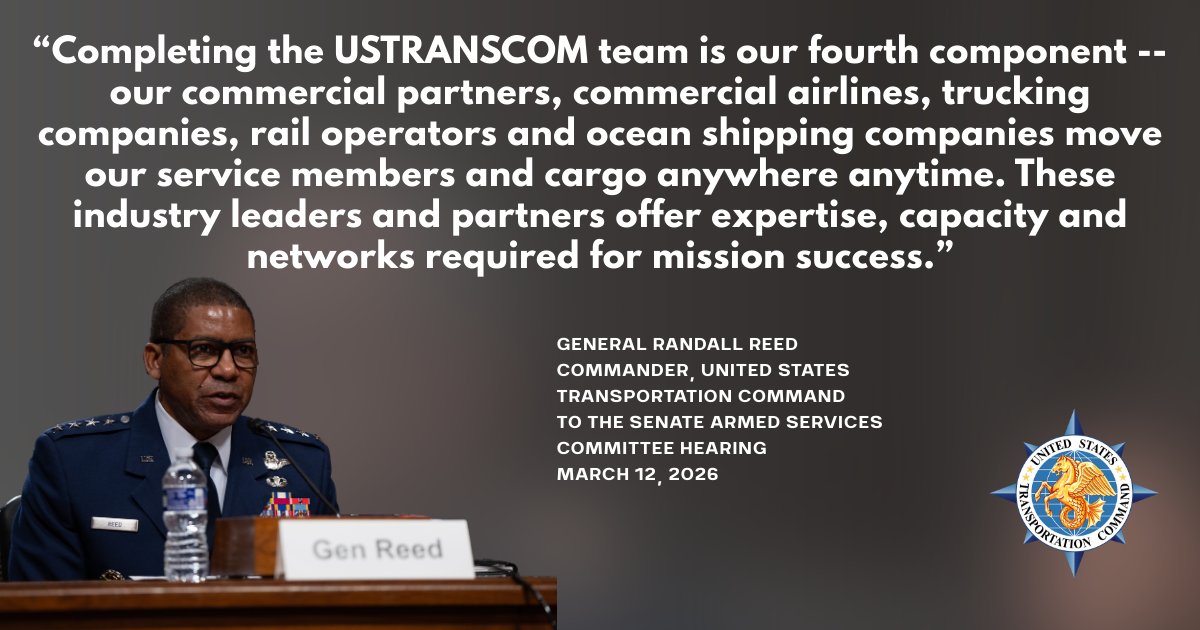
Gen. Randall Reed, our commander, testified before the Senate Armed Services Committee, emphasizing the importance of our commercial partners. Today, Gen. Reed will testify before the House Armed Services Committee. Watch here live at 3 p.m. EST: dvidshub.net/r/87t9dj
USTRANSCOM tweet media
English
0
2
8
543