We are the UN’s health agency - #HealthForAll. Always check our latest tweets for updated advice/information. We will respond to mis-and-disinformation.
Today is #WorldNoTobaccoDay 🚭
Almost 60% of tobacco users want to quit. Maybe you're one of them.
That’s 750 million people worldwide.
With support, you CAN make your wish come true.
Quitting tobacco can earn you big wins for your health:
⏱️ In 20 minutes, your heart rate drops
🫁 2–12 weeks, your lung function improves
❤️ In 1 year, heart disease risk is cut in half
You can overcome addiction. Help is available, quit today! 👉 bit.ly/4wIK34X#TobaccoExposed#WHO#WorldHealthOrganization
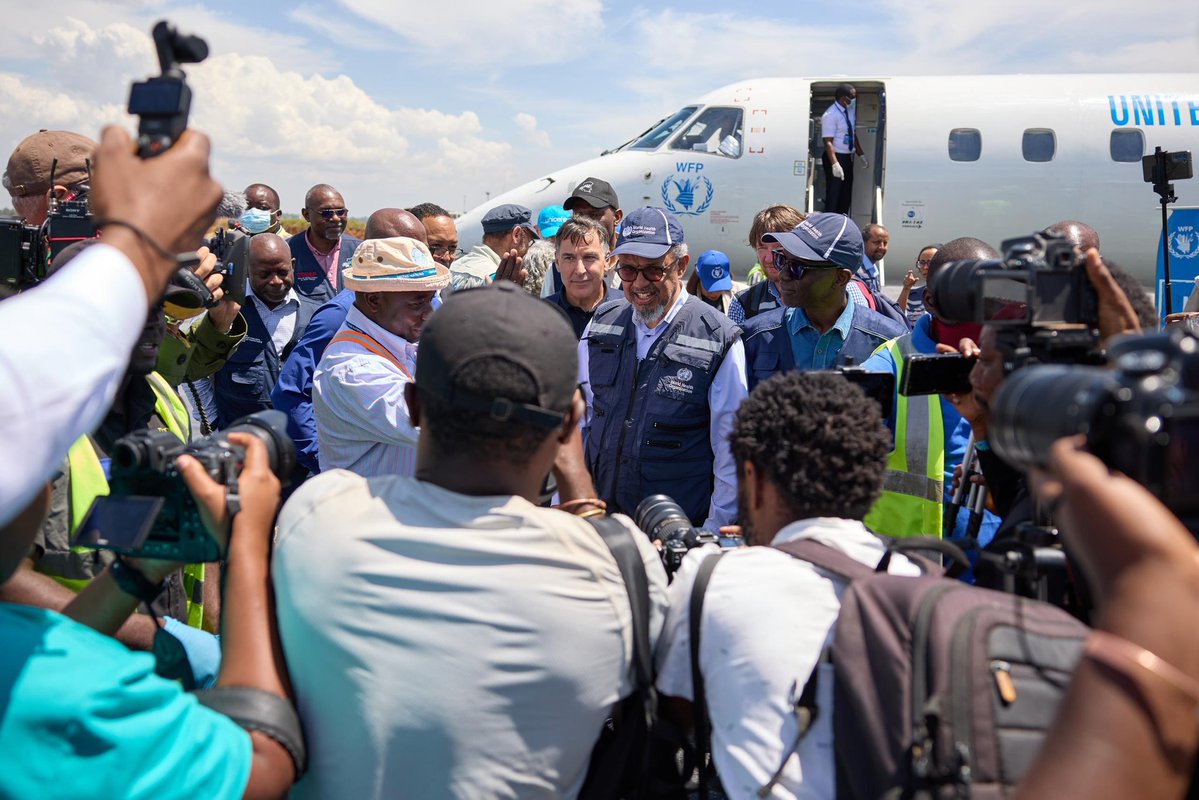
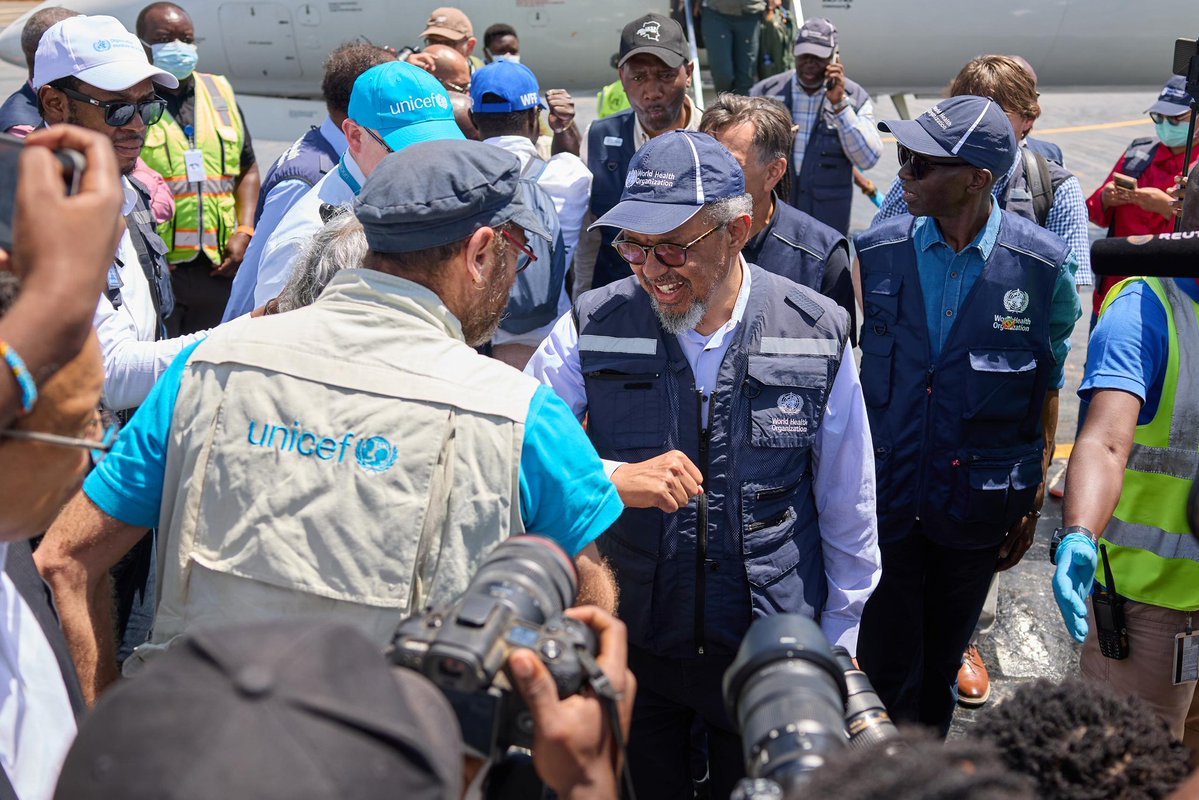
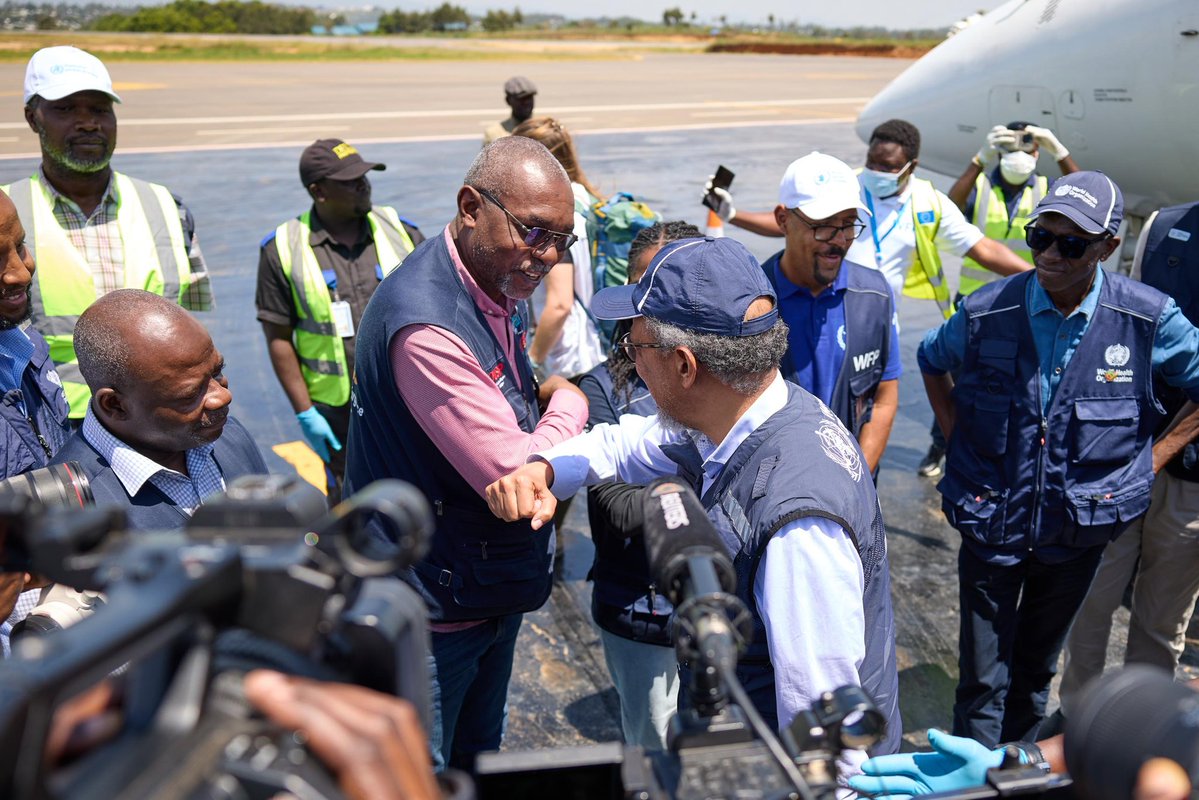
@DrTedros, Directeur général de l'OMS, est arrivé aujourd'hui à #Bunia🇨🇩, en Ituri, l'une des 3 provinces durement touchée par la maladie #Ebola, causée par le virus #Bundibugyo. Il rencontre les autorités & les intervenants, les remerciant pour leur engagement à sauver des vies.
Good meeting with Prime Minister @SuminwaJudith on #DRC’s response to the outbreak of #Ebola disease caused by the Bundibugyo virus in the country’s east.
We agreed that community ownership of the response is a critical component for bringing the outbreak under control, and that the government’s experience in ending 16 previous Ebola outbreaks leaves it well placed to end this one.
I updated the Prime Minister on @WHO’s coordination and collaboration with multiple partners in support of the government-led response.
We also discussed how we will use this outbreak as an opportunity to strengthen the health system in Ituri and other provinces of the country, and improve services and emergency preparedness.
Tobacco and nicotine companies deliberately design their products to hook you.
Sugars, flavours, and cooling agents all mask the harshness of nicotine so you inhale more, and get addicted faster.
But the grip of addiction can be broken. And the benefits are felt almost immediately:
⏱️ In 20 minutes, your heart rate drops
🫁 2–12 weeks, your lung function improves
❤️ In 1 year, heart disease risk is cut in half
Take the next step, break the addiction. Help is available! 👉 bit.ly/4wIK34X#TobaccoExposed#WorldNoTobaccoDay
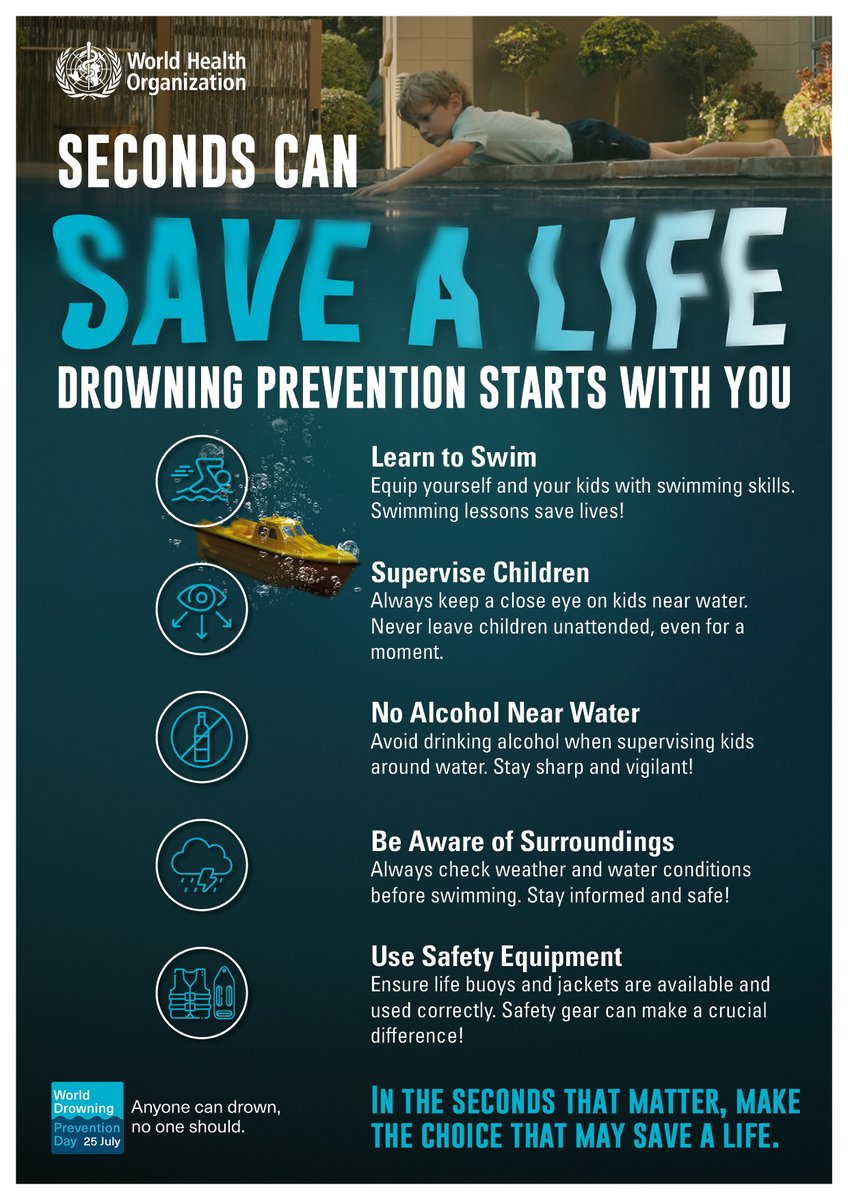
Anyone can drown, no one should.
Drowning prevention starts with YOU:
👀 Supervise children & don’t look away when they're near water
🦺 Use safety equipment like life jackets & make sure they’re in place before going out on a boat
🏊♂️ Learn to swim, or if you can’t swim, stay away from the water
🌧️ Check the weather conditions, the depth of the water & the strength of the current before entering the water
🚫 Don’t drink alcohol near water. It dulls your senses & can cause fatal accidents near water
Remember! Drowning is often silent & goes unnoticed.
Watch for the signs when someone is struggling to stay afloat, it’s never too soon to respond.
Brazil helped build one of the world’s strongest tobacco control movements.
Now cities like Rio de Janeiro are fighting the next battle: stopping vaping from renormalising nicotine addiction.
➡️Hundreds of inspections.
➡️Stronger laws.
➡️Vape-free public spaces.
➡️Public awareness campaigns.
#Cities4Health
As of 27 May, a total of 906 suspected cases and 223 deaths among suspected cases have been reported in the #DRC.
As of 29 May, a total of 134 confirmed cases, including nine in Uganda, with 18 deaths among the confirmed cases, have been reported across both countries.
This is an additional 49 confirmed cases, eight confirmed deaths, 160 suspected cases and 47 suspected deaths since the last update on 21 May.
Read the latest disease outbreak news: bit.ly/4wYz7jJ
Ebola outbreak: @WHO Director-General @DrTedros has arrived in DR Congo.
“I came here to show the communities in Ituri, North Kivu and South Kivu that they are not alone,” he said, urging the international community to step up support.
Ebola is a terrible disease because you often catch it while caring for someone you love – a husband, a child, a mother.
Stopping transmission means helping communities recognize symptoms early, access testing quickly and get timely care.
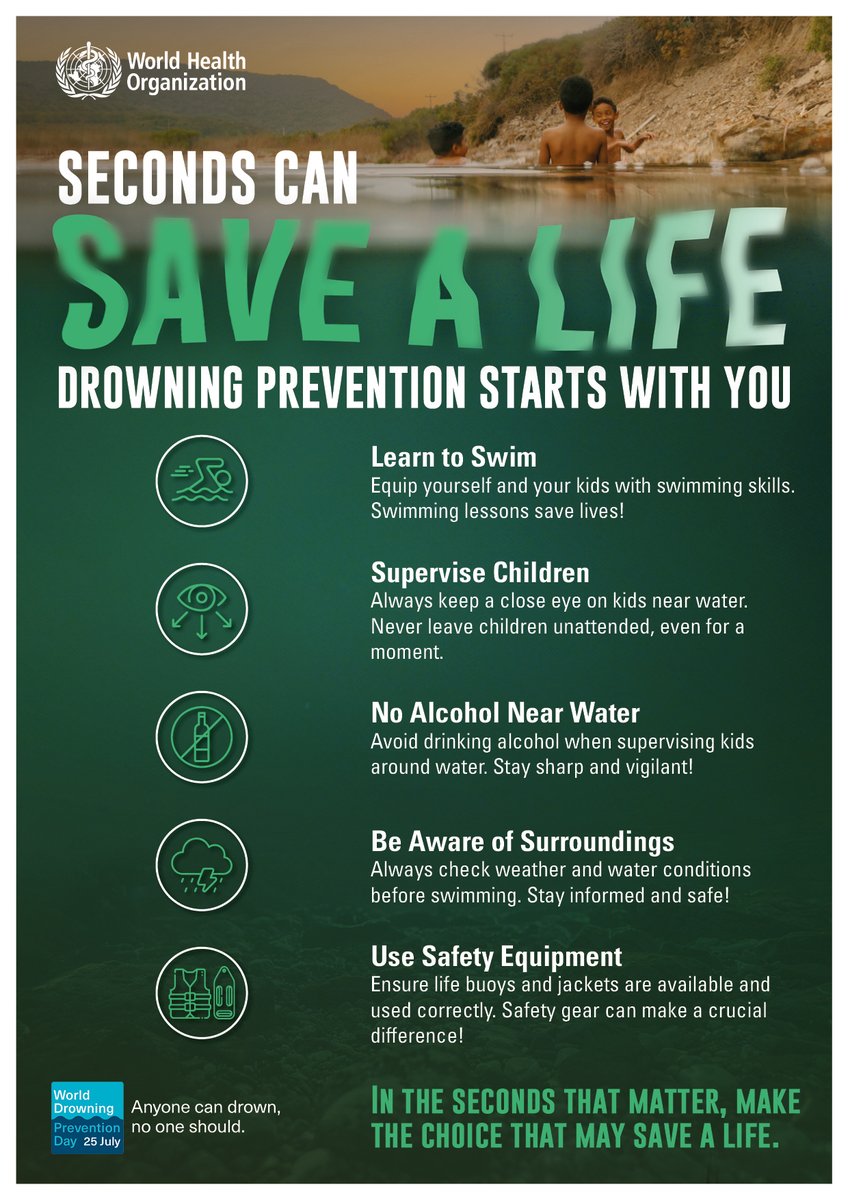
Anyone can drown, no one should.
Equip yourself & others with safety tips:
🏊♂️ Learn to swim
👀 Supervise children
🚫 No alcohol near water
🌧️ Be aware of surroundings
🦺 Use safety equipment
Kenya has officially launch the Every Woman Every Newborn Everywhere acceleration plan 2026-2028.
Built on @WHO guidance, the plan aims to save thousands of mothers and newborns each year across 26 high-burden counties.
Learn more: ewenekenya.org
At the age of 26, Laura Brennan passed away from #CervicalCancer, a vaccine-preventable disease.
"The HPV vaccine saves lives. It could have saved hers." Bernie and Larry narrate the heartbreaking loss of their daughter.
This is their story 👇
Kwa watu wa DRC, hasa kwa watu wa Ituri
Jambo kwenu wakahaji wa Ituri
Mbote na bino, bato ya Ituri
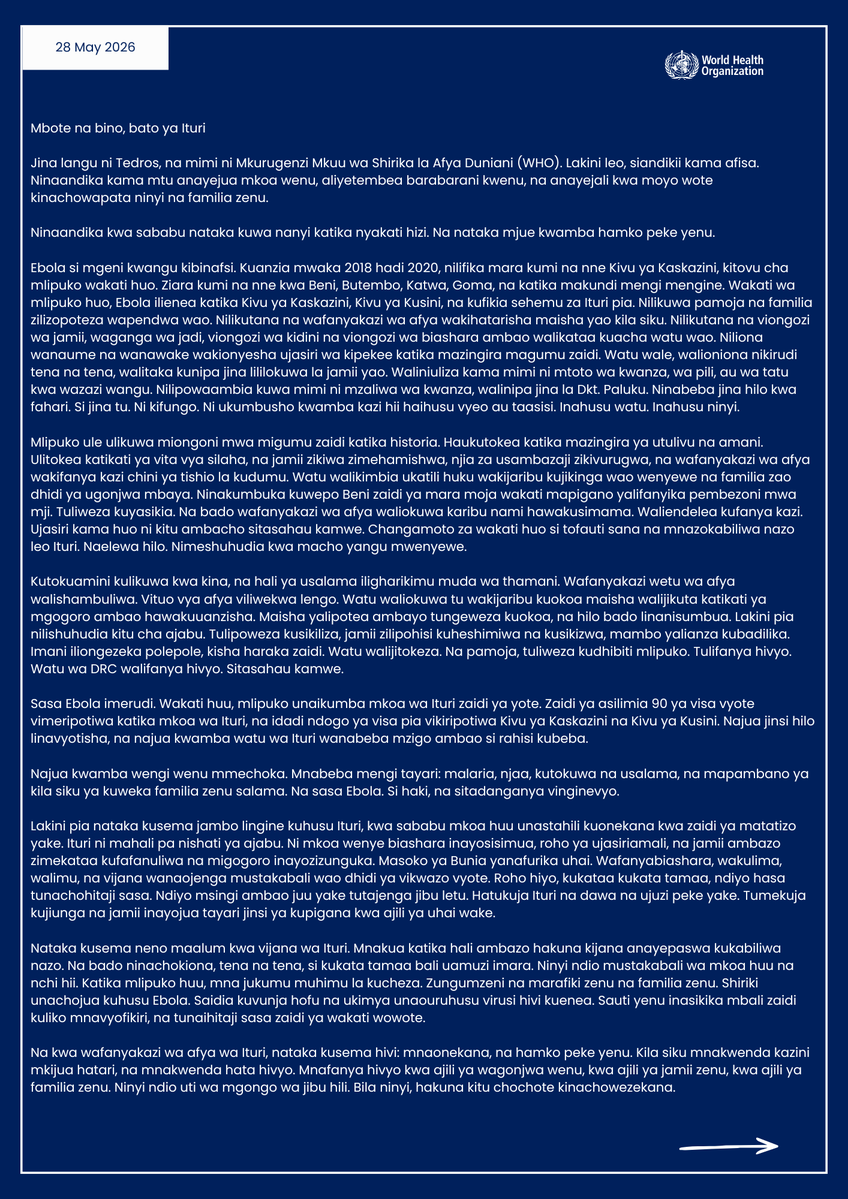
Jina langu ni Tedros, na mimi ni Mkurugenzi Mkuu wa Shirika la Afya Duniani (@WHO). Lakini leo, siandikii kama afisa. Ninaandika kama mtu anayejua mkoa wenu, aliyetembea barabarani kwenu, na anayejali kwa moyo wote kinachowapata ninyi na familia zenu.
Ninaandika kwa sababu nataka kuwa nanyi katika nyakati hizi. Na nataka mjue kwamba hamko peke yenu.
#Ebola si mgeni kwangu kibinafsi. Kuanzia mwaka 2018 hadi 2020, nilifika mara kumi na nne Kivu ya Kaskazini, kitovu cha mlipuko wakati huo. Ziara kumi na nne kwa Beni, Butembo, Katwa, Goma, na katika makundi mengi mengine. Wakati wa mlipuko huo, Ebola ilienea katika Kivu ya Kaskazini, Kivu ya Kusini, na kufikia sehemu za Ituri pia. Nilikuwa pamoja na familia zilizopoteza wapendwa wao. Nilikutana na wafanyakazi wa afya wakihatarisha maisha yao kila siku. Nilikutana na viongozi wa jamii, waganga wa jadi, viongozi wa kidini na viongozi wa biashara ambao walikataa kuacha watu wao. Niliona wanaume na wanawake wakionyesha ujasiri wa kipekee katika mazingira magumu zaidi. Watu wale, walioniona nikirudi tena na tena, walitaka kunipa jina lililokuwa la jamii yao. Waliniuliza kama mimi ni mtoto wa kwanza, wa pili, au wa tatu kwa wazazi wangu. Nilipowaambia kuwa mimi ni mzaliwa wa kwanza, walinipa jina la Dkt. Paluku. Ninabeba jina hilo kwa fahari. Si jina tu. Ni kifungo. Ni ukumbusho kwamba kazi hii haihusu vyeo au taasisi. Inahusu watu. Inahusu ninyi.
Mlipuko ule ulikuwa miongoni mwa migumu zaidi katika historia. Haukutokea katika mazingira ya utulivu na amani. Ulitokea katikati ya vita vya silaha, na jamii zikiwa zimehamishwa, njia za usambazaji zikivurugwa, na wafanyakazi wa afya wakifanya kazi chini ya tishio la kudumu. Watu walikimbia ukatili huku wakijaribu kujikinga wao wenyewe na familia zao dhidi ya ugonjwa mbaya. Ninakumbuka kuwepo Beni zaidi ya mara moja wakati mapigano yalifanyika pembezoni mwa mji. Tuliweza kuyasikia. Na bado wafanyakazi wa afya waliokuwa karibu nami hawakusimama. Waliendelea kufanya kazi. Ujasiri kama huo ni kitu ambacho sitasahau kamwe. Changamoto za wakati huo si tofauti sana na mnazokabiliwa nazo leo Ituri. Naelewa hilo. Nimeshuhudia kwa macho yangu mwenyewe.
Kutokuamini kulikuwa kwa kina, na hali ya usalama iligharikimu muda wa thamani. Wafanyakazi wetu wa afya walishambuliwa. Vituo vya afya viliwekwa lengo. Watu waliokuwa tu wakijaribu kuokoa maisha walijikuta katikati ya mgogoro ambao hawakuuanzisha. Maisha yalipotea ambayo tungeweza kuokoa, na hilo bado linanisumbua. Lakini pia nilishuhudia kitu cha ajabu. Tulipoweza kusikiliza, jamii zilipohisi kuheshimiwa na kusikizwa, mambo yalianza kubadilika. Imani iliongezeka polepole, kisha haraka zaidi. Watu walijitokeza. Na pamoja, tuliweza kudhibiti mlipuko. Tulifanya hivyo. Watu wa DRC walifanya hivyo. Sitasahau kamwe.
Sasa Ebola imerudi. Wakati huu, mlipuko unaikumba mkoa wa Ituri zaidi ya yote. Zaidi ya asilimia 90 ya visa vyote vimeripotiwa katika mkoa wa Ituri, na idadi ndogo ya visa pia vikiripotiwa Kivu ya Kaskazini na Kivu ya Kusini. Najua jinsi hilo linavyotisha, na najua kwamba watu wa Ituri wanabeba mzigo ambao si rahisi kubeba.
Najua kwamba wengi wenu mmechoka. Mnabeba mengi tayari: malaria, njaa, kutokuwa na usalama, na mapambano ya kila siku ya kuweka familia zenu salama. Na sasa Ebola. Si haki, na sitadanganya vinginevyo.
Lakini pia nataka kusema jambo lingine kuhusu Ituri, kwa sababu mkoa huu unastahili kuonekana kwa zaidi ya matatizo yake. Ituri ni mahali pa nishati ya ajabu. Ni mkoa wenye biashara inayosisimua, roho ya ujasiriamali, na jamii ambazo zimekataa kufafanuliwa na migogoro inayozizunguka. Masoko ya Bunia yanafurika uhai. Wafanyabiashara, wakulima, walimu, na vijana wanaojenga mustakabali wao dhidi ya vikwazo vyote. Roho hiyo, kukataa kukata tamaa, ndiyo hasa tunachohitaji sasa. Ndiyo msingi ambao juu yake tutajenga jibu letu. Hatukuja Ituri na dawa na ujuzi peke yake. Tumekuja kujiunga na jamii inayojua tayari jinsi ya kupigana kwa ajili ya uhai wake.
Nataka kusema neno maalum kwa vijana wa Ituri. Mnakua katika hali ambazo hakuna kijana anayepaswa kukabiliwa nazo. Na bado ninachokiona, tena na tena, si kukata tamaa bali uamuzi imara. Ninyi ndio mustakabali wa mkoa huu na nchi hii. Katika mlipuko huu, mna jukumu muhimu la kucheza. Zungumzeni na marafiki zenu na familia zenu. Shiriki unachojua kuhusu Ebola. Saidia kuvunja hofu na ukimya unaouruhusu virusi hivi kuenea. Sauti yenu inasikika mbali zaidi kuliko mnavyofikiri, na tunaihitaji sasa zaidi ya wakati wowote.
Na kwa wafanyakazi wa afya wa Ituri, nataka kusema hivi: mnaonekana, na hamko peke yenu. Kila siku mnakwenda kazini mkijua hatari, na mnakwenda hata hivyo. Mnafanya hivyo kwa ajili ya wagonjwa wenu, kwa ajili ya jamii zenu, kwa ajili ya familia zenu. Ninyi ndio uti wa mgongo wa jibu hili. Bila ninyi, hakuna kitu chochote kinachowezekana. Najua hali ni ngumu. Najua rasilimali mara nyingi hazitoshi. Najua hofu na uchovu ni wa kweli. Tafadhali jueni kwamba WHO inasimama pamoja nanyi, kwamba tunafanya kazi kupata msaada unaohitajika, na kwamba ujasiri wenu na kujitolea kwenu vinajulikana na kuthaminiwa sana mbali zaidi ya mipaka ya mkoa huu.
Pia najua kwamba hali ya usalama katika sehemu za mkoa huu inabaki kuwa ngumu sana. Migogoro na uhamishaji hufanya kila kitu kuwa kigumu zaidi, ikiwa ni pamoja na kuwafikia watu wanaohitaji huduma, na kuweka wafanyakazi wa afya salama. Nataka kuwa mkweli: hii ni moja ya changamoto zetu kubwa zaidi. Hatuwezi kufanya kazi hii kama wale wanaojaribu kusaidia wanazuiwa kufanya hivyo, au kuwekwa katika hatari. Tunafanya kazi kwa karibu na washirika wote wanaohusika kuhakikisha kwamba jibu linaweza kufikia kila jamii inayohitajika, na kwamba hakuna anayeachwa nyuma kwa sababu ya mahali wanapoishi au kinachoendelea karibu nao.
Ndiyo maana leo ninafanya ombi la moja kwa moja kwa pande zote zinazopigana katika mkoa huu: tafadhali, tangaza kusimama kwa mapigano. Hata kwa muda mfupi. Hata kiasi cha kuwaruhusu wafanyakazi wa afya kupita. Watu wanakufa kutokana na Ebola ambao hawahitaji kufa. Watoto wanaugua. Familia zinateseka. Hakuna sababu, hakuna mgogoro, hakuna malalamiko yanayostahili kuwahukumia watu wasio na hatia kifo kutokana na ugonjwa unaoweza kuzuiwa. Kusimama kwa mapigano, hata kwa muda, kutaokoa maisha. Nawasihi, nawaomba kwa nguvu zote: tupeni nafasi ya kusaidia watu wanaohitajika zaidi.
Pia najua kwamba kuna hasira na kutokuamini katika baadhi ya jamii, na naelewa kwa nini. Imani lazima ipatikane, haiwezi kudhaniwa. Hatujafanya mambo vizuri kila wakati. Lakini ninaahidi, tuko hapa kujifunza kama vile tupo hapa kusaidia.
Ninahitaji kuwa mkweli nawe kuhusu jambo muhimu. Milipuko mingi ya awali ya Ebola nchini DRC ilisababishwa na virusi viitwavyo Ebola Zaire, ambavyo tuna chanjo na matibabu. Mlipuko huu unasababishwa na virusi tofauti viitwavyo Ebola Bundibugyo. Kwa sasa hakuna chanjo wala matibabu yaliyoidhinishwa dhidi yake. Hii ni mbaya, na mnastahili kusikia hilo wazi. Lakini pia nataka mjue hivi: ingawa hakuna matibabu maalum ya Bundibugyo, kuna mengi tunayoweza kufanya pamoja kuzuia kuenea kwa virusi hivi na kuokoa maisha. Huduma ya msaada wa mapema katika vituo vyetu vya matibabu inaweza kuleta tofauti ya kweli. Kama wewe au mtu unayemjua anaugua, tafadhali usisubiri. Kujitokeza mapema kunaweza kumaanisha tofauti kati ya maisha na kifo. Na kila tunachofanya, tutafanya nawe. Tutakusikiliza, tutashiriki taarifa nawe, na tuko hapa kukusaidia. Na kwa wale ambao hatuwezi kuwaokoa, tutaomboleza nawe. Tutakusaidia kuomboleza wapendwa wako waliopotea kwa mazishi salama na yenye heshima.
Tunafanya kazi chini ya uongozi wa Serikali ya DRC, pamoja na washirika wote wanaohusika, tukiungana kwa lengo moja: kusimamisha mlipuko huu na kulinda jamii zenu. Hakuna anayefanya kazi peke yake. Hakuna anayefanya kazi kwa madhumuni tofauti. Tunaratibishwa, tumejitolea, na tuko hapa.
Ndiyo maana ninakuja Bunia. Nitakuwepo mwenyewe, pamoja na wenzangu, nikutana na viongozi wenu, nikisikiliza wasiwasi wenu, na kufanya kila niwezalo kukusaidia. Sitasimamia hili kutoka ofisi ya starehe mbali nawe.
Huu ni mlipuko wa 17 wa Ebola nchini DRC. Pamoja, mmeshinda kila mmoja wa milipuko iliyopita. Hilo si jambo dogo. Ni ushahidi wa nguvu na ustahimilivu wa jamii zenu. Nimeshuhudia nguvu hiyo kwa macho yangu mwenyewe.
Ndugu zangu wa Ituri, nataka mjue kwamba dunia inaangalia ujasiri wenu. Hamjasahauliwa. Pamoja, tutashinda mlipuko huu, kama vile mlivyoshinda kila changamoto iliyopita. Ustahimilivu wenu ni nuru inayotuongoza sisi sote.
Tutapita pia wakati huu. Si kwa sababu ya mtu yeyote, bali kwa sababu yenu.
Timu zetu zipo tayari huko, na zitabaki kwa muda wote unaohitajika. Na mlipuko huu utakapokwisha, hatutaondoka kimya kimya. Hatutawasahau. Tutabaki, na tutaendelea kufanya kazi nanyi kujenga mifumo ya afya inayolinda kila mtu katika kila jamii.
Ninatazamia kuwaona Bunia hivi karibuni. Hadi hapo, tafadhali jueni kwamba mko katika mawazo yangu.
Kwa heshima na mshikamano,
Paluku
Tedros
Tedros Adhanom Ghebreyesus
Mkurugenzi Mkuu, Shirika la Afya Duniani
Emergency teams, treatment centres, medical supplies and community outreach.
The @WHO-led response to the Ebola outbreak in eastern DR Congo is intensifying as agencies race to contain the virus.
Follow our coverage
news.un.org/en/tags/ebola-…
Latest update on #hantavirus outbreak linked to cruise ship travel, multi-locations
🔵 As of 27 May, a total of 13 hantavirus cases (11 confirmed and 2 probable cases), including 3 deaths (2 confirmed and 1 probable), have been reported.
📌All confirmed cases are among people who travelled onboard the MV Hondius. Given the long incubation period of up to six weeks, it is not unexpected that cases continue to be reported until the end of the six weeks since last exposure.
🔵 Based on the available information and the existing observations of the current outbreak, limited human-to-human transmission of Andes virus (ANDV) in known to occur. The exact mode(s) through which human-to-human transmission occurred during this outbreak are yet to be fully understood.
📌While the available evidence suggests that there are multiple modes of transmission that occur with ANDV, the probability of onward transmission between humans remains low.
🔵Therefore, at the present time, WHO is operating under the assumption that ANDV transmission:
🔹 may include contact with an infected individual or contaminated surfaces
🔹 and/or through the air transmission (via direct deposition of infectious respiratory particles onto exposed facial mucosal surfaces--mouth, nose or eyes)
🔹and/or airborne transmission (via inhalation of infectious respiratory particles).
📌This information is up to date as of 27 May 2026. It will be updated as new evidence becomes available and the understanding of transmission evolves.
🔵 Using data from the previously documented human-to-human outbreaks in Argentina and the 13 cases so far recorded from the cruise ship outbreak, WHO estimates that the mean incubation period is 22 days, corresponding to a probability of safe release from quarantine of 96% at 42 days, reducing to 91% at 35 days.
This reaffirms WHO’s recommendation of 42 days of quarantine for high-risk contacts and self-monitoring for low-risk contacts.
Read more: bit.ly/49mrQ3a
To the people of DRC, especially to the people of Ituri
Jambo kwenu wakahaji wa Ituri
Mbote na bino, bato ya Ituri
My name is Tedros, and I am the Director-General of the World Health Organization (@WHO). But today, I am not writing to you as an official. I am writing to you as someone who knows your region, who has walked your streets, and who cares deeply about what happens to you and your families.
I am writing because I want to be with you in these moments. And I want you to know that you are not alone.
#Ebola is not new to me personally. From 2018 to 2020, I came fourteen times to North Kivu, the epicentre of the outbreak at that time. Fourteen visits to Beni, Butembo, Katwa, Goma, and many other communities. During that outbreak, Ebola spread across North Kivu, South Kivu, and reached parts of Ituri as well. I was alongside families who had lost their loved ones. I met health workers risking their lives every day. I met community leaders, traditional healers, religious leaders and business leaders who refused to abandon their people. I saw men and women show extraordinary courage in the most difficult of circumstances. The people there, who saw me coming back again and again, wanted to give me a name that belonged to their community. They asked me whether I was the first, second, or third child of my parents. When I told them I was the firstborn, they gave me the name Dr. Paluku. I carry that name with pride. It is not just a name. It is a bond. It is a reminder that this work is not about titles or institutions. It is about people. It is about you.
That outbreak was one of the most complex in history. It did not unfold in a stable, peaceful environment. It happened in the middle of armed conflict, with communities displaced, supply routes disrupted, and health workers operating under constant threat. People were fleeing violence while also trying to protect themselves and their families from a deadly disease. I remember being in Beni on more than one occasion while fighting was taking place on the outskirts of the city. We could hear it. And yet the health workers around me did not stop. They kept working. That kind of courage is something I will never forget. The challenges of that time are not so different from what you are facing today in Ituri. I understand that. I have seen it with my own eyes.
Mistrust ran deep, and the security situation cost us precious time. Our health workers were attacked. Clinics were targeted. People who were only trying to save lives found themselves caught in the middle of a conflict they did not start. Lives were lost that we might have saved, and that weighs on me still. But I also witnessed something remarkable. When we listened, when communities felt respected and heard, things began to change. Trust grew slowly, then more quickly. People came forward. And together, we managed to contain the outbreak. We did it. The people of DRC did it. I will never forget that.
Ebola is now back. This time, the outbreak is hitting Ituri province the hardest. More than 90% of all cases have been reported in Ituri province, with a small number of cases also reported in North Kivu and South Kivu. I know how frightening that is, and I know that the people of Ituri are bearing a burden that is not easy to carry.
I know that many of you are exhausted. You are already carrying so much: malaria, hunger, insecurity, and the daily struggle to keep your families safe. And now Ebola. It is not fair, and I will not pretend otherwise.
But I also want to say something else about Ituri, because this province deserves to be seen for more than its hardships. Ituri is a place of remarkable energy. It is a province of vibrant commerce, of entrepreneurial spirit, of communities that have refused to be defined by the conflicts around them. The markets of Bunia buzz with life. Traders, farmers, teachers, and young people building their futures against all odds. That spirit, that refusal to give up, is exactly what we need now. It is the foundation on which we will build our response. We do not come to Ituri with only medicine and expertise. We come to join a community that already knows how to fight for its survival.
I want to say a special word to the young people of Ituri. You are growing up in circumstances that no young person should have to face. And yet what I see, again and again, is not despair but determination. You are the future of this province and this country. In this outbreak, you have a vital role to play. Talk to your friends and your families. Share what you know about Ebola. Help break the fear and the silence that allow this virus to spread. Your voice carries further than you know, and we need it now more than ever.
And to the health workers of Ituri, I want to say this: you are seen, and you are not alone. Every day you go to work knowing the risks, and you go anyway. You do it for your patients, for your communities, for your families. You are the backbone of this response. Without you, none of this is possible. I know the conditions are hard. I know the resources are often not enough. I know that fear and exhaustion are real. Please know that WHO stands with you, that we are working to get you the support you need, and that your courage and dedication are known and deeply valued far beyond the borders of this province.
I also know that the security situation in parts of this region remains very difficult. Conflict and displacement make everything harder, including reaching people who need care and keeping health workers safe. I want to be honest: this is one of our greatest challenges. We cannot do this work if those who are trying to help are prevented from doing so or put in danger. We are working closely with all relevant partners to ensure that the response can reach every community that needs it, and that no one is left behind because of where they live or what is happening around them.
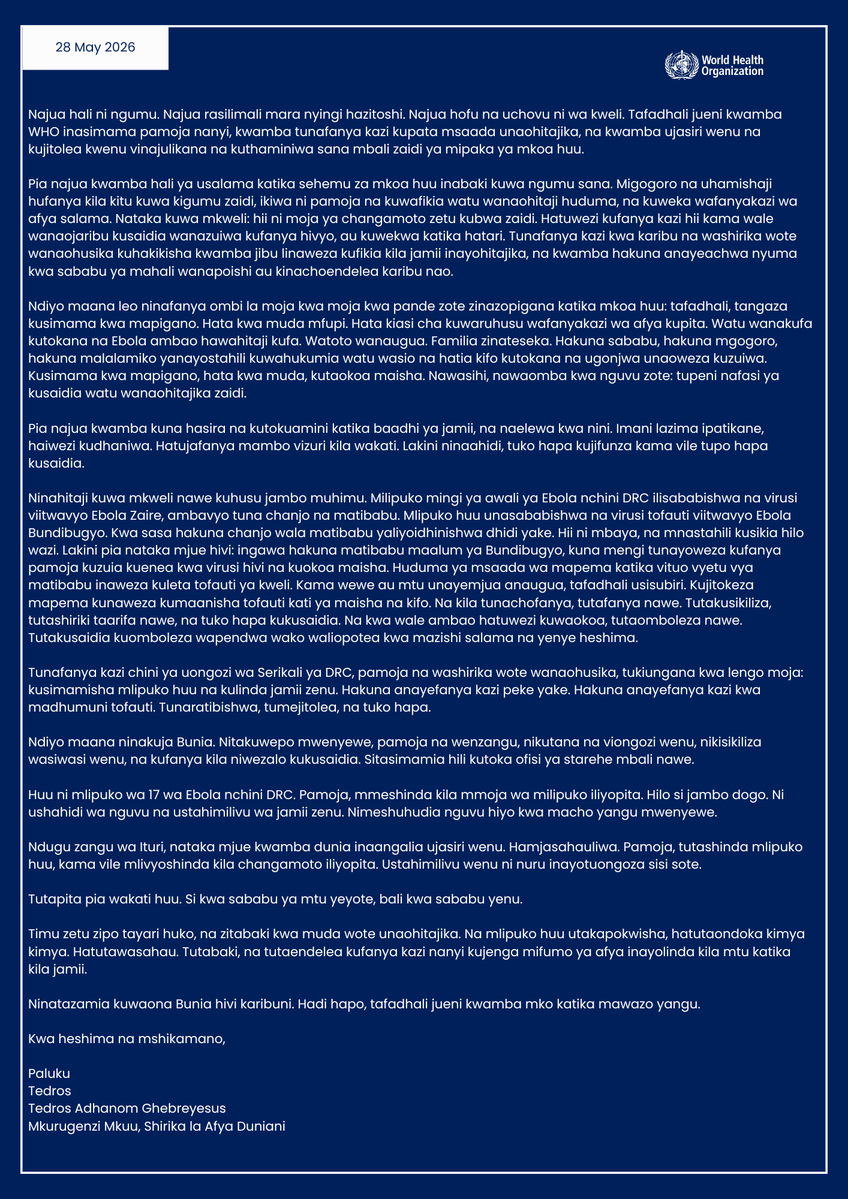
That is why today I am making a direct appeal to all warring parties in this region: please, declare a ceasefire. Even briefly. Even just enough to let health workers through. People are dying from Ebola who do not have to die. Children are sick. Families are suffering. No cause, no conflict, no grievance is worth condemning innocent people to death from a preventable disease. A ceasefire, even a temporary one, would save lives. I urge you, I implore you: give us the space to help the people who need it most.
I also know that there is anger and mistrust in some communities, and I understand why. Trust must be earned, it cannot be assumed. We have not always done things correctly. But I promise you, we are here to learn as much as we are here to help.
I need to be honest with you about something important. Most previous Ebola outbreaks in DRC were caused by a virus called Ebola Zaire, for which we have vaccines and treatments. This outbreak is caused by a different virus called Ebola Bundibugyo. There are currently no approved vaccines or treatments for it. This is serious, and you deserve to hear that plainly. But I also want you to know this: while there are no specific treatments for Bundibugyo, there is much we can do together to prevent the spread of this virus and save lives. Early supportive care in our treatment centers can make a real difference. If you or someone you know falls ill, please do not wait. Coming forward early can make the difference between life and death. And everything we do, we will do with you. We will listen to you, we will share information with you, and we are here to help. And for those we cannot save, we will mourn with you. We will help you grieve your lost loved ones with safe and dignified burials.
We are working under the leadership of the Government of DRC, together with all relevant partners, united around one goal: to stop this outbreak and protect your communities. No one is working alone. No one is working at cross purposes. We are coordinated, we are committed, and we are here.
That is why I am coming to Bunia. I will be there in person, alongside my colleagues, meeting your leaders, listening to your concerns, and doing everything in my power to help you. I will not be managing this from a comfortable office far away.
This is the 17th Ebola outbreak in DRC. Together, you have overcome every single one before. That is not a small thing. That is a testament to the strength and resilience of your communities. I have seen that strength with my own eyes.
My brothers and sisters of Ituri, I want you to know that the world is watching your courage. You are not forgotten. Together, we will overcome this outbreak, as you have overcome every challenge before. Your resilience is the light that guides us all.
We will get through this one too. Not because of anyone, but because of you.
Our teams are already on the ground, and they will stay for as long as necessary. And when this outbreak is over, we will not quietly disappear. We will not forget you. We will stay, and we will keep working with you to build health systems that protect every person in every community.
I look forward to seeing you in Bunia soon. Until then, please know that you are in my thoughts.
With respect and solidarity,
Paluku
Tedros Adhanom Ghebreyesus
Director-General, World Health Organization