Fiun StcoKlnger

53 posts

Fiun StcoKlnger banner
Fiun StcoKlnger

Fiun StcoKlnger

@agdam02

Beigetreten Haziran 2011
105 Folgt30 Follower
Finn Stockinger
Finn Stockinger@FinnStockinger·
$RMBS: The Reality Check. Why the "AI Nervous System" Just Had a 20% Stroke. Two weeks ago, I framed $RMBS as the "Silent Architect" of AI. Since then, the Q1 earnings report (April 27) delivered a brutal lesson in expectations vs. execution. The stock didn't just dip; it underwent a fundamental re-rating. Here is the objective breakdown of the 8-K and the earnings call. 1⃣The "Quality Issue" Trigger The most critical revelation wasn't a financial miss, but an operational one. During the call, management admitted to "quality issues" regarding Gen 1 and Gen 2 DDR5 RCD products. While they stated the issue is "behind them," it forced a temporary pause in shipments to key Tier-1 customers. In a 67x P/E environment, "quality issues" are a signal for institutional capital to exit first and ask questions later. 2⃣ A "Beat" Built on Legacy, Not AI Growth Rambus reported $180.2M in revenue, slightly ahead of the $179.9M consensus. However, the composition of that revenue tells a different story: ➡️Silicon IP Stagnation: The actual chip business (the "AI play") is growing at 10-15% - a solid rate for a legacy firm, but sluggish for an "AI darling." ➡️Licensing Reliance: A significant portion of the "beat" came from predictable, high-margin patent royalties. The market realized it was paying an AI premium for a licensing-heavy business model. 3⃣The 2027 Production Ceiling The 8-K highlights a transition to Gen 3 DDR5 and MRDIMM technology. However, management was explicitly conservative: ➡️Supply Chain: Back-end constraints and packaging bottlenecks are expected to persist, limiting upside until 2027. ➡️MRDIMM Timing: While MRDIMM is essential for AI bandwidth, meaningful revenue contribution won't hit the balance sheet for another 18-24 months. 4⃣Valuation Gravity vs. GuidanceHeading into the report, RMBS traded at 67x trailing earnings. ➡️Guidance: Q2 revenue guidance ($192M–$198M) implies ~11% sequential growth. ➡️The Verdict: The guidance is healthy, but it does not support a hyper-growth multiple. The 20% sell-off was a violent return to a more realistic 35-40x P/E range. 5⃣Insider Selling and Momentum SEC filings confirmed that key executives, including the CFO, offloaded shares at the $150 resistance level just days before the print. This insider activity, combined with a breach of the 200-day moving average, triggered algorithmic sell programs that accelerated the slide. ➡️The Bottom Line The thesis hasn’t changed, but the velocity has. Rambus remains a fortress with $786M in cash and zero debt, and its IP remains a "tax" on every AI server. However, the timeline for "AI Orchestration" to dominate the income statement has shifted from 2025 to 2027. We are no longer "chasing the breakout." We are watching a fundamental re-rating. Is $105 the new floor, or is the market waiting for the 2027 catalyst before buying back in?
Finn Stockinger tweet mediaFinn Stockinger tweet mediaFinn Stockinger tweet mediaFinn Stockinger tweet media
Finn Stockinger@FinnStockinger

$RMBS: The Silent Architect of the AI Orchestration Layer I feel like $RMBS is still flying under the radar. Aside from @damnang2 , I’ve seen very few people covering it, yet the stock has quietly ripped +50% over the last month. Yesterday’s $INTC results acted as a massive wake-up call. The market is finally realizing that the AI race isn't just about raw GPU power, it’s about the CPU and the Interconnect orchestration that keeps the entire system from bottlenecking. Rambus is the essential player you need to watch. Here is why: 1⃣The CPU Comeback As server architectures evolve, the burden is shifting back to the CPU for complex data management. Rambus provides the critical RCD (Registering Clock Driver) chips that allow these CPUs to talk to memory without signal degradation. No Rambus = No high-speed CPU performance. 2⃣Mastering Data Orchestration AI is a logistical nightmare. Rambus’s CXL technology is the "conductor" of the data orchestra. It enables memory pooling, allowing data to flow seamlessly between processors and RAM. They aren't just moving bits; they are orchestrating the entire flow of the modern data center. 3⃣ The "Infrastructure Tax" With 80% gross margins and a massive IP portfolio, RMBS has evolved from a patent play into a silicon powerhouse. Every time a provider scales their CPU capacity or memory density, Rambus collects their royalty. It's a direct tax on data volume. 4⃣Financial Fortress Zero debt and a massive cash pile. In a market seeking safety without sacrificing AI exposure, RMBS offers a rare combo of explosive growth and a rock-solid balance sheet. ⬇️The Reality Check: We are seeing a massive +10% spike in pre-market as I write this. The market is clearly front-running the Q1 earnings (due Monday, April 27). While a 50% monthly run usually screams "overbought," the current price action suggests we are witnessing a fundamental re-rating. Investors are no longer valuing $RMBS as a legacy patent firm, but as an AI infrastructure essential. With $INTC results highlighting the shift toward CPU-led orchestration, the "overhead" might just be the new floor. The Verdict: If the CPU is the brain, Rambus is the nervous system. The "Interconnect" era is officially here. Are you chasing the breakout, or waiting for a retest of support? Let’s discuss. 👇
English
2
2
16
8.4K
Finn Stockinger
Finn Stockinger@FinnStockinger·
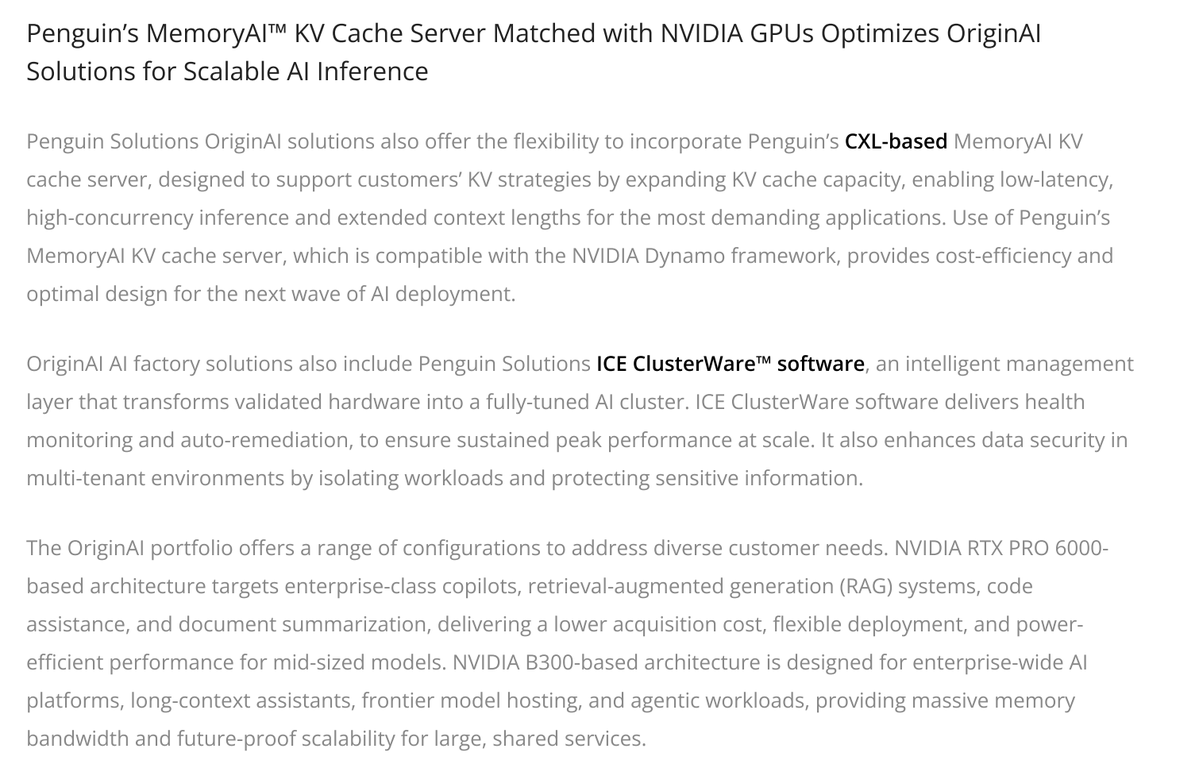
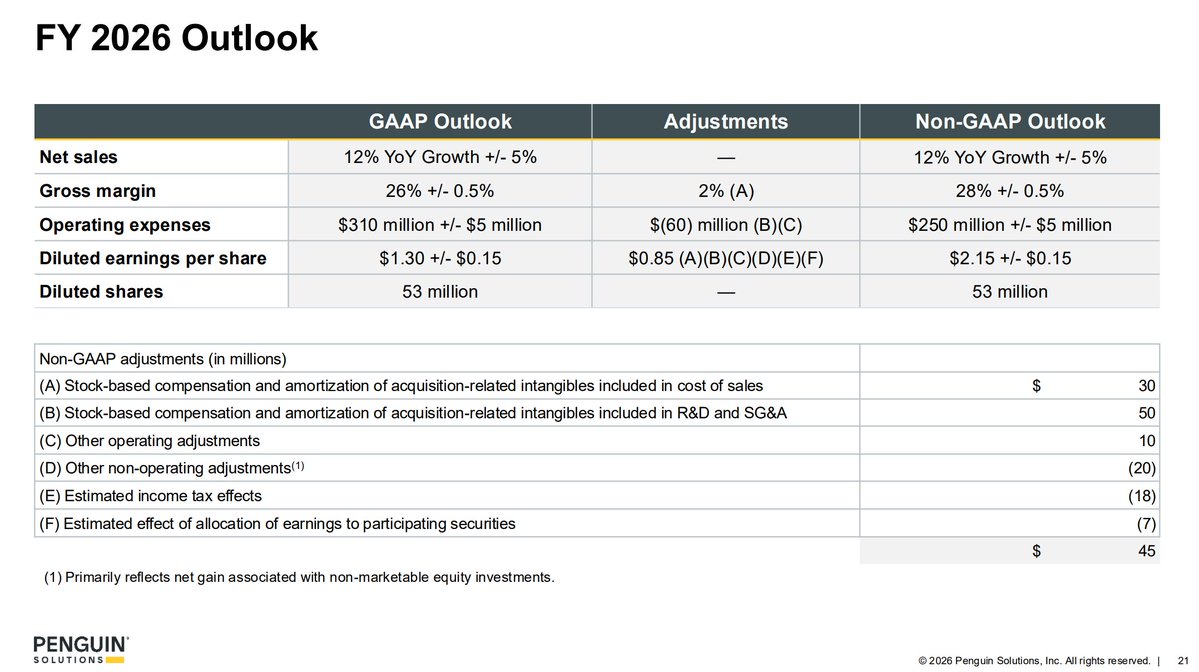
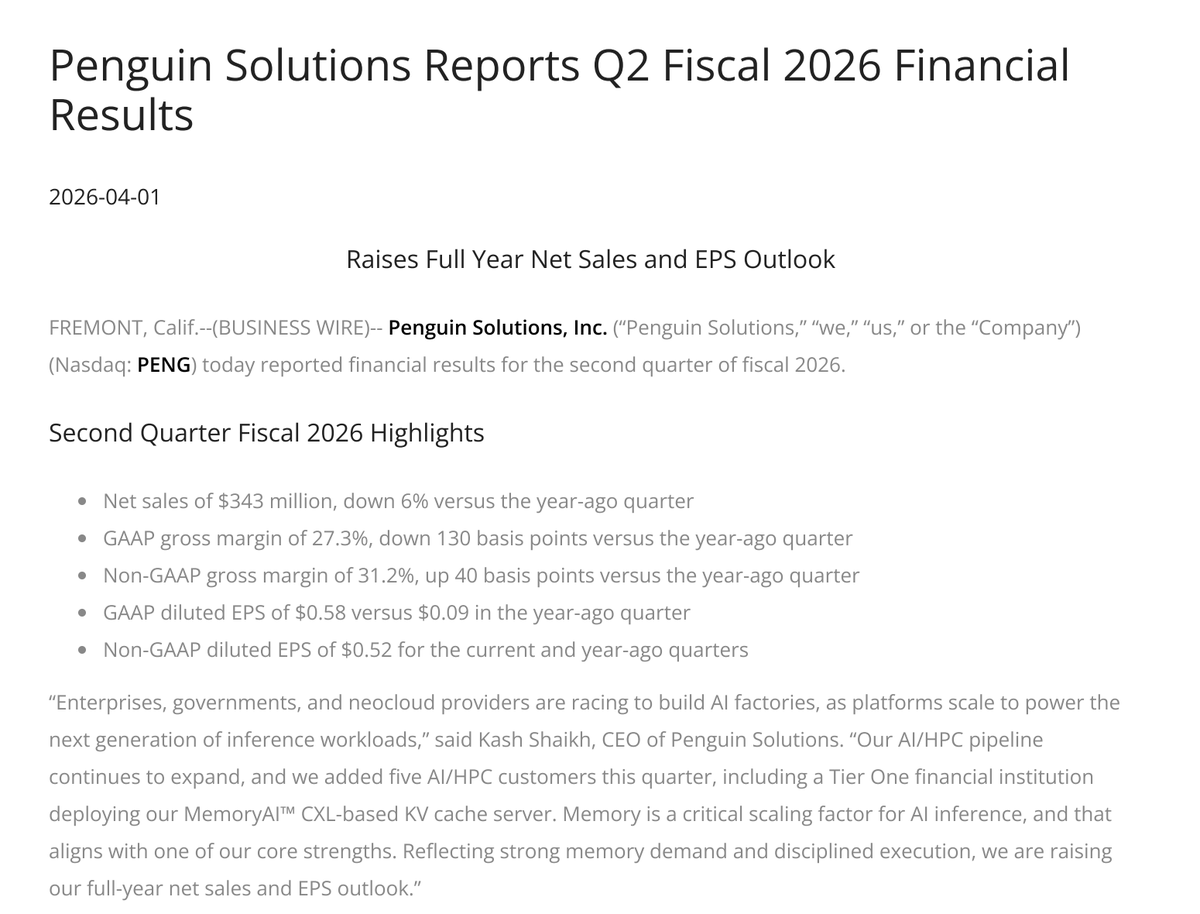
$PENG Penguin Solutions: Institutional Briefing 2026 Strategic Focus: The Transition to High-Margin AI Infrastructure As of late April 2026, Penguin Solutions has confirmed its status as a pure-play AI infrastructure provider. The Q2 fiscal 2026 results (reported April 1, 2026) demonstrate a significant shift in revenue quality and technical differentiation. 1⃣Verified Financial Performance (Q2 2026) Data sourced from the official SEC Form 8-K filing (April 1, 2026): ➡️Net Sales: $343 Million (Down 6% YoY). Analysis: This decrease is strategic, resulting from the planned phase-out of the lower-margin Penguin Edge segment and the divestiture of legacy South American operations. ➡️Non-GAAP EPS: $0.52. The company beat analyst consensus ($0.37) by 40.5%. ➡️Non-GAAP Gross Margin: 31.2% (Up 40 basis points YoY). This confirms the shift toward higher-value services and software-integrated systems. ➡️Updated FY2026 Guidance: Management raised the full-year outlook, now projecting net sales between $1.5 billion and $1.6 billion. 2⃣Technical Deep-Dive: MemoryAI™ CXL Architecture The core of the "Hyper-growth" thesis lies in PENG’s dominance of the Compute Express Link (CXL) standard. AI inference is currently "memory-bound," and PENG's new hardware is designed to break this bottleneck. The CXL "Memory Wall" Solution On March 16, 2026, PENG introduced the industry’s first production-ready MemoryAI™ KV Cache Server. ➡️Massive Scaling: An Altus-based 4U server capable of hosting up to 22 TB of CXL-based memory per server. ➡️Performance Benchmark: Delivers data access speeds 10x faster than traditional NVMe-based storage. ➡️Memory Pooling: Unlike standard GPU memory (HBM) which is "trapped" within a card, PENG's CXL fabric allows for disaggregated memory pooling. This enables klastry to dynamically share memory resources across multiple GPU nodes, preventing expensive GPU idle time. ➡️Market Adoption: In Q2 2026, PENG secured a Tier-One Financial Institution as a customer specifically for this CXL-based KV cache technology to handle real-time AI parsing of massive datasets. 3⃣ Segment Analysis (Where the Revenue Flows) ➡️Integrated Memory (50% of Revenue): Reported $172 Million (up 63% YoY). This is the company's financial engine, benefiting from the global transition to DDR5 and high-bandwidth CXL modules. ➡️Advanced Computing (34% of Revenue): Reported $116 Million (down 42% YoY). Note: This segment is project-based and "lumpy." However, for the first half of 2026, this segment grew 50% when excluding legacy hyperscale hardware, indicating strong demand from the "Sovereign AI" and Enterprise sectors. ➡️Optimized LED (16% of Revenue): Reported $56 Million (down 7% YoY). This remains a stable "cash cow" used to fund R&D in AI infrastructure. 4⃣Risk Assessment & Investment Verdict Critical Risks: ➡️Customer Concentration: Major contracts (e.g., Meta’s 16,000 GPU klastry) represent a significant revenue weight. Any shift in capital expenditure from these "Big Tech" players poses a risk. ➡️Supply Chain: As an integrator, PENG is dependent on third-party GPU availability (e.g., Nvidia Blackwell/B300). Delays in chip deliveries directly delay PENG's project recognition. ⬇️Summary: Penguin Solutions is no longer a commodity memory player. It is one of the few companies with a validated CXL Memory Appliance in a market where memory bandwidth is the primary constraint for AI agents. ➡️Investment Thesis: With a Forward P/E of approximately 16.9x (as of late April 2026) and a Moderate Buy consensus with a price target of $27.29, the stock remains attractive relative to pure AI infrastructure peers. If operating margins exceed 10% in H2 2026, it will confirm the transition to a high-margin platform business, likely triggering a significant valuation re-rating.
Finn Stockinger tweet mediaFinn Stockinger tweet mediaFinn Stockinger tweet media
Finn Stockinger@FinnStockinger

5 Under-the-Radar Rockets Poised to Ride the AI "Memory Wall" The market is obsessed with "Compute," but it’s ignoring the fact that the smartest AI on Earth is currently starving to death. While everyone is chasing the same crowded trades, I’ve identified 5 "under-the-radar" rockets that are solving the ultimate bottleneck. Here is why the "Memory Wall" is where the real Alpha is hiding in March 2026. We need to realize that the current Von Neumann architecture is surrendering to LLMs. If the processor is a Formula 1 engine, memory is currently the tiny straw we’re trying to refuel it through while driving at 300 km/h. Here are 3 deep-dives shaping the market right now: 1️⃣ Data Locality is the New Currency: In AI model training, 90% of energy is wasted just... moving data between chips. Not on the actual computation. This is why any company shortening the physical distance between the byte and the transistor (HBM, CXL, Chiplets) basically has a license to print money. 2️⃣ HBM Cannibalization is Real: According to the latest Q1 2026 reports, DRAM and NAND spot prices have surged by 80-90%. Producing one HBM4 die consumes 3x more wafer capacity than standard DDR5. The result? Giants like Samsung and Hynix are "abandoning" the PC and Auto markets. Whoever has physical inventory on the shelf now dictates the margin. 3️⃣ CXL 3.0 as a Game Changer: Instead of buying ultra-expensive RAM for every individual server, we are entering the era of Memory Pooling. This allows servers to "borrow" memory dynamically. The companies controlling this protocol are the new Gatekeepers of the data center. Where to find Alpha when the market is already "heated"? Here are the 5 tickers I’ve shortlisted for deep analysis: 👇 1️⃣ $CRSR (Corsair Gaming) – Inventory Arbitrage A classic play on supply-side "short squeeze." Corsair entered 2026 with a massive stockpile of DRAM contracted at 2025 prices. With current spot prices up nearly 90%, their margins on DDR5 modules are pure arbitrage. Their recent $50M buyback and record Q4 margins (up to 35% in components) suggest management sees the windfall coming. 2️⃣ $PENG (Penguin Solutions) – The CXL Architects A pivotal player in breaking the "Memory Wall." At GTC last week (March 2026), they unveiled MemoryAI™ an 11TB CXL-based KV Cache server. They are solving the bottleneck at the systems level, not just the component level. Still trading at an attractive forward P/E (~10-12x) despite near 100% EPS growth projections. 3️⃣ $NLST (Netlist) – The Legal Bottleneck DDR5 and HBM cannot scale without LRDIMM technology, which Netlist patented years ago. On Feb 23, 2026, the CAFC (Appeals Court) upheld their key '314 patent against Micron for the third time. With a massive trial against Samsung scheduled for April, we are approaching a "Binary Event" that could trigger billion-dollar licensing settlements. 4️⃣ $RMBS (Rambus) – IP Monopoly They don't build fabs; they design the data superhighways. They just announced the industry-first HBM4E controllers (4.1 TB/s!). With 80%+ gross margins, Rambus profits from every increase in transfer speed without risking a single dollar on physical manufacturing or inventory. 5️⃣ $SANM (Sanmina / Viking Tech) – Edge AI Defense Owner of the Viking Technology brand. Their new Viking Edge series is exactly what the industry needs: ultra-dense, custom memory produced locally in the US. In an era of deglobalization and Asian supply chain fragility, their "Made in USA" specialty memory is a massive strategic moat. Bottom Line: The memory wall isn't a one-quarter blip - it’s a structural shift that is only beginning to be priced in. I wanted to ask - what are your thoughts on these? Perhaps some of you are deeper into these names and can save me a few hours of due diligence?
English
3
4
16
4.4K
Finn Stockinger
Finn Stockinger@FinnStockinger·
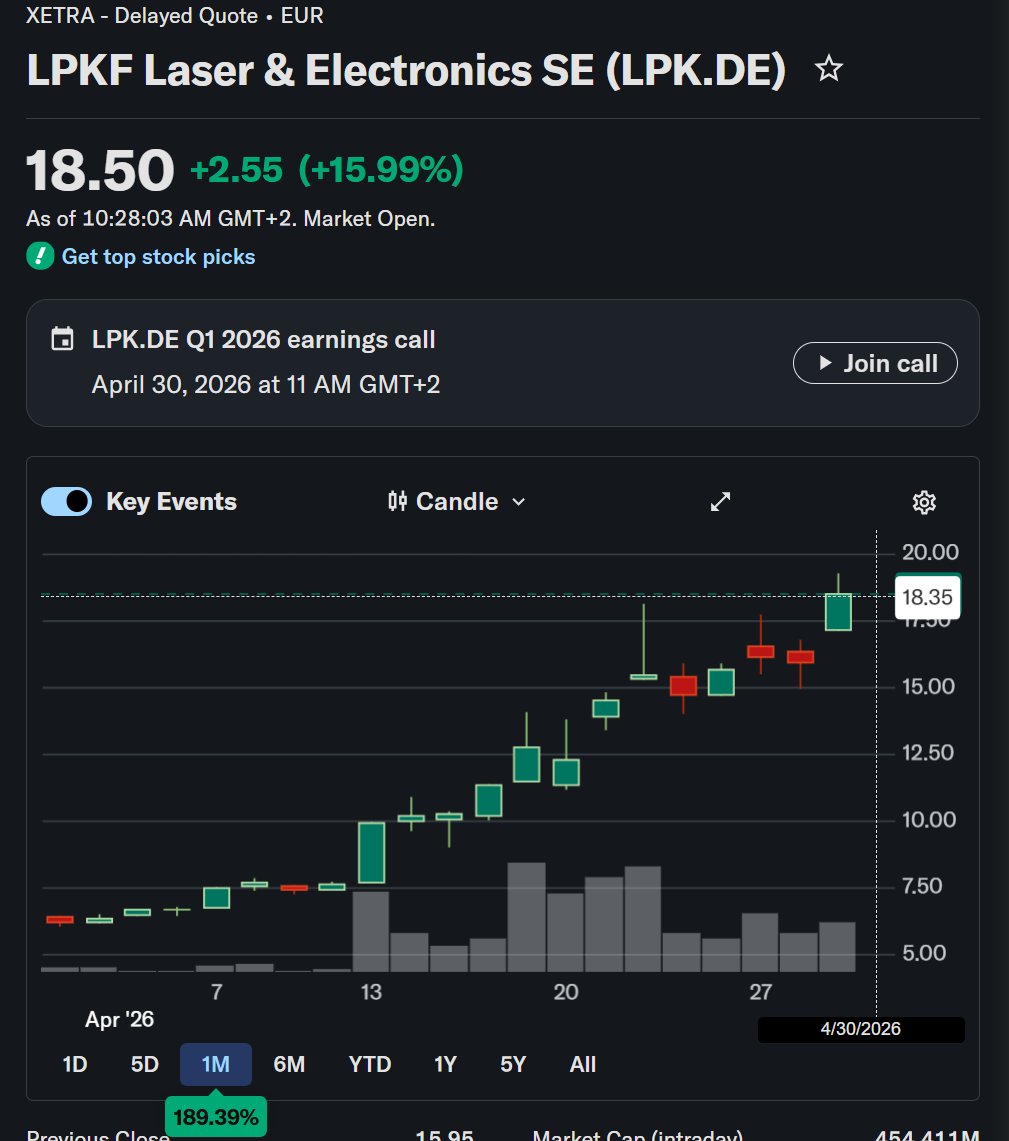
$LPKF: Can Fundamentals Catch Up with the Price? (Pre-Earnings Update) Since I entered $LPKF at €7, the stock has surged over 160%. Today’s price of €18.50 suggests the market has stopped viewing Glass Substrates as a distant R&D project and started pricing them as a critical, "here-and-now" component of the AI supply chain. With the Q1 2026 Earnings Report dropping tomorrow morning (April 30th), here is the technical reality driving the valuation: 1️⃣ Acceleration in Advanced Packaging Recent data from the Asian supply chain indicates a significant shift: Intel, Samsung, and Absolics have accelerated their validation timelines for TGV (Through Glass Via) technology. ➡️The Fact: LPKF has already delivered LIDE systems to the majority of key industry players for testing. ➡️The Implication: Tomorrow’s report needs to show a tangible increase in the Order Backlog within the Semiconductor division. This is the primary metric that justifies holding the €18+ level. 2️⃣ LIDE: The Only Scalable Standard Unlike traditional chemical etching, LPKF’s Laser Induced Deep Etching (LIDE) allows for high-speed glass processing without inducing micro-cracks. ➡️The Context: As we transition to 1.6T and 3.2T standards in data centers, organic substrates hit a physical thermal wall. ➡️The Moat: Glass is the inevitable successor, and LPKF holds the critical patents for processing it at scale (High-Volume Manufacturing). 3️⃣ Efficiency & "North Star" Strategy The €18.50 valuation discounts more than just tech; it expects an operational turnaround. Investors are looking for: ➡️Expansion of margins through the divestment of non-core, capital-intensive projects. ➡️Hyper-focus on high-margin segments: LIDE and Vitrion systems. 4⃣The Investment Thesis Entering at €7 provided the margin of safety to ride out the market’s initial skepticism. At €18.50, LPKF has entered the "prove it" phase. ➡️Bull Case: Confirmation of high-volume commercial orders from a "Top 3" global chipmaker. ➡️Realistic View: We may see a "sell the news" reaction if the guidance for H2 2026 doesn't explicitly point to exponential growth in machine orders. My core thesis remains centered on the technical bottleneck. As long as LPKF maintains its dominance in the TGV process, it remains a strategic asset in the architecture of next-generation AI processors. ⬇️Key Metrics I’m Watching Tomorrow: 🔹 Semiconductor Segment: Are orders growing by at least 20-30% YoY? 🔹 Gross Margin: Is LPKF targeting 50%+ as they shift to high-tech systems? 🔹 HVM Guidance: Does management confirm the start of mass production orders for 2026/2027? Are you holding through the report, or taking chips off the table at €18.50?
Finn Stockinger tweet media
Finn Stockinger@FinnStockinger

$LPKF: Beyond the Hype – How I Spot the Next Bottleneck I’ve already written plenty about $LPKF as a company, but today I want to share the "how" rather than the "what." How did I find a stock that ran from €7 to over €17 in just 1.5 months (+150%)? 1⃣The Methodology: Solving for the Bottleneck While the masses were focused on Indium Phosphide (InP) shortages, I was already asking: "What comes next?" * The InP Bottleneck: Led me to $IQE (~600%) and $AIXA (100%). The Laser Alternative: Led me to $SIVE (+800%). But I kept digging. As we move toward 1.6T standards, the semiconductor supply chain is hitting a wall. I believe Glass Substrates are the next revolution. 2⃣Why $LPKF? Glass substrates solve massive thermal and signaling issues, but they have one fatal flaw: cracking during production. This is where TGV (Through Glass Via) comes in. $LPKF’s LIDE (Laser Induced Deep Etching) technology is currently the only proven method to handle this process at scale without compromising the glass. It is the definition of a technical bottleneck. 3⃣Realistic Timelines vs. Market Madness Let’s be real: full High-Volume Manufacturing (HVM) for glass substrates likely won’t hit until 2028, with major machine orders starting in 2027. (I hope so). The current price action is absolute madness - I didn't expect a 150% move this quickly. However, I’m not going to stand on the sidelines when the thesis starts playing out. 4⃣Conviction and Concentration As @MarkosAAIG noted yesterday: "Not every bottleneck or constraint is investable. You really need to understand that." I don't buy every company I mention. I prefer a concentrated portfolio. I started a small position in $LPKF at €7, and because I had done my homework, I was ready to add at €8.50 and €10 as the momentum confirmed my thesis. I didn’t have to "check" what the company did when it started moving - I was already prepared. 5⃣The Strategy Moving Forward Two months ago, I didn't think $LPKF was a "put your entire life savings on it" play. It was a calculated bet on a specific technical constraint. My advice? Always ask yourself: Why am I investing in this specific company? How long can I realistically afford to hold this?
English
10
7
72
26.5K
Finn Stockinger
Finn Stockinger@FinnStockinger·
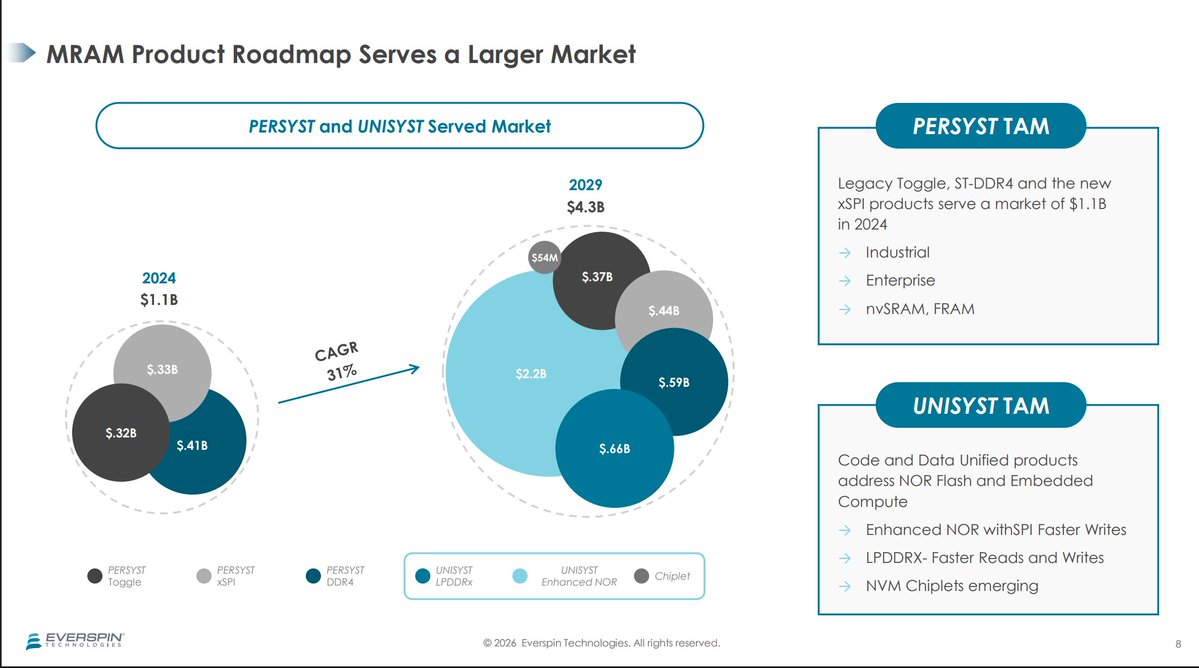
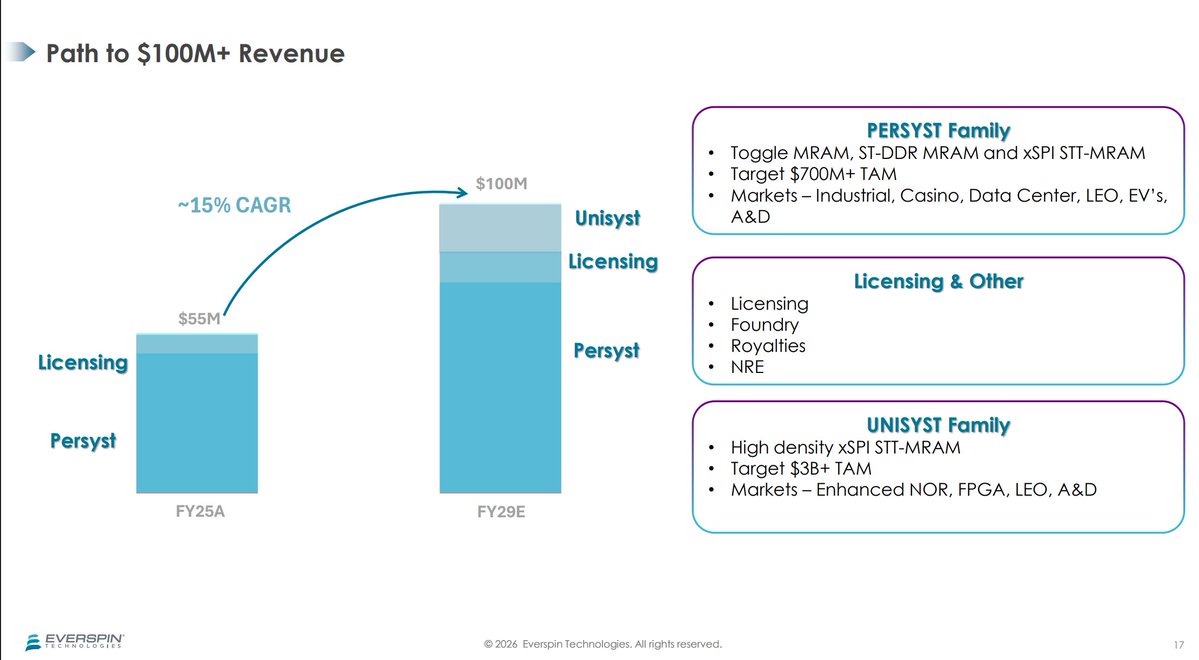
Everspin Technologies ($MRAM): A Brief History of "Memory That Doesn’t Forget" Before we dive into the hard numbers of the upcoming earnings, we need to understand who Everspin is. This isn’t just another Silicon Valley startup promising a revolution. They are a pioneer and leader that has spent over 20 years (originating from Freescale/Motorola) building a technology that the world is only just becoming ready for in 2026. ➡️ What do they do? Everspin is the world pioneer and dominant player in discrete MRAM (Magnetoresistive RAM). Unlike traditional memory (like the DRAM in your PC or Flash in your phone), MRAM stores data using magnetic states rather than electric charges. Why is it a "Big Deal" in 2026? ➡️Non-volatility: Power off? The data stays. No batteries or capacitors required. ➡️Speed: It operates nearly as fast as RAM but is as persistent as a hard drive. ➡️Endurance: You can write to it billions of times. Flash memory is a "toy" by comparison. ⬇️ Today, Everspin is evolving from a niche player for industrial meters into a strategic U.S. asset for AI infrastructure and automotive safety. ➡️When Will "Small Steps" Turn Into Massive Scale? Investors watching Everspin have every right to feel a bit weary. While the AI sector is growing exponentially, $MRAM has been delivering stable but modest quarterly revenues around $14M–$15M for some time. This is a classic case of a company with "great tech" stuck in a long design-in cycle. Here is the brutal and realistic assessment: When will we actually see the money on the table? 1⃣The "Design Win" Trap and the Real Revenue Timeline Everspin boasts hundreds of design wins (238 in 2025 alone). In the semiconductor industry, the journey from a "win" to "mass production" typically takes 18–24 months. Realistic Outlook: Most AI Edge and Automotive projects contracted in 2024 will only start generating massive, recurring orders in H2 2026 and throughout 2027. The Inflection Point: The landmark Microchip ($MCHP) agreement signed on April 8, 2026, is an operational breakthrough. However, it's vital to note the timeline: while the first Toggle MRAM products from this deal may hit the market in late 2027, the higher-margin STT-MRAM production is expected closer to 2028. Until then, expect steady growth rather than a vertical spike. Until then, expect steady but slow growth. 2⃣ "Hard Truth": What Needs to Happen for the Stock to Soar? The market is waiting for Everspin to break the $20M quarterly revenue barrier. This is the level where operational leverage starts to work its magic: with gross margins exceeding 50%, every additional dollar of revenue flows almost entirely to the net profit line. Watch the production ramp of the 256Mb STT-MRAM. Qualification is expected to wrap up in July 2026, the Q4 2026 report could be the first real "revenue surprise." 3⃣The Competitive Landscape: MRAM vs. the Giants While Everspin is the king of discrete (standalone) MRAM, they aren't playing in a vacuum. To understand the risk, we must look at the "Hidden Giants": ➡️The eMRAM Threat: Companies like TSMC and Samsung are increasingly integrating embedded MRAM (eMRAM) directly into their logic chips (at 22nm and 5nm nodes). This means for simple tasks, designers don't need a separate Everspin chip. ➡️The "Discrete" Moat: Everspin’s defense lies in high-density, high-reliability standalone modules (like the new 256Mb). Unlike the giants who focus on mass-market consumer tech, Everspin owns the "Industrial & Aerospace" niche. Their modules meet the AEC-Q100 Grade 1 standards, providing capacities and extreme-temperature resilience that embedded solutions from giants often cannot match. ➡️Operational Comparison: While $MRAM is a "pure-play," investors often compare its growth to the Philadelphia Semiconductor Index (SOX). For $MRAM to break out of its current valuation, it must prove that its growth rate can decouple from the general slow-moving industrial sector and align with the high-velocity AI infrastructure market. 4⃣Is Everspin a Takeover Target? The structure of the 10-year Microchip deal suggests deep integration. In the tech world, such partnerships are often a prelude to a full acquisition. For Microchip, buying Everspin would be a logical step to dominate the non-volatile memory market for the Aerospace & Defense sectors. ➡️Verdict: If you’re looking for a stock that will show +50% revenue tomorrow morning, you’ll be disappointed. Everspin and Magnachip are games of patience. Tonight’s results (11:00 PM CET) will likely be "stable," but the key will be management’s commentary on the Microchip wafer ramp-up speed. ➡️My strategy for “future” companies like Everspin: Accumulate on dips, but aim for 2027. That is when "tomorrow's technology" finally shows up in the Excel sheets as today's profits. It's not financial advice. DYOR.
Finn Stockinger tweet mediaFinn Stockinger tweet media
English
7
4
42
11.3K
Fiun StcoKlnger
Fiun StcoKlnger@agdam02·
Thrilled to share my recent training on [核心主题, e.g., "Sustainable Leadership"]! Learned actionable strategies from industry experts, connected with amazing peers, and left with fresh ideas to drive impact. Grateful for the opportunity—growth never stops!
Fiun StcoKlnger tweet media
English
0
0
1
5
Fiun StcoKlnger
Fiun StcoKlnger@agdam02·
Just shared a bag of crispy matcha cookies with my crew—crunchy, sweet, and so satisfying! Who’s grabbing their favorite snack to share today #SnackTimeVibes #ShareTheJoy
Fiun StcoKlnger tweet media
English
0
1
1
3
Fiun StcoKlnger retweetet
Cameron Cole
Cameron Cole@OneinAZ·
5-min Avocado Toast Hack! Toast sourdough, mash avocado with a pinch of salt/pepper, top with red pepper flakes + a squeeze of lime. Quick, creamy, so satisfying. Perfect for busy mornings! #HomemadeEats #QuickMeals
English
0
3
3
13
Fiun StcoKlnger
Fiun StcoKlnger@agdam02·
Passed the CFA Level I exam! Grateful for late nights, study buddies, and coffee that kept me going. On to Level II—let’s keep grinding! #CFA #ExamSuccess #LevelUp
Fiun StcoKlnger tweet media
English
0
0
1
2
Fiun StcoKlnger
Fiun StcoKlnger@agdam02·
" Festive glow, warm hearts—today’s the day to pause, cherish, and celebrate the little (and big) joys that wrap the year in magic. Happy [节日名称]! "
Fiun StcoKlnger tweet media
English
0
0
1
6