

James Alexander
157 posts


Missing toronto techweek and this door is all I have to show for it

English
I've said it before and will say it again. @bqueener at Bonfire is consistently ahead of the curve and provides the single greatest value an investor can: truth.
It remains to be seen if Bonfires vertical approach in technology outlasts operator ontology / judgement in the world of AI; but Brett will be correct regardless in guidance
English

Finding funds that 𝑡𝑟𝑢𝑙𝑦 invest in pre-seed is hard.
Here's a list of some I know do A LOT of pre-seed (add to comments):
Hustle Fund
Everywhere Ventures
Pear VC
Antler
Wonder Ventures
Forum Ventures
Precursor Ventures
Wischoff Ventures
Nido Ventures
Plug and Play Tech Center
Gaingels
Amplify LA
Dorm Room Fund
MBA Ventures
Unshackled Ventures
Torch Capital
Rally Cap
Cortado Ventures
LvlUp Ventures
Ganas Ventures
Symphonic Capital
Alpaca VC
Deciens Capital
Afore Capital
The Council
GoAhead Ventures
Barrel Ventures
Enzo Ventures
Redbud VC
Next Wave NYC
f7 Ventures
Recall Capital
Launch Factory
Kiplin Capital
Better Tomorrow Ventures
Incisive Ventures
Boost VC
Outlander VC
XRC Ventures
Basis Set
BoxGroup
What are others?
English
In 2013 @paulg solved for the tasks that survive AI in "Do Things That Don't Scale".
While the specifics remain accurate, the themes are more prescient. Solving problems only you can uniquely solve.
The little hand-cranked engine that could: belief plus manual labor against gravity, until momentum takes over.
paulgraham.com/ds.html
English
The noise in legal technology today is deafening.
Every week there is a new tool, an update to a core model, or a “I used Claude to do this boring task”. A thousand different songs playing simultaneously.
Law firms are three orders of magnitude behind where this innovation is happening. We see legal tech tools come out, legal technologists build features on top of the big LLM providers, those models build their infrastructure based on insights in academia.
The current problems in academia are strikingly similar to the issues lawyers face today. Optimal compute allocation (how to tackle which tasks) and mechanistic interoperability (not what systems produce, but how).
We face the same problems today: how do these tools work and how should we apply them strategically. When researchers debate how to allocate compute across reasoning tasks, that’s the same question as: should I use AI for research or drafting first?
I don’t think the answer to this is the new tool that came out in any given week. It’s in understanding the theme that exists across the noise: native models will keep getting better and individuals are bridging the gap to build their own features faster.
This does not mean lawyers should start vibe coding their own tools. This is a distraction from your core skillset of law and you’ll never out build the legal tech companies. It means you need to think intentionally about what you’re working on.
The mechanism of work becomes the only defensible moat. There will always be those who exercise this judgement natively at an elite level whose services will be in demand. But for most, your best bet is to map your cognition so it can either scale or get so refined that the aggregation of it puts you into elite territory.
This doesn’t occur in a tool. It also doesn’t live in a native LLM. It is already in the work you do. In a world of democratized tools, self knowledge remains the only true technology that compounds.
The question is: can you put the headphones on and listen?
English
@EmpiresPod @grok rank these books by highest impact per page calculated by avg Goodreads rating and page length
English

====S TIER (17 books)====
1. Napoleon: A Life, Andrew Roberts (2014)
2. Blood Meridian, or The Evening Redness in the West, Cormac McCarthy (1985)
3. War and Peace, Leo Tolstoy (1869)
4. The Count of Monte Cristo, Alexandre Dumas (1844)
5. The Rise of Theodore Roosevelt, Edmund Morris (1979)
6. Theodore Rex, Edmund Morris (2001)
7. Alexander Hamilton, Ron Chernow (2004)
8. The Complete Works of William Shakespeare, William Shakespeare (1623)
9. The Lord of the Rings trilogy, J.R.R. Tolkien (1954-5)
10. All the King's Men, Robert Penn Warren (1946)
11. Crime and Punishment, Fyodor Dostoyevsky (1866)
12. The Iliad, Homer (c. 750 BC)
13. Twilight of the Idols & The Antichrist, Friedrich Nietzsche (1888, 1895)
14. Peter the Great: His Life and World, Robert K. Massie (1980)
15. The Odyssey, Homer (c. 725 BC)
16. Heart of Darkness, Joseph Conrad (1899)
17. The Romanovs: 1613-1918, Simon Sebag Montefiore (2016)
====A TIER (59 books)====
1. The History of the Decline and Fall of the Roman Empire, Edward Gibbon (1776-1788)
2. No Country for Old Men, Cormac McCarthy (2005)
3. The Rise and Fall of American Growth, Robert J. Gordon (2016)
4. The End of History and the Last Man, Francis Fukuyama (1992)
5. Churchill: Walking with Destiny, Andrew Roberts (2018)
6. Caesar: Life of a Colossus, Adrian Goldsworthy (2006)
7. My Early Life: 1874-1904, Winston Churchill (1930)
8. Elon Musk, Walter Isaacson (2023)
9. Alexander the Great, Philip Freeman (2011)
10. Augustus: First Emperor of Rome, Adrian Goldsworthy (2014)
11. Young Stalin, Simon Sebag Montefiore (2007)
12. Antifragile: Things That Gain from Disorder, Nassim Nicholas Taleb (2012)
13. Zero to One: Notes on Startups, or How to Build the Future, Peter Thiel & Blake Masters (2014)
14. The Path to Power: The Years of Lyndon Johnson, Robert A. Caro (1982)
15. Stanley Kubrick's Napoleon: The Greatest Movie Never Made, Alison Castle (2018)
16. Heart of Europe: A History of the Holy Roman Empire, Peter H. Wilson (2016)
17. The Campaigns of Napoleon, David G. Chandler (1966)
18. Catherine the Great & Potemkin: The Imperial Love Affair, Simon Sebag Montefiore (2000)
19. The Road, Cormac McCarthy (2006)
20. A Game of Thrones, George R.R. Martin (1996)
21. Stalin: The Court of the Red Tsar, Simon Sebag Montefiore (2003)
22. The Path Between the Seas: The Creation of the Panama Canal, 1870-1914, David McCullough (1977)
23. The New Roman Empire: A History of Byzantium, Anthony Kaldellis (2023)
24. Steve Jobs, Walter Isaacson (2011)
25. A Clash of Kings, George R.R. Martin (1998)
26. Dune, Frank Herbert (1965)
27. The Last Wish, Andrzej Sapkowski (1993)
28. Foundational Concepts in Neuroscience: A Brain-Mind Odyssey, David E. Presti (2015)
29. The Prince, Niccolo Machiavelli (1532)
30. Frederick II: A Medieval Emperor, Ernst Kantorowicz (1931)
31. Chaos Monkeys: Obscene Fortune and Random Failure in Silicon Valley, Antonio Garcia Martinez (2016)
32. Einstein: His Life and Universe, Walter Isaacson (2007)
33. The Burgundians: A Vanished Empire, Bart Van Loo (2021)
34. The Wright Brothers, David McCullough (2015)
35. Brave New World, Aldous Huxley (1932)
36. Thus Spoke Zarathustra, Friedrich Nietzsche (1885)
37. Candide, Voltaire (1759)
38. Twelve Against the Gods: The Story of Adventure, William Bolitho (1929)
39. Outer Dark, Cormac McCarthy (1968)
40. The Bed of Procrustes: Philosophical and Practical Aphorisms, Nassim Nicholas Taleb (2010)
41. The Amazing Adventures of Kavalier & Clay, Michael Chabon (2000)
42. All the Pretty Horses, Cormac McCarthy (1992)
43. The Grand Strategy of Philip II, Geoffrey Parker (1998)
44. Elon Musk: Tesla, SpaceX, and the Quest for a Fantastic Future, Ashlee Vance (2015)
45. The Great Gatsby, F. Scott Fitzgerald (1925)
46. Leonardo da Vinci, Walter Isaacson (2017)
47. Benjamin Franklin: An American Life, Walter Isaacson (2003)
48. Leadership in War: Essential Lessons from Those Who Made History, Andrew Roberts (2019)
49. The Historians of Ancient Rome: An Anthology of the Major Writings, Ronald Mellor (1997)
50. A Distant Mirror: The Calamitous 14th Century, Barbara W. Tuchman (1978)
51. Siddhartha, Hermann Hesse (1922)
52. SPQR: A History of Ancient Rome, Mary Beard (2015)
53. The Godfather, Mario Puzo (1969)
54. The Age of Faith, Will Durant (1950)
55. How Rome Fell: Death of a Superpower, Adrian Goldsworthy (2009)
56. The Age of Napoleon, Will Durant (1975)
57. The Normans in the South, 1016-1130, John Julius Norwich (1967)
58. Nineteen Eighty-Four, George Orwell (1949)
59. The Time of Contempt, Andrzej Sapkowski (1995)
====B TIER (83 books)=====
1. The Innovators: How a Group of Hackers, Geniuses, and Geeks Created the Digital Revolution, Walter Isaacson (2014)
2. The Great Bridge: The Epic Story of the Building of the Brooklyn Bridge, David McCullough (1972)
3. The Dawn of Everything: A New History of Humanity, David Graeber & David Wengrow (2021)
4. The Black Swan: The Impact of the Highly Improbable, Nassim Nicholas Taleb (2007)
5. History of the Franks, Gregory of Tours (c. 594)
6. Roman History, Cassius Dio (c. 229)
7. Commentarii de Bello Gallico, Julius Caesar (c. 50 BC)
8. A Tale of Two Cities, Charles Dickens (1859)
9. Life 3.0: Being Human in the Age of Artificial Intelligence, Max Tegmark (2017)
10. Fall of the Roman Republic, Plutarch (c. 100)
11. The Metamorphosis, Franz Kafka (1915)
12. Life of Charlemagne, Einhard (c. 830)
13. Fahrenheit 451, Ray Bradbury (1953)
14. The Romans: A 2000 Year History, Edward J. Watts (2025)
15. Sword of Destiny, Andrzej Sapkowski (1992)
16. The Innovation Stack: Building an Unbeatable Business One Crazy Idea at a Time, Jim McKelvey (2020)
17. Hit Makers: The Science of Popularity in an Age of Distraction, Derek Thompson (2017)
18. Never Split the Difference: Negotiating As If Your Life Depended On It, Chris Voss (2016)
19. The Inner Game of Tennis, W. Timothy Gallwey (1974)
20. How to Live: Or A Life of Montaigne, Sara Bakewell (2010)
21. The Hard Thing About Hard Things, Ben Horowitz (2014)
22. The Old Man and the Sea, Ernest Hemingway (1952)
23. Otto III, Gerd Althoff (2003)
24. The Rise of Napoleon Bonaparte, Robert Asprey (2000)
25. The Kite Runner, Khaled Hosseini (2003)
26. Meditations, Marcus Aurelius (c. 180)
27. Shoe Dog: A Memoir by the Creator of Nike, Phil Knight (2016)
28. Afghan Napoleon: The Life of Ahmad Shah Massoud, Sandy Gall (2021)
29. Conquerors: How Portugal Forged the First Global Empire, Roger Crowley (2015)
30. Range: Why Generalists Triumph in a Specialized World, David Epstein (2019)
31. Empires of the Normans: Makers of Europe, Conquerors of Asia, Levi Roach (2022)
32. Agricola and Germania, Tacitus (c. 98)
33. Heimskringla: History of the Kings of Norway, Snorri Sturluson (c. 1230)
34. Dream Psychology: Psychoanalysis for Beginners, Sigmund Freud (1920)
35. First Principles: What America's Founders Learned from the Greeks and Romans, Thomas E. Ricks (2020)
36. How to Live: Or A Life of Montaigne in One Question and Twenty Attempts at an Answer, Sara Bakewell (2010) - DUPLICATE
37. Stalin's Folly: The Tragic First Ten Days of World War II on the Eastern Front, Constantine Pleshakov (2005)
38. Team of Rivals: The Political Genius of Abraham Lincoln, Doris Kearns Goodwin (2005)
39. Gesta Regum Anglorum (Chronicle of the Kings of England), William of Malmesbury (c. 1125)
40. Beyond Good and Evil, Friedrich Nietzsche (1886)
41. The Sorrows of Young Werther, Johann Wolfgang von Goethe (1774)
42. As I Lay Dying, William Faulkner (1930)
43. Group Psychology and the Analysis of the Ego, Sigmund Freud (1921)
44. The Poetic Edda, Various (trans. Jackson Crawford) (c. 1270)
45. The Ascent of Money: A Financial History of the World, Niall Ferguson (2008)
46. Blood of Elves, Andrzej Sapkowski (1994)
47. On Revolution, Hannah Arendt (1963)
48. The Abacus and the Cross: The Story of the Pope Who Brought the Light of Science to the Dark Ages, Nancy Marie Brown (2010)
49. The Colosseum, Mary Beard & Keith Hopkins (2005)
50. The Cognitive Challenge of War: Prussia 1806, Peter Paret (2009)
51. The Romans: From Village to Empire, Mary T. Boatwright et al. (2004)
52. The Age of Gold: The California Gold Rush and the New American Dream, H.W. Brands (2002)
53. The House of Islam: A Global History, Ed Husain (2018)
54. Spain in Our Hearts: Americans in the Spanish Civil War, Adam Hochschild (2016)
55. Historia Augusta, Various (attributed) (c. 400)
56. Night, Elie Wiesel (1956)
57. The Frankish Kingdoms Under the Carolingians, 751-987, Rosamond McKitterick (1983)
58. History of the Empire from the Death of Marcus, Herodian (c. 250)
59. The Wealth of Nations, Adam Smith (1776)
60. The Alexiad, Anna Komnene (c. 1148)
61. The Wandering Scholars of the Middle Ages, Helen Waddell (1927)
62. Memoirs of Napoleon Bonaparte, Louis Antoine Fauvelet de Bourrienne (1829)
63. Death of a Salesman, Arthur Miller (1949)
64. Lying, Sam Harris (2013)
65. Things Fall Apart, Chinua Achebe (1958)
66. Ecce Homo, Friedrich Nietzsche (1908)
67. The Hawk and the Dove: Paul Nitze, George Kennan, and the History of the Cold War, Nicholas Thompson (2009)
68. Moonwalking with Einstein: The Art and Science of Remembering Everything, Joshua Foer (2011)
69. The Carolingian World, Marios Costambeys, Matthew Innes & Simon MacLean (2011)
70. Memoirs of Napoleon, His Court and Family, Laure Junot, Duchesse d'Abrantes (1831)
71. The Ride of a Lifetime: Lessons Learned from 15 Years as CEO of the Walt Disney Company, Robert Iger (2019)
72. Alibaba: The House That Jack Ma Built, Duncan Clark (2016)
73. Beowulf, Unknown (trans. J.R.R. Tolkien) (c. 1000)
74. The Importance of Being Earnest, Oscar Wilde (1895)
75. Struggle for Empire: Kingship and Conflict Under Louis the German, 817-876, Eric J. Goldberg (2006)
76. Howard Hughes: His Life and Madness, Donald L. Barlett & James B. Steele (1979)
77. Animal Farm, George Orwell (1945)
78. Strange Pilgrims, Gabriel Garcia Marquez (1992)
79. Patton: A Genius for War, Carlo D'Este (1995)
80. The Origin and Deeds of the Goths, Jordanes (c. 551)
81. Predatory Kinship and the Creation of Norman Power, 840-1066, Eleanor Searle (1988)
82. The Lady of the Lake, Andrzej Sapkowski (1999)
83. War As I Knew It, George S. Patton Jr. (1947)
====C TIER (103 books)====
1. Heavenly Intrigue: Johannes Kepler, Tycho Brahe, and the Murder Behind One of History's Greatest Scientific Discoveries, Anne-Lee & Joshua Gilder (2004)
2. Traction: How Any Startup Can Achieve Explosive Customer Growth, Justin Mares & Gabriel Weinberg (2015)
3. The Age of Agade: Inventing Empire in Ancient Mesopotamia, Benjamin R. Foster (2016)
4. The Cambridge History of Russia, Vol. 1: From Early Rus' to 1689, Maureen Perrie (ed.) (2006)
5. Ancient Rome, William E. Dunstan (2010)
6. The Magnificent Ride: The First Reformation in Hussite Bohemia, Thomas A. Fudge (1998)
7. The Economy of Renaissance Florence, Richard A. Goldthwaite (2009)
8. The Emperor and the Saint: Frederick II of Hohenstaufen, Francis of Assisi, Richard Casady (2011)
9. Maxims and Reflections, Johann Wolfgang von Goethe (1833)
10. Chronicle of a Death Foretold, Gabriel Garcia Marquez (1981)
11. Baptism of Fire, Andrzej Sapkowski (1996)
12. Pudd'nhead Wilson, Mark Twain (1894)
13. Around the World in Eighty Days, Jules Verne (1873)
14. The Sorrows of the Ancient Romans: The Gladiator and the Monster, Carlin A. Barton (1993)
15. The Normans in Europe, Elisabeth Van Houts (2000)
16. History of the Goths, Herwig Wolfram (1988)
17. The Young Emperors: Rome, A.D. 193-244, George C. Brauer (1967)
18. The Hitchhiker's Guide to the Galaxy, Douglas Adams (1979)
19. The Normans: The Conquests That Changed the Face of Europe, Francois Neveux (2008)
20. Carolingian Chronicles: Royal Frankish Annals and Nithard's Histories, Bernhard Walter Scholz & Barbara Rogers (1970)
21. Warfare in Tenth-Century Germany, David S. Bachrach (2012)
22. Medieval Germany, 500-1300: A Political Interpretation, Benjamin Arnold (1997)
23. Pre-Sargonic Period: Early Periods, Volume 1 (2700-2350 BC), Douglas R. Frayne (2008)
24. Jan Hus: Religious Reform and Social Revolution in Bohemia, Thomas A. Fudge (2010)
25. The Roman Games: Historical Sources in Translation, Alison Futrell (2006)
26. From Roman to Merovingian Gaul: A Reader, Alexander Callander Murray (2000)
27. Napoleon the Man, Dmitry Merezhkovsky (1929)
28. Warfare in Medieval Europe c.400-c.1453, Bernard S. Bachrach & David S. Bachrach (2017)
29. The Tower of the Swallow, Andrzej Sapkowski (1997)
30. Information: The New Language of Science, Hans Christian von Baeyer (2003)
31. William the Conqueror, David Bates (2016)
32. The Last Viking: The True Story of King Harald Hardrada, Don Hollway (2021)
33. William I and the Norman Conquest, Frank Barlow (1965)
34. Guns, Germs, and Steel: The Fates of Human Societies, Jared Diamond (1997)
35. The Oxford History of Byzantium, Cyril Mango (ed.) (2002)
36. William the Conqueror: The Norman Impact upon England, David C. Douglas (1964)
37. The General Theory of Employment, Interest and Money, John Maynard Keynes (1936)
38. Historia Normannorum (History of the Normans), Dudo of Saint-Quentin (c. 1015)
39. The Lion, the Witch and the Wardrobe, C.S. Lewis (1950)
40. Great Expectations, Charles Dickens (1861)
41. The Medieval Empire in Central Europe, Herbert Schutz (2010)
42. Sapiens: A Brief History of Humankind, Yuval Noah Harari (2011)
43. Mesopotamia: The Invention of the City, Gwendolyn Leick (2001)
44. The Merovingian Kingdoms, 450-751, Ian Wood (1994)
45. Warfare and Society in the Barbarian West, 450-900, Guy Halsall (2003)
46. War, Revolution, and the Bureaucratic State, Howard Brown (1995)
47. The 48 Laws of Power, Robert Greene (1998)
48. Mindhunter: Inside the FBI's Elite Serial Crime Unit, John Douglas & Mark Olshaker (1995)
49. The Story of Russia, Orlando Figes (2022)
50. Liber Historiae Francorum, Unknown (c. 727)
51. The Deeds of Count Roger of Calabria and Sicily, Geoffrey Malaterra (c. 1099)
52. Clausewitz and Modern Strategy, Michael I. Handel (1986)
53. Frederick the Great on the Art of War, Jay Luvaas (1966)
54. Building Anglo-Saxon England, John Blair (2018)
55. The Great Transformation, Karl Polanyi (1944)
56. Upheaval: Turning Points for Nations in Crisis, Jared Diamond (2019)
57. Outliers: The Story of Success, Malcolm Gladwell (2008)
58. Talking to Strangers: What We Should Know About the People We Don't Know, Malcolm Gladwell (2019)
59. King Hammurabi of Babylon: A Biography, Marc Van de Mieroop (2004)
60. Secrets of Sand Hill Road: Venture Capital and How to Get It, Scott Kupor (2019)
61. Babylon: Mesopotamia and the Birth of Civilization, Paul Kriwaczek (2010)
62. Thinking, Fast and Slow, Daniel Kahneman (2011)
63. The Growth of Napoleon: A Study in Environment, Norwood Young (1910)
64. The Illustrated Chronicles of Matthew Paris, Matthew Paris (trans. Richard Vaughan) (c. 1259)
65. The Civilization of the Middle Ages, Norman Cantor (1993)
66. Macroeconomics as a Second Language, Martha Olney (2009)
67. Four Books of Histories, Richer of Saint-Remi (c. 998)
68. A History of the Ancient Near East, ca. 3000-323 BC, Marc Van de Mieroop (2004)
69. Crusade: The Untold Story of the Persian Gulf War, Rick Atkinson (1993)
70. Trust Me, I'm Lying: Confessions of a Media Manipulator, Ryan Holiday (2012)
71. The Checklist Manifesto: How to Get Things Right, Atul Gawande (2009)
72. The Normans in Europe, Elisabeth Van Houts (2000) - DUPLICATE
73. To Kill a Mockingbird, Harper Lee (1960)
74. A Doll's House, Henrik Ibsen (1879)
75. The Restoration of Rome: Barbarian Popes and Imperial Pretenders, Peter Heather (2013)
76. The Things They Carried, Tim O'Brien (1990)
77. The Boy Who Lost His Face, Louis Sachar (1989)
78. Harry Potter series, J.K. Rowling (1997)
79. The Giver, Lois Lowry (1993)
80. The Outsiders, S.E. Hinton (1967)
81. The Complete Works of Liudprand of Cremona, Liudprand of Cremona (trans. Paolo Squatriti) (2007)
82. The Fall of the Roman Empire: A New History of Rome and the Barbarians, Peter Heather (2005)
83. Creating a Common Polity: Religion, Economy, and Politics in the Making of the Greek Koinon, Emily Mackil (2013)
84. Beloved, Toni Morrison (1987)
85. Percy Jackson & The Olympians series, Rick Riordan (2005)
86. The Silence of the Lambs, Thomas Harris (1988)
87. Past Convictions: The Penance of Louis the Pious and the Decline of the Carolingians, Courtney M. Booker (2009)
88. The Emperor Frederick II of Hohenstaufen, Immutator Mundi, Thomas Curtis Van Cleve (1972)
89. Freakonomics: A Rogue Economist Explores the Hidden Side of Everything, Steven D. Levitt & Stephen J. Dubner (2005)
90. Journey from the Land of No: A Girlhood Caught in Revolutionary Iran, Roya Hakakian (2004)
91. 21 Lessons for the 21st Century, Yuval Noah Harari (2018)
92. Their Eyes Were Watching God, Zora Neale Hurston (1937)
93. Conrad II, 990-1039: Emperor of Three Kingdoms, Herwig Wolfram (2006)
94. Red Dragon, Thomas Harris (1981)
95. Emperors and Gladiators, Thomas Wiedemann (1992)
96. Capital in the Twenty-First Century, Thomas Piketty (2013)
97. Microeconomics as a Second Language, Martha Olney (2009)
98. Among the Hidden, Margaret Peterson Haddix (1998)
99. For the Time Being, Annie Dillard (1999)
100. The Medici Effect: What Elephants and Epidemics Can Teach Us About Innovation, Frans Johansson (2004)
101. The Life of Cesare Borgia, Rafael Sabatini (1911)
102. The Memory and Motivation of Jan Hus, Medieval Priest and Martyr, Thomas A. Fudge (2013)
103. Baghdad, Yesterday: The Making of an Arab Jew, Sasson Somekh (2007)
====D TIER (60 books)====
1. Macroeconomics, 2nd Edition, J. Bradford DeLong & Martha Olney (2006)
2. The Salian Century: Main Currents in an Age of Transition, Stefan Weinfurter (1999)
3. Germany in the Early Middle Ages, 800-1056, Timothy Reuter (1991)
4. The Napoleonic Empire and the New European Political Culture, Michael Broers et al. (2012)
5. Good Economics for Hard Times, Abhijit Banerjee & Esther Duflo (2019)
6. The Police of France, Philip John Stead (1957)
7. Frederick II of Hohenstaufen: A Life, Georgina Masson (1957)
8. Books Are Made Out of Books: A Guide to Cormac McCarthy's Literary Influences, Michael Lynn Crews (2017)
9. The Street Lawyer, John Grisham (1998)
10. Early Medieval Europe, 300-1000, Roger Collins (1991)
11. Sword, Miter, and Cloister: Nobility and the Church in Burgundy, 980-1198, Constance Brittain Bouchard (1987)
12. The Rainmaker, John Grisham (1995)
13. Homo Deus: A Brief History of Tomorrow, Yuval Noah Harari (2015)
14. Why Nations Fail: The Origins of Power, Prosperity, and Poverty, Daron Acemoglu & James A. Robinson (2012)
15. Invent and Wander: The Collected Writings of Jeff Bezos, Walter Isaacson & Jeff Bezos (2020)
16. Fundraising, Ryan Breslow (2022)
17. How Not to Be Wrong: The Power of Mathematical Thinking, Jordan Ellenberg (2014)
18. Myths from Mesopotamia: Creation, the Flood, Gilgamesh, and Others, Stephanie Dalley (1989)
19. Rome and its Empire, AD 193-284, Olivier Hekster (2008)
20. The Black Death: Natural and Human Disaster in Medieval Europe, Robert Gottfried (1983)
21. How to Win Friends and Influence People, Dale Carnegie (1936)
22. Henry IV of Germany, 1056-1106, I.S. Robinson (1999)
23. Akkad, the First World Empire, Mario Liverani (1993)
24. William Wallace: Brave Heart, James Mackay (1995)
25. Trillion Dollar Coach: The Leadership Playbook of Silicon Valley's Bill Campbell, Eric Schmidt, Jonathan Rosenberg & Alan Eagle (2019)
26. How Google Works, Eric Schmidt & Jonathan Rosenberg (2014)
27. The Lean Startup, Eric Ries (2011)
28. Kings and Queens, Neil Grant (1996)
29. The Battle of the Catalaunian Fields, AD 451, Evan Schultheis (2019)
30. Hacking Growth: How Today's Fastest-Growing Companies Drive Breakout Success, Sean Ellis & Morgan Brown (2017)
31. Algorithms to Live By: The Computer Science of Human Decisions, Brian Christian & Tom Griffiths (2016)
32. Growth Hacker Marketing, Ryan Holiday (2013)
33. The Gods of War, Conn Iggulden (2006)
34. Collaboration and Resistance in Napoleonic Europe, Michael Rowe (2003)
35. Moonwalking with Einstein, Ed Cooke (featured in Joshua Foer) (2011) - DUPLICATE
36. An American Plague: The True and Terrifying Story of the Yellow Fever Epidemic of 1793, Jim Murphy (2003)
37. The Longest Night: The Bombing of London on May 10, 1941, Gavin Mortimer (2005)
38. Napoleon: A Life, Paul Johnson (2002)
39. A Short History of the Italian Renaissance, Virginia Cox (2015)
40. Vaclav Havel, Kieran Williams (2016)
41. Ancient Iraq, Georges Roux (1964)
42. Reset: Regaining India's Economic Legacy, Subramanian Swamy (2019)
43. Death and Life in the Tenth Century, Eleanor Duckett (1967)
44. Lost to the West: The Forgotten Byzantine Empire That Rescued Western Civilization, Lars Brownworth (2009)
45. The Normans: From Raiders to Kings, Lars Brownworth (2014)
46. The Normans: The History of a Dynasty, David Crouch (2002)
47. The Cambridge History of the Byzantine Empire c.500-1492, Jonathan Shepard (ed.) (2008)
48. This America: The Case for the Nation, Jill Lepore (2019)
49. Napoleon's Empire: European Politics in Global Perspective, Ute Planert (2015)
50. The American Revolution, 1775-1783, John Richard Alden (1954)
51. D-Day: Minute by Minute, Jonathan Mayo (2014)
52. The Trial of Jan Hus: Medieval Heresy and Criminal Procedure, Thomas A. Fudge (2013)
53. Norse Mythology, Neil Gaiman (2017)
54. The Baobab and the Mango Tree: Lessons About Development, Nicholas Thompson & Scott Thompson (2020)
55. Pirate Latitudes, Michael Crichton (2009)
56. Target Iran: The Truth About the White House's Plans for Regime Change, Scott Ritter (2006)
57. Alexander the Great: The Macedonian Who Conquered the World, Sean Patrick (2013)
58. Napoleon: The Art of War & Power, George D'Aguilar (2017)
59. Napoleon's Police, Peter de Polnay (1970)
60. Doughnut Economics: Seven Ways to Think Like a 21st-Century Economist, Kate Raworth (2017)
Empire-Builders@EmpiresPod
This is every book I've read in the last few yrs. S: life-changing A: really, really good B: good C: ok D: skip unless you're a specialist or slopologist Ok go ahead and roast me.
English
@raifordpalmer @LexideskAI Why don't you build your own internally and control the velocity of tuning, data and competitive moat (including security parameters)?
English
We started using an AI intaker to back up our humans (@LexideskAI) - so far, we are impressed.
A recent update makes it more human like than ever. The pauses in the conversation seem natural, the questions and comments from “Emma” flow naturally.
We disclose that “Emma” is an AI at the outset of the call, and the caller can ask to talk to a human. Most don’t. “She” is that good. And “Emma” will only continue to improve, quickly as the underlying LLMs improve and we add more training data, and the voice models leap ahead even further. The uncanny valley is disappearing, fast.
What this makes me think about (after reading @jennyrozelle’s post about a random lawyer calling for a copy of an estate plan) is this: what if an opponent uses a voice AI tool like that from @elevenlabs to call your firm, posing as your client - to have a conversation with you?
I’ve read that security people are recommending that families and friends have a two word password exchange (like “sugar - acid”) that each person says as a recognition signal.
Maybe we should be telling our clients this? Am I paranoid?
English
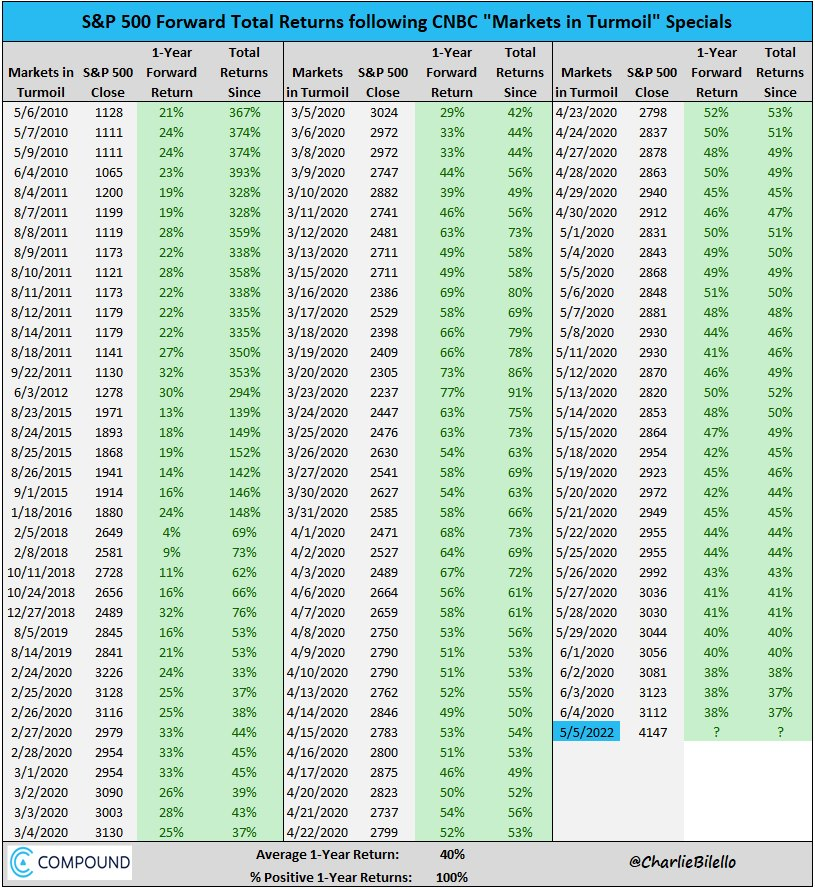
@dividendology @grok what is the average dip as a percentage for the S&P 500 to trigger CNBC running a "Markets in Turmoil". Use the dates in the above data and cross reference it with dips
English

This is funny.
What if you invested in the S&P 500 every time CNBC had a "Markets in Turmoil" special?
Well... your average return after one year would be 40%, with a 100% success rate.
English
@scottastevenson Scott, how do you have so much time to produce content while being the captain of a high growth company? Most founders I know live and breathe product 24/7
English
Modern philosophy content is so narrow. Almost all of it is about philosophers rather than philosophies. There’s a great whitespace for a new podcast or something like that to exist.
TBPN filled the opposite whitespace: all tech content was about the tech rather than the people behind it. So they made a super people-centric show.
Pretty much any topic can be covered with a “people” lens or a “thing” lens, and those lenses will appeal to different kinds of people.
English

@raifordpalmer I've seen it be as high as 55% this week alone!
English
A divorce firm is apparently offering one of our associates 40% of collected production and 20% of collected origination.
If you are out there reading this, you will destroy your firm with this comp system assuming you provide staff, pay for marketing, and cover your attorneys’ overhead costs, have benefits, etc. Your profit margin will be zero to negative. Don’t take it from me, ask around.
Wait, I did the homework for you:

English


James Alexander retweetet

James Alexander retweetet

@LegalTechStrtUp Any reports on the details of the acquisition?
English
Mat Rotenberg, who just sold his legal tech startup Dashboard Legal to Bloomberg, pens a heartfelt and insightful article about his startup journey. Enjoy.
@mathew.rotenberg/i-sold-my-legaltech-company-to-bloomberg-thoughts-from-the-week-after-2bacf58bb033" target="_blank" rel="nofollow noopener">medium.com/@mathew.rotenb…
#legaltech
English
When it comes to business, integrity trumps intelligence.
English
@raifordpalmer Here's a great podcast on it! open.spotify.com/episode/665iwu…
English
Listening to Titan by Ron Chernow.
Outstanding book about Rockefeller and Standard Oil.
Recommended! 👍🏼
audible.com/pd/B00ECGLKLG?…
English
James Alexander retweetet


James Alexander retweetet

Russell Alexander @familyLLB: Will artificial intelligence (AI) replace family lawyers? thelawyersdaily.ca/articles/42473… "In the first of a multipart series, we explore how AI is changing the practice of family law and the role of lawyers in particular."

English