Ankaj Mohindroo

899 posts

Ankaj Mohindroo

Ankaj Mohindroo

@amhrtech

AI Analyst at GAI Insights. Follow for latest insights on GenAI.

Beigetreten Temmuz 2011
2K Folgt149 Follower
Ankaj Mohindroo retweetet

Nathan Lambert
Nathan Lambert@natolambert·
There's been a rapid increase in political chatter on the need to stop AI distillation "attacks". I've been following this area closely, especially early legislation, as I see it being an area where initial action has pretty big unintended second order consequences. At face value, I see the desire to ban Chinese models built on distillation (e.g. via entity listing or other interventions). I agree that the strength of leading AI companies, particularly OpenAI and Anthropic, is a massive strategic asset for the country. The argument is that distillation limits their competitive position, where Chinese labs use distillation to "steal" capabilities and undercut them on price. But, on balance so long as these distilled models are released openly with permissive licenses, the US AI ecosystem benefits massively by accessing them. The U.S. has by far and away the biggest inference market, and having the option of cheaper, specialized open models to counterweight the best closed models is an excellent economic equilibrium driving investment and innovation at the frontier. We do not want to kneecap this dynamic in the middle of one of the most incredible times of rapid model progress. To state the core of my worry clearly – we don't have clear evidence on the exact benefits Chinese companies gain from distillation. We have some evidence on HOW distillation data is accessed, only from the same companies likely championing this policy action. This doesn't map cleanly to impact. Some experts think distillation is becoming less relevant in the era of RL environments as training data, some others think distillation is becoming easier. We need to know the true effects before we consider siloing the US AI ecosystem out of the global, open ecosystem. Flourishing startups like Cursor use these open-weight models as a central method for pushing their long-term independence in the ecosystem. Also, a large majority of academic research in the U.S. is built on Chinese models right now. Banning the Chinese open weight models right now will result in massive consolidation of power onto the closed AI labs right when the open ecosystem in the US is starting to explore and blossom more. I worry it could be a sort of 6-12month delay in capability rollout of open models if such a ban was enacted, and long term make the open ecosystem not really viable. The open ecosystem is currently very fragile, supported by a few model builders. At the same time, lots of weird effects globally could follow this ban, where the US may not play a role in the global open model ecosystem. So if people want to discuss this more, happy to try and help. I think the interdependencies in the ecosystem aren't well communicated.
English

18
36
234
26K
Ankaj Mohindroo retweetet
OpenAI
OpenAI@OpenAI·
Introducing GPT-5.5 A new class of intelligence for real work and powering agents, built to understand complex goals, use tools, check its work, and carry more tasks through to completion. It marks a new way of getting computer work done. Now available in ChatGPT and Codex.
English
2.4K
6.9K
51.4K
11.9M
David Ulevitch 🇺🇸
Lazyweb: What’s the best AI tool to help me generate a small 5-10 slide presentation? Ideally I'd just prompt the structure and have it make the slides, text, images, etc. and then let me fine tune it and edit the copy as I see fit.
English
37
0
46
29.7K
Ankaj Mohindroo retweetet
Claude
Claude@claudeai·
Introducing Claude Opus 4.7, our most capable Opus model yet. It handles long-running tasks with more rigor, follows instructions more precisely, and verifies its own outputs before reporting back. You can hand off your hardest work with less supervision.
Claude tweet media
English
4.8K
10.3K
81.2K
13.6M
Ankaj Mohindroo retweetet
Patrick OShaughnessy
Patrick OShaughnessy@patrick_oshag·
Some early thoughts after building real apps by myself for the first time… We built an internal tool called Conveyor It’s an app builder, and internal App Store It is connected to all of our data, context, and external data APIs I’m completely and utterly useless as an engineer, but I’m good at knowing what I want a tool to do. I’d previously struggled to make useful programs with pure CLIs. Our wrapper made it easy for me. In the first 3 days of having this tool, I’ve built several fairly complicated applications, two of which I’ve used a ton for real work. I’ve only used a couple hundred million tokens so far. Some early feelings: 1) It’s obvious to my that my companies Positive Sum and Colossus will have fully bespoke operating systems, built in house. They will manage as much of our work as possible. This is already exploding for things like research and reporting. Every business will want this for themselves. Sure we won’t built our own slack, but we will built everything that pertains specifically to our shape as a firm, which is a lot. 2) x402 protocol (which enables AI agents and users to pay for API access and digital services instantly, without accounts or subscriptions) is immediately interesting to me. Many times I’ve wished I could just stream payments for individual data points. 3) right now each loop of prompt to output takes 5 to 15 minutes. As models and ASICs (@Etched !) make this faster, it’s going to be so much more fun. Even 5 minutes makes it hard to get in the flow. Can’t wait for seconds instead of minutes. 4) it’s so much easier to design things by starting with a shitty first draft of an app and seeing what’s wrong and iterating than nailing a full design ahead of time. When I had directed the design of software before this was always maddening and slow. 5) this has made me realize that my imagination had atrophied. Use it or lose it is real. Very quickly I’m finding it easier to have good ideas by building more stuff. I encourage everyone to do the same. So fun and rewarding. 6) We need more compute
English
21
13
257
31.1K
Ankaj Mohindroo
Ankaj Mohindroo@amhrtech·
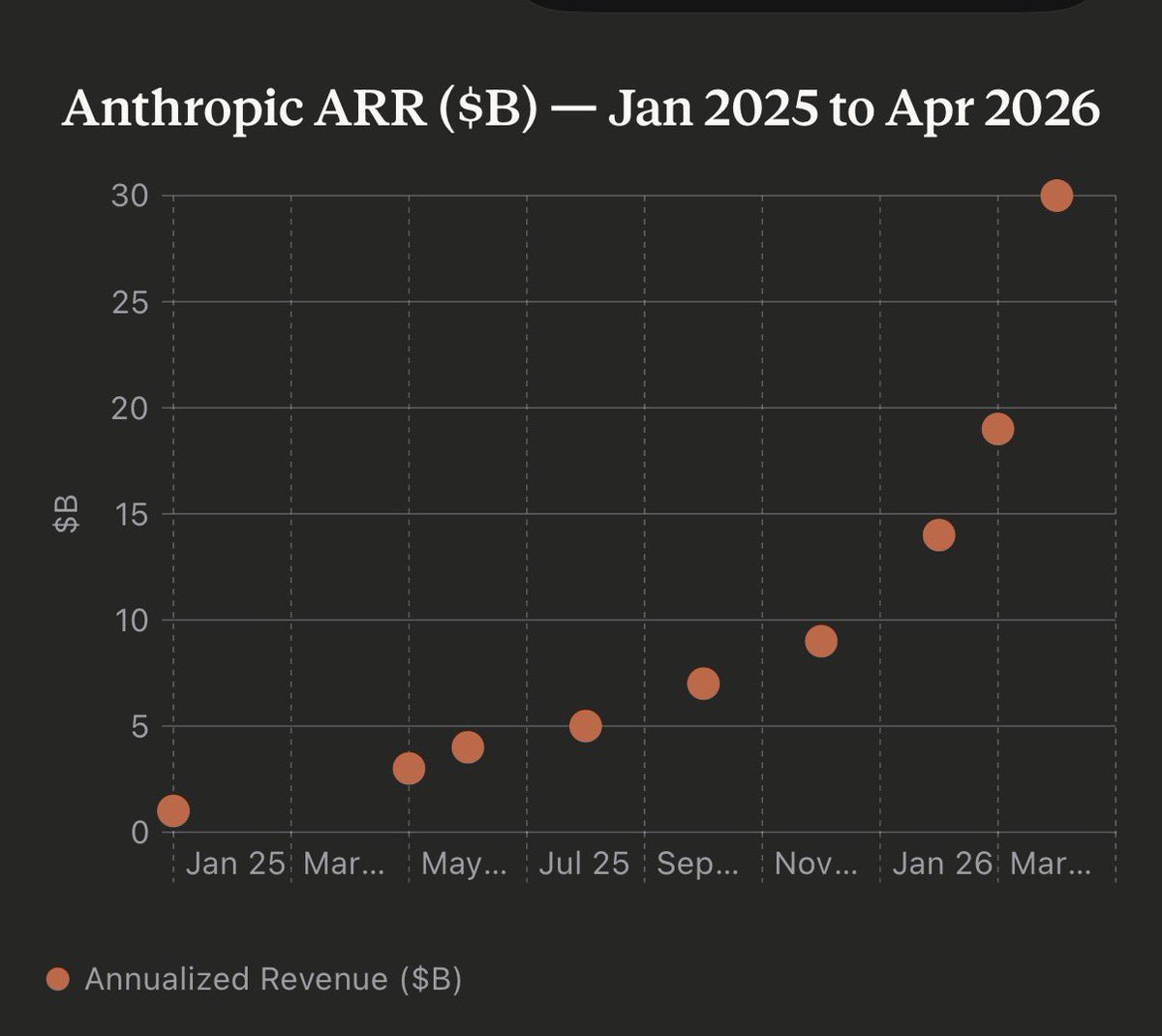
Anthropic was at $19B run rate in February and now at $30B
Ankaj Mohindroo tweet media
English
0
0
0
4
Ankaj Mohindroo retweetet
Google DeepMind
Google DeepMind@GoogleDeepMind·
Meet Gemma 4: our new family of open models you can run on your own hardware. Built for advanced reasoning and agentic workflows, we’re releasing them under an Apache 2.0 license. Here’s what’s new 🧵
GIF
English
370
1.2K
8.8K
3.9M
Ankaj Mohindroo retweetet
Arcee.ai
Arcee.ai@arcee_ai·
Today we're releasing Trinity-Large-Thinking. Available now on the Arcee API, with open weights on Hugging Face under Apache 2.0. We built it for developers and enterprises that want models they can inspect, post-train, host, distill, and own.
English
100
244
2.1K
695.9K
Ankaj Mohindroo retweetet
Arvind Jain
Arvind Jain@jainarvind·
Agentic AI is everywhere right now. But very few teams can explain why their agents behave the way they do, or how to systematically make them better. People often describe traces as the “codebase” for agents. They show how an agent thinks and what it did at every step. As agents take on more tools, sandboxes, and skills, their paths multiply. That makes them harder to reason about and harder to improve. Static prompts don’t scale when every run looks different. At @glean, we use traces as part of the learning and memory loop, not just logging. Trace learning lets agents learn from real usage, adapt to edge cases, and get better without model fine-tuning or long instruction sets. The goal isn’t to replay old runs, but to extract the signal that helps the agent make a better decision next time. In the enterprise, tool strategies are never one-size-fits-all. Each company wires systems together differently, defines its own sources of truth, and has its own rules of engagement. Treating this as generic is both a security risk and a quality problem, because it ignores how work actually gets done. Work is also personal. The systems people touch, the updates they make, and the templates they use all vary. So we built learning at two levels: - Enterprise-level strategies for how tools and workflows operate - User-level preferences for how work actually gets done Traces give us a way to understand and shape agent decision-making, and to create a feedback loop that compounds over time. If agentic AI is going to move beyond impressive demos to reliable day-to-day work, this kind of trace-driven learning is essential. It’s one of the ways we’re building self-learning agents that can execute real work, at scale.
Tony Gentilcore@tonygentilcore

x.com/i/article/2039…

English
20
48
366
60.9K
Ankaj Mohindroo retweetet
Thariq
Thariq@trq212·
/buddy
Thariq tweet media
English
489
171
4.1K
541.1K
Ankaj Mohindroo
Ankaj Mohindroo@amhrtech·
Stripe has developed a new tool which takes care of all deployment concerns for your vibe coded stuff
Patrick Collison@patrickc

When @karpathy built MenuGen (karpathy.bearblog.dev/vibe-coding-me…), he said: "Vibe coding menugen was exhilarating and fun escapade as a local demo, but a bit of a painful slog as a deployed, real app. Building a modern app is a bit like assembling IKEA future. There are all these services, docs, API keys, configurations, dev/prod deployments, team and security features, rate limits, pricing tiers." We've all run into this issue when building with agents: you have to scurry off to establish accounts, clicking things in the browser as though it's the antediluvian days of 2023, in order to unblock its superintelligent progress. So we decided to build Stripe Projects to help agents instantly provision services from the CLI. For example, simply run: $ stripe projects add posthog/analytics And it'll create a PostHog account, get an API key, and (as needed) set up billing. Projects is launching today as a developer preview. You can register for access (we'll make it available to everyone soon) at projects.dev. We're also rolling out support for many new providers over the coming weeks. (Get in touch if you'd like to make your service available.) projects.dev

English
0
0
0
25
Mckay Wrigley
Mckay Wrigley@mckaywrigley·
looking for a handful of people to test something new... i've been using it for a few months and am prepping to share. if you're a fan of claude cowork, openclaw, manus, perplexity computer, etc then you're a perfect fit. this will self destruct in 4hrs - please dm or reply.
Mckay Wrigley@mckaywrigley

you’re like 6 prompts away from infinitely customizable personal agi. anthropic gave you a world class agentic harness for free. use it!!!

English
1K
15
769
158.2K
Ankaj Mohindroo retweetet
Ethan Mollick
Ethan Mollick@emollick·
Human interaction is going to shift to discords and group chats, invite-only. The open web and social media are going to be left for the agents lurking amongst the ruins. Everything public will be Moltbook.
English
147
113
1.4K
109.7K
Ankaj Mohindroo retweetet
Ethan Mollick
Ethan Mollick@emollick·
I would avoid downloading AI skills that have not been vetted by you through careful reading of the markdown files (or, if outside your field, by an expert in that field you trust). There are obvious security risks, but there is even greater risk that the skill is just bad.
English
38
11
306
18.9K
Ankaj Mohindroo
Ankaj Mohindroo@amhrtech·
@emollick Their positioning for enterprise AI offering is really confusing as well.
English
0
0
0
145
Ethan Mollick
Ethan Mollick@emollick·
I think they are figuring it out, but there are standouts that no one else seems to have an equivalent to: Google AI Studio is the best API testing tool of the AI Labs, NotebookLM is the only app in its category (& very good), AI Mode for Google search, etc. But all scattered.
English
9
3
115
11.8K
Ethan Mollick
Ethan Mollick@emollick·
Writing my latest guide on what AI to use made it really clear how confusing the Google AI situation is. Great models with radically different harnesses in different apps. Great AI products, mixed in with some bad ones. None of which seem to clearly connect or interact together.
English
22
9
203
18.4K