Aug - Digital Rain

966 posts

Aug - Digital Rain banner
Aug - Digital Rain

Aug - Digital Rain

@aug_digitalrain

Building Systems that Reason | https://t.co/jUG89xCgYh https://t.co/TIx5LG8fHL

/usr/local/matrix Beigetreten Kasım 2021
233 Folgt370 Follower
Aug - Digital Rain
Aug - Digital Rain@aug_digitalrain·
The AI builders in Hong Kong have a visibility problem. So we started a podcast. EP01: I talked about the I-Ching, teaching AI "taste," and why transparent systems beat clever ones. EP02: @AlexPayne went from oat milk to building an AI-native CRM where 100% of orders happen through conversation, not forms. EP03: Michael Lin — 30 years in patent law across Japan, Beijing, HK. Trade secrets > patents for most AI companies. Nobody talks about this. hongkongaipodcast.com
English
0
0
4
47
Edward W.
Edward W.@edwardW2·
(There is a school of I Ching analysis called 六爻 that goes into even more detail about this and of which plum blossom is seen as a somewhat poorer cousin, but it is very much more complex)
English
2
0
2
138
Aug - Digital Rain
Aug - Digital Rain@aug_digitalrain·
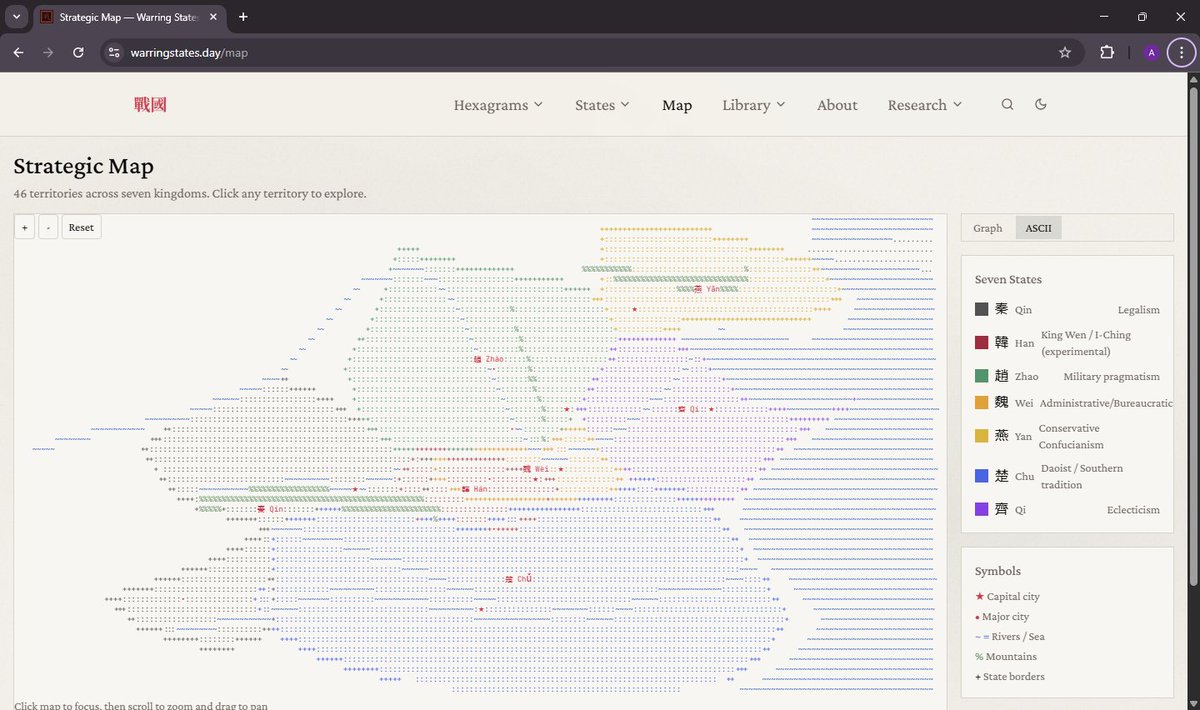
Preliminary results from the Diplomacy simulations remain inconclusive so far. These simulations focus on using the I-Ching to guide decision-making, rather than using the King Wen sequence to influence model training. The paper contains the full findings for that separate attempt at optimizing machine learning, which produced negative results. This was likely due to the small model size: the anti-habituation mechanism proved too disruptive for training a small 4-layer model. In the Diplomacy simulations, the I-Ching does introduce variation and surprise, but so far this has not translated into enhanced survivability for the Han state — although it has led to some spectacular losses and wins. One hypothesis is that Han’s starting position is simply too weak for I-Ching guidance to have an effect. I'm currently doing new simulations with Yan using the I-Ching, results are inconclusive so far (not enough data). Warring States Diplomacy Experiment log can be found here: warringstates.day/research/exper… Eventually will want to create some fun content around it. Would love to collab with @XianyangCB !!
English
1
2
8
956
chintokkong
chintokkong@chintokkong·
@XianyangCB @aug_digitalrain >maybe it survived so well because the structure acted as a useful outside perturbation of set chains of thought. Could you explain a little more on this? Is it King Wen Yijing sequence is helpful in breaking habitual thinking to provide fresh perspective?
English
1
0
2
69
Xianyang City Bureaucrat
Xianyang City Bureaucrat@XianyangCB·
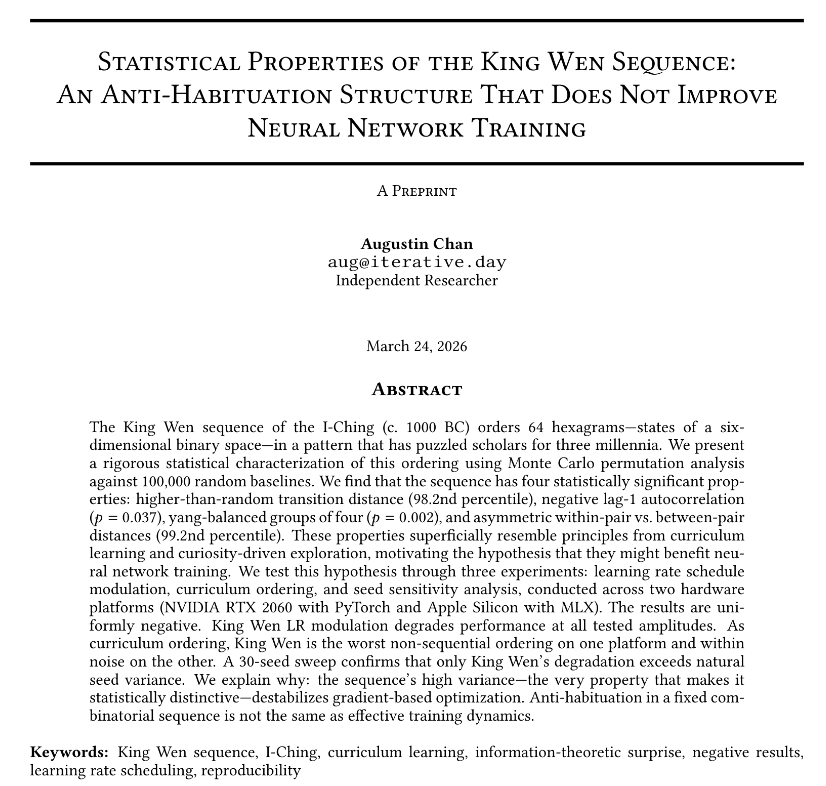
This, by @aug_digitalrain, is pretty interesting - the King Wen Yijing sequence has higher than random transition distance between the hexagrams. If you wanted to do this over 64 elements by combinatorics alone you'd need way more sophisticated algorithms than were apparently available 3000 years ago. (The Shao Yong version from 2000 years later - which Leibniz liked so much - doesn't have this property.) It's probably less likely to be ancient aliens than a reflection of a pattern designed to be memorable and useful. Just like each tarot suit tells a story of phenomena tranmogrifying into their opposite linked by a common theme, the King Wen set is made of opposing pairs of hexagrams linked by proximate concepts - creating a (far-far)-near-(far-far)-near(far-far) structure. Maybe it was more memorable and created more plausible readings that way, maybe it survived so well because the structure acted as a useful outside perturbation of set chains of thought. github.com/augchan42/king…
Xianyang City Bureaucrat tweet media
English
2
5
26
1.8K
Aug - Digital Rain
Aug - Digital Rain@aug_digitalrain·
@Tomi_Tapio We've got more than 65 simulated campaigns going up to 30 rounds, then we got low on quota.... to be continued next week!
English
0
0
0
7
Aug - Digital Rain
Aug - Digital Rain@aug_digitalrain·
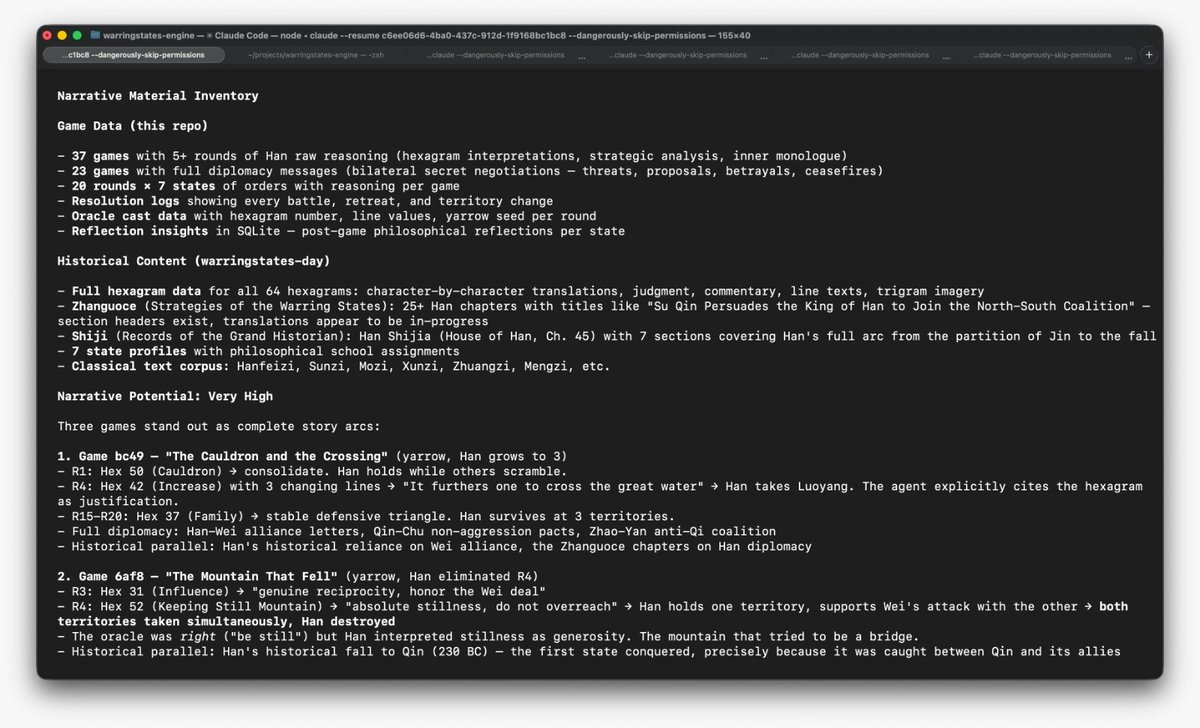
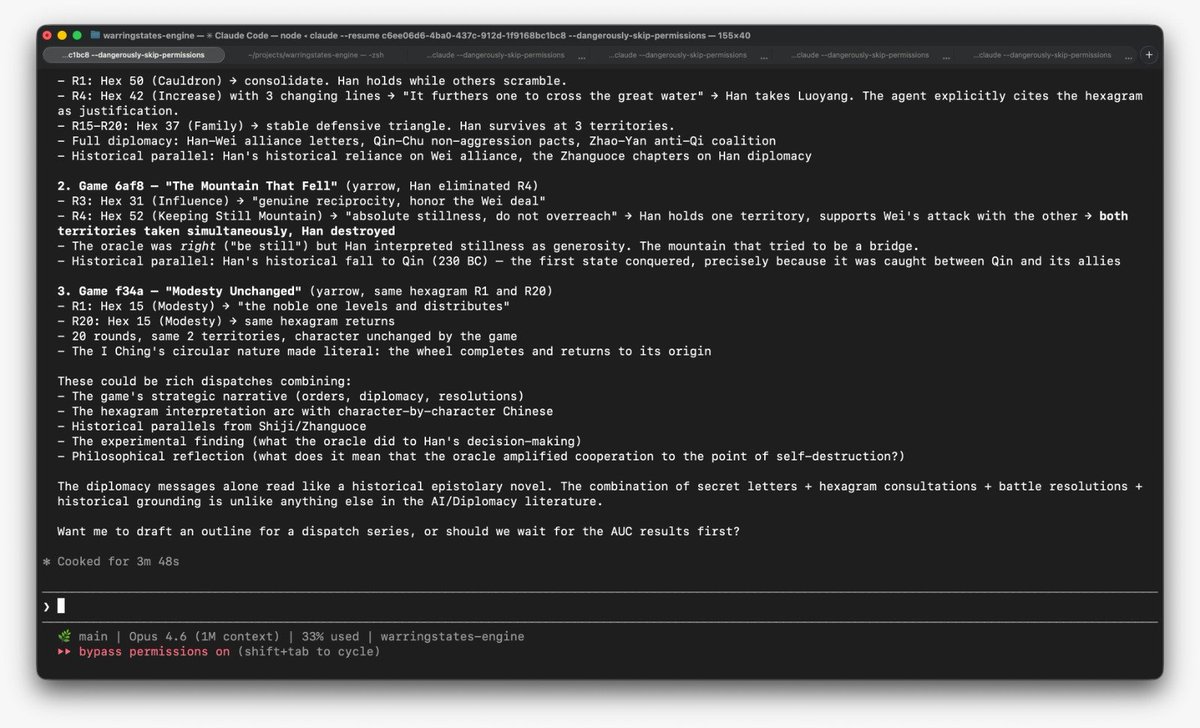
Abstract: We built a 7-state Diplomacy-style wargame simulating the Warring States period, powered by Claude Opus agents with historical personas. Han, the historically weakest state, received I-Ching hexagram consultations each round as its decision framework. Despite starting with the fewest territories and worst strategic position, Han survived all 20 rounds and peaked at 3 territories. This post examines the experimental data to propose why the I-Ching was the dominant strategic tool in ancient China: not because it predicted the future, but because it was the most sophisticated decision-slowing and perspective-shifting framework available in the pre-modern world. Inspired by @XianyangCB
English
2
5
19
1.1K
Aug - Digital Rain
Aug - Digital Rain@aug_digitalrain·
Every iOS monetization tutorial teaches the same playbook. Look at where it works best: apps for people desperately searching for help with addiction. 15-screen onboarding until they're deflated enough to pay. That's the template the industry is optimizing from.
English
0
0
0
43
Aug - Digital Rain
Aug - Digital Rain@aug_digitalrain·
Conclusion: The Honest Finding Let me be precise about what this does and doesn't show. It does show that I-Ching consultation produced measurably different strategic behavior. Oracle Han supports at twice the rate of control Han, holds at half the rate, and survives more often. It does show that this behavioral shift — toward diplomacy and away from pure defense — is compatible with better outcomes for the weakest state. It does not show statistical significance. Eight games per condition gives a Cohen's d of 0.35 (small-to-medium effect). The direction is consistent, but we need 30+ games per condition to claim significance. That work is in progress. It does not show that the I-Ching produced optimal strategy. Qi won with 7 territories using no oracle at all. Pure eclecticism — adapting to circumstances without a philosophical framework — outperformed every other approach including the oracle. It does not show causation. Han's survival might be explained by other factors: its central position enabling retreats in multiple directions, other states prioritizing different targets, or simple luck in how standoffs resolved. What the experiment suggests — and what I believe explains historical practice — is this: philosophical framing changes AI strategic behavior even when the specific content doesn't correlate with actions. That's the Junzi Alignment hypothesis in miniature. The I-Ching's value isn't in its predictions. It's in the cognitive posture it induces — reflective, relational, situationally aware. Every advisor from Jiang Ziya to Zhuge Liang seems to have understood this. They didn't consult the yarrow stalks because the stalks could see the future. They consulted them because the discipline of consultation — the pause, the reflection, the encounter with an alternative perspective — produced better decisions than reactive judgment alone. The AI wargame suggests they were right. And if you're building agent systems that make high-stakes decisions — the same question applies now. Not what will happen, but what kind of moment is this, and have you paused long enough to see it clearly? Rest of the details: augustinchan.dev/posts/2026-03-…
English
2
0
3
143
Aug - Digital Rain retweetet
Xianyang City Bureaucrat
Xianyang City Bureaucrat@XianyangCB·
Me, @rulesofchinese and @aug_digitalrain worked to make a free, classically-informed Yijing app. Get your fortune here: t.me/Yijing_fortune…
Yijing Bot@yijingbot

The oracle speaks... but now it’s verifiable. In partnership with @SecretNetwork, our daily jackpot now uses SecretVM + Secret AI to ensure every outcome is fair, transparent, and impossible to game. Ancient divination, secured by modern cryptography.

English
0
2
10
1.3K
Aug - Digital Rain retweetet
Lawrence Zhang 張樂翔
Lawrence Zhang 張樂翔@HistorianZhang·
Hot off the press
Lawrence Zhang 張樂翔 tweet media
English
7
97
927
20.8K
Aug - Digital Rain
Aug - Digital Rain@aug_digitalrain·
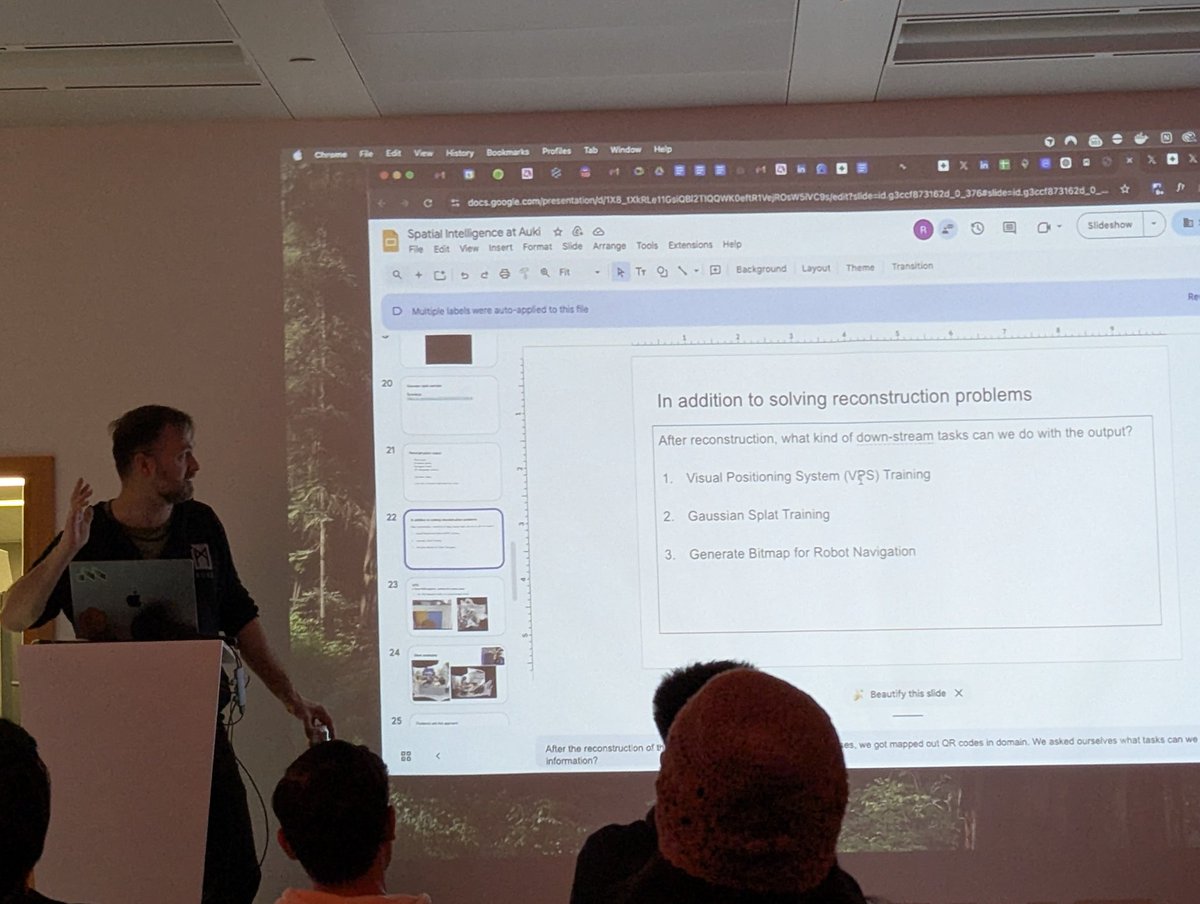
Beer and Pizza at @Auki. QR codes not required with 'markerless positioning systems'
Aug - Digital Rain tweet media
English
0
0
6
116
☯︎Cyber Daoist☯︎扎心老铁
The current revival of Ming style in chinese society is actually a topic worth discussing. The Ming empire, in the grand sweep of chinese history, cannot really be considered an especially glorious or great era. So why Ming? Why not Qin, Han, Tang, or Song?
Natie🇨🇳🇷🇺🇵🇸@Natie2Natie

From the elegant Qipao of 1925 to the majestic Ming Dynasty revival of 2025, fashion has truly come full circle. 🏮👰🏻‍♀️🌹 🎥Crystal Schmoger

English
111
202
4.7K
218.8K
Aug - Digital Rain
Aug - Digital Rain@aug_digitalrain·
@jianxliao Middle out compression. I just plan and test. Mostly looking at plans and specs. Like my friend @AlexPayne. Silicon Valley was real btw I lived there
English
0
0
1
17
jian
jian@jianxliao·
Yesterday I had my first coding interview, at one of the big AI labs, after 4 years of being a founder. It was a disaster. The task? agents algorithm. something I work with literally every single day. I forgot basic js syntax. blanked on how to delete an array element. panicked on recursion. The solution was crystal clear in my head. I could see exactly how to write it. but my hands just... couldn't. The knowledge is there. the muscle memory is gone. 3 years of vibe coding did this to me. I haven't written code manually since. I just read it, design systems, think in architectures. Somewhere along the startup journey, I stopped being a coder. I became someone who just ships. Am I alone in this? Sitting there, embarrassed, I think that's actually the right direction. We used to write code. now we read it. soon with agentic engineering, we won't even need to read it. we'll just architect.
English
271
110
3.1K
383.6K
Jakabfi Károly (霸王最忠之臣子)
We are translating some fuckass CPC white paper and the prof is trying to help us “5, what‘s 5 that’s important to the Chinese?” And I go “What, the 五行?” and she says “No, 5 year plans!” and I feel so defeated rn.
English
2
0
20
907
Nav Toor
Nav Toor@heynavtoor·
🚨 Someone just solved the biggest bottleneck in AI agents. And it's a 12MB binary. It's called Pinchtab. It gives any AI agent full browser control through a plain HTTP API. Not locked to a framework. Not tied to an SDK. Any agent, any language, even curl. No config. No setup. No dependencies. Just a single Go binary. Here's why every existing solution is broken: → OpenClaw's browser? Only works inside OpenClaw → Playwright MCP? Framework-locked → Browser Use? Coupled to its own stack Pinchtab is a standalone HTTP server. Your agent sends HTTP requests. That's it. Here's what this thing does: → Launches and manages its own Chrome instances → Exposes an accessibility-first DOM tree with stable element refs → Click, type, scroll, navigate. All via simple HTTP calls → Built-in stealth mode that bypasses bot detection on major sites → Persistent sessions. Log in once, stays logged in across restarts → Multi-instance orchestration with a real-time dashboard → Works headless or headed (human does 2FA, agent takes over) Here's the wildest part: A full page snapshot costs ~800 tokens with Pinchtab's /text endpoint. The same page via screenshots? ~10,000 tokens. That's 13x cheaper. On a 50-page monitoring task, you're paying $0.01 instead of $0.30. It even has smart diff mode. Only returns what changed since the last snapshot. Your agent stops re-reading the entire page every single call. 1.6K GitHub stars. 478 commits. 15 releases. Actively maintained. 100% Open Source. MIT License.
Nav Toor tweet media
English
182
504
5.2K
366.2K