

Blake
1.5K posts


English
We got confirmation that Ethena and Ink/Tydro have sent their financial commitment
Still waiting for @LayerZero_Core or @KelpDAO to announce what their *actual* contribution will be
Both companies confirmed that they will be participating financially
OAK Research@OAK_Res
English
Blake retweetet

The social value of Ethereum is largely ignored
This is why the case for $250k per $ETH makes sense for me
Ethereum is the future of finance - @fundstrat
$ETH $BMNR
English
Blake retweetet

无意中去Aave的捐款地址看了一下,出乎我意料的是,真的有大量散户,甚至 mini 户在给 Aave 发起的这个 DefiUnited捐钱。
看到几块,十几块的转账陆陆续续进入账户,我觉得这个行业还是有一些原来的极客精神在保留的,甚至可以算是人性光辉了。
目前账户已经有了1.61亿,不少了。
我捐了 0.1eth,小小尽一点力,也算是亲身再一次经历了行业危机时刻。钱不多,估计也起不了什么作用,但至少我觉得 Crypto 还并不完全是个粪坑,试着让它更好吧。
传送门:
defiunited.world
土澳大狮兄BroLeon | 🔶BNB |@BroLeon
以太坊基金会又出来骚操作了。 为什么大家一直对以太坊基金会印象很差?因为 EF 除了之前攒了一堆圣母和蛀虫围绕 V 神搞小朝廷修仙之外,一直不停的卖卖卖。每年要卖出远超他们正常运营所需的钱,尤其经常在市场不好的时候 dump,。 今天这次进一步引起众怒的原因是,在 AAVE 的 Defi 危机里,整个 DeFi 生态在自救,Lido/Aave/EtherFi 创始人都在捐 ETH的时候,EF 反向操作。 他们非但没有站出来牵头,甚至也没有积极参与,而是在 2387 这个并不算好的价格又套现了 10000 个 $ETH ,而且还有点得意的表示这次我可没有直接砸盘哦,是 OTC 的,快来表扬我。 推文发出引发群嘲。 尤其是在诸多项目响应 AAVE 的"DeFi United"纷纷解囊相助,甚至 @StaniKulechov 都开始开放对散户的募资通道的时候, @ethereumfndn 干出这种事真的非常刺眼。 本来就没啥公信力的组织进一步加深了行业对他们的负面印象,well done,不如早日解散算了吧。
中文
The logistics of how the money will be deployed is surely murky. On the surface there are a couple ways funds can be deployed. I think the simplest way is to give the funds to kelp to restake an amount equal to the extra rseth in circulation and then let people naturally unwind and withdraw their positions. Another way is some type of redemption process that burns the extra rseth in circulation but this seems much more complex. I’m no expert but this is going to require thought and trust to execute. Time is of the essence as lenders/borrowers are still under stress.
@KelpDAO @aave @dcfgod
English
@mbaril010 Yeah I’m sure there will be a mass exodus from kelp which will cause an LST unwind. I personally want no more risk in LSTs. Simply not worth the few percent. I’ll be glad just holding eth.
English

I mean KelpDao is dead now. Why would you ever use them ?
Trueo@Trueo_app
KELPDAO NOTABLY CONTRIBUTES NOTHING TO EXPLOIT RECOVERY AS DEFI RECAPITALIZATION EFFORT REACHES 97% - 43K FREEZE NOT PART OF DEFI SHORTFALL 🚨
English
Blake retweetet

Blake retweetet

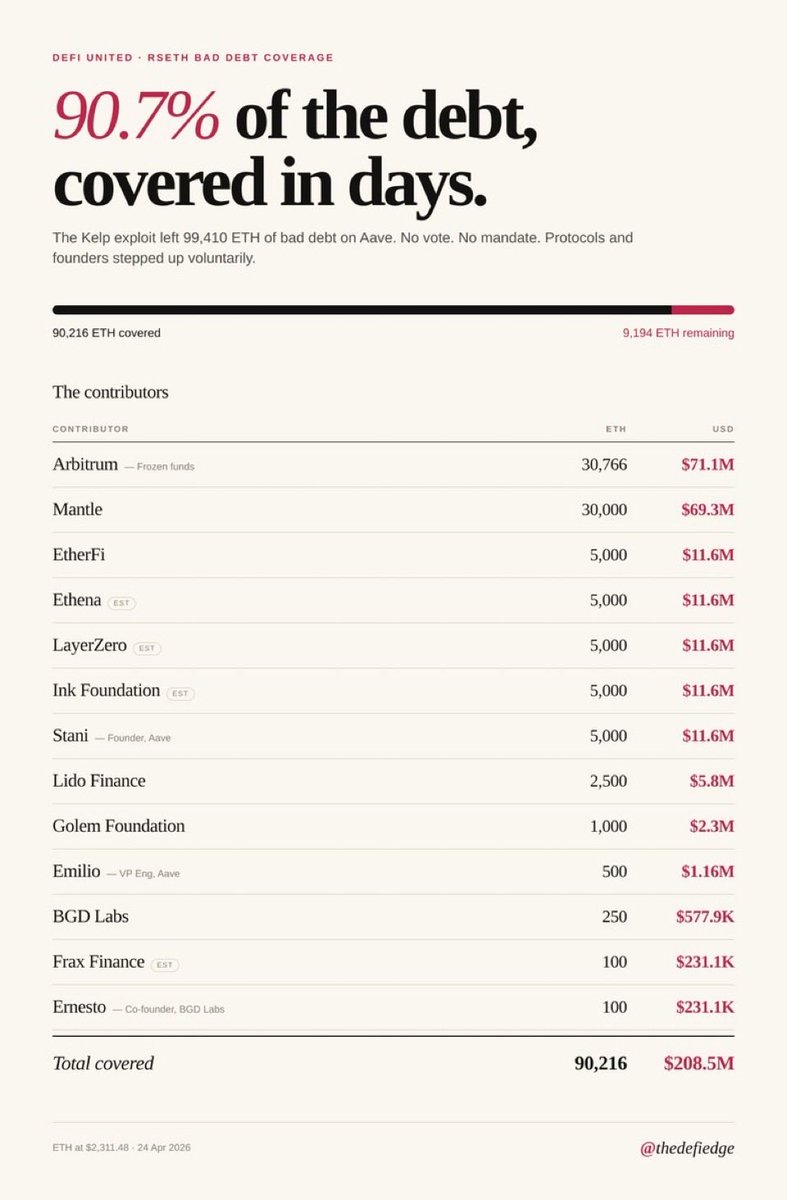
rsETH hole filling tracker:
Hole: 112204 rsETH = 118.4k ETH
Lido: -2.5k ETH
Etherfi: -5k ETH
Arbitrum freeze: -30.7k ETH
Ethena: Didn't say how much, assume -1k ETH
Excess rsETH in aave / coumpound: ~-15k ETH
Stani personal donation: -5k ETH
Layerzero: Didn't say how much, assume -5k ETH
Mantle: -30k (!!!!)
Kraken / Ink: Didn’t say how much, assume -5k eth
Golem: -1k eth
Ernesto: -0.1k eth
BGD labs: -0.25k ETH
Emilio: -0.5k ETH
Aave dao: -25k ETH
THE HOLE IS FILLED.
likely goal is now reducing the amount they need to borrow from Mantle.
Far better outcome if Aave themselves have to take on no laons
English
Blake retweetet

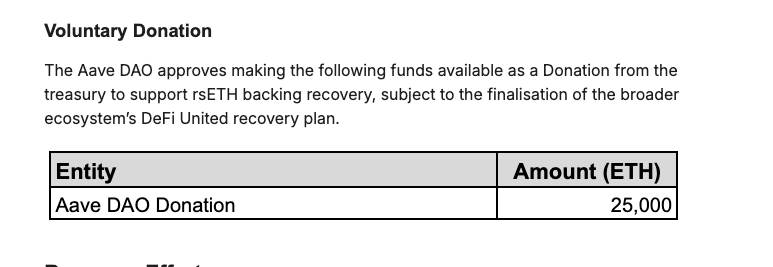
Aave service providers have published an Aave DAO governance proposal to contribute 25,000 ETH to the ongoing DeFi United effort.
Aave DAO's ETH contribution would go towards the plan to restore rsETH's backing to try and normalize market conditions as quickly as possible.
DeFi United.
governance.aave.com/t/arfc-rseth-i…
English
Blake retweetet
Blake retweetet

Grateful for this contribution. Emilio has been side by side working on Aave for almost a decade when DeFi wasn't a thing and we were called ETHLend (if anyone remembers). Now its time to put all efforts to unite under one team and solve this.
Emilio^@The3D_
I am committing 500 ETH to the Defi united recovery fund. This represents a large part of my crypto holdings, but there are things that are more important than money - Like Stani, I have been working on Aave since the beginning and the only thing I care about is to see it succeed. There are no defeats in life, only lessons. We will be coming back stronger. Aave will win.
English

I am committing 500 ETH to the Defi united recovery fund. This represents a large part of my crypto holdings, but there are things that are more important than money - Like Stani, I have been working on Aave since the beginning and the only thing I care about is to see it succeed. There are no defeats in life, only lessons. We will be coming back stronger.
Aave will win.
English
Blake retweetet
Another one. @golemproject and @golemfoundation have made a 1,000 ETH contribution to the ongoing rsETH relief effort.
We appreciate their willingness to participate and help users.
DeFi United.
Golem Foundation@GolemFoundation
Golem Foundation and Golem Factory are contributing a combined 1000 ETH from our treasuries to @aave's coordinated DeFi relief effort following the rsETH incident. We've been working closely with the Aave team this week in a supporting capacity. Our contribution will go toward restoring rsETH backing and enabling an orderly resolution for affected stakeholders. Glad to stand with @aave and the rest of the ecosystem responding here. DeFi United.
English
Blake retweetet
Blake retweetet
rsETH hole filling tracker:
Hole: 112204 rsETH = 118.4k ETH
Lido: -2.5k ETH
Etherfi: -5k ETH
Arbitrum freeze: -30.7k ETH
Ethena: Didn't say how much, assume -1k ETH
Excess rsETH in aave / coumpound: ~-15k ETH
Stani personal donation: -5k ETH
Layerzero: Didn't say how much, assume -5k ETH
54.2k ETH left to find
English

"This is really unpopular, but I don't see a very long-term use case for a lot of enterprises using, say, ETH."
@canaryfunds's CEO argues that we are witnessing a fundamental miscalculation in how the market views institutional adoption.
While retail assumes big banks will flood into the public Ethereum ecosystem, the reality is more predatory.
These corporations love the technology, but they are simply forking the code and owning their own private versions of the chain.
This creates a "Utility Leak" where the public asset is bypassed entirely.
@stevenmcclurg’s focus is shifting to protocols designed to be broad-based foundations where institutions are forced to build directly on top rather than just taking the code.
English
Blake retweetet

“But don't be fooled - if you are a mainnet rsETH holder, you should not be exposed to rsETH-OFT wrapper risks.”
💯💯💯💯
bartek.eth@bkiepuszewski
Lot's of discussion re: should reETH mainnet holders be affected by kelpDAO LZ bridge hack or not. Some argue that every reETH (on L1 and L2s) is "equal", part of the same "social contract" that should be known to all reETH holders. Also, for all intents and purposes, they are fungible, so how can they not be the same ? Others point out that, from the technical PoV, we actually have two different tokens on mainnet - rsETH and rsETH-OFT wrapper. Is this really a technicality, an unimportant implementation detail, and they are part of the same, common "social contract" or they cannot be ? In my opinion implementation which anyone can (and should) verify should follow a social contract. KelpDAO implemented reETH w/out OFT functionality first. Later, they could have upgraded it to include OFT functionality. The ability to upgrade is part of a social contract (as it can be seen in the code and anyone that buys reETH agrees to the upgradability functionality). Ideally there should be a time delay, so if you are reETH holder and you see an upgrade that you don't like, you can rage-quit. Monitoring of upgrades and time delays should be the norm as is the case in any social contract in the real world - your supplier changes Terms - you should be able to quit the contract But KelpDAO did not do the upgrade. Instead they created a seperate reETH-OFT wrapper. This action cannot be detected by reETH holder just by observing reETH contract onchain. I fail to see how reETH holders could automatically enter the new "social contract" of an OFT version of reETH. The confusion clearly comes from the fact that every single UI, ranging from wallets to exchanges and DeFi apps fooled everybody that reETH and reETH-OFT are the same tokens. No, they are not. They carry very different operational risks. Hiding this fact is something I am strongly opposed to. You want the convenience (and risks) of an OFT token? Fine, issue your token as a pure burn-mint OFT or upgrade the existing token to it. But if you create an OFT wrapper, you create a new token with a new social contract. The main problem with this interpretation is that - ironically - it creates much bigger losses for Aave (see governance.aave.com/t/rseth-incide…), so it is perhaps not surprising that the "all rsETH is the same" theory is being promoted. But don't be fooled - if you are a mainnet rsETH holder, you should not be exposed to rsETH-OFT wrapper risks.
English
Blake retweetet
The past few days have been intense, but I wanted to give some updates as we continue to work on this. Our priority is our users, and every decision we are making is aimed at an orderly return to normal market conditions and the best possible outcome for everyone involved.
Working around the clock, the team has made progress on multiple paths forward with several partners. The Arbitrum Security Council also recovered $70 million in ETH, which could meaningfully reduce the potential exposure, and multiple discussions and solutions are being considered. I am confident we will move towards a strong resolution.
Reviewing what happened and learning from it matters. But pointing fingers is not something that gets us to the other side of this.
Every bit of my energy right now is focused on the outcome for Aave users and the protocol. Aave has been my life's work, and this is an important moment for DeFi as much as it is for Aave. I am deeply grateful for the support and collaboration we have received from builders and partners across the industry.
We’ll get through this together and we’ll continue to publish updates on @aave as they happen.
English