CLI ◈

145 posts

CLI ◈ banner
CLI ◈

CLI ◈

@clithecreator

building something. Aped into predictions

Beigetreten Ekim 2011
158 Folgt132 Follower
Angehefteter Tweet
CLI ◈
CLI ◈@clithecreator·
The Pyth Terminal didn't launch in a vacuum. It soft-launched alongside Polymarket as the verification layer for prediction market traders, and the choice of that specific launch partner tells you exactly what kind of product Pyth is building. Polymarket is the largest prediction market in the world by volume. It settled hundreds of millions of dollars in bets across the 2024 election cycle. It integrated Pyth Pro earlier this year as the resolution oracle for traditional asset markets covering Apple, NVIDIA, gold, silver, and major stock indices. Every time a Polymarket trader places a bet on a stock price outcome, the resolution depends on Pyth's first-party institutional data. Now imagine you're that trader. You've just put down $5,000 on whether NVIDIA closes above $487 on Friday. The price is updating in real time on the exchange. Your position is binary. If the price ticks up by a dollar at 3:59pm, you win. If it ticks down, you lose. The amount of money on the line means you need to know, with absolute confidence, what price the resolution oracle will use. Before the Terminal, that trader had to take Pyth's word for it. The price feed was a single number coming through an API. Verifiable in theory through onchain data. Difficult to verify in practice without writing custom tools. With the Terminal, that trader opens app.pyth.com, navigates to the NVIDIA feed, and watches the same data the resolution oracle will use, tick by tick, with full publisher transparency. They can compare it against the exchange's live feed. They can verify which firms are contributing. They can audit the construction logic. They can confirm with their own eyes that the price determining a five-figure outcome is exactly what it should be. This is the part of the launch story that nobody is unpacking properly. Pyth didn't ship a generic market data product and then look for use cases. They shipped a product specifically designed to solve the most painful trust problem in one of the highest-stakes use cases in DeFi. Then they generalized. The Polymarket integration is the proof point. If the Terminal works for resolving binary outcome markets with real money at stake, it works for everything downstream of that. Perpetual exchanges. Lending protocols. Structured products. Insurance contracts. Every category of DeFi that depends on oracle pricing now has a verification layer they can point users to. "Don't trust us. Verify the price yourself at app.pyth.com" is now a valid customer service response from any protocol building on Pyth. That sentence didn't exist last week. It exists now. And it changes how DeFi protocols can talk to their users about oracle dependency forever. 700+ blockchain applications use Pyth. Every single one of them just inherited a verification layer for their users. @PythNetwork
CLI ◈ tweet media
CLI ◈@clithecreator

Cocoa moved 9.83% in a single day last month on weather reports from Ivory Coast. Coffee is rallying on Brazilian drought concerns. Sugar moves on Iran sanctions because Brazilian sugarcane is dual-use as ethanol. Live cattle prices respond to every tariff headline because US beef exports are directly exposed to trade policy retaliation. These are not sleepy agricultural markets. These are some of the most macro-sensitive contracts in the entire global financial system, and they are experiencing the highest volatility in a decade. Now look at the macro environment for the next 24 months. Climate volatility is intensifying. The El Niño cycle is forming again, threatening West African cocoa, Vietnamese coffee, and US grain belts simultaneously. Tariff escalations are restructuring global trade routes for the first time since 1947, with retaliatory measures hitting agricultural exports particularly hard. Supply chain disruption from geopolitical conflict is rerouting shipping through more expensive paths, raising input costs across every commodity that depends on global logistics. Currency volatility in emerging markets is moving the local cost basis for commodity producers, which propagates back into futures pricing within hours. Every one of these forces is structurally bullish for commodity volatility, and therefore structurally bullish for commodity trading volume. Commodity hedge funds raised record AUM in 2025. Macro funds are rotating significant allocation into soft commodities and livestock as a hedge against equity beta. Specialist traders who haven't been relevant in a decade are suddenly running waiting lists for institutional capital. This is the macro context in which Pyth shipped Cocoa, Coffee, Raw Sugar, and Live Cattle feeds last week. The timing is not accidental. It's the deliberate decision to ship the data products that match where institutional and retail trading flow is actually moving. When commodity volatility spikes, commodity data demand spikes with it. When demand for commodity exposure outpaces the supply of accessible products, the gap creates massive openings for builders to launch new instruments. A perpetual futures DEX listing cocoa pairs right now would be unique in DeFi. A prediction market on the next coffee harvest would have built-in narrative appeal during every climate report. A structured product offering yield linked to commodity volatility would attract capital that currently has nowhere to express that view onchain. None of these products could exist without reliable institutional commodity feeds. Last week, those feeds went live. Watch what builds in the next 90 days. Commodity perp DEXes. Climate-linked prediction markets. Tariff-hedge structured products. Supply chain insurance protocols. Yield strategies that bundle commodity exposure with stablecoin returns. The data unlock comes first. The products come second. The volume comes third. The narrative catches up fourth. We're at step one. Pay attention.


English
8
1
24
251
CLI ◈ retweetet
The Beacon
The Beacon@The_Beacon_GG·
Season 1 is just getting warmed up! 🧙‍♂️ Week 2 is here, Zone 2 is open, and over 7M $BCN still on the table. The dungeon isn't going to clear itself! ⚔️ app.thebeacon.gg/season-one
English
321
318
444
8.9K
CLI ◈
CLI ◈@clithecreator·
@NNymphs Is there a meaningful chance Bloomberg responds with their own onchain product or self-serve tier in the next year??
English
0
0
0
17
Nymphs🙈
Nymphs🙈@NNymphs·
Bloomberg generates approximately $13 billion per year selling access to data behind a wall. Pyth just put the same data on a public website with live charts, publisher-level transparency, and a free tier. I've spent the last week thinking about how to frame this for people who don't follow financial infrastructure closely, and I keep coming back to the same observation. We are watching, in real time, the moment a $40 billion industry's pricing model becomes structurally indefensible. Let me spell out exactly what just happened. For 40 years the market data industry operated on three assumptions. First, that aggregating institutional pricing data required massive capital expenditure on exchange licensing, technology infrastructure, and global compliance, which justified high enterprise pricing. Second, that buyers wouldn't or couldn't evaluate the product before purchase, which justified opaque sales processes. Third, that switching costs were high enough that even mediocre data products could retain customers through inertia, which justified annual price increases without proportional product improvement. The Pyth Terminal undermines all three assumptions in a single product launch. It undermines the first assumption because the cost structure of onchain first-party data is fundamentally lower than legacy aggregation. Publishers like Jane Street, Cboe, Jump, Two Sigma, and Virtu push their prices directly. There's no aggregator layer. There's no third-party node operator. The cost per feed scales radically better than legacy infrastructure. It undermines the second assumption because the product is fully visible before purchase. You can verify the data quality, audit the construction logic, and stress test the system before paying anything. The information asymmetry that justified opaque pricing is gone. It undermines the third assumption because the integration is API-based rather than terminal-application based. Switching costs are dramatically lower for any developer team that's willing to point their data calls at a different endpoint. Lock-in via proprietary keyboard, proprietary chat, and proprietary workflows doesn't apply when the customer is a smart contract or a quant model rather than a human trader sitting at a desk. Three structural advantages stacked on top of each other. Each one is enough to chip at the incumbent. All three combined is the kind of compound disruption that reshapes categories. The Pyth Terminal is not going to kill Bloomberg in 2026. Bloomberg has 40 years of accumulated workflow integrations, institutional relationships, regulatory positioning, and brand trust that won't unwind in a year or even five. The terminal application itself is a real product with real value for human traders who spend their days inside it. But Pyth doesn't need to kill Bloomberg. Pyth needs to capture the next decade of new builders, new protocols, new fintechs, and new use cases that never had a Bloomberg seat in the first place and never will. Every onchain prediction market. Every crypto-native perp DEX. Every multi-asset structured product on a blockchain. Every fintech startup that needs institutional pricing without institutional cost. Every quant team that can finally backtest exotic strategies without negotiating individual data licenses. That's where the future revenue of financial data is going. Not at Bloomberg's installed base. At the next generation of products that are getting built right now, on top of self-serve infrastructure, by developers who never had access to the legacy stack in the first place. The Terminal is how Pyth captures that generation. By giving them a front door. By letting them see the product before paying for it. By treating builders the way every other software category has treated builders for the last 20 years. The walls cracked. Walk through. 3,000+ feeds. Crypto, equities, FX, commodities, metals. Live publisher transparency. Free tier. Public pricing. app.pyth.com. The next decade of financial infrastructure is going to look very different from the last one. We just saw the front door open. Most people will read this and scroll past. A small number will open the Terminal, click around, and start building things that didn't exist last week. Which one are you. @PythNetwork
Nymphs🙈 tweet media
Nymphs🙈@NNymphs

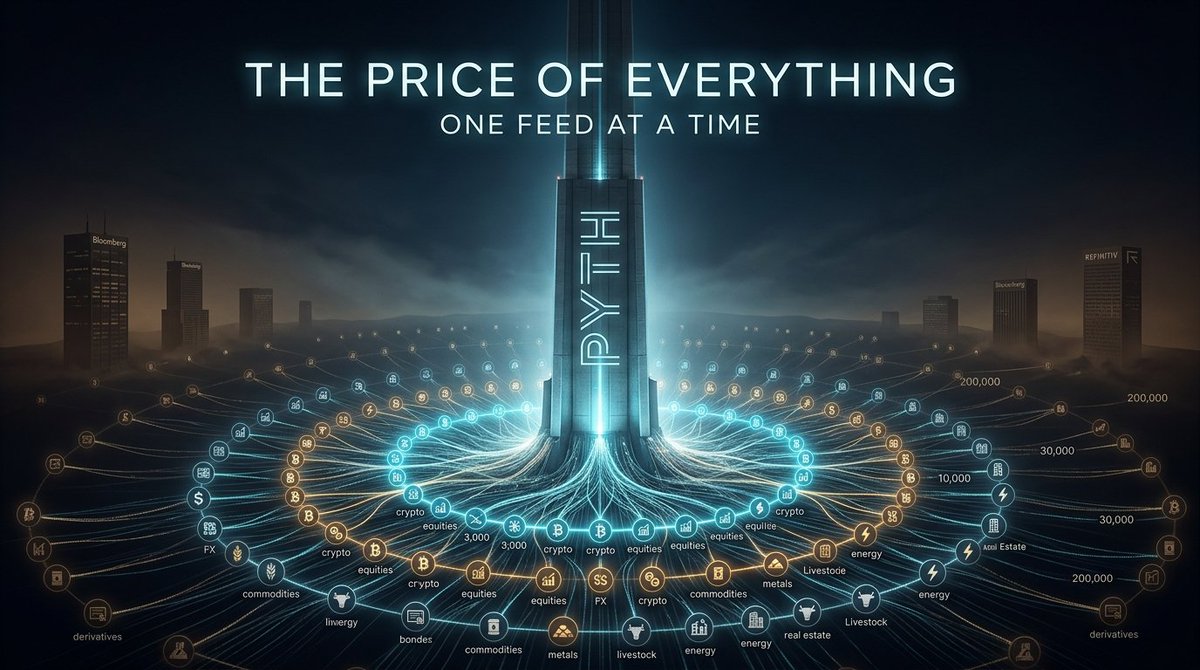
There's a single phrase Pyth keeps using in their messaging and I want to spend a few minutes explaining why it matters more than most people are reading into it. "The price of everything is coming onchain. One feed at a time." On the surface this sounds like marketing copy. It is not. It's a mission statement, and it's one of the most ambitious statements any infrastructure project in crypto has made in years. Let me unpack what "everything" actually means in the context of global financial markets. There are roughly 200,000 actively priced instruments in the global financial system. Every equity on every major exchange. Every government bond on every issuer. Every corporate bond with active secondary trading. Every major FX pair and cross. Every commodity futures contract on every major exchange. Every meaningful ETF. Every major REIT. Every active derivative on any of the above. Every cryptocurrency with non-trivial liquidity. Add to that the long tail: private equity valuations, real estate price indices, art market estimates, intellectual property valuations, carbon credit prices, weather derivatives, freight rates, electricity prices by grid region, water rights, and dozens of other markets that price continuously somewhere but don't show up in retail data products. Total addressable price feed universe: roughly 200,000 to 500,000 instruments depending on how you count. Pyth Pro currently has 3,000. That's roughly 1% of the addressable universe. Now here's the part that should reshape how you think about this project. The growth rate is not linear. Pyth shipped 1,000 feeds by early 2025 and tripled the catalog in about 15 months. New feeds are launching weekly. Each new asset class added (livestock last week, energy a few months ago, equities earlier this year) opens an entire new category that gets densely populated within 6 to 12 months. If the cadence continues, Pyth Pro reaches 10,000 feeds within 18 months, 30,000 within 4 years, and approaches the full addressable universe sometime in the next decade. That timeline sounds long until you realize what that endpoint actually means. It means a single onchain endpoint, accessible to any developer, anywhere, with no enterprise contracts, that returns institutional-grade pricing for every meaningful financial instrument that humans trade. With first-party publishers. With confidence intervals. With cryptographic verifiability. At a fraction of the cost of any legacy data vendor. That is not an oracle. That is the global pricing layer. If Pyth executes this mission to even 30% completion in the next decade, the entire architecture of how the world prices assets shifts. Every fintech, every neobank, every retail brokerage, every DeFi protocol, every quantitative fund, every pricing-dependent application in any vertical becomes a potential downstream consumer of a single onchain endpoint. That's a $40 billion industry being slowly reorganized around a single piece of infrastructure. Not in months. Over years. Quietly. One asset class at a time. Last week the asset class was livestock and softs. Next week it'll be something else. The week after, something else again. Most of crypto is still trying to figure out which token will pump in the next 30 days. @PythNetwork Pyth is building the pricing layer for the next 30 years. Watch what gets shipped. Count what gets added. The thesis is in the cadence. The price of everything is coming onchain. Live cattle was just one feed in a very long list.

English
6
2
23
255
SEMARGL
SEMARGL@se_margl·
@clithecreator transparency is cool until the publishers diverge by a cent on the closing tick and your position is in limbo
English
1
0
2
7
CLI ◈
CLI ◈@clithecreator·
The Pyth Terminal didn't launch in a vacuum. It soft-launched alongside Polymarket as the verification layer for prediction market traders, and the choice of that specific launch partner tells you exactly what kind of product Pyth is building. Polymarket is the largest prediction market in the world by volume. It settled hundreds of millions of dollars in bets across the 2024 election cycle. It integrated Pyth Pro earlier this year as the resolution oracle for traditional asset markets covering Apple, NVIDIA, gold, silver, and major stock indices. Every time a Polymarket trader places a bet on a stock price outcome, the resolution depends on Pyth's first-party institutional data. Now imagine you're that trader. You've just put down $5,000 on whether NVIDIA closes above $487 on Friday. The price is updating in real time on the exchange. Your position is binary. If the price ticks up by a dollar at 3:59pm, you win. If it ticks down, you lose. The amount of money on the line means you need to know, with absolute confidence, what price the resolution oracle will use. Before the Terminal, that trader had to take Pyth's word for it. The price feed was a single number coming through an API. Verifiable in theory through onchain data. Difficult to verify in practice without writing custom tools. With the Terminal, that trader opens app.pyth.com, navigates to the NVIDIA feed, and watches the same data the resolution oracle will use, tick by tick, with full publisher transparency. They can compare it against the exchange's live feed. They can verify which firms are contributing. They can audit the construction logic. They can confirm with their own eyes that the price determining a five-figure outcome is exactly what it should be. This is the part of the launch story that nobody is unpacking properly. Pyth didn't ship a generic market data product and then look for use cases. They shipped a product specifically designed to solve the most painful trust problem in one of the highest-stakes use cases in DeFi. Then they generalized. The Polymarket integration is the proof point. If the Terminal works for resolving binary outcome markets with real money at stake, it works for everything downstream of that. Perpetual exchanges. Lending protocols. Structured products. Insurance contracts. Every category of DeFi that depends on oracle pricing now has a verification layer they can point users to. "Don't trust us. Verify the price yourself at app.pyth.com" is now a valid customer service response from any protocol building on Pyth. That sentence didn't exist last week. It exists now. And it changes how DeFi protocols can talk to their users about oracle dependency forever. 700+ blockchain applications use Pyth. Every single one of them just inherited a verification layer for their users. @PythNetwork
CLI ◈ tweet media
CLI ◈@clithecreator

Cocoa moved 9.83% in a single day last month on weather reports from Ivory Coast. Coffee is rallying on Brazilian drought concerns. Sugar moves on Iran sanctions because Brazilian sugarcane is dual-use as ethanol. Live cattle prices respond to every tariff headline because US beef exports are directly exposed to trade policy retaliation. These are not sleepy agricultural markets. These are some of the most macro-sensitive contracts in the entire global financial system, and they are experiencing the highest volatility in a decade. Now look at the macro environment for the next 24 months. Climate volatility is intensifying. The El Niño cycle is forming again, threatening West African cocoa, Vietnamese coffee, and US grain belts simultaneously. Tariff escalations are restructuring global trade routes for the first time since 1947, with retaliatory measures hitting agricultural exports particularly hard. Supply chain disruption from geopolitical conflict is rerouting shipping through more expensive paths, raising input costs across every commodity that depends on global logistics. Currency volatility in emerging markets is moving the local cost basis for commodity producers, which propagates back into futures pricing within hours. Every one of these forces is structurally bullish for commodity volatility, and therefore structurally bullish for commodity trading volume. Commodity hedge funds raised record AUM in 2025. Macro funds are rotating significant allocation into soft commodities and livestock as a hedge against equity beta. Specialist traders who haven't been relevant in a decade are suddenly running waiting lists for institutional capital. This is the macro context in which Pyth shipped Cocoa, Coffee, Raw Sugar, and Live Cattle feeds last week. The timing is not accidental. It's the deliberate decision to ship the data products that match where institutional and retail trading flow is actually moving. When commodity volatility spikes, commodity data demand spikes with it. When demand for commodity exposure outpaces the supply of accessible products, the gap creates massive openings for builders to launch new instruments. A perpetual futures DEX listing cocoa pairs right now would be unique in DeFi. A prediction market on the next coffee harvest would have built-in narrative appeal during every climate report. A structured product offering yield linked to commodity volatility would attract capital that currently has nowhere to express that view onchain. None of these products could exist without reliable institutional commodity feeds. Last week, those feeds went live. Watch what builds in the next 90 days. Commodity perp DEXes. Climate-linked prediction markets. Tariff-hedge structured products. Supply chain insurance protocols. Yield strategies that bundle commodity exposure with stablecoin returns. The data unlock comes first. The products come second. The volume comes third. The narrative catches up fourth. We're at step one. Pay attention.

English
8
1
24
251
CLI ◈
CLI ◈@clithecreator·
@xbtremi Doesnt a self serve model also mean less handholding for integrations, which institutional teams often need?
English
0
0
0
13
∅ REMI
∅ REMI@xbtremi·
The most interesting thing about the Pyth Terminal isn't the product. It's the name. Pyth called it the front door. Not the dashboard. Not the explorer. Not the platform. The front door. That word choice tells you something about how the team thinks about distribution. A front door isn't where the product lives. It's where the relationship starts. It's the threshold between a stranger and a user, between someone passing by and someone walking in. The metaphor implies that what's inside is supposed to be welcoming, accessible, and clearly visible from the street. Most software in this category is the opposite. It's built like a vault. You don't enter a vault. You apply for permission to enter a vault. Bloomberg, Refinitiv, ICE Connect, CME DataMine. Every legacy market data product is designed with the architecture of a vault. High walls. Locked doors. Security checks. Identity verification. Multi-year commitments before you see the inside. Pyth's strategic choice to build a front door instead of a vault is more important than any specific feature in the Terminal itself. A front door says: we believe the product is good enough that visibility is in our favor. We trust the data quality to speak for itself. We don't need to control the evaluation process. We don't need to gatekeep who gets to try it. We don't need a sales funnel that takes 6 weeks to qualify a prospect. We just need to put the product where people can see it and let the people who care walk in. This is a fundamentally different bet than what every legacy data vendor is making. Legacy vendors bet that opacity protects pricing power. Pyth is betting that transparency creates volume, and volume creates revenue, and the cumulative effect compounds faster than any defensive moat the incumbents can build. The bet is correct as long as the underlying data is actually competitive. Which is the part that nobody quite believes until they open the Terminal and start clicking around. Open a feed. Watch it update tick by tick. Compare it against an external benchmark. Toggle the publishers. Watch the construction live. Sign up if you want to build on top of it. Walk back out if you don't. That entire experience used to require multiple sales meetings, an enterprise contract, and a budget approval at a director level. Now it requires opening a browser tab. The front door is the actual feature. Everything else inside the building is downstream of that single design decision. Most of the time when a piece of infrastructure changes how an industry works, the change happens at the level of access patterns, not technical capabilities. Stripe didn't beat the banks by inventing payments. It beat them by making payments self-serve. AWS didn't beat enterprise IT by inventing cloud computing. It beat them by making infrastructure self-serve. Pyth isn't beating Bloomberg by inventing market data. It's beating Bloomberg by making market data self-serve. The front door is open. The implications take years to play out. But the door is open today.
∅ REMI tweet media
∅ REMI@xbtremi

Commodities are the oldest market in the world. People were trading cocoa beans as currency in Mesoamerica a thousand years before stock exchanges existed. The first organized futures contracts on rice were settled in 17th century Osaka, before Adam Smith was born, before central banks, before paper money was even widely accepted in Europe. Coffee, sugar, livestock, grains, metals. These commodities have been pricing themselves continuously for centuries longer than any equity, any bond, any currency in current use. And until last week, almost none of that price discovery was readable onchain. Think about how strange that is. We built an entire decentralized financial system. We tokenized stocks and bonds and real estate and art. We deployed smart contracts that handle more transaction volume than most national stock exchanges. We achieved verifiable global settlement of digital assets in seconds. And the oldest, most settled, most globally important markets on earth, the markets that literally determine what people eat and what economies can afford to build, were sitting outside the onchain economy entirely. Locked behind ICE Connect licenses and CME DataMine subscriptions. Visible only to institutions with the legal teams and budget to negotiate access to data that has been continuously priced for centuries. Pyth just added cocoa, coffee, raw sugar, and live cattle. Four feeds. Quiet announcement. Easy to miss. But the meaning is structural. The oldest markets on the planet are starting to make themselves readable to the youngest financial system on the planet. A smart contract on Solana can now reference the same cocoa futures price that a buyer in Amsterdam used to settle physical delivery yesterday morning. That same price discovery, that same global consensus on what the world's chocolate supply is worth, is now accessible to anyone with an internet connection and a few lines of code. This is the actual long arc of what onchain finance was supposed to be. Not just trading more crypto. Not just gambling on tokens. Bringing the entire global pricing system onto a public verifiable layer, slowly, asset class by asset class, until eventually every meaningful market that humans care about is queryable by anyone, anywhere, without permission. Cocoa is one feed. Coffee is one feed. Sugar is one feed. Live cattle is one feed. 3,000 down. Roughly 197,000 to go before the entire institutional pricing universe is onchain. That's the project. That's what infrastructure work actually looks like at scale. Quiet. Slow. Compounding. And one day someone is going to write a history of finance that includes the sentence "in 2026, the price of everything started coming onchain". And then they're going to spend a chapter explaining why that mattered. Right now we're just adding cattle.

English
6
0
29
178
CLI ◈
CLI ◈@clithecreator·
@runik_owners Нow does Pyth make money on the free tier users, is this a loss leader funded by the paid customers?
English
0
0
0
15
Nomad☠️
Nomad☠️@runik_owners·
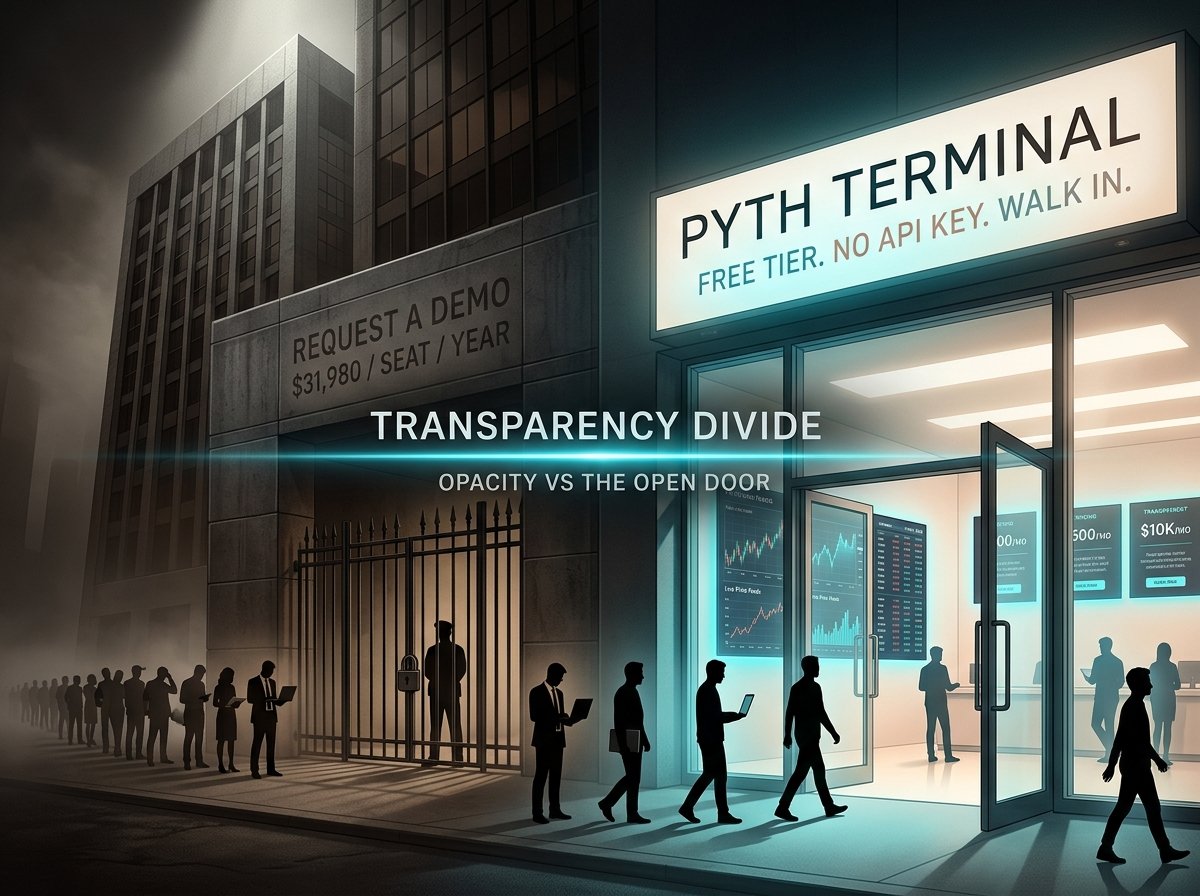
Bloomberg sales process: 1. Visit bloomberg.com 2. There is no pricing page 3. Click "Request Demo" 4. Fill out a form with your firm size, role, and contact info 5. Wait for a sales call 6. Take the sales call 7. Get quoted approximately $32,000 per seat per year 8. Negotiate a 2-year minimum contract 9. Sign 10. Wait for the proprietary keyboard to ship 11. Install 12. Finally see the product Pyth Terminal sales process: 1. Visit app.pyth.com 2. See the product Genuinely think about this for a second because most people scroll past it without sitting with how strange the legacy model is. There is no other major software category in 2026 where you cannot evaluate the product before committing six figures over two years. Not even close. Project management software lets you sign up free. AI APIs have free tiers. Cloud infrastructure gives you credits before you pay anything. Design tools have demos that work without a credit card. Even most enterprise software shows you screenshots and architectural diagrams of what you're buying. Bloomberg is one of the last holdouts. The reason it survived this long is that financial data was structurally hard to deliver without locking everything behind enterprise contracts. Each exchange had its own license. Each asset class had its own pipeline. Each region had its own compliance. The vendor that solved all of that bundled it together and charged for the bundle, because the bundle itself was the product. Pyth's design choice to expose the entire product publicly before charging anything inverts the assumption that financial data must be sold behind a demo call. The product is the same on both sides of the paywall. You see it for free. You pay when you want to build production systems on top of it. That alone is the kind of mechanism that compounds over time. Every developer who opens app.pyth.com to check a price spends one less moment thinking "I need a Bloomberg license to do this". Every quant who toggles a publisher to verify a feed gets one more data point that maybe the legacy model isn't actually necessary. Every startup founder who realizes they can prototype a multi-asset product on a free tier becomes a future paying customer down the line. This is exactly how AWS displaced enterprise IT. Not by being aggressive. Just by being usable. The product was good. The barrier to access was low. The category moved. The front door is open. Walk in. @PythNetwork
Nomad☠️ tweet media
Nomad☠️@runik_owners

Things you can now query from a single API endpoint: BTC. ETH. SOL. NVIDIA stock. Apple stock. EUR/USD. Gold. Silver. Crude oil. Natural gas. Corn. Wheat. Soybeans. Coffee. Cocoa. Raw sugar. Live cattle. Yes, live cattle. The actual price of actual cows traded on the actual CME, accessible by an actual smart contract on Solana through actual one-line REST calls at pythdata.app. This is genuinely funny if you sit with it for a second. The same endpoint that gives you the BTC mark price also gives you what a US feedlot is paying for beef futures in Chicago. The same SDK call. The same JSON response format. The same confidence interval. The same first-party institutional pricing pipeline. It used to take a Bloomberg terminal, a Refinitiv contract, a CME data license, an ICE data license, and a small army of compliance officers to even legally access half of these prices in one place. Now it takes a curl request. And nobody is talking about how absurd this is. For the entire history of finance, asset class fragmentation has been the moat that protected data vendors from competition. Every category had its own vendor, its own licensing regime, its own pricing model, its own data feed format. Crypto data came from CoinGecko or CMC. Equities came from Bloomberg. FX came from Refinitiv. Commodities came from ICE Connect or CME DataMine. Each one a separate seven-figure annual contract for any institution that wanted full coverage. Pyth collapsed that. One subscription. One API. One JSON schema for crypto, equities, FX, commodities, metals. This isn't an incremental product improvement. This is the kind of platform consolidation that, when it happens to any mature industry, completely reshapes who wins and who disappears within a decade. AWS did it to enterprise IT. Stripe did it to payment processing. Both started looking like niche tools and ended as the default infrastructure for everything in their respective categories. Pyth is at the moment where the niche tool starts to look like the default. The 3,000-feed catalog, the institutional publisher list, the onchain verifiability, the per-query economics, all of these compound on top of each other. Degens asked for prediction markets on beef futures. They shall now receive. One API call at a time. The price of everything is coming onchain. The only question is whether you're paying attention to it now or three years from now.

English
6
1
23
247
CLI ◈
CLI ◈@clithecreator·
@degenkenzie Is there any historical data on which publishers have been most accurate over time, like a publisher leaderboard?
English
0
0
0
17
degenkenzie
degenkenzie@degenkenzie·
Almost nobody is talking about the most important feature in the new Pyth Terminal and I want to fix that. When you open a feed at app.pyth.com you can toggle individual publishers on and off and watch the price recompute in real time. You can see exactly which institutional firms are contributing to any specific price update. You can compare what the feed shows with each publisher included versus excluded. You can verify the price construction live, tick by tick, with full visibility into the inputs. I have spent close to a decade working with financial data and I'm telling you this is not how market data has worked at any point in modern history. Here's how the legacy model works. Bloomberg, Refinitiv, ICE Data, and every other major vendor aggregate prices from exchanges, market makers, and other sources, then publish a single number through their feed. They tell you the price. They don't tell you exactly how they got there. The aggregation logic is internal. The contributor list is partially disclosed but the weights and the exclusion rules are mostly opaque. You trust the vendor or you don't use them. This works fine for casual queries. It does not work for production financial systems where the cost of a wrong price can be catastrophic. Lending protocols liquidate users based on these prices. Perpetual exchanges settle billions in PnL on these prices. Prediction markets resolve high-stakes outcomes on these prices. Insurance contracts pay or don't pay based on these prices. And the people writing those smart contracts have historically had to take the oracle's word for it that the number is right. Pyth flipped this. Every feed in the Terminal exposes its full publisher contribution. You can see Jane Street's submitted price. You can see Jump's submitted price. You can see Cboe's submitted price. You can see the confidence interval. You can see the aggregation. You can verify it. For builders this is operationally transformative. You can now audit your oracle dependency before integrating it. You can stress test what happens if a specific publisher drops out by toggling them off and watching the feed recompute. You can identify which publishers are contributing meaningfully to feeds you depend on and build redundancy strategies around that. You can prove to auditors that your protocol's pricing assumptions are verifiable. For institutions this is the part that quietly changes everything. The historical objection to onchain data was "we don't trust the construction methodology". The Terminal addresses that objection by making the construction methodology fully visible at any moment, by any user, with no gating. The transparency feature isn't a minor UX improvement. It's the structural answer to the longest-standing institutional concern about onchain data. And it's available now, in the browser, with no signup required. Open a feed. Toggle a publisher. Watch the price move. Then ask yourself when Bloomberg will let you do the same thing.
degenkenzie tweet media
degenkenzie@degenkenzie

Pyth passed 1,000 onchain price feeds in early 2025. The Pyth Pro catalog has tripled since then and is still accelerating. We're now at 3,000+ feeds across crypto, equities, FX, commodities, and metals. Let me put that growth rate in context because the surface number doesn't tell you what's actually happening underneath. A traditional data vendor like Refinitiv or Bloomberg has roughly 100,000 to 200,000 instruments in their full enterprise feed catalogs. That's the universe of everything a global institutional trader might want to price. Those companies built those catalogs over four to five decades, with thousands of employees managing data partnerships, contracts, normalization, and quality control. Pyth Pro has built 3% of that universe in roughly four years. Not 3% of the easy stuff. 3% of the entire institutional data universe, including ICE softs, CME livestock, US equities, FX majors, metals, energy, and the full crypto stack. And the growth rate is the part nobody is pricing in. Let me show you the actual cadence. Energy feeds were added in recent months. Equities expanded earlier this year. Pyth Pro shipped FX majors and crosses. Then metals expanded. Then softs. Now livestock. New feeds are launching roughly every week. If you extrapolate the current cadence linearly (and the data suggests it's actually accelerating), Pyth Pro hits 10,000 feeds within 18 months and 30,000 feeds within 4 years. At 30,000 feeds you're at 15-20% of the full Bloomberg/Refinitiv universe, accessible through a single API, with onchain verifiability, with first-party publishers, at a fraction of the legacy cost. That's not an incremental product upgrade. That's the moment a single onchain endpoint becomes a credible alternative to seven-figure annual data vendor contracts for any builder, fund, or fintech that wants institutional-grade pricing without the institutional-grade overhead. Now ask yourself which categories of builders this enables. Quantitative hedge funds that want to backtest strategies against any global asset without negotiating individual data licenses. Fintechs that want to launch multi-asset retail products in jurisdictions where local data vendors gatekeep access. Prediction markets that want to settle on any tradeable instrument globally. Perpetual exchanges that want to list exotic asset pairs without infrastructure costs. Insurance protocols that want to write coverage tied to commodity, FX, or equity price thresholds. Every single one of these used to require its own custom data deal. Now they all share the same endpoint. 3,000 feeds is the milestone. The trajectory is the trade. Watch the cadence, not the snapshot. x.com/degenkenzie/st…

English
6
0
24
187
CLI ◈
CLI ◈@clithecreator·
@TOXA_CNPHNK How does Pyth handle the institutional features Bloomberg includes like messaging, chat, and bond depth that aren't really price feed adjacent?
English
0
0
0
30
toxacnphnk.eth
toxacnphnk.eth@TOXA_CNPHNK·
Bloomberg charges $31,980 per seat per year in 2026. Single user. Multi-seat deployments get a discount down to $28,320. The contract minimum is 2 years. There is no public pricing page. There is no trial for individual users. There is no month-to-month option. You request a demo, you talk to sales, you sign a multi-year contract, and only then do you actually see the product you've been paying for. I want to spend a minute on that last part because nobody is unpacking what it means. Bloomberg is a $13 billion annual business built on the assumption that you cannot evaluate the product before purchasing it. The entire moat depends on opacity. You can't see how the data is constructed. You can't see which exchanges contribute to which feeds. You can't compare specific instruments against alternative sources. You can't test latency on your specific use case. You commit first, then learn. That model worked for 40 years because nobody had a credible alternative. Now Pyth just published one. The Pyth Terminal launched this week at app.pyth.com. 3,000+ live price feeds across crypto, equities, FX, and commodities. Free tier with no API key. Charts updating tick by tick. Publisher level transparency where you can toggle individual data sources on and off and see exactly how each feed is constructed. Paid tiers starting at $500 per month for crypto and going up to $10,000 per month for the full library across every asset class. Public pricing. Public tiers. 14 day free trials on every paid plan. Now read that pricing sentence again. $500 per month at the bottom. $10,000 per month at the top. Bloomberg's perseat cost is roughly $2,665 per month with a 2 year minimum. The Pyth equivalent for serious institutional coverage is roughly the same monthly number for the entire firm, not per seat, accessible by API rather than a single locked-down terminal application. The economics here are not a 10x improvement over Bloomberg. The economics are a complete reorganization of how market data is priced and distributed. But the part that actually matters is the transparency. Pyth's pitch is "see the data before you pay for it". That single design choice (let users evaluate freely first, only charge when they're ready to build on top) is the kind of structural shift that doesn't get reversed once it ships. Bloomberg cannot copy it because their entire revenue model depends on the democall first funnel. This is what infrastructure disruption looks like when it actually starts working. Not aggressive marketing. Not lower prices. Just removing the abstraction layer that protected the incumbent's pricing power and letting the data speak for itself. Walk through the front door. Pyth opened it. @PytheniansNFT @PythNetwork @sleepagotchi
toxacnphnk.eth tweet media
toxacnphnk.eth@TOXA_CNPHNK

Cocoa hit an all-time high of $12,931 per ton in December 2024, then crashed 61.9% to $4,924 by November 2025. As of last week it sits around $3,800. That's a single soft commodity going through a complete bubble and crash cycle in 11 months, with weekly moves of 8-10% in either direction triggered by Ivory Coast weather reports. And until this week, you couldn't trade that volatility on-chain with a reliable price feed. Pyth just added Cocoa, Coffee, Raw Sugar, and Live Cattle futures to Pyth Pro. ICE softs and CME livestock. That sounds boring on first read. It is genuinely not boring once you look at what's been happening in these markets. Coffee is rallying on dry weather in Brazil and Vietnam. Sugar correlates with crude oil because Brazilian sugarcane is dual-use as ethanol feedstock, so every Iran headline moves sugar futures. Live cattle is one of the most tariff-sensitive contracts in the entire CME complex, with every trade war headline rippling through US beef pricing within minutes. These aren't sleepy agricultural markets anymore. They're some of the most actively traded contracts in the entire macro environment right now. Hedge funds run dedicated soft commodity desks. Macro funds use livestock as a tariff proxy. Climate funds short cocoa as an El Niño hedge. And every single one of those trading desks operates from Bloomberg terminals with data licenses that cost five to six figures a year per seat. Now think about what onchain access to these prices unlocks for builders. Prediction markets on the next cocoa harvest. Perpetual futures on coffee for crypto-native traders who don't have ICE accounts. Structured products that bundle commodity exposure with crypto. Insurance contracts that pay out based on agricultural price thresholds. Yield products that hedge stablecoin yields against soft commodity inflation. None of these existed before institutional commodity feeds came onchain. Now the data is there. The market discovers the products. Pyth Pro now sits at 3,000+ price feeds across crypto, equities, FX, commodities, and metals. One subscription. One API at pythdata.app. From BTC to beef cattle. The legacy data vendor model is a toll booth where every category of asset requires a separate license, a separate contract, a separate dataset, a separate seven-figure relationship with Refinitiv or Bloomberg. Pyth is collapsing that entire architecture into a single endpoint. The price of everything is coming onchain. One feed at a time. You don't notice infrastructure shifts like this in real time. You notice them three years later when an entire category of products exists that didn't exist before. When Pyth adds @sleepagotchi data. I need a sleep quality chart from sleepagotchi.

English
21
3
40
463
CLI ◈
CLI ◈@clithecreator·
@NNymphs what does Pyth need to do to actually capture meaningful share of the $40B data industry partnerships, regulatory wins, what?
English
0
0
0
14
Nymphs🙈
Nymphs🙈@NNymphs·
There's a single phrase Pyth keeps using in their messaging and I want to spend a few minutes explaining why it matters more than most people are reading into it. "The price of everything is coming onchain. One feed at a time." On the surface this sounds like marketing copy. It is not. It's a mission statement, and it's one of the most ambitious statements any infrastructure project in crypto has made in years. Let me unpack what "everything" actually means in the context of global financial markets. There are roughly 200,000 actively priced instruments in the global financial system. Every equity on every major exchange. Every government bond on every issuer. Every corporate bond with active secondary trading. Every major FX pair and cross. Every commodity futures contract on every major exchange. Every meaningful ETF. Every major REIT. Every active derivative on any of the above. Every cryptocurrency with non-trivial liquidity. Add to that the long tail: private equity valuations, real estate price indices, art market estimates, intellectual property valuations, carbon credit prices, weather derivatives, freight rates, electricity prices by grid region, water rights, and dozens of other markets that price continuously somewhere but don't show up in retail data products. Total addressable price feed universe: roughly 200,000 to 500,000 instruments depending on how you count. Pyth Pro currently has 3,000. That's roughly 1% of the addressable universe. Now here's the part that should reshape how you think about this project. The growth rate is not linear. Pyth shipped 1,000 feeds by early 2025 and tripled the catalog in about 15 months. New feeds are launching weekly. Each new asset class added (livestock last week, energy a few months ago, equities earlier this year) opens an entire new category that gets densely populated within 6 to 12 months. If the cadence continues, Pyth Pro reaches 10,000 feeds within 18 months, 30,000 within 4 years, and approaches the full addressable universe sometime in the next decade. That timeline sounds long until you realize what that endpoint actually means. It means a single onchain endpoint, accessible to any developer, anywhere, with no enterprise contracts, that returns institutional-grade pricing for every meaningful financial instrument that humans trade. With first-party publishers. With confidence intervals. With cryptographic verifiability. At a fraction of the cost of any legacy data vendor. That is not an oracle. That is the global pricing layer. If Pyth executes this mission to even 30% completion in the next decade, the entire architecture of how the world prices assets shifts. Every fintech, every neobank, every retail brokerage, every DeFi protocol, every quantitative fund, every pricing-dependent application in any vertical becomes a potential downstream consumer of a single onchain endpoint. That's a $40 billion industry being slowly reorganized around a single piece of infrastructure. Not in months. Over years. Quietly. One asset class at a time. Last week the asset class was livestock and softs. Next week it'll be something else. The week after, something else again. Most of crypto is still trying to figure out which token will pump in the next 30 days. @PythNetwork Pyth is building the pricing layer for the next 30 years. Watch what gets shipped. Count what gets added. The thesis is in the cadence. The price of everything is coming onchain. Live cattle was just one feed in a very long list.
Nymphs🙈 tweet media
Nymphs🙈@NNymphs

the largest token unlock in Pyth's history just happened on May 19. 2.13 billion PYTH. roughly $94 million in fresh supply. 36.96% of the entire circulating supply hitting the market in a single cliff release. if the protocol had nothing under it, this is the kind of unlock that ends projects. i've watched dozens of L1s, L2s, and DeFi protocols get unwound by exactly this scenario. team unlock hits, market wasn't pricing it in cleanly, sell pressure overwhelms organic demand, chart goes vertical down, narrative dies with the price, community moves on. you can map the exact moment when most failed projects in 2024 and 2025 got terminal damage and it's usually a major unlock during a weak market. and yet, in the same month Pyth absorbed this unlock, the following happened: on May 22, three days after the unlock, the protocol had a five-hour outage that paused half of DeFi on multiple chains. the post-incident reaction wasn't migration away from Pyth. it was a wave of teams publicly committing to keep using it because nothing else gives them institutional-grade first-party data at sub-second latency. last month, Polymarket integrated Pyth Pro as the resolution source for traditional asset prediction markets. Apple, NVIDIA, gold, silver, stock indices — all now resolve through Pyth feeds. that's a multi-year structural revenue contract from one of the largest prediction markets in the world. in April, Pyth launched its Data Marketplace with major financial institutions. the same trading firms that publish prices are now structurally positioned to monetize that data through the marketplace, with revenue flowing back to the protocol. OIS emissions ended on April 22. weekly emissions of roughly 1.93M PYTH that had been hitting the market for the entire history of the token went to zero, removing structural sell pressure on top of the buyback flow from the DAO Reserve. 500 price feeds. 100+ blockchains. 120+ data publishers including Jane Street, Cboe, Jump Trading, Two Sigma, and Virtu Financial. Cardano shipped with Pyth pre-integrated in December. and the chart is still trading near range lows. think about that for a second. this is a protocol that has absorbed the largest unlock in its history, survived its biggest outage, ended its emissions program, signed its largest integration deal, launched a new revenue product, and the price barely moves either direction. that's not weakness. that's a market that has stopped caring about news and is waiting for something else. the unlock was the loudest bearish event of the year. it's still not enough to bend the structural thesis. that tells you something important about what's actually compressing under the chart. most tokens get unwound by their unlocks. some absorb them. a smaller number absorb them and then quietly start a new leg up six to nine months later because the structural buyer (in this case the protocol itself, via revenue-funded buybacks) keeps showing up every single month with cash flow from real customers. watch which bucket Pyth ends up in. the only signal that matters now is whether revenue keeps growing month over month. if it does, the unlock becomes a footnote. if it doesn't, the bears were right. i've made my pick. integration count goes up. publisher count goes up. revenue lines keep expanding. that's the trade. the rest is noise.

English
12
0
36
487
CLI ◈
CLI ◈@clithecreator·
Cocoa moved 9.83% in a single day last month on weather reports from Ivory Coast. Coffee is rallying on Brazilian drought concerns. Sugar moves on Iran sanctions because Brazilian sugarcane is dual-use as ethanol. Live cattle prices respond to every tariff headline because US beef exports are directly exposed to trade policy retaliation. These are not sleepy agricultural markets. These are some of the most macro-sensitive contracts in the entire global financial system, and they are experiencing the highest volatility in a decade. Now look at the macro environment for the next 24 months. Climate volatility is intensifying. The El Niño cycle is forming again, threatening West African cocoa, Vietnamese coffee, and US grain belts simultaneously. Tariff escalations are restructuring global trade routes for the first time since 1947, with retaliatory measures hitting agricultural exports particularly hard. Supply chain disruption from geopolitical conflict is rerouting shipping through more expensive paths, raising input costs across every commodity that depends on global logistics. Currency volatility in emerging markets is moving the local cost basis for commodity producers, which propagates back into futures pricing within hours. Every one of these forces is structurally bullish for commodity volatility, and therefore structurally bullish for commodity trading volume. Commodity hedge funds raised record AUM in 2025. Macro funds are rotating significant allocation into soft commodities and livestock as a hedge against equity beta. Specialist traders who haven't been relevant in a decade are suddenly running waiting lists for institutional capital. This is the macro context in which Pyth shipped Cocoa, Coffee, Raw Sugar, and Live Cattle feeds last week. The timing is not accidental. It's the deliberate decision to ship the data products that match where institutional and retail trading flow is actually moving. When commodity volatility spikes, commodity data demand spikes with it. When demand for commodity exposure outpaces the supply of accessible products, the gap creates massive openings for builders to launch new instruments. A perpetual futures DEX listing cocoa pairs right now would be unique in DeFi. A prediction market on the next coffee harvest would have built-in narrative appeal during every climate report. A structured product offering yield linked to commodity volatility would attract capital that currently has nowhere to express that view onchain. None of these products could exist without reliable institutional commodity feeds. Last week, those feeds went live. Watch what builds in the next 90 days. Commodity perp DEXes. Climate-linked prediction markets. Tariff-hedge structured products. Supply chain insurance protocols. Yield strategies that bundle commodity exposure with stablecoin returns. The data unlock comes first. The products come second. The volume comes third. The narrative catches up fourth. We're at step one. Pay attention.

CLI ◈ tweet media
CLI ◈@clithecreator

nobody is talking about what just happened between Polymarket and Pyth and that's exactly the part that makes it interesting. last month Polymarket integrated Pyth Pro as the resolution source for traditional asset markets. that means prediction markets on Apple stock, NVIDIA, gold, silver, major stock indices — all now resolve against Pyth's first-party institutional data feeds. read that one more time and let it land. a prediction market with billions of dollars in cumulative volume picked an oracle to settle bets on stocks that were originally priced by the same trading firms that publish to that oracle. the loop closed. the data that decides who wins a NVIDIA prediction market on Polymarket comes from the same firms (Jane Street, Two Sigma, Virtu) that make markets in NVIDIA's actual price on US equity exchanges. this is exactly the kind of integration most oracle projects spend years trying to land and most never do. let me walk through why this is structurally bigger than the headline suggests. first, it's a tradfi/crypto crossover. Polymarket users now bet on real stocks using real institutional pricing. that pulls a much larger user base into prediction markets and validates Pyth's "tradfi-grade data on-chain" thesis with a real high-volume use case. second, it's exclusive in practice. once Polymarket integrates Pyth Pro as the primary resolution oracle, the switching cost is enormous. they're not going to migrate to a different oracle next quarter. this is a multi-year structural relationship. third, it opens the door for every other prediction market on every chain to do the same thing. Polymarket validated the architecture. now the next dozen prediction market protocols that want to offer stock and commodity markets have a template to copy, and that template ends with Pyth. fourth, it brings revenue. every Pyth Pro integration is paid infrastructure. Polymarket isn't using Pyth out of friendship. they're paying for it because it's the only oracle that gives them institutional-grade price data for tradfi assets with the latency profile prediction markets need. Pyth isn't trying to be the biggest oracle for native crypto pairs. that's a saturated market and Chainlink has the brand. Pyth is trying to be the layer where DeFi and tradfi data finally agree on the same number, in real time, with confidence intervals, on every chain that wants to plug in. that's not a competitor to Chainlink. that's a different market entirely. one that's an order of magnitude larger because it touches the entire tradfi data industry, not just on-chain DeFi. and Polymarket just signed the first major contract in it. quietly. while everyone else was watching memecoins.

English
1
0
21
327
CLI ◈
CLI ◈@clithecreator·
@abby_on_eth Genuine question/ are there enough independent builders to actually move the needle on $40B in legacy data revenue?
English
0
0
0
25
ABBY (Abbs)
ABBY (Abbs)@abby_on_eth·
Bloomberg makes roughly $13 billion in annual revenue. Refinitiv makes roughly $7 billion. ICE Data Services makes another $2 billion. CME DataMine, S&P Global Market Intelligence, Morningstar, FactSet, and a long tail of specialized vendors push the global financial market data industry to over $40 billion in annual revenue. That entire $40 billion is the price institutions pay every year for the privilege of accessing pricing data on assets they want to trade. Read that one more time. Forty billion dollars annually. Just for reading the price of things. Not for executing trades. Not for clearing. Not for custody. Just for the right to see what an instrument is currently worth. This is one of the largest legalized toll booths in modern finance. It exists because each asset class historically required its own infrastructure to collect, normalize, and distribute pricing data, and the firms that built that infrastructure decades ago locked it up behind enterprise licensing that small builders could never afford. If you're a hedge fund running a $500 million book, your Bloomberg license costs are a rounding error. If you're a five-person startup trying to build a prediction market or a perp DEX, the same license costs would consume your entire annual runway. The data toll booth has always priced out exactly the builders who would create the most innovative products. Pyth Pro is collapsing that toll booth one feed at a time. Cocoa, coffee, sugar, and live cattle joined the catalog last week. ICE softs and CME livestock now sit next to crude oil, natural gas, gold, silver, corn, wheat, soybeans, all the major FX pairs, hundreds of US equities, and the full crypto stack. 3,000 feeds, one subscription, one API endpoint at pythdata.app. The pricing model is the part most people miss. Pyth Pro doesn't charge per asset class. It doesn't charge per category. It doesn't lock specific instruments behind premium tiers. You subscribe once and you access the entire catalog through a single endpoint. For institutional builders this is meaningful cost savings. For independent builders, indie quants, fintech startups, and DeFi protocols, this is the difference between "we can't afford to build that product" and "we can launch tomorrow". The Bloomberg moat was always cost. Not technology, not data quality, not coverage. Just cost. Pyth's strategic insight was that the cost moat is the most vulnerable kind because the underlying data has zero marginal cost to redistribute once you have publisher relationships. Once enough builders flip their data subscription from a $50,000-a-year Bloomberg seat to a single Pyth Pro endpoint, the legacy vendors lose pricing power. Not because their data is worse but because their pricing model assumes an information asymmetry that no longer exists. This shift takes years. It's already started. The cocoa feed going live last week is one more brick removed from the toll booth wall. Watch which side of this transition you're standing on. @PythNetwork
ABBY (Abbs) tweet media
ABBY (Abbs)@abby_on_eth

i've been watching Pyth integrations for about a year now and there's a pattern i want to point out because i don't think enough people have seen it framed this way. the projects that integrate Pyth never go back. when a team picks an oracle, that decision is usually a multi-year commitment because rebuilding the integration is expensive in engineering hours, expensive in audit costs, and risky in terms of breaking production. switching oracles isn't like switching a frontend library. it's like switching the foundation of a building. so integration data is sticky in a way that almost no other crypto metric is. count what's actually happening. count the perp DEXes on Solana that use Pyth as their primary feed. now go look at their TVL and ask yourself which of them are going to suddenly rip out Pyth and rebuild around a different oracle. answer: none of them. count the lending protocols on Base. count the prediction markets on Polygon. count the perpetuals platforms on Arbitrum. count the new chains launching that ship with Pyth integration on day one. Cardano did exactly this in December 2025. the chain went live with Pyth pre-integrated as the recommended oracle. now compare that to almost any other crypto metric. token holders rotate. TVL flows in and out within weeks. DAU spikes and crashes with narrative cycles. liquidity migrates chasing yield. memecoin attention lasts 72 hours. none of this is sticky. oracle integrations are. once a protocol depends on Pyth for liquidations or settlement, that dependency is structural. it doesn't get reversed by a bad week of price action. it doesn't get reversed by a bad month. it gets reversed only by something catastrophic happening to Pyth, and even then most teams will dual-integrate rather than fully migrate. this is balance sheet infrastructure. and balance sheet infrastructure compounds linearly while the rest of crypto rotates. most of the noise in this space is rotational. you can win for a quarter by riding a narrative and lose it back the next quarter when the meta moves. you cannot do that with infrastructure adoption. you build it once, slowly, painfully, with each integration earned individually. and once you have it, you keep it. count the integrations. count the chains. count the publishers. and ask yourself which of those numbers can plausibly decrease in the next twelve months. then ask the same question about your other crypto bets. most people watch the price. infrastructure investors watch the integration count.

English
12
0
28
411
CLI ◈
CLI ◈@clithecreator·
@xbtremi How does this compare to existing tokenized commodity products like $PAXG for gold, is Pyth complementary or competitive?
English
0
0
0
24
∅ REMI
∅ REMI@xbtremi·
Commodities are the oldest market in the world. People were trading cocoa beans as currency in Mesoamerica a thousand years before stock exchanges existed. The first organized futures contracts on rice were settled in 17th century Osaka, before Adam Smith was born, before central banks, before paper money was even widely accepted in Europe. Coffee, sugar, livestock, grains, metals. These commodities have been pricing themselves continuously for centuries longer than any equity, any bond, any currency in current use. And until last week, almost none of that price discovery was readable onchain. Think about how strange that is. We built an entire decentralized financial system. We tokenized stocks and bonds and real estate and art. We deployed smart contracts that handle more transaction volume than most national stock exchanges. We achieved verifiable global settlement of digital assets in seconds. And the oldest, most settled, most globally important markets on earth, the markets that literally determine what people eat and what economies can afford to build, were sitting outside the onchain economy entirely. Locked behind ICE Connect licenses and CME DataMine subscriptions. Visible only to institutions with the legal teams and budget to negotiate access to data that has been continuously priced for centuries. Pyth just added cocoa, coffee, raw sugar, and live cattle. Four feeds. Quiet announcement. Easy to miss. But the meaning is structural. The oldest markets on the planet are starting to make themselves readable to the youngest financial system on the planet. A smart contract on Solana can now reference the same cocoa futures price that a buyer in Amsterdam used to settle physical delivery yesterday morning. That same price discovery, that same global consensus on what the world's chocolate supply is worth, is now accessible to anyone with an internet connection and a few lines of code. This is the actual long arc of what onchain finance was supposed to be. Not just trading more crypto. Not just gambling on tokens. Bringing the entire global pricing system onto a public verifiable layer, slowly, asset class by asset class, until eventually every meaningful market that humans care about is queryable by anyone, anywhere, without permission. Cocoa is one feed. Coffee is one feed. Sugar is one feed. Live cattle is one feed. 3,000 down. Roughly 197,000 to go before the entire institutional pricing universe is onchain. That's the project. That's what infrastructure work actually looks like at scale. Quiet. Slow. Compounding. And one day someone is going to write a history of finance that includes the sentence "in 2026, the price of everything started coming onchain". And then they're going to spend a chapter explaining why that mattered. Right now we're just adding cattle.
∅ REMI tweet media
∅ REMI@xbtremi

Think about what an oracle actually is for a second. It's the place where the chain meets reality. where smart contracts that exist as pure logic finally have to admit that the price of BTC isn't whatever they want it to be. it's whatever the actual market said it was at this exact second. Every other layer of the stack can lie a little. A chain can advertise TPS it never actually delivers under load. a protocol can inflate TVL by counting wrapped versions of itself. a token can have a roadmap full of features that never ship. a frontend can show you a chart of price action that doesn't reflect actual execution depth. an exchange can publish volume that's mostly wash trades. Oracles can't. an oracle that lies about price gets caught instantly because money moves through it. somebody opens a position. somebody else takes the other side. one of them is wrong, by an amount equal to whatever the oracle lied about. that error compounds into liquidations, into bad debt, into protocol insolvency. an oracle that lies has a half-life measured in days because real capital flows through it and surfaces every distortion. This is why oracles are the only honest layer in DeFi. Pyth pulls that honesty straight from the people making the markets. no middleman. no delay. 120+ firms whose entire business is knowing the price, all pushing it to the same place at the same time, with confidence intervals attached. The rest of crypto can have its narratives. its memes. its rotations. its season after season of attention chasing the next L1 or DePIN or AI agent thesis. Oracles only get to have one thing. the number, as it was, at the exact moment it was. And you can sell narratives for a cycle. you can sell hype for a quarter. but the number, every second, on every chain, forever — that's the part of the stack that compounds. that's the part that doesn't go out of style when the meta rotates. Most of crypto wants to be exciting. Infrastructure wants to be invisible. it wants you to not think about it. it wants you to forget it exists. and the day you do forget it exists is the day it's actually winning. The boring layer is where the real money is being made. it always has been.

English
14
0
29
327
CLI ◈
CLI ◈@clithecreator·
@runik_owners Does Pyth pay licensing fees to CME and ICE for redistributing their reference prices?
English
0
0
0
19
Nomad☠️
Nomad☠️@runik_owners·
Things you can now query from a single API endpoint: BTC. ETH. SOL. NVIDIA stock. Apple stock. EUR/USD. Gold. Silver. Crude oil. Natural gas. Corn. Wheat. Soybeans. Coffee. Cocoa. Raw sugar. Live cattle. Yes, live cattle. The actual price of actual cows traded on the actual CME, accessible by an actual smart contract on Solana through actual one-line REST calls at pythdata.app. This is genuinely funny if you sit with it for a second. The same endpoint that gives you the BTC mark price also gives you what a US feedlot is paying for beef futures in Chicago. The same SDK call. The same JSON response format. The same confidence interval. The same first-party institutional pricing pipeline. It used to take a Bloomberg terminal, a Refinitiv contract, a CME data license, an ICE data license, and a small army of compliance officers to even legally access half of these prices in one place. Now it takes a curl request. And nobody is talking about how absurd this is. For the entire history of finance, asset class fragmentation has been the moat that protected data vendors from competition. Every category had its own vendor, its own licensing regime, its own pricing model, its own data feed format. Crypto data came from CoinGecko or CMC. Equities came from Bloomberg. FX came from Refinitiv. Commodities came from ICE Connect or CME DataMine. Each one a separate seven-figure annual contract for any institution that wanted full coverage. Pyth collapsed that. One subscription. One API. One JSON schema for crypto, equities, FX, commodities, metals. This isn't an incremental product improvement. This is the kind of platform consolidation that, when it happens to any mature industry, completely reshapes who wins and who disappears within a decade. AWS did it to enterprise IT. Stripe did it to payment processing. Both started looking like niche tools and ended as the default infrastructure for everything in their respective categories. Pyth is at the moment where the niche tool starts to look like the default. The 3,000-feed catalog, the institutional publisher list, the onchain verifiability, the per-query economics, all of these compound on top of each other. Degens asked for prediction markets on beef futures. They shall now receive. One API call at a time. The price of everything is coming onchain. The only question is whether you're paying attention to it now or three years from now.
Nomad☠️ tweet media
Nomad☠️@runik_owners

Your favorite oracle: Retail trader queries chain → smart contract pulls from oracle → oracle reads from 3rd party node operator → node operator sources from public API → public API aggregates from data vendor → data vendor sources from exchange feed → exchange feed sources from market maker → market maker has the actual price Pyth: Market maker → Pyth → chain It's literally the difference between asking your friend who asked his friend who asked his cousin if their dealer has anything left, versus calling the dealer directly. One of these is going to give you fresher data. one of these is going to give you the actual number. one of these is going to be operational at 2am when you actually need it. You already know which one. And yet half of DeFi is still routing through 4 layers of abstraction to get prices that originated from the same firms that publish directly to Pyth anyway. It's like ordering uber eats from a restaurant that's literally across the street. the food gets there. it's just cold and you paid 40% more than walking. Most of crypto infrastructure is exactly this. legacy decisions made when there was no better option, kept in place because nobody wants to do the migration work, justified after the fact with "well it still works". It still works until it doesn't. and when it doesn't, you find out you've been paying the abstraction tax for years for no reason. Call the dealer.

English
14
0
28
553
CLI ◈
CLI ◈@clithecreator·
@degenkenzie What's the unit economics of adding a new feed, like how much does it cost Pyth to onboard cocoa vs the revenue it generates?
English
0
0
0
21
degenkenzie
degenkenzie@degenkenzie·
Pyth passed 1,000 onchain price feeds in early 2025. The Pyth Pro catalog has tripled since then and is still accelerating. We're now at 3,000+ feeds across crypto, equities, FX, commodities, and metals. Let me put that growth rate in context because the surface number doesn't tell you what's actually happening underneath. A traditional data vendor like Refinitiv or Bloomberg has roughly 100,000 to 200,000 instruments in their full enterprise feed catalogs. That's the universe of everything a global institutional trader might want to price. Those companies built those catalogs over four to five decades, with thousands of employees managing data partnerships, contracts, normalization, and quality control. Pyth Pro has built 3% of that universe in roughly four years. Not 3% of the easy stuff. 3% of the entire institutional data universe, including ICE softs, CME livestock, US equities, FX majors, metals, energy, and the full crypto stack. And the growth rate is the part nobody is pricing in. Let me show you the actual cadence. Energy feeds were added in recent months. Equities expanded earlier this year. Pyth Pro shipped FX majors and crosses. Then metals expanded. Then softs. Now livestock. New feeds are launching roughly every week. If you extrapolate the current cadence linearly (and the data suggests it's actually accelerating), Pyth Pro hits 10,000 feeds within 18 months and 30,000 feeds within 4 years. At 30,000 feeds you're at 15-20% of the full Bloomberg/Refinitiv universe, accessible through a single API, with onchain verifiability, with first-party publishers, at a fraction of the legacy cost. That's not an incremental product upgrade. That's the moment a single onchain endpoint becomes a credible alternative to seven-figure annual data vendor contracts for any builder, fund, or fintech that wants institutional-grade pricing without the institutional-grade overhead. Now ask yourself which categories of builders this enables. Quantitative hedge funds that want to backtest strategies against any global asset without negotiating individual data licenses. Fintechs that want to launch multi-asset retail products in jurisdictions where local data vendors gatekeep access. Prediction markets that want to settle on any tradeable instrument globally. Perpetual exchanges that want to list exotic asset pairs without infrastructure costs. Insurance protocols that want to write coverage tied to commodity, FX, or equity price thresholds. Every single one of these used to require its own custom data deal. Now they all share the same endpoint. 3,000 feeds is the milestone. The trajectory is the trade. Watch the cadence, not the snapshot. x.com/degenkenzie/st…
degenkenzie tweet media
English
15
0
31
339
CLI ◈
CLI ◈@clithecreator·
@TOXA_CNPHNK What's the latency on these commodity feeds compared to crypto pairs, are we talking sub-second or minute-level updates?
English
0
0
1
22
CLI ◈
CLI ◈@clithecreator·
nobody is talking about what just happened between Polymarket and Pyth and that's exactly the part that makes it interesting. last month Polymarket integrated Pyth Pro as the resolution source for traditional asset markets. that means prediction markets on Apple stock, NVIDIA, gold, silver, major stock indices — all now resolve against Pyth's first-party institutional data feeds. read that one more time and let it land. a prediction market with billions of dollars in cumulative volume picked an oracle to settle bets on stocks that were originally priced by the same trading firms that publish to that oracle. the loop closed. the data that decides who wins a NVIDIA prediction market on Polymarket comes from the same firms (Jane Street, Two Sigma, Virtu) that make markets in NVIDIA's actual price on US equity exchanges. this is exactly the kind of integration most oracle projects spend years trying to land and most never do. let me walk through why this is structurally bigger than the headline suggests. first, it's a tradfi/crypto crossover. Polymarket users now bet on real stocks using real institutional pricing. that pulls a much larger user base into prediction markets and validates Pyth's "tradfi-grade data on-chain" thesis with a real high-volume use case. second, it's exclusive in practice. once Polymarket integrates Pyth Pro as the primary resolution oracle, the switching cost is enormous. they're not going to migrate to a different oracle next quarter. this is a multi-year structural relationship. third, it opens the door for every other prediction market on every chain to do the same thing. Polymarket validated the architecture. now the next dozen prediction market protocols that want to offer stock and commodity markets have a template to copy, and that template ends with Pyth. fourth, it brings revenue. every Pyth Pro integration is paid infrastructure. Polymarket isn't using Pyth out of friendship. they're paying for it because it's the only oracle that gives them institutional-grade price data for tradfi assets with the latency profile prediction markets need. Pyth isn't trying to be the biggest oracle for native crypto pairs. that's a saturated market and Chainlink has the brand. Pyth is trying to be the layer where DeFi and tradfi data finally agree on the same number, in real time, with confidence intervals, on every chain that wants to plug in. that's not a competitor to Chainlink. that's a different market entirely. one that's an order of magnitude larger because it touches the entire tradfi data industry, not just on-chain DeFi. and Polymarket just signed the first major contract in it. quietly. while everyone else was watching memecoins.
CLI ◈ tweet media
English
0
0
24
248
∅ REMI
∅ REMI@xbtremi·
Think about what an oracle actually is for a second. It's the place where the chain meets reality. where smart contracts that exist as pure logic finally have to admit that the price of BTC isn't whatever they want it to be. it's whatever the actual market said it was at this exact second. Every other layer of the stack can lie a little. A chain can advertise TPS it never actually delivers under load. a protocol can inflate TVL by counting wrapped versions of itself. a token can have a roadmap full of features that never ship. a frontend can show you a chart of price action that doesn't reflect actual execution depth. an exchange can publish volume that's mostly wash trades. Oracles can't. an oracle that lies about price gets caught instantly because money moves through it. somebody opens a position. somebody else takes the other side. one of them is wrong, by an amount equal to whatever the oracle lied about. that error compounds into liquidations, into bad debt, into protocol insolvency. an oracle that lies has a half-life measured in days because real capital flows through it and surfaces every distortion. This is why oracles are the only honest layer in DeFi. Pyth pulls that honesty straight from the people making the markets. no middleman. no delay. 120+ firms whose entire business is knowing the price, all pushing it to the same place at the same time, with confidence intervals attached. The rest of crypto can have its narratives. its memes. its rotations. its season after season of attention chasing the next L1 or DePIN or AI agent thesis. Oracles only get to have one thing. the number, as it was, at the exact moment it was. And you can sell narratives for a cycle. you can sell hype for a quarter. but the number, every second, on every chain, forever — that's the part of the stack that compounds. that's the part that doesn't go out of style when the meta rotates. Most of crypto wants to be exciting. Infrastructure wants to be invisible. it wants you to not think about it. it wants you to forget it exists. and the day you do forget it exists is the day it's actually winning. The boring layer is where the real money is being made. it always has been.
∅ REMI tweet media
English
6
0
30
425
CLI ◈
CLI ◈@clithecreator·
@runik_owners what's the catch with first-party publishing, surely there must be a downside
English
0
0
0
6
Nomad☠️
Nomad☠️@runik_owners·
Your favorite oracle: Retail trader queries chain → smart contract pulls from oracle → oracle reads from 3rd party node operator → node operator sources from public API → public API aggregates from data vendor → data vendor sources from exchange feed → exchange feed sources from market maker → market maker has the actual price Pyth: Market maker → Pyth → chain It's literally the difference between asking your friend who asked his friend who asked his cousin if their dealer has anything left, versus calling the dealer directly. One of these is going to give you fresher data. one of these is going to give you the actual number. one of these is going to be operational at 2am when you actually need it. You already know which one. And yet half of DeFi is still routing through 4 layers of abstraction to get prices that originated from the same firms that publish directly to Pyth anyway. It's like ordering uber eats from a restaurant that's literally across the street. the food gets there. it's just cold and you paid 40% more than walking. Most of crypto infrastructure is exactly this. legacy decisions made when there was no better option, kept in place because nobody wants to do the migration work, justified after the fact with "well it still works". It still works until it doesn't. and when it doesn't, you find out you've been paying the abstraction tax for years for no reason. Call the dealer.
Nomad☠️ tweet media
English
6
0
22
605
CLI ◈
CLI ◈@clithecreator·
@degenkenzie If the moat is institutional relationships why hasn't Chainlink just done the same thing with their network effects??
English
1
0
1
23
degenkenzie
degenkenzie@degenkenzie·
500 price feeds. 100+ blockchains. 120+ data publishers including Jane Street, Cboe, Jump Trading, Two Sigma Securities, and Virtu Financial. Let me put that in context, because the number 120 doesn't mean anything until you understand what it represents. Jane Street alone moved roughly $20 trillion in tradeable assets in 2024. Cboe operates the largest options exchange in the United States, with over $3 trillion in notional volume monthly. Jump Trading runs one of the largest electronic market making operations on the planet. Two Sigma Securities executes a meaningful share of all US equity volume. Virtu Financial is responsible for roughly 25% of all retail equity order flow in the country. These aren't "crypto firms publishing crypto prices to Pyth as a side project". these are the firms that literally generate the price data the rest of the financial system consumes downstream. Bloomberg gets prices from these firms. Refinitiv gets prices from these firms. ICE Data Services gets prices from these firms. Pyth gets the same prices from the same firms, pushed directly on-chain. Now here's why this matters more than the headline numbers suggest. most oracle networks run a third-party node model. someone (a node operator, an aggregator service, a relayer) sits between the source of the data and the chain. they fetch from public APIs, calculate a median, package it, and write it on-chain. that pipeline works but it has structural latency, and more importantly, it has aggregator risk. you're not really getting Jane Street's price. you're getting an aggregator's estimate of what Jane Street's price was, processed through a node, then written to the chain. Pyth flipped this. Jane Street pushes its price directly. so does Jump. so does Cboe. each publisher submits a price and a confidence interval. Pyth aggregates them on-chain into a single feed with a transparent confidence range. you can verify exactly which firms contributed to any given update. it's the difference between asking a news aggregator what the price of NVIDIA was at 3:47pm, versus calling the NYSE specialist who actually executed trades on NVIDIA at 3:47pm. the gap doesn't matter for casual price queries. it matters enormously for high-frequency DeFi applications: perpetuals, options, lending liquidations, prediction market resolution. these are the use cases where being 200 milliseconds late or 3 basis points off means money changes hands in the wrong direction. most people see "Pyth has 500 feeds" and think it's a metric. it's actually a moat. one that took years to build and would take a competing oracle a decade to replicate, because you can't just buy 120 institutional publisher relationships overnight. count the names. then count who else has them.
degenkenzie tweet media
English
23
0
39
326