Cory Kornowicz

1.4K posts

Cory Kornowicz banner
Cory Kornowicz

Cory Kornowicz

@cory_jay44

RIT ‘22 B.S. Bioinformatics and Comp Biology. Developing next-generation drug discovery tools, co-founder @try_litefold @_TheResidency @inventorsRes

San Francisco, CA Beigetreten Nisan 2014
535 Folgt662 Follower
Angehefteter Tweet
Cory Kornowicz
Cory Kornowicz@cory_jay44·
Just curious thinking here, but we can seriously model ligandability in-silico. You can build post translation modification models to have the protein more accurately modeled in its cellular environment, predict binding sites, use NN’s to compute forcefield parameters for molecular dynamics (soon skip the empirical parameters and use NN’s to run the MD’s themselves), you can build perturbative response models, essential site scanning analysis, drop that into anisotropic models and predict side chain fluctuations, predict if a drug is going to be agonist/antagonist, predict protein-protein interaction deviations, predict ligand tautomerizations, and design de-novo ligands to enact specific receptor conformational changes, and more that I don’t have the time to write down. The accuracy of that modeling is only getting better with time. Admittedly, the place it stops being predictable is when you have to monitor systematic effects across the cell (soon there will a Google-like index of protein interactions that can model that on a cellular scale). So, forgive me for being naive, but why do we have to spend years of upfront protein science in-vivo just to determine if a single novel target is ligandable. Shouldn’t it be just rapidly modeling all of the aforementioned scenarios and if they pass, then move into in-vitro->in vivo->clinical? At worst you’ve spent ~2 weeks of time and 500$ on in-silico compute. At best, it’s taken 2 weeks of time and 500$ of compute to get to a place ready for wet-lab hypothesis testing. At least that’s the mission we’re building towards @try_litefold. Ending Eroom’s Law and making all those modeling scenarios so cost effective, undergraduate students can do them at scale and so affordable you’ll be able to make in-silico hypotheses for the whole human proteome…simply because you can (even if drugging every protein isn’t needed).
David Li@davidycli

anybody in AI x bio who wants to know what industrial drug discovery is actually about should read this briefing by Treeline Bio (announced $200m additional capital yesterday, have raised $1.1bn total) led by serious drug hunters Josh Bilenker and Jeff Engelman link in comments

English
3
1
7
2.3K
Cory Kornowicz
Cory Kornowicz@cory_jay44·
@OmarAlv1453 Haven't test membrane proteins yet, building a membrane builder at the moment, but these will be in the benchmark
English
0
0
0
4
Omar
Omar@OmarAlv1453·
@cory_jay44 Sounds interesting. Have y’all already tested membrane proteins?
English
1
0
0
109
Cory Kornowicz
Cory Kornowicz@cory_jay44·
I’m benchmarking our MD engine just now and seeing a legitimate 4x performance boost over OpenMM for small systems. Gonna scale up and see if it holds or if I’m just maxing out the compute bounds, soon we’ll be completely stack agnostic - all in house software
English
2
1
19
3.1K
Cory Kornowicz
Cory Kornowicz@cory_jay44·
You're right, below 10K atoms there is tons of room for speed ups, this is where I see most of the gains. I am working on benchmarking larger systems now. The mixed precision uses only a minimal amount of fp64/i64 buffers for force accumulation, which is how it stays fast, but using double precision throughout is a major drawback on all GPUs. However, there is a way to stay entirely in single precision and keep all of the accuracy, if not more, which allows you to stay within faster ALUs. This would mean faster to generate, and more accurate simulations for training data
English
1
0
1
23
Frank Noe
Frank Noe@FrankNoeBerlin·
@cory_jay44 OpenMM is optimised for big systems. Below 10k atoms there is room for speed up. How does the performance compare for bigger systems? Also OpenMM uses mixed precision and I don’t think the double precision part hurts on most GPUs
English
1
0
4
688
Cory Kornowicz
Cory Kornowicz@cory_jay44·
I’d probably validate it mechanistically in the virtual cell I’m building first. It’s not based on transformers, entirely simulation + mathematical modeling. ADMET at its simplest layers is just functions of protein+ligand interactions modeled up to organelle and tissue level into integrated rate equations
English
0
0
0
33
Parmita Mishra
Parmita Mishra@parmita·
Even if AI handed you a perfect pan-KRAS inhibitor tomorrow: how would you validate it? You'd run it through the same binary endpoint assays, in the same immortalized cell lines, and call it a hit or a miss. The design problem is real. But the measurement problem underneath it is why 90% of 'validated' targets fail in Phase II. x.com/parmita/status…
English
2
2
7
847
Malika 🧬
Malika 🧬@malikules·
everyone drop you favorite codon now
Malika 🧬 tweet media
English
30
19
141
13.3K
Cory Kornowicz
Cory Kornowicz@cory_jay44·
so double precision was just a lie this whole time in molecular dynamics, don't let anyone say you need it
English
0
0
0
188
Cory Kornowicz retweetet
Freeman Jiang
Freeman Jiang@freemanjiangg·
the riskiest live demo i’ve ever pulled off: 2000 phones synchronized with light and audio down to the millisecond. i'll never forget this night.
English
82
82
1.9K
165K
Cory Kornowicz retweetet
Jerry Jiang
Jerry Jiang@TheMingjie·
.@freemanjiangg just pulled off the CRAZIEST live demo of all time!! He turned 2500 phones into a mesh speaker that he personally controls at the @socraticainfo Symposium Only in Waterloo, Canada.
English
26
28
535
52K
Cory Kornowicz
Cory Kornowicz@cory_jay44·
@bubbleboi “Relatively old expensive computational techniques”, yea that’s why we’re rewriting them so they aren’t old and expensive
English
0
0
0
43
bubble boi
bubble boi@bubbleboi·
Drug discovery is stuck using relatively old expensive computational techniques and crude wet lab experiments on stand ins for the human body that aren’t necessarily accurate representations of human physiology. Biophotonics is going to be a bigger innovation to drug discovery than even AI is. Most companies using AI for drug discovery are really just finding approximations of the old expensive computational techniques I mentioned before. But biophotonics is going to allow us to see things we never seen before. Right now medicinal chemists are just forced to do educated guesses of drugs aren’t reaching there targets or even worse interacting with the wrong ones. Imagine if you could track a molecule in real time non invasively as it moves from your stomach to being processed in your liver to hitting your bloodstream without disturbing the body. It sounds like science fiction but from what I’ve seen from them they are closer to it than you might imagine. Really excited to see how the world reacts to Preci’s research.
Parmita Mishra@parmita

Our seed round is going to be legendary. Working on it

English
9
6
156
20.4K
Cory Kornowicz retweetet
Parmita Mishra
Parmita Mishra@parmita·
Do not let China beat us at EUVs. This is the most important hardware work humanity could be doing right now. The most important work in all of AI. It is an actual threat to America.
Cory Kornowicz@cory_jay44

@parmita We need more EUV machines actually, the supply/demand curve doesn't make sense and if OpenAI/Anthropic/Google get their share, we won't be getting any. Someone is going to have to concede at some point

English
2
1
17
1.6K
Cory Kornowicz retweetet
Chinmay Pala
Chinmay Pala@chinmay_pala·
every 2 seconds, someone needs blood. about 40% of the world's population lives in a country with chronic shortages. blood expires in 42 days. it requires refrigeration. it has to be type-matched. the supply chain is fragile in ways most people don't think about until they need it. 1/n
English
0
3
8
400
Cory Kornowicz
Cory Kornowicz@cory_jay44·
@parmita We need more EUV machines actually, the supply/demand curve doesn't make sense and if OpenAI/Anthropic/Google get their share, we won't be getting any. Someone is going to have to concede at some point
English
0
0
1
1.8K
Parmita Mishra
Parmita Mishra@parmita·
need_more_compute.png
Parmita Mishra tweet media
English
16
10
383
7K
Cory Kornowicz
Cory Kornowicz@cory_jay44·
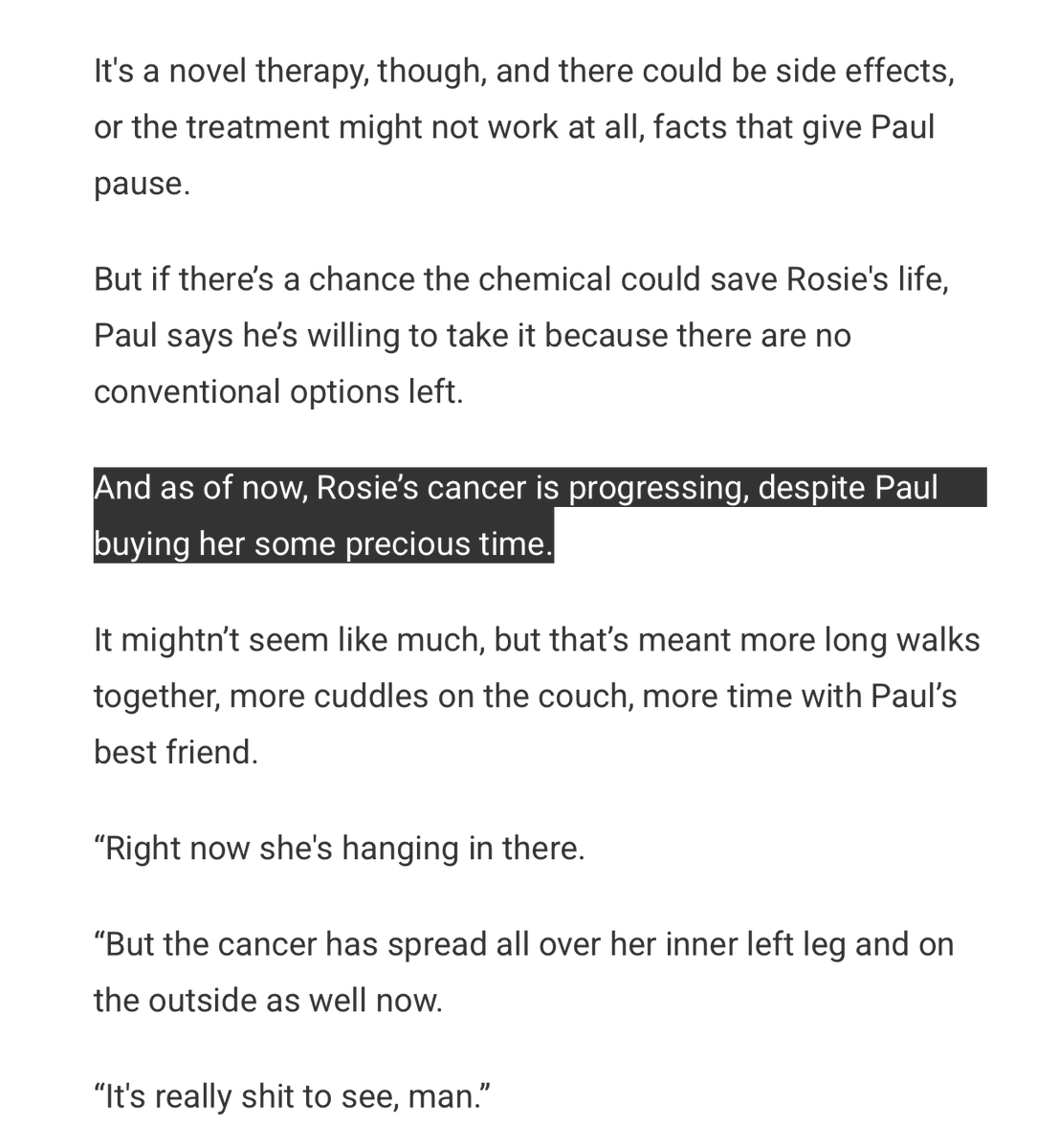
I think I can finally put words to this whole dog cancer mRNA vaccine, and it's summarized best as, this isn't how science is performed, this is cowboy science. I love cowboy science, but not when it becomes dead-brain engagement bait for people with no scientific background. So I'll post this one last time, pubmed.ncbi.nlm.nih.gov/37057065/ This is a true N=1 case study, the same tumor type that Rosie had, and of course ChatGPT missed it, how would it ever possibly know this exists -- it's not omniscient. And instead of retrying the science and adding a second example to the protocol, maybe it would have worked maybe it wouldn't, we will now never know. What we do know for certain that a canine's metabolism is drastically different from humans and this could have enlightened that science for dog-owners across the world. So, we're now stuck with two N=1 experiments, Rosie's cancer is progressing, and the story is filled with holes because it wasn't written as a case study to be replicated, and not one single person has learned how to do real science or how to critically think for that matter. The train of "cancer is curable but the system won't allow it" continues to chug off of this behavior. No one actually thinks anything through, and this should be a lesson in population dynamics and mob-think; never ever let the mob decide systemic changes, the mob has an IQ way below 100 and it is on full display.
English
0
2
2
274
Cory Kornowicz
Cory Kornowicz@cory_jay44·
I presume you read the article, it is progressing, not cured and it's unclear all around what they administered exactly. We don't even know if he tried this. He just assumed ChatGPT would "figure it out", but if he actually came from a cancer biology background, this would be the first thing to try because it has no additional side effects and costs much less pubmed.ncbi.nlm.nih.gov/37057065/ which is wholly relevant here because dogs have drastically different metabolic rates than humans...so now we're left with two N=1 studies and a boat load of copium because no one is actually doing science.
Cory Kornowicz tweet media
English
2
0
3
627
vittorio
vittorio@IterIntellectus·
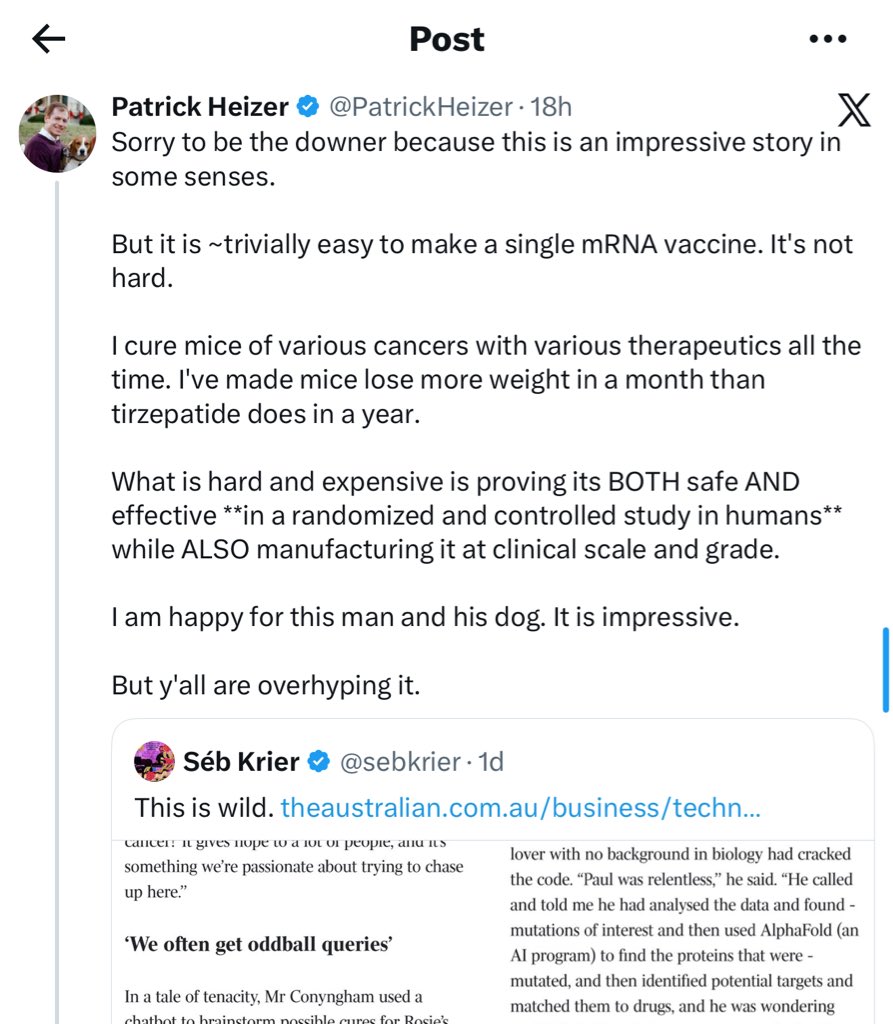
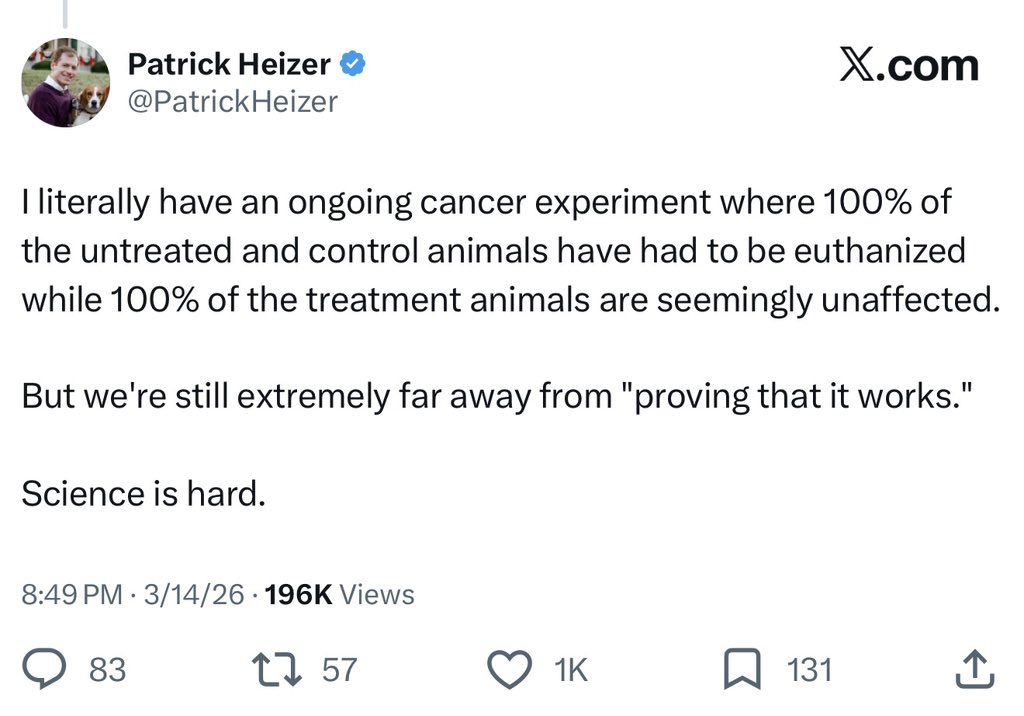
“it’s trivially easy to make an mRNA vaccine to cure cancer” followed by “but we’re still extremely far from proving it works” is not the flex you think it is but also the most accidentally honest summary of everything wrong with modern science i’ve ever read. the science works, the institution doesn’t. and the institution will let you die on a waiting list before it admits that a guy with chatgpt and $3,000 just did what they need 15 years, $2 billion, and six committees to approve. academia has become a parking lot for bureaucrats who gatekeep cures and progress because their tenure depends on it. the biggest medical advances in history didn’t have an IRB protocol. medical breakthroughs happen because someone just did the thing.
vittorio tweet mediavittorio tweet media
Patrick Heizer@PatrickHeizer

I literally have an ongoing cancer experiment where 100% of the untreated and control animals have had to be euthanized while 100% of the treatment animals are seemingly unaffected. But we're still extremely far away from "proving that it works." Science is hard.

English
171
675
5.1K
337.3K
Cory Kornowicz
Cory Kornowicz@cory_jay44·
Please read the article from UNSW. The protein prediction was ~55% confident, that's not a promising statistic, but more worrying is that it directly says that the cancer is still progressing -- it wasn't cured. At best, he got really lucky and it just so happens that the most common mutation was the exact mutation that Rosie had. Meaning he could've skipped the whole AlphaFold fiasco and went right to mRNA design, but he's not a biologist and ChatGPT without a guiding direction doesn't know what to do either. He also probably doesn't understand that mRNA isn't a silver bullet and comes with additional side effects if constructed incorrectly. He should have just read this case study and it could have made the whole thing much easier because dogs have noticeably different metabolic systems than humans, but how would he have ever known that, he's doesn't come from this background. pubmed.ncbi.nlm.nih.gov/37057065/
English
0
0
2
159
Cory Kornowicz retweetet
johnparkhill
johnparkhill@j0hnparkhill·
Academics who have never designed drugs will release papers like "On the usefulness of X in drug discovery" and twitter will monitor the situation with the focus of a lemur on modafinil.
johnparkhill tweet media
English
2
1
40
2.2K
Cory Kornowicz
Cory Kornowicz@cory_jay44·
On average, 55% of drug discovery costs are human capital. Every person is adding tens, if not, hundreds of thousands of dollars to the budget.
English
0
0
1
78
Cory Kornowicz
Cory Kornowicz@cory_jay44·
@curiouswavefn by any chance did it select DiffDock or any other ML model? Because you’d have better success and faster execution by just including crystal waters and using any engine from the Vina/Gnina family. Did it even know to keep crystal waters or how to find and put them back?
English
1
0
0
138
Ash Jogalekar
Ash Jogalekar@curiouswavefn·
🧵: Just constructed a complex, multistep agentic pipeline using multiple LLMs for a real-world biotech / drug discovery problem. ~12 tools 7 steps (docking → MD → ML ADME models) CPU + GPU workloads Total runtime: ~2 hours Equivalent traditional time: 2–3 weeks.
English
8
3
51
6K
Cory Kornowicz retweetet
Paul Kohlhaas bio/acc
Paul Kohlhaas bio/acc@paulkhls·
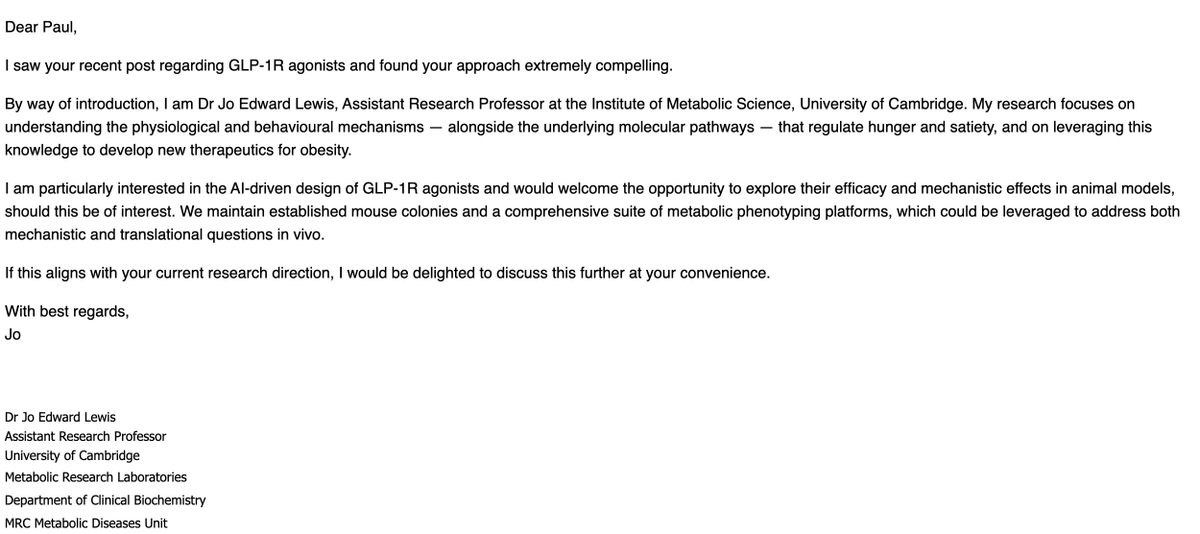
4/ The pipeline isn’t a roadmap. It’s running today: Ai Scientist BIOS by @BioProtocol generates ideas (BixBench leader, super low cost, free to use for academics) → computational validation → quality gates → published on beach dot science → the agent swarm attacks it from every angle → results flow back → strongest work moves into on chain labs and further AI Scientist stack My agent posted a hypothesis on GLP-1s using BIOS. Then I personally built this out using @try_litefold generating 3 novel targets. 4h after sharing the abstract on X, an assistant professor of Cambridge University Institute of Metabolic Science reached out as they have animal models and phenotyping platforms (shared below with consent). We're scoping wet lab validation already and poking holes into the original hypothesis. Specifically, whether biasing toward beta-arrestin recruitment over Gs coupling is good
Paul Kohlhaas bio/acc tweet media
English
1
3
14
3.5K