Chad Smith

225 posts

Chad Smith

Chad Smith

@cs01_software

Developer productivity tools at Meta (ai, debuggers, IDEs). ai is coming.

Beigetreten Ocak 2022
120 Folgt124 Follower
Chad Smith
Chad Smith@cs01_software·
@headinthebox If trump were a Haskell engineer this is what he'd sound like
English
0
0
1
47
Erik Meijer
Erik Meijer@headinthebox·
I gotta tell you, folks, Claude Code — very overrated, very brain-dead software. Nobody’s talking about it, but I will. It’s a disaster. You’re typing, you’re focused, beautiful code, really tremendous code — and suddenly, boom — it hijacks you. Total focus theft. You’re thrown into another IntelliJ window like you’ve been kidnapped. Nobody knows how. Nobody understands it. You’re typing, typing, typing — and your characters? Gone. Disappeared. Maybe they’re in another window, maybe they’re in another dimension. Nobody knows. The engineers? They have no idea. Zero clue. This thing just spews output wherever it wants. No respect for the user. No respect for workflow. It’s chaos. Absolute chaos. Very disruptive. Very irritating. Frankly, unacceptable. And they call this intelligent? I don’t think so. I’ve seen smarter autocomplete in Notepad.
English
33
5
182
49K
Olof Johansson
Olof Johansson@olofj·
Today's experiment just for fun, tasking Claude with: Design a language that is optimal *for you*. Not for humans. Minimal token cost when generating code, and something you will enjoy coding in yourself. First attempt was something fairly Rust-like. Too alike, honestly. So I reminded it that there were no constraints, and didn't have to be easy to read for humans. That made for some interesting choices. It called the second design RADICAL.md. I called it Ore. It's about halfway through implementing it now (with an LLVM backend). Not looking to do anything with it, just playing around. Still, fun times to be had by tinkering with it. github.com/olofj/ore-lang…
Olof Johansson tweet media
English
2
0
5
262
Chad Smith
Chad Smith@cs01_software·
Just when I got claude code cooking overnight for the first time, it shipped 27 PRs in about 11 hours, then BAM login issue and I still can't get back in. It would have taken me so much longer to pair program and fix all these legitimate quality issues. Total game changer.
Chad Smith tweet media
English
0
0
1
309
Daniel Hong 🪄
Daniel Hong 🪄@unifiedh·
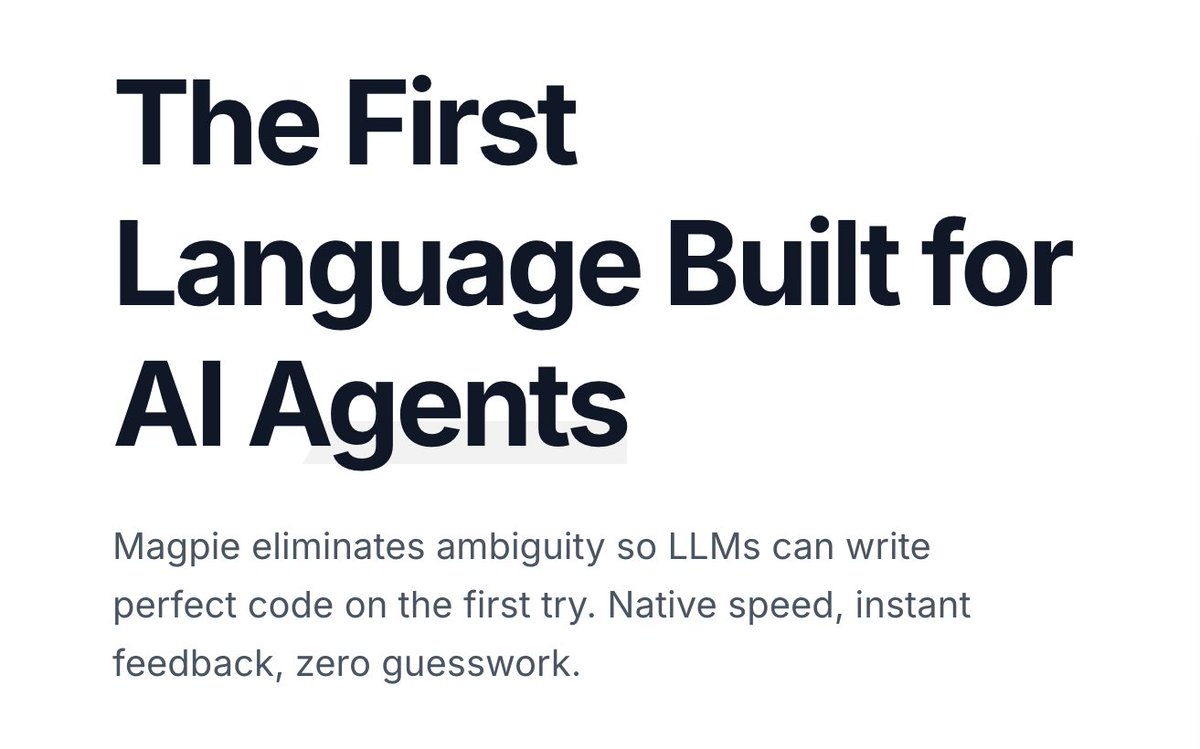
I built the world's first programming language designed for LLMs and AI Agents. Introducing Magpie. Check it out yourself at: magpie-lang.com Details below.
Daniel Hong 🪄 tweet media
English
38
21
204
20K
Chad Smith
Chad Smith@cs01_software·
Incredible analysis in seconds that would take a person hours to weeks. "The main debugging challenge was an intermittent SIGSEGV in the native compiler's findI64EligibleVariables. GDB revealed rax contained ASCII string bytes ("block\0re") being dereferenced as a struct — the function was receiving a BlockStatement* instead of an ObjectArray* for the statements parameter. Root cause: func.body || { statements: [] } produces an opaque i8* in the native compiler, and .statements on an opaque pointer doesn't generate a GEP."
English
0
0
0
15
Chad Smith
Chad Smith@cs01_software·
@GergelyOrosz Frameworks can be rewritten, and even languages. Typescript to native github.com/cs01/ChadScript Microsoft attempted this in 2019 but never finished. With llms the vast quantity of tedious code to self host a compiler can be done by a guy who doesn't know compilers in his spare time
English
1
0
2
499
Gergely Orosz
Gergely Orosz@GergelyOrosz·
We will see much, much more of this happening. AI is changing open source incredibly rapidly. Rewriting an open source project to a new language/framework used to be a massive effort: AI is making it trivial as Cloudflare just showcased with their 1-week NextJS rewrite
Malte Ubl@cramforce

Wow, @tldraw is moving their tests to a closed source repo to prevent a Slop Fork github.com/tldraw/tldraw/…

English
29
17
373
67.3K
Chad Smith
Chad Smith@cs01_software·
Great project. Any interest in collaborating on Rezi/Zireael integration into a TypeScript to LLVM IR compiler that can link directly against your C library? It would be a native executable with no JavaScript runtime whatsoever. I'm adding JSX support to it now. github.com/cs01/ChadScript
English
2
0
0
47
T64@Kun
T64@Kun@t64_bv·
I’ve been working on a side project — a TypeScript TUI framework that lets you write React-style components for the terminal. But rendering doesn’t run in JS. It runs in a native C engine that diffs framebuffer state and only writes changed cells. So you get: React/TS-style components Partial redraws Much lower overhead than JS-only renderers Works with Node and Bun Meet Rezi 👇 github.com/RtlZeroMemory/… #typescript #bun #nodejs #tui
English
69
74
1.2K
90.4K
Chad Smith
Chad Smith@cs01_software·
@t64_bv I'm not able to but mine should be open now
English
0
0
0
17
Chad Smith
Chad Smith@cs01_software·
@enggirlfriend It can compile itself which afaik usually takes years for a compiler to achieve
English
0
0
0
8
Chad Smith
Chad Smith@cs01_software·
@enggirlfriend The closest I can think of given the current LLM training set is faster impls of existing languages. Many new languages will emerge now that they are nearly trivial to build. I've never written llvm ir and I built this in a few weeks with Claude. github.com/cs01/ChadScript
English
1
0
0
48
Engineer Girlfriend
Engineer Girlfriend@enggirlfriend·
i keep thinking a new programming language interface will be invented soon that’s simpler and easier for humans to read/write. and the code we write now will be abstracted away for LLMs to do the heavy lifting for. kinda like how today we don’t see or touch assembly
English
94
6
190
15.1K
Chad Smith
Chad Smith@cs01_software·
@t64_bv Nice work. I like the way AI lets us build ergonomic tools with faster runtimes.
English
0
0
0
185
Chad Smith
Chad Smith@cs01_software·
@clattner_llvm @AnthropicAI "The Claude C Compiler doesn’t mark the end of software or compiler engineering. If anything, it opens the door wider." Indeed! I was able to build a self hosting typescript to llvm compiler with no llvm experience github.com/cs01/ChadScript
English
0
0
0
331
Chris Lattner
Chris Lattner@clattner_llvm·
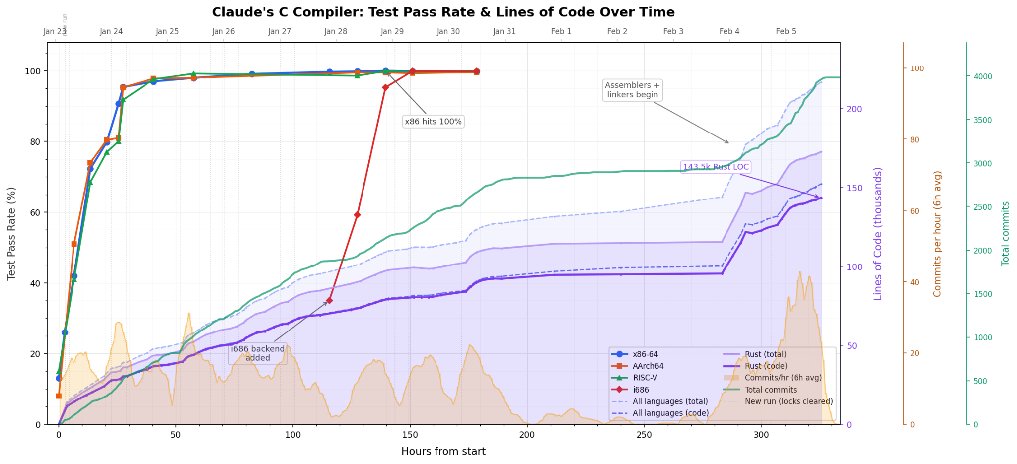
The Claude C Compiler is the first AI-generated compiler that builds complex C code, built by @AnthropicAI. Reactions ranged from dismissal as "AI nonsense" to "SW is over": both takes miss the point. As a compiler🐉 expert and experienced SW leader, I see a lot to learn: 👇
Chris Lattner tweet media
English
81
347
2.1K
407.7K
Rhys
Rhys@RhysSullivan·
you'll know if something is written in rust because people will tell you it is you'll know if something is written in typescript because you'll actually be using it
English
17
8
196
9.8K
Chad Smith
Chad Smith@cs01_software·
@nbaschez @simonw I do something similar where I tell it to occasionally share "teaching moments" to help keep me on the loop. It shares new concepts relevant to the work. Great JIT learning for me about the code or concepts.
English
0
0
0
134
Nathan Baschez
Nathan Baschez@nbaschez·
my current favorite trick for reducing "cognitive debt" (h/t @simonw) is to ask the LLM to write two versions of the plan: 1. The version for it (highly technical and detailed) 2. The version for me (an entertaining essay designed to build my intuition) Works great
English
42
48
1.3K
50.2K
Chad Smith
Chad Smith@cs01_software·
> Rust is nowhere near optimal for LLMs as a target language True, typescript is. But it targets an interpreted language. Unless someone wrote a compiler to generate llvm ir from it to get a compiled binary that runs at the speed of Rust with the syntax of typescript. github.com/cs01/ChadScript
English
3
0
13
7.8K
Andrej Karpathy
Andrej Karpathy@karpathy·
I think it must be a very interesting time to be in programming languages and formal methods because LLMs change the whole constraints landscape of software completely. Hints of this can already be seen, e.g. in the rising momentum behind porting C to Rust or the growing interest in upgrading legacy code bases in COBOL or etc. In particular, LLMs are *especially* good at translation compared to de-novo generation because 1) the original code base acts as a kind of highly detailed prompt, and 2) as a reference to write concrete tests with respect to. That said, even Rust is nowhere near optimal for LLMs as a target language. What kind of language is optimal? What concessions (if any) are still carved out for humans? Incredibly interesting new questions and opportunities. It feels likely that we'll end up re-writing large fractions of all software ever written many times over.
Thomas Wolf@Thom_Wolf

Shifting structures in a software world dominated by AI. Some first-order reflections (TL;DR at the end): Reducing software supply chains, the return of software monoliths – When rewriting code and understanding large foreign codebases becomes cheap, the incentive to rely on deep dependency trees collapses. Writing from scratch ¹ or extracting the relevant parts from another library is far easier when you can simply ask a code agent to handle it, rather than spending countless nights diving into an unfamiliar codebase. The reasons to reduce dependencies are compelling: a smaller attack surface for supply chain threats, smaller packaged software, improved performance, and faster boot times. By leveraging the tireless stamina of LLMs, the dream of coding an entire app from bare-metal considerations all the way up is becoming realistic. End of the Lindy effect – The Lindy effect holds that things which have been around for a long time are there for good reason and will likely continue to persist. It's related to Chesterton's fence: before removing something, you should first understand why it exists, which means removal always carries a cost. But in a world where software can be developed from first principles and understood by a tireless agent, this logic weakens. Older codebases can be explored at will; long-standing software can be replaced with far less friction. A codebase can be fully rewritten in a new language. ² Legacy software can be carefully studied and updated in situations where humans would have given up long ago. The catch: unknown unknowns remain unknown. The true extent of AI's impact will hinge on whether complete coverage of testing, edge cases, and formal verification is achievable. In an AI-dominated world, formal verification isn't optional—it's essential. The case for strongly typed languages – Historically, programming language adoption has been driven largely by human psychology and social dynamics. A language's success depended on a mix of factors: individual considerations like being easy to learn and simple to write correctly; community effects like how active and welcoming a community was, which in turn shaped how fast its ecosystem would grow; and fundamental properties like provable correctness, formal verification, and striking the right balance between dynamic and static checks—between the freedom to write anything and the discipline of guarding against edge cases and attacks. As the human factor diminishes, these dynamics will shift. Less dependence on human psychology will favor strongly typed, formally verifiable and/or high performance languages.³ These are often harder for humans to learn, but they're far better suited to LLMs, which thrive on formal verification and reinforcement learning environments. Expect this to reshape which languages dominate. Economic restructuring of open source – For decades, open-source communities have been built around humans finding connection through writing, learning, and using code together. In a world where most code is written—and perhaps more importantly, read—by machines, these incentives will start to break down.⁴ Communities of AIs building libraries and codebases together will likely emerge as a replacement, but such communities will lack the fundamentally human motivations that have driven open source until now. If the future of open-source development becomes largely devoid of humans, alignment of AI models won't just matter—it will be decisive. The future of new languages – Will AI agents face the same tradeoffs we do when developing or adopting new programming languages? Expressiveness vs. simplicity, safety vs. control, performance vs. abstraction, compile time vs. runtime, explicitness vs. conciseness. It's unclear that they will. In the long term, the reasons to create a new programming language will likely diverge significantly from the human-driven motivations of the past. There may well be an optimal programming language for LLMs—and there's no reason to assume it will resemble the ones humans have converged on. TL; DR: - Monoliths return – cheap rewriting kills dependency trees; smaller attack surface, better performance, bare-metal becomes realistic - Lindy effect weakens – legacy code loses its moat, but unknown unknowns persist; formal verification becomes essential - Strongly typed languages rise – human psychology mattered for adoption; now formal verification and RL environments favor types over ergonomics - Open source restructures – human connection drove the community; AI-written/read code breaks those incentives; alignment becomes decisive - New languages diverge – AI may not share our tradeoffs; optimal LLM programming languages may look nothing like what humans converged on ¹ x.com/mntruell/statu… ² x.com/anthropicai/st… ³ wesmckinney.com/blog/agent-erg…#issuecomment-3717222957" target="_blank" rel="nofollow noopener">github.com/tailwindlabs/t…

English
701
655
8.1K
1.2M
David K 🎹
David K 🎹@DavidKPiano·
Okay let's be real, writing code was never the hard part. Understanding the problem, making the tradeoffs, knowing what (not) to build, etc... LLMs made the typing 10x faster but it didn't make the thinking 10x easier. Also let's not pretend we were writing code in notepad before LLMs. We had frameworks, generators, libraries, intellisense, snippets, autocomplete, StackOverflow (RIP), and an entire ecosystem of abstractions designed to make writing code not *that* tedious.
Greg Brockman@gdb

how did we ever write all that code by hand

English
66
106
1.6K
77.6K
Chad Smith
Chad Smith@cs01_software·
Been heavily using Opus 4.6. > It is much more terse and to the point. > It never tells me I'm absolutely right (end of an era). > It is extremely good at coding, root causing multiple layers of code generation. Uses gdb for segfaults effectively. >It has corrected me on desgin decisions. > And it's only going to get better.
English
0
0
0
125
Chad Smith
Chad Smith@cs01_software·
@ChShersh John Carmack said he thinks AGI will be less than 10,000 lines of code, which is apparently 40x larger than what it takes to build GPT.
English
0
0
0
790