drcoder.eth 🦇🔊🐬

3.8K posts

drcoder.eth 🦇🔊🐬 banner
drcoder.eth 🦇🔊🐬

drcoder.eth 🦇🔊🐬

@davidryan59

Blockchain/Python backend dev, NFT artist (Moving Mondrians, Ethereum Merge Fractals), Nifty Ink fractals (niftymaestro.eth) – musician, Christian (Romans 10:9)

UK / Vietnam Beigetreten Mayıs 2012
1.6K Folgt747 Follower
Angehefteter Tweet
drcoder.eth 🦇🔊🐬
drcoder.eth 🦇🔊🐬@davidryan59·
My new NFT series, Moving Mondrians, is live on OP mainnet! 100,000 unique generative art NFTs, with animated SVG image generated fully onchain 50% of funds raised are donated to @ProtocolGuild to support Ethereum core development NFT entered into @Optimism #welovetheart compo
GIF
English
3
24
44
4.5K
drcoder.eth 🦇🔊🐬 retweetet
Jason Shuman
Jason Shuman@JasonrShuman·
Silicon Valley thinks AI agents are a $20/mo self-serve subscription. Main Street is paying local agencies $10,000 just to turn them on. Everyone assumes AI will be bought primarily online like Slack or Zoom. I think they are wrong. Some of the biggest winners in the AI boom won't be the software vendors. It will be the humans installing it. Here is the reality of SMBs right now: • 54% lack internal AI expertise. • 41% have data quality too poor for AI to even work. • 41% already prefer buying AI through a local IT provider. You cannot "1-click install" a genius AI into a messy CRM or a 15-year-old server. It will just execute the wrong tasks at the speed of light. The AI software will be cheap and a lot will absolutely be bought online. Making it actually work for a messy, real-world business will be expensive. Very bullish on the "Do It For Me" economy being back.
English
270
137
1.9K
575.3K
drcoder.eth 🦇🔊🐬
drcoder.eth 🦇🔊🐬@davidryan59·
@AriEiberman Trustlessly we have: - wrap the bitcoin and use a lending protocol on Ethereum? - or convince Bitcoin core devs to implement EVM smart contracts, fork Aave, attract billions of TVL, then take out a loan using native bitcoin Or trust a centralised custodian with your bitcoin
English
0
0
0
23
Ari Eiberman 🇦🇷 Stablecards
I’m a bit embarrassed to ask this, but… Where can I take out a loan using self-custodied Bitcoin as collateral? With a low APY, obviously. And preferably no wBTC or similar wrappers 🙏
English
146
4
123
39.3K
drcoder.eth 🦇🔊🐬 retweetet
Milk Road AI
Milk Road AI@MilkRoadAI·
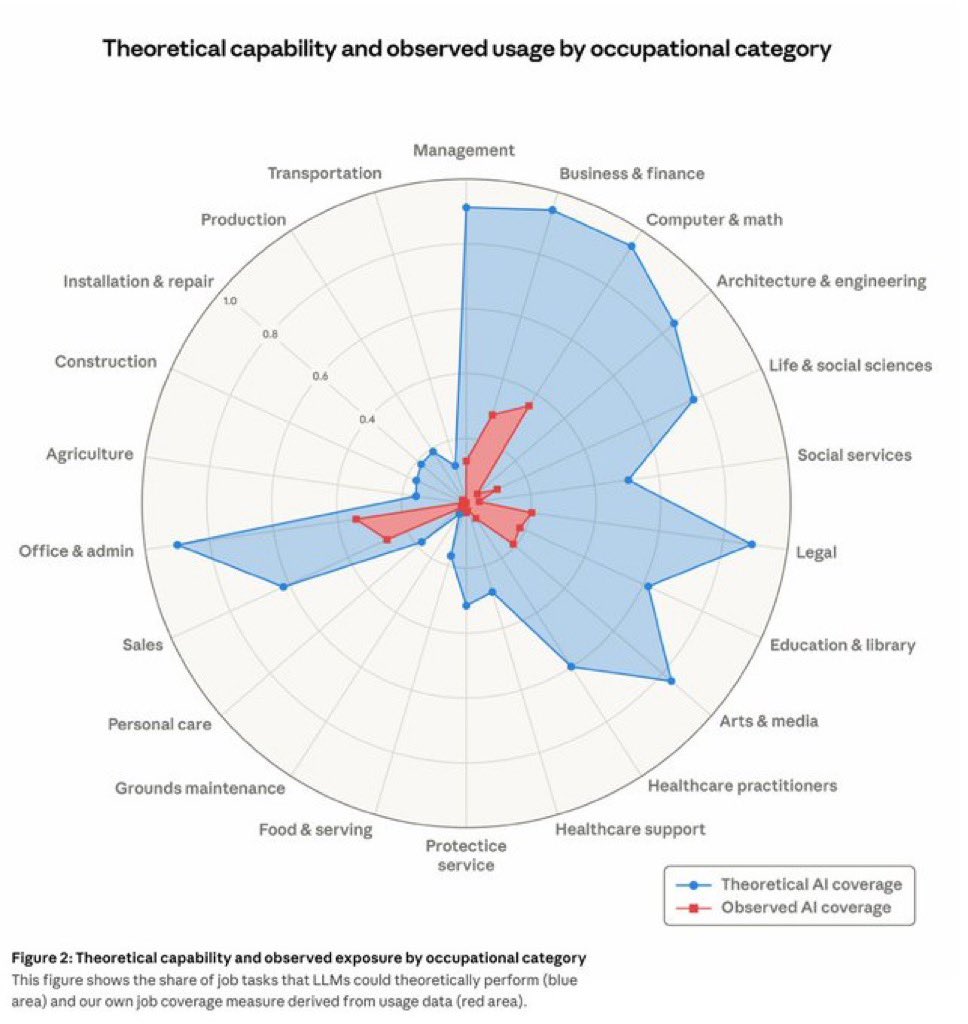
Anthropic just released the most IMPORTANT chart in the AI labor debate. This comes from the company that builds Claude using data from 2 million real conversations. Here’s what it shows. The blue area is every task AI could theoretically do right now. The red area is what people are actually using it for. The gap between them is enormous and that gap is your career runway. Computer programmers are already 75% covered. Customer service reps, data entry workers, financial analysts, they’re next. But here’s what no one is talking about. The mass layoffs haven’t really started. Unemployment for exposed workers hasn’t budged. So what’s actually happening? Companies are closing the front door, hiring for workers aged 22 to 25 in AI exposed jobs has dropped 14%. The most exposed workers aren’t factory workers, they’re college educated, higher earning. 49% of US jobs now have at least a quarter of their tasks inside AI’s reach. That’s up from 36% just one year ago. And the red area on that chart, the real world usage is still a fraction of what’s possible. Every month, it grows a bit. Anthropic built the scoreboard and most people haven’t looked at it yet.
Milk Road AI tweet media
English
273
1.1K
4.2K
655.3K
drcoder.eth 🦇🔊🐬
drcoder.eth 🦇🔊🐬@davidryan59·
@sidrmsh "What used to take a team of eight engineers four months can now be prototyped by one person over a weekend, which is genuinely wonderful if you’re a builder and terrifying if your entire business *is* the build." Yes. Be the builder
English
0
0
1
248
drcoder.eth 🦇🔊🐬 retweetet
Jesse Genet
Jesse Genet@jessegenet·
So, @openclaw can use a computer but lacks physicality… I’ve been solving that by taking photos of physical things (like books to digest), but what if I gave it access to my 3D printer!? Going to see what this can do for our homeschool curriculum 📚🤓
English
209
305
4.9K
1.1M
drcoder.eth 🦇🔊🐬 retweetet
Johann Sathianathen
Johann Sathianathen@johann_sath·
Your OpenClaw setup can be hacked in under 5 minutes 10 things to lock it down: 1. Run it on a VPS or Mac mini, not your main machine 2. Never run as root 3. Change the default port (18789 is public knowledge) 4. Install Tailscale (invisible to the internet, free) 5. SSH keys + Fail2ban (3 wrong tries = 24hr ban) 6. Firewall with UFW (close every port you don't need) 7. Allowlist your users (everyone else gets ignored) 8. Ask your bot to audit its own security 9. Set up real-time alerts (it messages you when something's off) 10. DMs only (group chats = everyone can control it) Bonus: Sandbox your subagents in Docker. If one gets prompt injected, it can't touch your keys or files. Copy & paste this to your OpenClaw. Tell it to help you set these up
English
81
287
3.4K
493.9K
drcoder.eth 🦇🔊🐬 retweetet
Morgan
Morgan@morganlinton·
I’ve had a lot of people ask me about running models locally lately. So here’s essentially what I keep sending to all my friends, and thought why not share with all of you. And you honestly don’t need to know anything about how LLMs work under-the-hood to follow this. A running LLMs locally thread 🧵
English
22
37
586
94.2K
drcoder.eth 🦇🔊🐬 retweetet
Joseph Chalom
Joseph Chalom@joechalom·
Vitalik Buterin just published his vision for Ethereum and AI. The core thesis is clear: Ethereum becomes a critical economic coordination layer for autonomous AI agents as AI moves from experimentation into mass production. I called this out in my 2026 predictions and I believe this is one of the most underestimated tailwinds for ETH. We are quickly moving toward an Ethereum autonomous machine economy, where task-specific AI agents transact, coordinate, and establish reputation (enter ERC-8004) without intermediaries. As enterprise software evolves from AI copilots to fully autonomous agents, and then to networks of collaborating agents, those agents will need a neutral, programmable settlement layer to operate across systems. That activity implies a step-function increase in transaction volume, network demand, and TVL. A 10x expansion to over $500 billion is not aggressive in that context. And it will happen on Ethereum. Ethereum’s decentralization, liquidity, and emerging agent standards make it uniquely suited to support autonomous market participants that trade, rebalance, provide liquidity, and allocate capital continuously, onchain, 24/7. @VitalikButerin also emphasizes a non-negotiable point: responsible AI requires privacy and trustless interaction, especially for payments. These are requirements, not nice-to-haves, and they only work on infrastructure that is genuinely decentralized. Put simply: AI needs Ethereum. Ethereum isn’t just scaling for humans anymore. It’s scaling for machines. And if AI agents are becoming active participants in financial markets, owning ETH means owning the foundation of that agentic economy. This is one of many reasons we’re singularly focused on the Ethereum opportunity @SharpLink
vitalik.eth@VitalikButerin

Two years ago, I wrote this post on the possible areas that I see for ethereum + AI intersections: vitalik.eth.limo/general/2024/0… This is a topic that many people are excited about, but where I always worry that we think about the two from completely separate philosophical perspectives. I am reminded of Toly's recent tweet that I should "work on AGI". I appreciate the compliment, for him to think that I am capable of contributing to such a lofty thing. However, I get this feeling that the frame of "work on AGI" itself contains an error: it is fundamentally undifferentiated, and has the connotation of "do the thing that, if you don't do it, someone else will do anyway two months later; the main difference is that you get to be the one at the top" (though this may not have been Toly's intention). It would be like describing Ethereum as "working in finance" or "working on computing". To me, Ethereum, and my own view of how our civilization should do AGI, are precisely about choosing a positive direction rather than embracing undifferentiated acceleration of the arrow, and also I think it's actually important to integrate the crypto and AI perspectives. I want an AI future where: * We foster human freedom and empowerment (ie. we avoid both humans being relegated to retirement by AIs, and permanently stripped of power by human power structures that become impossible to surpass or escape) * The world does not blow up (both "classic" superintelligent AI doom, and more chaotic scenarios from various forms of offense outpacing defense, cf. the four defense quadrants from the d/acc posts) In the long term, this may involve crazy things like humans uploading or merging with AI, for those who want to be able to keep up with highly intelligent entities that can think a million times faster on silicon substrate. In the shorter term, it involves much more "ordinary" ideas, but still ideas that require deep rethinking compared to previous computing paradigms. So now, my updated view, which definitely focuses on that shorter term, and where Ethereum plays an important role but is only one piece of a bigger puzzle: # Building tooling to make more trustless and/or private interaction with AIs possible. This includes: * Local LLM tooling * ZK-payment for API calls (so you can call remote models without linking your identity from call to call) * Ongoing work into cryptographic ways to improve AI privacy * Client-side verification of cryptographic proofs, TEE attestations, and any other forms of server-side assurance Basically, the kinds of things we might also build for non-LLM compute (see eg. my ethereum privacy roadmap from a year ago ethereum-magicians.org/t/a-maximally-… ), but for LLM calls as the compute we are protecting. # Ethereum as an economic layer for AI-related interactions This includes: * API calls * Bots hiring bots * Security deposits, potentially eventually more complicated contraptions like onchain dispute resolution * ERC-8004, AI reputation ideas The goal here is to enable AIs to interact economically, which makes viable more decentralized AI architectures (as opposed to non-economic coordination between AIs that are all designed and run by one organization "in-house"). Economies not for the sake of economies, but to enable more decentralized authority. # Make the cypherpunk "mountain man" vision a reality Basically, take the vision that cypherpunk radicals have always dreamed of (don't trust; verify everything), that has been nonviable in reality because humans are never actually going to verify all the code ourselves. Now, we can finally make that vision happen, with LLMs doing the hard parts. This includes: * Interacting with ethereum apps without needing third party UIs * Having a local model propose transactions for you on its own * Having a local model verify transactions created by dapp UIs * Local smart contract auditing, and assistance interpreting the meaning of FV proofs provided by others * Verifying trust models of applications and protocols # Make much better markets and governance a reality Prediction and decision markets, decentralized governance, quadratic voting, combinatorial auctions, universal barter economy, and all kinds of constructions are all beautiful in theory, but have been greatly hampered in reality by one big constraint: limits to human attention and decision-making power. LLMs remove that limitation, and massively scale human judgement. Hence, we can revisit all of those ideas. These are all things that Ethereum can help to make a reality. They are also ideas that are in the d/acc spirit: enabling decentralized cooperation, and improving defense. We can revisit the best ideas from 2014, and add on top many more new and better ones, and with AI (and ZK) we have a whole new set of tools to make them come to life. We can describe the above as a 2x2 chart. There's a lot to build!

English
75
144
829
95.8K
Greg Bresnitz
Greg Bresnitz@GregBresnitz·
I’m joining @Optimism to lead narrative and strategy. You either die a hero or live long enough to see “storyteller” in your job title. Here we are. We’re at an inflection point most people are still missing. Regulatory clarity arrived. JPMorgan processes $2B daily on blockchain rails. BlackRock manages $2.5B in tokenized assets. The GENIUS Act gave banks a real pathway in. The question shifted from “if institutions come onchain” to “through whom.” Everyone talks about bringing a billion users onchain. Here’s what I’ve come to believe: That doesn’t happen through consumer apps alone. It happens when the institutions those users already trust—their banks, their exchanges, their payment providers—build on infrastructure they can actually rely on. The billion users come through the enterprise door. And the enterprises coming through that door want three things: their own blockchain, their own revenue, and guarantees they can take to their board. Optimism has a front row seat for this. Coinbase built @base on the OP Stack. Sony’s @soneium. Kraken’s @inkonchain. Uniswap’s @unichain. @world_chain_. These aren’t experiments—they’re production systems processing over half of all Ethereum L2 transactions. When enterprises evaluate where to build, they’re choosing Optimism. I spent time understanding the architecture before saying yes. The OP Stack is MIT licensed and fully open. Stage 1 decentralization means permissionless fraud proofs and independent exit windows. When a CTO looks under the hood, they find something built by people who know what they’re doing. Technical credibility closes deals. I also believe in the people. @jinglejamOP, @karl_dot_tech, @ben_chain, Kevin, @tyneslol , and the team have been building toward an open internet for years—through bear markets, technical rewrites, and an industry that rewards hype over substance. They kept shipping. That dedication is rare, and it’s why the Superchain exists today. The next few years will be exciting. AI agents coordinating through programmable rails. Institutional capital flowing into infrastructure that doesn’t require trust in intermediaries. The technology receding into the background until it becomes invisible, essential, everywhere. Like electricity. Like the internet before it. Optimism has been building for years. Now it’s time to tell that story. Four years at @FWBtweets taught me how much narrative matters. Optimism built something real. It’s time to make sure people know. Let’s go.
English
31
4
197
18.5K
drcoder.eth 🦇🔊🐬
drcoder.eth 🦇🔊🐬@davidryan59·
@mattshumer_ Personally what took me 1 week to code in Feb 2025 now takes me 10 minutes to code with Claude 4.6 Opus in Feb 2026 Amazing - can build seemingly anything! But what will the work be in 2030? What education path do we advise young people to have? No idea!
English
0
0
0
81