dividendblower

6K posts

dividendblower banner
dividendblower

dividendblower

@dividendblower

Gaming data and stock market enthusiast

Stockholm, Sweden Beigetreten Mart 2015
882 Folgt21.3K Follower
dividendblower retweetet

Rhys Elliott
Rhys Elliott@superhys·
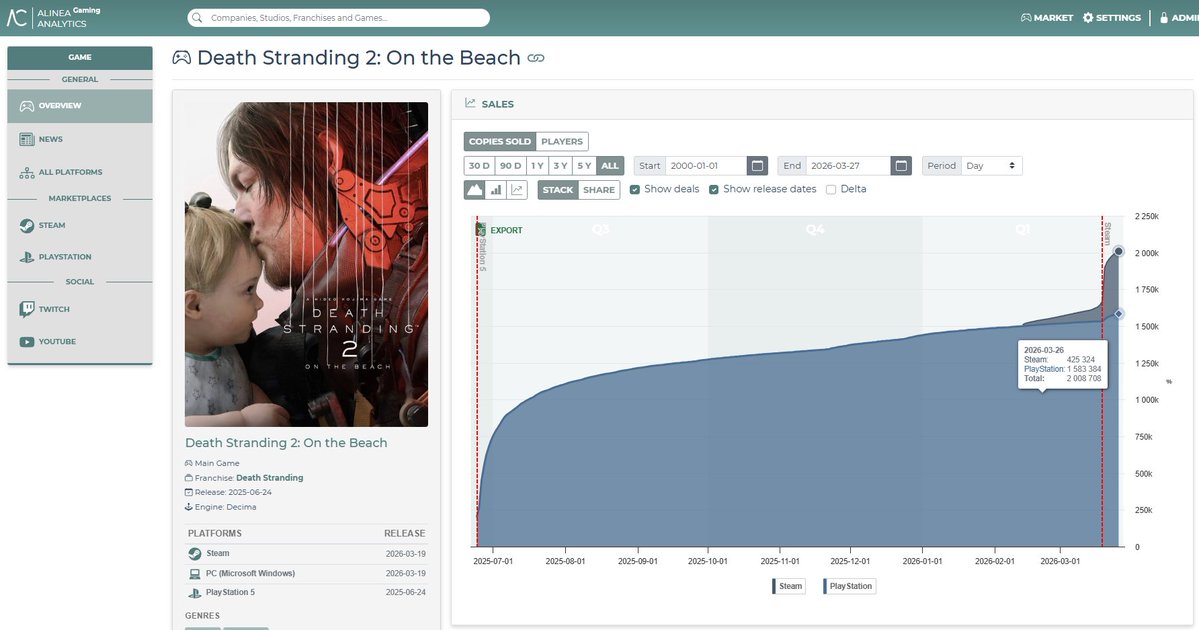
Death Stranding 2's Steam port has helped the game pass 2M copies sold and $150M in gross revenue overall (@alineaanalytics estimates) The port has extended DS2’s product lifecycle, with the Steam version selling 425K copies in its first week. Adding this to the 1.6M copies sold on PS5, the game’s total volume now sits at over 2M. This means the Steam version of Death Stranding 2 already accounts for 21% of copies. In terms of revenue, Death Stranding 2 has generated over $110M on PS5 and $32.6M on Steam. With Epic included, it’s safe to say Death Stranding 2 has now passed $150M. Players are getting sucked into Death Stranding 2 on PC. In a week, it has an average playtime of 18 hours. Over a third of the player base on Steam has already played for 20 hours or more, and almost 5% has played for over 50 hours. Fair play. Death Stranding 2 has especially been a hit on Steam in China, which accounts for almost half of the game’s Steam players. This highlights a strategic advantage Sony would otherwise forfeit by skipping PC; it’s a direct pipeline to a massive, high-intent Chinese audience that’s increasingly influential in a game’s total lifecycle. To me, the quicker rollout of Death Stranding 2 and Stellar Blade on Steam suggests Sony is running a live A/B test on the long-term ROI of the PC ecosystem. Using second-party titles as the tests, PlayStation can measure exactly how much platform decay occurs when a high-profile exclusive moves to PC in under a year, without risking the crown jewels of its first-party stable. All this ahead of that reported move away from PC, too. One outcome I could see happening – and what I’d do –is that Sony tiers its releases in the following way: - Core first-party single-player IP, the tentpole titles from Naughty Dog or Santa Monica Studios, remain gated as console exclusives to maintain hardware pull and protect the box’s value proposition for the enthusiast crowd. This becomes even more critical as Sony prepares to launch its next generation of consoles and handhelds, where a distinct reason to own the hardware is the primary sales driver. - Live-service games will still launch multiplatform to maximise network effects and player liquidity. Live-ops costs are nuts and require a critical mass that a single console ecosystem can’t provide. - Second-party partnerships like Kojima and Shift Up offer a strategic middle ground. These allow Sony to capture the PC surge and build organic relationships with these studios before moving toward a formal acquisition, effectively using Steam as a proving ground for an IP’s global reach. Organic acquisitions like this (Insomniac) have worked better in the past for PlayStation than buy-and-hope ones (like Bungie). I also suspect the original play for PlayStation involved the development of a proprietary PC launcher to reclaim the 30% margin currently lost to Valve. While the initial friction surrounding mandatory account linking for Helldivers 2 created a PR hurdle, I reckon it was the first step in a broader attempt to centralise the PlayStation ecosystem across hardware boundaries (and away from third parties like Valve). As market dynamics shift toward a more platform-agnostic future, Sony has to decide if it wants to remain a premier storefront or a premier publisher. If the results from Death Stranding 2 are any indication, the most profitable path lies in being both. Sony can essentially have its cake and eat it here, provided it can manage the optics of its console exclusivity while treating Steam as a high-conversion top-of-funnel for the second-party side. More in the new free Substack! Link in bio
Rhys Elliott tweet media
English
28
47
602
52.7K
dividendblower retweetet
Paul Tassi
Paul Tassi@PaulTassi·
New ‘Marathon’ Sales, Playercount Reports Are Close To Reality via @ForbesGames I checked in about those new Alinea estimates, and those figures are in fact close to the actual numbers at Bungie forbes.com/sites/paultass…
Paul Tassi tweet media
English
120
36
942
133.3K
dividendblower retweetet
Rhys Elliott
Rhys Elliott@superhys·
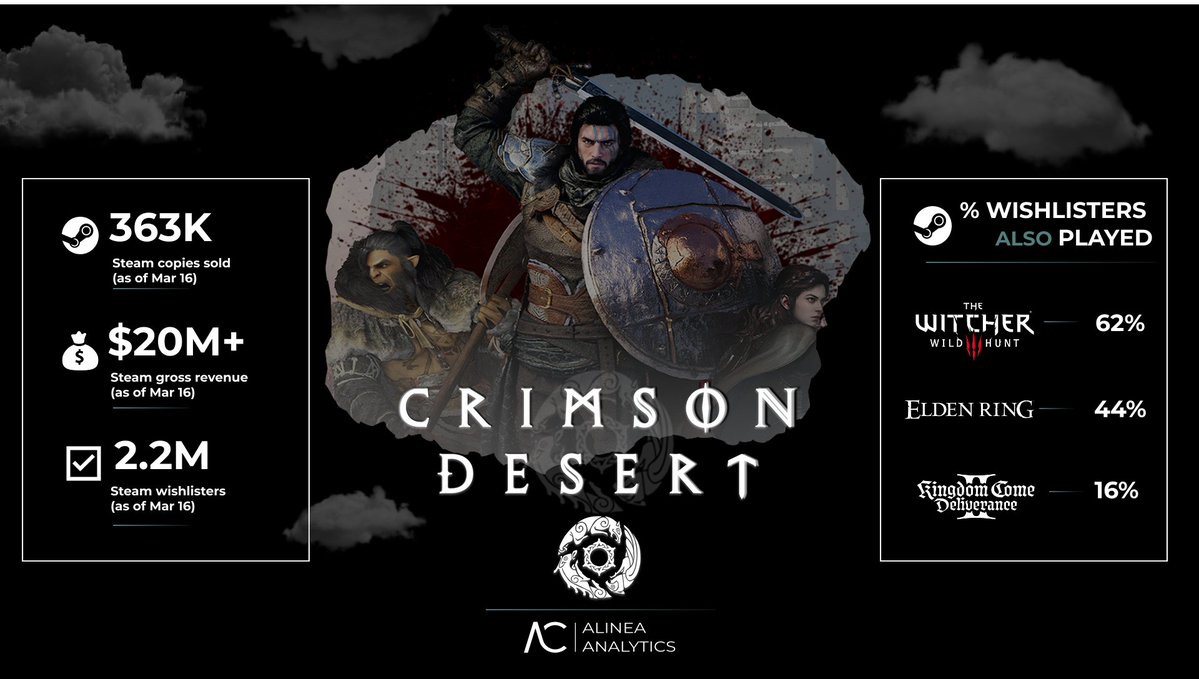
Crimson Desert is on track for a killer launch on Steam. As of yesterday, it was approaching 400K pre-launch copies sold on Steam (@alineaanalytics estimates), representing gross revenues of $20M+. Notably, over 10% of those sales occurred in a single 24-hour window yesterday, generating $2.6 million in revenue as the marketing campaign reached its peak. This game could really blow up, if it sticks the landing. Players are very curious. Pearl Abyss announced that Crimson Desert reached 3M wishlists last week. Our estimates show that around 2.2M of those come from Steam. It’s worth noting that for a successful $70 AAA game, wishlist-to-buyer conversion is typically pretty low, 6-7% a week after launch. Hype really started to escalate in the past few months, thanks to extensive community building and well-timed announcements. In general, the marketing – including the gameplay reveal and the recent features deep dives – has been great. But where Pearl Abyss has really hit it out of the park is in quelling vocal online crowds, actively listening to the community, and responding with what gamers really want to hear. It feels authentic. PR and Marketing Director @WillJPowers has been the primary face of this effort, adopting an unusually direct communication style. Candidly, it’s refreshing amid the sea of PR drivel we usually get. Authenticity wins. At the three-day pre-launch mark, Crimson Desert’s $20.3M on Steam means it’s outperforming Kingdom Come: Deliverance II by nearly 4x ($5.2M) and Expedition 33 by nearly 10x ($2.4M) at the same point in their respective lifecycles. But the longer-term data for Expedition 33 and KCD2 shows that a strong start is only the foundation. Both enjoyed sustained revenue growth – reaching $95.5M and $101.3M on Steam respectively by day 120. And it’s because they delivered fantastic, well-reviewed experiences that fueled long-term word-of-mouth. For Crimson Desert, the initial hype has ticked all the right pre-launch boxes, but now Pearl Abyss has to put its money where its mouth is. If the quality of Pywel’s open world and its sandbox doesn’t live up to the promising trailers and previews, that momentum will be cut short before it can reach the long-tail success seen by KCD2 and Expedition 33. I reckon we’re looking at Steam’s second new 2026 $150M+ powerhouse, after Resi. More in the new free newsletter (link in bio).
Rhys Elliott tweet media
English
10
27
465
35.1K
dividendblower retweetet
Alinea Analytics
Alinea Analytics@alineaanalytics·
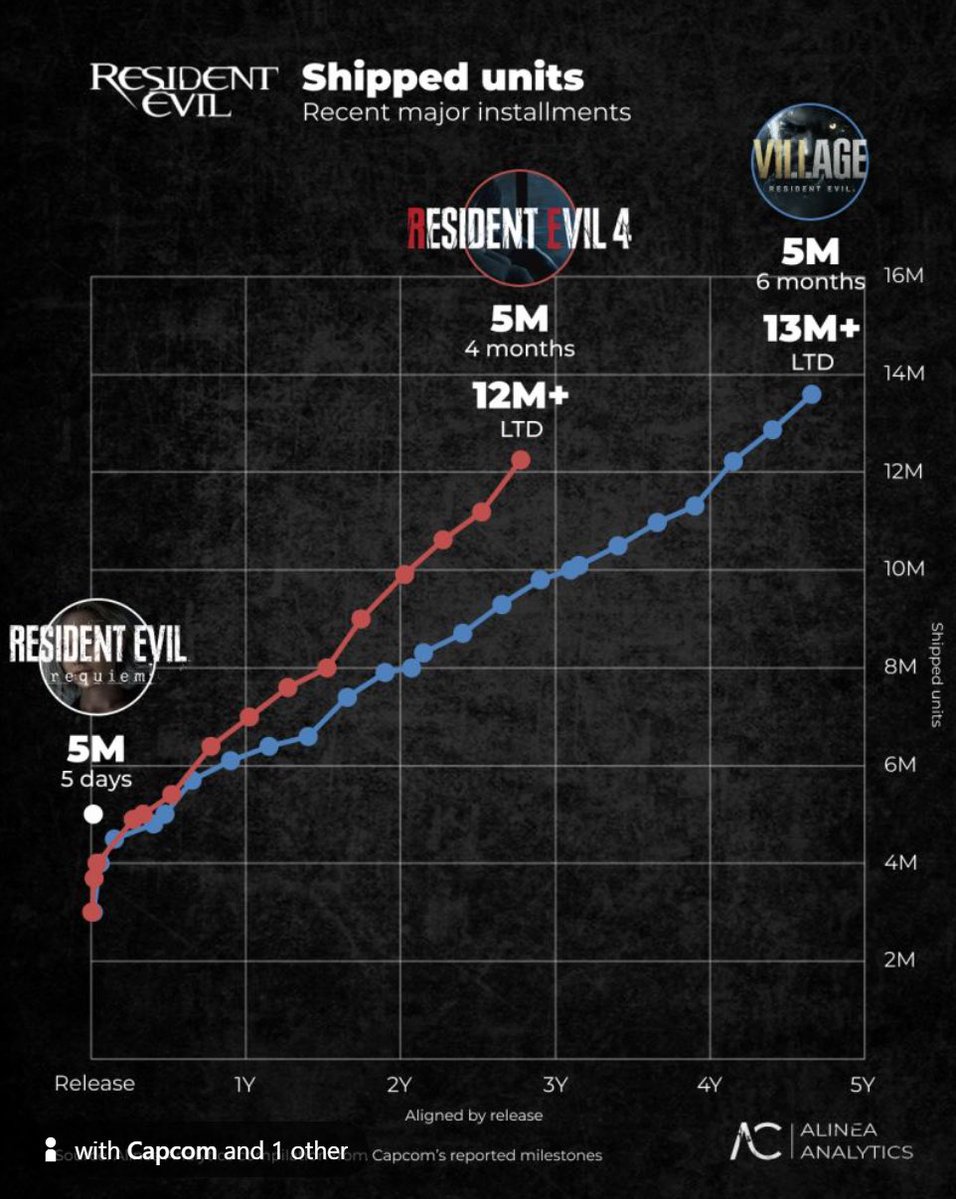
🧟‍♂️ Resident Evil: Requiem is off to a record-breaking start, delivering one of the biggest launches in Capcom history, perfectly timed for the franchise’s 30th anniversary. Today, Capcom announced 5M units shipped in just five days, making it the fastest-selling title in franchise history. As shown in our visual, the game is tracking well ahead of prior entries and is positioned to generate substantial long-tail sales for the franchise in the years ahead. Huge congrats to Capcom for doing what they do best, pure quality. 💫 This will go down as one of 2026’s most acclaimed and biggest releases. Capcom continues its 2026 slate with Monster Hunter Stories 3: Twisted Reflection next week (currently #16 top-selling in Japan), followed by PRAGMATA, which already has an est. $1M+ Steam pre-orders and ranks 16th most anticipated on the platform, also selling especially strongly on the PlayStation Store in Japan. March is turning into a feast for gamers, with heavy-hitters like Crimson Desert, Slay the Spire 2, and Marathon lined up next.
Alinea Analytics tweet media
English
2
8
44
6.9K
dividendblower retweetet
Rhys Elliott
Rhys Elliott@superhys·
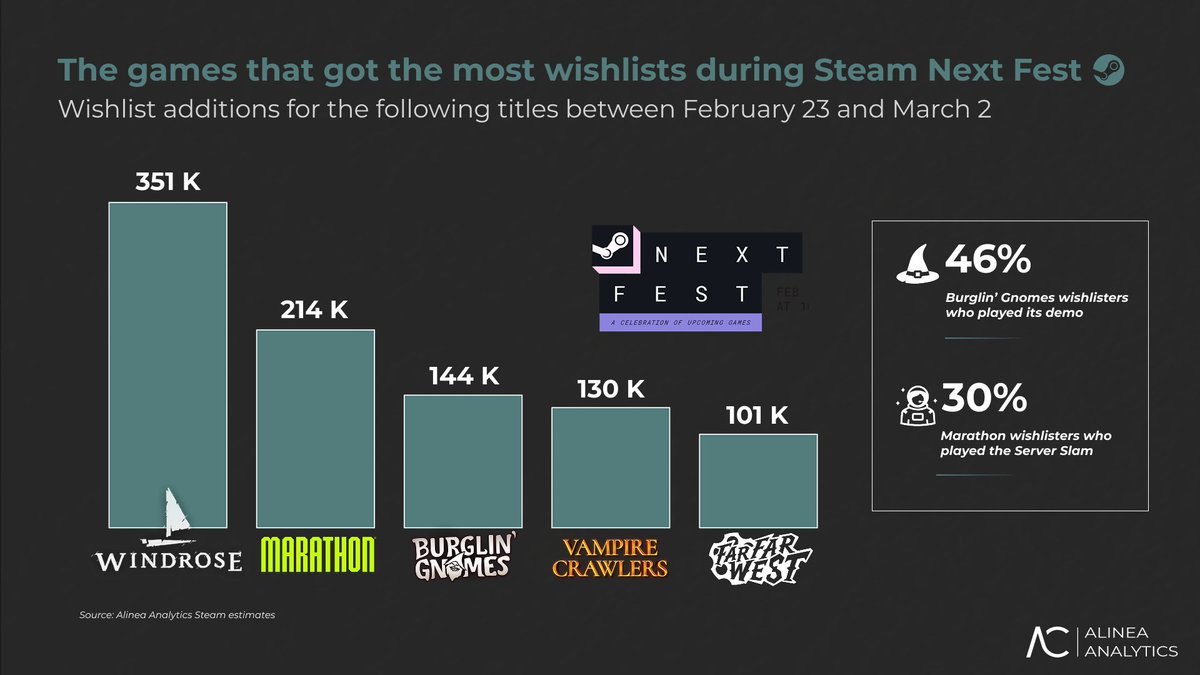
Here's the top Steam Next Fest games by new wishlists during the event (@alineaanalytics estimates). Co-op pirate survival game #Windrose took the #1 spot, securing 351K new wishlists during the week-long event. This brings Windrose’s total count to over 1.3M, so Next Fest – and related promotions – account for about a quarter of wishlisters. Around 11.7% of Windrose’s total wishlisters played the demo, which was the third-most-played during the event. Despite the small team size, the Windrose looks stunning on high-end machines, too. Focusing on a PvE experience that scales for both solo and group play, Windrose Crew has so far done a nice job of turning the ship away from the sweatiness that can cause friction in this type of game (looking at you, Sea of Thieves). That said, over a third of Windrose’s wishliters have played Sea of Thieves previously. Given the positive reaction to the demo, I’m expecting plenty of Sea of Thieves regulars to – sorry in advance – jump ship when Windrose launches proper. Bungie’s Marathon secured the #2 spot for new wishlisters this Next Fest, adding 213K new wishlists and bringing its total to about 1.2M. A high 29.8% of those wishlisters played the Server Slam, the second-highest ratio in our top five. I was very curious about this one, so I spent a good chunk of the weekend playing Marathon (also, Resident Evil; more on that on Thursday). I’m happy to report that mechanically, Marathon is sublime. But there's a but. While Bungie’s gunplay remains best-in-class – feeling like a snappy, refined evolution of Destiny – the transition from the polished tutorial to the actual extraction loop is jarring. A messy UI combined with the punishingly quick time-to-kill (TTK) only makes things worse, and many players are being sent back to the lobby by AI before they even encounter another human. Marathon will likely do well due to Bungie’s pedigree and the fantastic mechanics. But for those outside that group, first impressions matter. While ARC Raiders succeeded by leaning into co-op and social glue, Marathon feels more weighted toward a hardcore PvP environment in its current state. Once I moved past those confusing first hours and internalised Marathon’s loop, it became clear that Bungie has a unique, fantastic game on their hands. Like, generational. But IMO, if Bungie wants to maximise its success here and capture the wider market, it needs to take a leaf from Arc Raiders’ playbook and bridge the gap between stellar presentation and high-friction onboarding. Full write-up on the free Tuesday Substack (link in bio)
Rhys Elliott tweet media
English
1
5
52
6.6K
dividendblower retweetet
Rhys Elliott
Rhys Elliott@superhys·
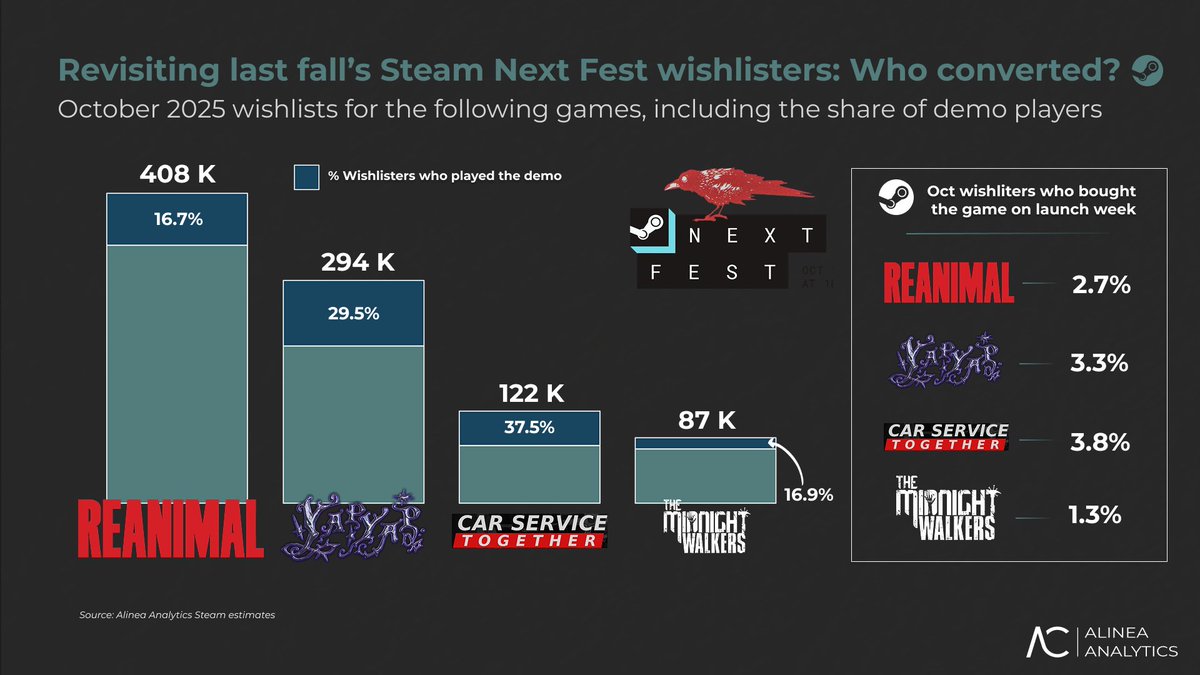
Do wishlisters during Steam Next Fest actually convert at launch? Here's some @alineaanalytics estimates for four games included in October's edition (that have now released). #REANIMAL is the most fascinating case study here due to the legacy of developer Tarsier, the $40 price – the highest in the group – and its use of a friend pass (allowing a friend to access a copy of the game for ‘’free’’). Despite having the largest October 2025 wishlist pool here (408K), REANIMAL saw the lowest demo participation at 16.7%. This makes sense, as REANIMAL was a known game with a bigger marketing push beyond Steam Next Fest (relative to the other games), including press coverage and video previews. A week after its February 19 launch, REANIMAL managed to convert around 2.7% (11K) of its October 2025 wishlisters to buyers. The core fans were willing to pay a premium for the Tarsier-developed experience, regardless of the demo’s reach. Some fans likely even avoided playing the demo, already sold on Tarsier’s track record with the first two Little Nightmares games. #YAPYAP’s $8 entry point helped it capitalise on its high demo engagement. An impressive 29.5% of its 294K wishlisters in October had previously tried the demo. So there’s a strong “try-before-you-buy” foundation. YAPYAP was also the #3 most-played demo of the October event. Of the October 2025 wishlisters, 3.3% bought YAPYAP a week after launch, rising to 5.5% as of yesterday (23 days after launch). At under $10, the barrier to entry is minimal for a player who already enjoyed the demo, effectively turning a “maybe” into a “yes” without much hesitation. #CarServiceTogether remains the standout performer, relatively speaking. YAPYAP shows the power of a low-friction price point and memeable mechanics, but Car Service Together shows the power of niche. It had the highest conversion of demo players to wishlisters in October 2025 (37.5%) and the highest conversion from October wishlisters to week-one buyers (3.8%). Players of this niche genre were clearly convinced by the unique gameplay loop, making the $18 price point feel like a fair trade for the fun they already experienced in October. #TheMidnightWalkers struggled to find its footing with a $16 price point and a January 29th launch. It saw a weaker conversion rate of only 1.3% from its 87K October wishlisters, with just 1.6% converting almost a month after launch. Around 16.9% of the October wishlisters played the demo, and it was the #7 most played demo of the event overall, suggesting that the demo failed to impress enough to justify wishlists and – indeed -- purchases. It's a cautionary tale and underlines a bit of a discovery paradox. In more competitive and buzzy genres, a demo can actually work against you if it reveals a lack of polish or depth compared to the competition. Bigger deep dive on the free Alinea Insight Substack. We also look at whether wishlists are becoming vanity metrics (spoiler: they are). Link in bio.
Rhys Elliott tweet media
English
0
3
40
7.5K
dividendblower retweetet
Rhys Elliott
Rhys Elliott@superhys·
Some thoughts on the new Xbox CEO. Since Microsoft hired Asha Sharma, the internet has gone mental. There are two camps, really: 1. Those on a witch hunt because of her AI and non-gaming background 2. And those who are overly sympathetic to Sharma because she’s in a tough position and her heart’s in the right place. As ever, the truth’s somewhere in the middle, and everybody is screaming at the symptoms while ignoring the disease. The transition has been, to put it gently, a PR nightmare, so business as usual for Xbox ... Many of us suspected that Phil Spencer’s tenure was coming to an end, but the exit of Sarah Bond – long considered the next in line – certainly took me off guard. Xbox positioned Bond as the face of the future, but as fantastically reported by The Verge's @tomwarren, Microsoft’s top brass thought she was too tied to the disastrous “This is an Xbox” strategy – a confusing, muddled shotgun approach. Replacing a mostly beloved industry veteran with an AI executive whose Gamertag was seemingly set up last Tuesday is a bad look and lacks authenticity. It’s a shaky start, to be honest. Especially as Xbox did something similar with Bond. The scepticism surrounding Sharma is understandable, and that was my first reaction, too. We gamers are a protective bunch, and seeing a leader who has to ask for game recommendations on here feels like a betrayal of the gamer-first culture Spencer spent a decade building. The reality is that Spencer’s good-guy strategy has hit a wall – and it did so years ago, truth be told. As @longislandviper has rightly said many times on Sacred Symbols, Spencer has talked out of both sides of his mouth, and has talked too much. Still, Spencer has kept Xbox afloat since the disastrous Xbox One. But despite a $69 billion acquisition of Activision Blizzard, Xbox hardware is in dire straits -- as is its reputation. The brand never recovered from losing the Xbox One generation. The Game Pass thesis, while noble in its attempt to shift gaming distribution, came from desperation. And the abysmal “Everything's an Xbox!” vision made everything worse. Now, Xbox has a muddled brand identity and a stagnant subscriber base. Bond’s strategy of chasing tomorrow’s mobile and cloud customers – ostracising today’s console fans in the process – left the door open for Sony and Valve to continue eating Xbox’s lunch (despite sharing some of via Xbox games on PS/Steam and PS games on Xbox). Sharma’s hiring is to try to salvage things. Her background in user acquisition at Meta and platform scaling at Instacart, two roles she excelled in, is obviously what drove Microsoft to this decision. However, the hiring has also reignited the fear that Microsoft is moving toward an AI-first, games-second model. Xbox co-founder Seamus Blackley hasn’t held back, suggesting that Sharma’s role is more akin to a “palliative care doctor” (oof) brought in to euthanise Xbox once and for all. That’s a hot take, and not one I fully agree with. There IS a legitimate concern that Microsoft, now AI-obsessed and sullying its core products with its experiments, has the patience for the messy, unpredictable business of making art. The layoffs point to this, but they’re happening across the industry. I’m still not over Bluepoint. I digress. Entertainment is a hits-driven business. As an analyst, it pains me to say this a little, but making hit games is an art (outside of the live-ops and mobile predatory stuff). There is a gut feel for culture and trends that doesn’t show up in analytics or a spreadsheet. That number crunching is important, don't get me wrong, but it's not the heart of our industry. That’s always been part of my mantra as an analyst, and it’s served me pretty well, to be honest. There’s a balance. If Sharma does view games merely as content for an AI-driven delivery system, which she might well do, what’s left of Xbox’s soul will wither. But Sharma can turn things around. Sharma’s first memo promised a return to the old Xbox, a refusal to flood the ecosystem with AI slop. Right now, these are just PR-directed words, and words are cheap. But if she if she can put Microsoft’s money – and resources – where her mouth currently is, giving the creatives the air cover they need to take risks, she could turn things around. She doesn’t need to have beaten Elden Ring to be a great CEO; she needs to be a leader and amplifier who surrounds herself with people who know what they’re doing and actually listens to them. This is something I saw @Chris_Dring saying on LinedIn earlier this week, and I wholeheartedly agree. I’m going to be brutally candid here, though (not like me, I know! 🙃). This goes higher than Sharma. I don’t think a high-growth tech giant and a creative entertainment business are compatible. Like I said at the top, everybody is screaming at the symptoms while ignoring the disease. The games business is low margin versus what Microsoft is currently chasing (for now), and the development timelines are long. Despite Sharma’s potential, the most logical long-term move is to spin Xbox off. It has Activision, Bethesda, and some of the most valuable IP in the business. A standalone Xbox would be free from the burden of matching the ROI of Azure or the ubiquity of Windows. It could return to its roots as a scrappier, game-focused competitor. Sharma may well be the person to prepare Xbox for a transition away from Game Pass stagnation and ‘’this is an Xbox!’’, but for the brand to truly reclaim its 25-year legacy, it needs to stop being a footnote for Satya Nadella and become something of its own. It’s big enough. The best pathway forward, in my eyes, is to set Xbox free. Not by euthanising it, but by spinning it off. Gaming is in a better place with a strong, independent Xbox. But, as that’s not likely right now, let’s give Sharma a shot. If she’s smart (she is), she’ll take cues from Take-Two’s top dog, Strauss Zelnick. I come back to this late-2024 Zelnick quote from a CNBC interview: ‘’I do not play video games’’ Zelnick said. ‘’My role is to attract, maintain, and motivate the best talent in the business, and then get out the way.’’ So there's hope, if only a little. Let's see.
Rhys Elliott tweet media
English
28
35
226
34.5K
dividendblower retweetet
Rhys Elliott
Rhys Elliott@superhys·
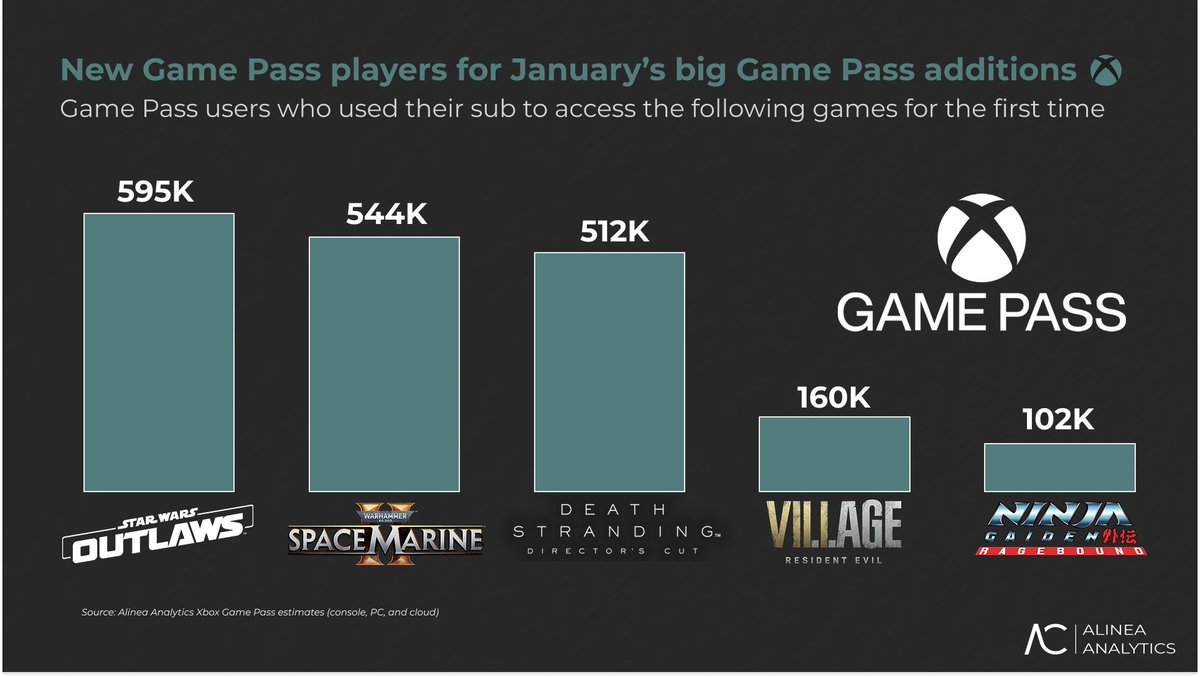
Here's how many new players January's big Game Pass gets brought in (@alineaanalytics estimates). The data is for console, PC, and cloud. Star Wars Outlaws, integrated into Game Pass following its disappointing launch, onboarded almost 600K new players via Game Pass. This influx effectively doubled the game’s total reach on Xbox, with the volume of new Game Pass players matching Outlaws’ lifetime sales on the platform. Around 100K Game Pass subscribers used the service to play Outlaws on the day it was added. Given that the Xbox sales curve for Outlaws had basically flatlined before this integration, the timing was a calculated bet to increase the game’s ROI via the deal. Warhammer 40,000: Space Marine II entered the service at month-end and quickly got 544K new players, demonstrating the tried-and-true genre-fit for the Xbox ecosystem. Xbox gamers love over-the-shoulder shooters. Our estimates show that 57% of Space Marine II players on Xbox previously played Gears 5. And 35% of its players have engaged with Helldivers 2, a paid game – and a PlayStation-published one, no less – that’s never been part of Game Pass. Death Stranding Director’s Cut’s addition to the console and cloud tiers on January 21 brought in 512K new players, marking a significant expansion for the Hideo Kojima-led IP on the platform. It successfully tapped into a latent Kojima-curious demographic. Our data indicates that about 25% of Xbox’s Death Stranding players had previously engaged with Metal Gear Solid V on Xbox. Resident Evil Village saw a more modest uptake, adding 160K new players via its January 20 Game Pass debut. It’s another calculated lead-in strategy to build momentum ahead of Resident Evil Requiem’s launch on Friday. Notably, its addition to PlayStation Plus Extra (on the same day) yielded significantly higher engagement (852K). On Xbox, Village had over 500K MAUs in January, suggesting plenty of folks replaying the older title ahead of the new one. That’ll sell pretty well on Xbox, I reckon. Ninja Gaiden Ragebound, a 2D retro-modern revival from the talented team behind Blasphemous, got 102K new players via Game Pass. Despite a strong critical reception, Ragebound has struggled to find a commercial foothold since its July 2025 launch, suggesting Game Pass is a tactical play to offset the soft sales. Ragebound did, however, find a niche audience within the side-scroller vertical, with 75% of its Xbox players having previously engaged with the 2022 hit TMNT: Shredder’s Revenge. While it remains a brilliant mechanical achievement (and an awesome game), Ragebound is a sobering reminder of the crowded market’s volatility. Deeper dive in the new Substack (link in bio!)
Rhys Elliott tweet media
English
35
55
533
47.1K
dividendblower retweetet
Rhys Elliott
Rhys Elliott@superhys·
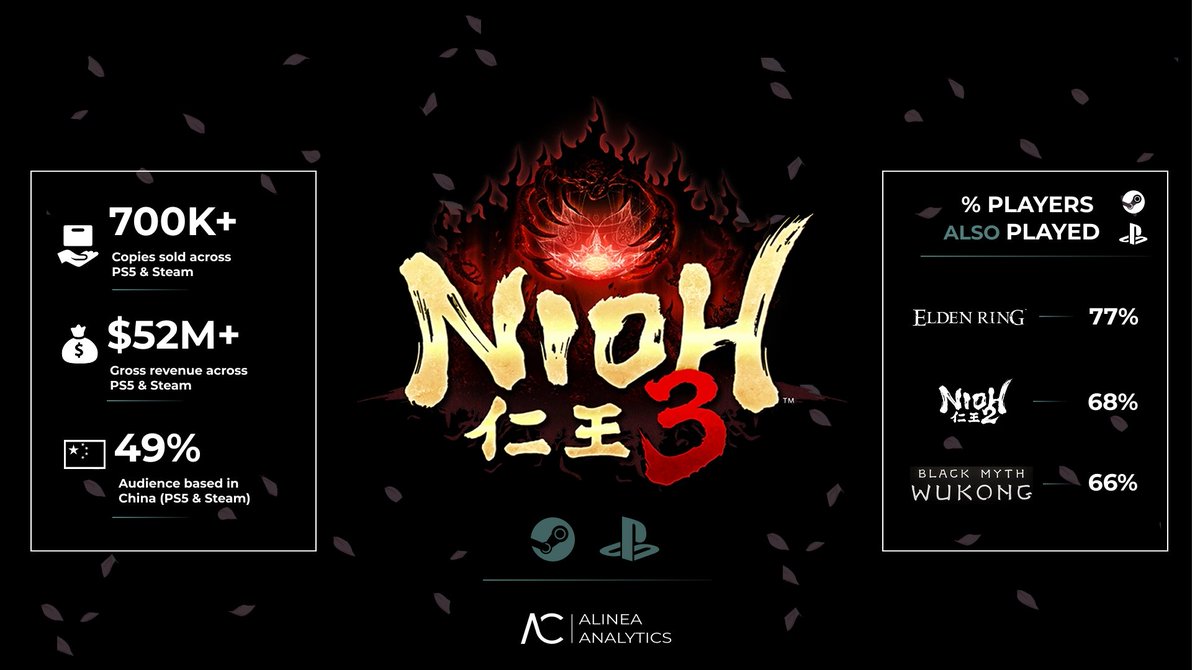
China is driving Nioh 3's promising start. @alineaanalytics estimates show that, despite Nioh 3 being out for under a week, it sold THROUGH over 700K copies across PlayStation and Steam as of yesterday (four days after launch). That's $50M in gross revenue. And we’re not including unsold retail copies in these numbers. Sold IN numbers (including retailers) are typically a lot higher for these kinds of Japanese-developed titles. The Nioh series has been a sleeper hit in the souls-like genre. Alongside Lies of P, it’s one of the few franchises that approaches the quality of FromSoftware’s games IMO. Nioh is no copycat, though, having carved its own unique identity around random loot, stances, and Team NINJA’s speciality: fast-as-hell combat. In terms of market share, China is the top country for the Nioh franchise, now accounting for 48.7% of the total player base across Steam and PlayStation. While the series has historically had a strong presence in the region on Steam, Nioh 3 peaked in China engagement across the board. This success is the result of a deliberate, localised marketing push by Team NINJA, headlined by producer Kohei Shibata’s appearance at ChinaJoy 2025. In fact, East Asia accounts for almost two-thirds of Nioh 3’s audience (including China, Japan, and Taiwan). Nioh 3 blends deep Shinto and Buddhist philosophies with an authentic dark fantasy retelling of Japan’s Bakumatsu period, grounding its supernatural elements in shared regional history. Nioh 3 has drawn more heavily from the broader souls-like audience than from its own direct predecessor. While loyalty remains high, with 66.6% of Nioh 3 Steam players and 69.0% of PlayStation players having played Nioh 2, more Nioh 3 players have played Elden Ring. On Steam, 80.7% of Nioh 3 players previously played Elden Ring, suggesting that Elden Ring has indeed lifted the souls-like barrier for many players. And of course, Nioh 3 has also successfully positioned itself as the “next big challenge” for the massive FromSoftware audience (🙋). The Wukong effect is clearly visible too, with 71.3% of the Steam audience having played Black Myth: Wukong, again emphasising the huge Chinese audience for Nioh 3. On PlayStation, the trend holds steady, with Elden Ring crossover (73%) still outpacing Nioh 2’s audience (69%) despite Nioh 2 having been on PlayStation Plus. While there are some challenges to overcome, including regional pricing in markets like Brazil and Poland, Nioh 3 is off to a decent start, and China's driving it. Get more data, and me gushing about Mewgenics, in the new Alinea Insight free newsletter (link in bio)
Rhys Elliott tweet media
English
15
36
276
102.4K
dividendblower retweetet
Rhys Elliott
Rhys Elliott@superhys·
I'm off to GDC this year! ✈️ Anyone going? HMU if you want to chat about the games market, games data, or just grab a drink.
Rhys Elliott tweet media
English
0
4
10
5.8K
dividendblower retweetet
Rhys Elliott
Rhys Elliott@superhys·
Here's the full top 10 for January's ranking of Steam games by copies sold (@alineaanalytics). Stardew Valley selling another 531K makes me smile. That $9 sale really upped the sales volume, but Stardew still sells 250K+ every month on Steam month regardless. Our PlayStation ranking is coming later, with an analysis in our Alinea Insight newsletter. Subscribe to the newsletter to get that in your inbox as soon as we publish. Link in my bio and the comments.
Rhys Elliott tweet media
English
3
5
24
5.1K
dividendblower
dividendblower@dividendblower·
@Aktieprenoren Den positionen med så många omgångar och chips kvar är ju en guld utgångspunkt! Snyggt. Själv kommer jag behöva ta en del djärva beslut för att klättra snabbt.
Svenska
0
0
1
1.1K
AktieEntreprenören
AktieEntreprenören@Aktieprenoren·
@dividendblower Segt, men många omgångar kvar! Hovrat 100-150k i typ 10 omgångar. 120k nu. Alla chips kvar. Gjort en del slarviga misstag (typ bränt deadline två ggr osv), men oavsett nöjd med placeringen så klart.
Svenska
1
0
0
1.4K
dividendblower
dividendblower@dividendblower·
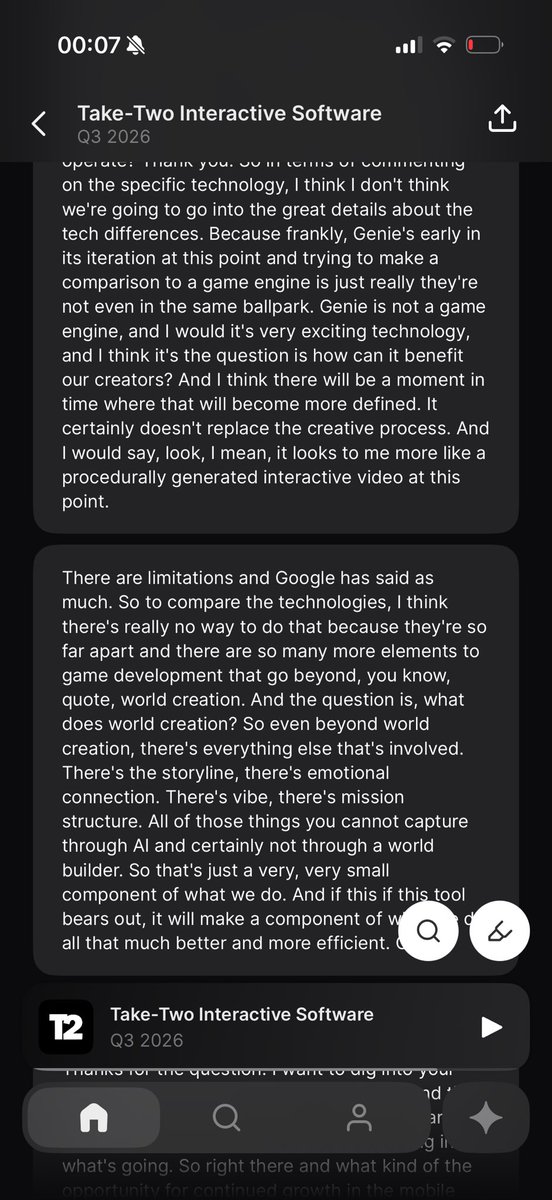
Rhys (and our) take on the AI craziness that crashed the gaming stock market. Genie in the bottle.
Rhys Elliott@superhys

AI bros and Wall Street have lost the plot again.🤦 Following Google Genie 3’s announcement, gaming stocks dipped as investors panicked over a supposed “disruption” of the industry. It’s the same kind of DiSrUpTiOn we saw with web3, blockchain, the metaverse, cloud gaming, and esports. How are they doing again? The reaction to Genie is the clearest indicator yet for what most of us already know: generally speaking, the stock market doesn't have a bloody clue about games. Yes, it's a cool prototype, but Google will eventually shove Genie back into the bottle – or more accurately, the Google Graveyard. We saw this pattern with Stadia in 2019, a cloud gaming venture that Google unceremoniously axed. Genie 3 follows the same pattern of a flashy PR cycle followed by a prototype phase with no viable path to a profitable consumer product. Back when Google announced Stadia in 2019, I made a bet with one of my old bosses that it'd be in the Google Graveyard by 2023. I won that bet, and I’d bet the same thing again here – Genie will be in the Graveyard by 2028. Genie essentially guesses, frame-by-frame, what the next visual output should be based on your inputs. This lacks the core foundations of game development. There’s no intentionality here. In a real game, if you press ‘A’ to jump (let’s not argue about facebutton placement…), the game checks your velocity, collision, and gravity. From what I’ve experienced, there’s NONE of this in Genie – only a statistical guess that the next frame should look like a jump. In other words, because the model is just predicting the next pixels, it has no concept of rules, which are fundamental to games. Hell, they define a game in many respects. Scrolling through a video that reacts to your thumbstick is not playing a game. The model seems to be training on the visual output of games rather than the source code. That’s sort of like trying to build a working Ferrari by looking at photos of a Ferrari. And then there’s the plagiarism problem. Google says the model is trained on “publicly available web data,” AKA unlabelled gameplay footage belonging to publishers. Early user tests have already produced output that rips off Breath of the Wild and Super Mario 64, complete with paragliders and clearly plagiarised environmental assets. Nintendo’s lawyers are ruthless, and they’re not going to like this. I’d have loved to be a fly on the wall of that meeting. Nintendo has a history of litigating against even fan-made projects using their assets and IP (like AM2R, Pokemon Prism, and Lost in Hyrule). A multi-billion-dollar corporation like Google using its IP to train a commercial AI is a completely different kettle of Magikarp. Either way, there’s plenty of things to worry about when it comes to investing in AAA games, but Google Genie – and its ilk – isn’t one of them.

English
1
3
24
28.6K
dividendblower
dividendblower@dividendblower·
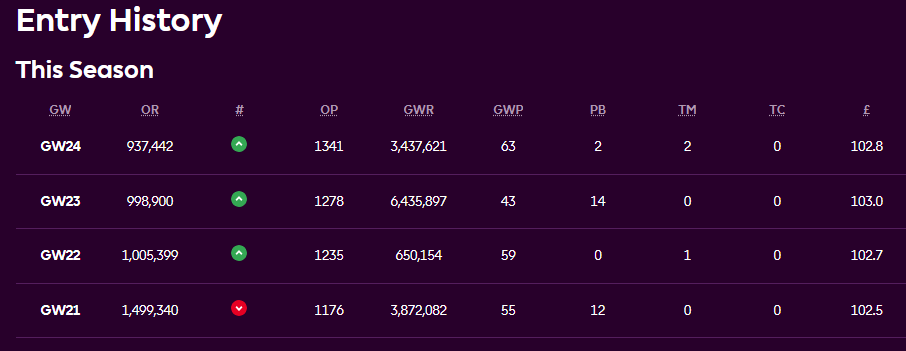
@Aktieprenoren Katastrof! Men klättrar åtminstone. Förhoppningsvis kan man kriga sig till en sub 100k i andra halvan. Men bättre än så är nog uteslutet med den start jag haft. Själv?
dividendblower tweet media
Svenska
1
0
0
849
dividendblower
dividendblower@dividendblower·
@Aktieprenoren Thx pal. Skrivit mindre, men är här hela tiden med stort intresse fortsatt! :) Lite mindre dobbel, spel och digitalt i flödet bara, mer frukt, chips och kassar.
Svenska
1
0
8
3.2K
dividendblower retweetet
Rhys Elliott
Rhys Elliott@superhys·
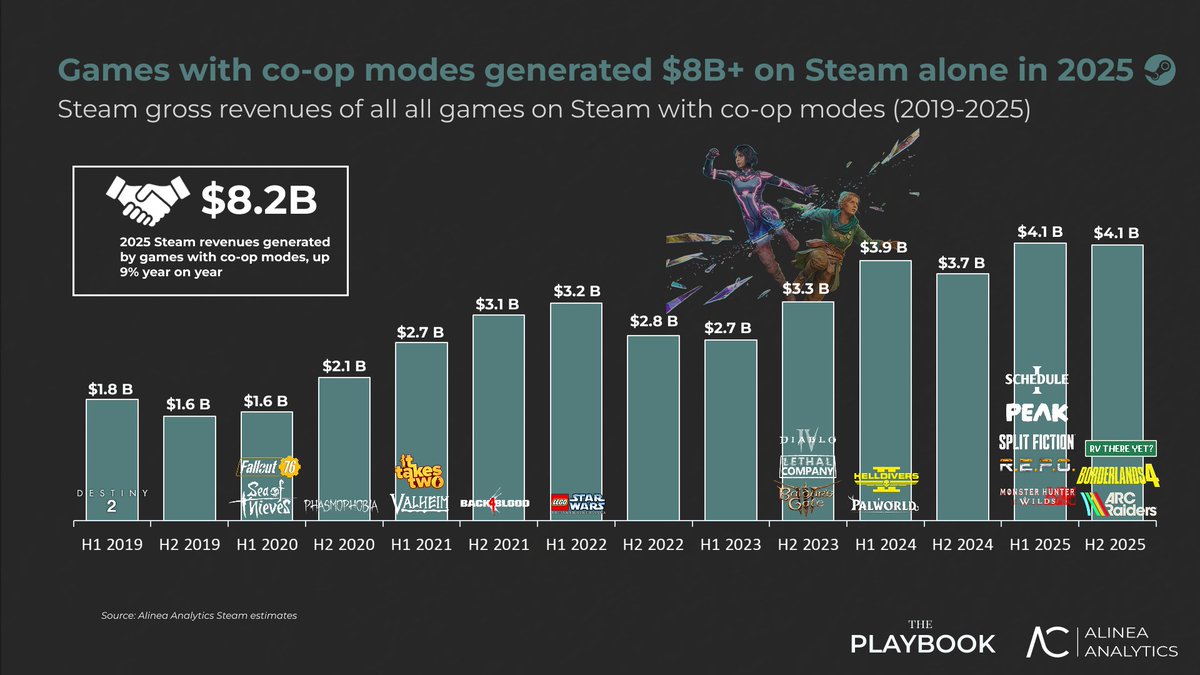
Games with co-op modes generated $8.2B in gross revenue on Steam last year (@alineaanalytics estimates) This is a 9% increase over 2024 and marks the highest revenue ever recorded for co-op games on Steam. Both 2024 and 2025 beat the COVID-accelerated high from 2021. Obviously, the pandemic initially sparked a surge in shared experiences, but our estimates show the momentum is actually accelerating after a small correction. And unlike the more oversaturated PvP space, there’s more room for success here. In fact, seven of 2025's top new games on Steam (by copies-sold revenues) heavily lean into cooperative play. Those games are: #MonsterHunterWilds ($376M on Steam in 2025) #ARCRaiders ($206M) #ScheduleI ($153M) #REPO ($150M) #Borderlands4 ($128M) #SplitFiction ($118M) #EldenRingNightreign ($116M) Collectively, these seven titles generated over $1.2 billion in revenue on Steam alone last year, but the most compelling takeaway is the sheer diversity of titles on offer here. Just last week, we reported that Helldivers 2 had crossed 20M players, as per our estimates. We also recently published the first-edition of our client-only newsletter, the Playbook, which dives deep into the co-op opportunity for publishers, including plenty of data, best practices, case studies, pitfalls to watch out for, and a short history of the co-op's rise.
Rhys Elliott tweet media
English
3
9
54
8.3K
dividendblower retweetet
Rhys Elliott
Rhys Elliott@superhys·
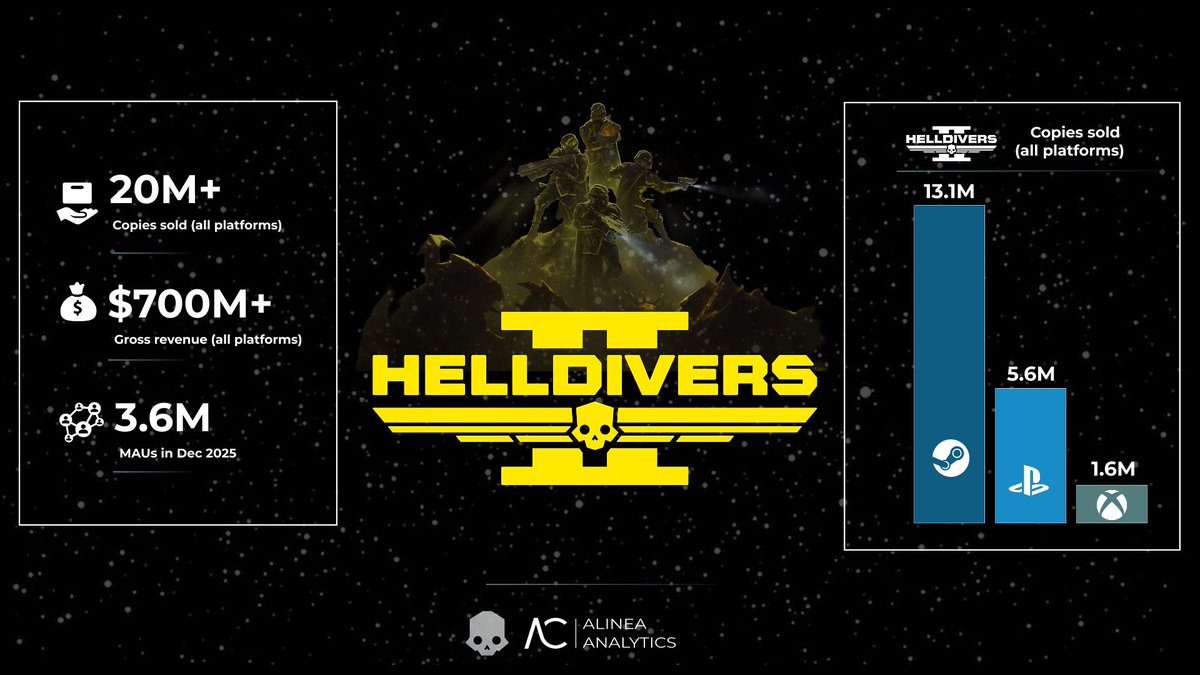
Helldivers 2 has now sold over 20 million copies (@alineaanalytics). WILD. That's over $700 million in gross revenue via copies sold alone. That accounts for regional pricing and historical discounts, of course. And Helldivers is keeping fans engaged, with 3.6M MAUs last month across Steam, PS5, and Xbox. Our estimates show that over 250K gamers have played Helldivers 2 for over 500 hours. Super Earth is in dedicated hands. HD2 is a generational success story alongside Elden Ring and Baldur's Gate 3. And to think: Sony initially bet on Concord instead. More in the new free Substack (link in bio)
Rhys Elliott tweet media
English
11
29
209
52.3K