Angehefteter Tweet
Mathew John
2K posts

Mathew John
@drmathewjohn
Endocrinologist, Learner. Interested in everything ✨
Trivandrum Beigetreten Haziran 2009
871 Folgt1.8K Follower
Mathew John retweetet

Happy to share our publication in BMC Medical Education on the journey of the CCEBDM program in strengthening diabetes care in India.
Over 17,500 primary care physicians trained with significant improvements in clinical practice and patient care. A scalable model for capacity building in non-communicable diseases.
Read more: link.springer.com/article/10.118…
#diabetes #type2diabetes #CCEBDM #DiabetesEducation #DiabetesinIndia @thePHFI @Rssdi_official @WHO @DrJitendraSingh @JPNadda @MoHFW_INDIA @EduMinOfIndia @timesofindia @IndianExpress @IndiaToday @ndtv @ICMRDELHI @IntDiabetesFed @NewIndianXpress @the_hindu

English
Mathew John retweetet

Nothing summarises the brain drain and severe indictment of research infra in India than this study by @Careers360. On a comprehensive study of 31 JEE toppers from 1990 to 2020 (31 years), this is what we found:
A. 23 of the 31 toppers are settled abroad.
B. 28 of the 31 toppers work for a non Indian company.
C. 17 of them are settled in USA.
D. In the 1990 to 2010 period, 7 chose to stay in India. However in the 2011 to 2020 cycle only one in ten stayed back in India.
E. In a severe indictment of academic research in India, 19 of them went on to pursue masters and Phd(13), But NONE chose to pursue any masters in India.
F. 6 studied at Stanford and 5 studied at MIT.
G. 16 of the toppers chose IIT Bombay followed by kanpur and Delhi. However, since 2007, IIT Bombay is the preferred choice.
G. While the initial years, 7 of them chose to be in academia and research, of the 2011 to 2020 period, no one chose academia and research. In fact, many chose to work in investment and hedge fund companies.
So, not many stayed back. Not a single person chose India to study further. Just 10% work for an Indian company.
engineering.careers360.com/articles/the-j…
English
Mathew John retweetet

Hyderabad-based paediatrician Dr. Sivaranjani Santosh on Wednesday (April 1, 2026) defended her campaign against certain electrolyte drinks, alleging that misleading branding and high sugar content in products such as ORSL and its rebranded version ERZL pose a risk to children’s health, reports @The_SidSingh
thehindu.com/news/cities/Hy…

English
Mathew John retweetet

Flu vaccine: Who needs it, how often, and is it worth it?
1. Who should take it?
Annual influenza vaccination is recommended for:
🔸Elderly (≥60 years)
🔸Children (6 months–5 years)
🔸Pregnant women
🔸People with diabetes, asthma and heart Disease
🔸Healthcare workers
Ideally, everyone benefits, but these groups benefit the most
2. How often is flu vaccine needed?
It is recommended to be taken once every year.
This is because:
🔸Flu viruses keep changing
🔸Immunity wanes over time
✅In India, the best time to take is April–May (before monsoon peak)
3. Which flu vaccine is the best?
There are two options:
🔸Trivalent (protects against 3 strains of flu viruses)
🔸Quadrivalent (protects against 4 strains)
✅Quadrivalent vaccine is preferred because of broader protection.
✅All approved vaccines are effective and safe. Brand matters less than getting vaccinated on time.
4. What are the side effects of this vaccine?
🔸Side effects are usually mild, which include injection site pain, low-grade fever and body ache.
🔸Serious reactions such as immune-mediated complications are very rare.
🔸Vaccine does NOT cause flu
5. Who should avoid or delay?
🔸Severe allergy to previous flu vaccine
🔸History of severe allergic reaction to components
🔸Moderate–severe acute illness → delay, not avoid
Flu vaccine is safe in pregnancy and most chronic diseases.
6. Why should one take flu vaccine?
🔸Flu is often a mild illness, but it is NOT always “mild”.
🔴Severe flu can result in hospitalization including mechanical ventilation and ICU care, worsening of chronic diseases, and can even result in myocardial Infarction (heart attack) in high-risk individuals.
Bottom line:
🔸Annual flu vaccine is a simple, safe, underused protection.
🔸Flu shot is not just about flu, it is about preventing complications.
Dr Sudhir Kumar
@hyderabaddoctor
Dr Sudhir Kumar MD DM@hyderabaddoctor
I take annual flu shots; everyone in my family takes. Protection offered by flu shots is much more in value than its cost.
English
Mathew John retweetet

Indian Consensus Guidelines on Adult Immunization 2026 Update
🔹 Adult vaccination in India remains a major missed opportunity, despite excellent gains in pediatric immunization. Adult coverage for influenza, pneumococcal and hepatitis B remains alarmingly low.
🔹 This 2026 update simplifies adult vaccine practice by grouping patients into 12–18 years, 18–49 years, and ≥50 years, with added focus on at-risk, high-risk, immunocompromised, lifestyle-related, pregnancy, and special situations.
🔹 Every adult visit should become a vaccine review visit. Prevention should no longer be restricted to childhood schedules alone.
High-impact practice takeaways
🔹 Influenza vaccine should be annual for all adults, especially older adults, pregnancy, diabetes, CKD, chronic heart/lung/liver disease, and immunocompromised states.
🔹 Pneumococcal vaccination is now much simpler:
Use single-dose PCV20 for all adults ≥50 years and for 18–49 years with risk factors/comorbidities.
🔹 Tdap/Td remains underused in adults.
Give one Tdap in adulthood, then Td/Tdap every 10 years, and one Tdap in every pregnancy (27–36 weeks).
🔹 Hepatitis B vaccination should be strongly considered routine adult preventive care, particularly in diabetes, CKD, dialysis, liver disease, HCPs, and high-risk adults.
🔹 Shingles vaccine is no longer optional thinking in older adults.
Recombinant zoster vaccine is recommended for all ≥50 years, and earlier in selected high-risk individuals.
🔹 COVID-19 vaccination remains relevant in adults, particularly during pandemic/local epidemic settings, and should continue to be prioritized in older adults, obesity, and comorbidity clusters.
Special populations matter
🔹 Diabetes is now clearly recognized as a vaccine-relevant condition.
Core adult vaccine basket in diabetes includes: Influenza, Pneumococcal, Tdap/Td, Hepatitis B, COVID-19, Shingles, and selected MMR/Varicella/HPV where indicated.
🔹 CKD, dialysis, transplant, malignancy, HIV, rheumatologic disease and immunosuppression need structured vaccine planning, not opportunistic prescribing.
🔹 Pregnancy is a key window for prevention.
Routine focus should include Influenza, Tdap, COVID-19, and Hepatitis B when indicated.
🔹 Healthcare professionals must be fully vaccinated, not only for self-protection but for patient safety and institutional infection control.
Practical India-focused message
🔹 Adult immunization should now be treated like BP, HbA1c, and lipid review—a standard part of chronic disease management.
🔹 If the patient has diabetes, CKD, CVD, CLD, COPD, cancer, transplant, or age >50 years, think vaccines proactively—not reactively.
🔹 In Indian OPD practice, the “Big 6” to routinely think of are:
Influenza, Pneumococcal, Tdap/Td, Hepatitis B, COVID-19, and Shingles.
Bottom line
Adult vaccination is no longer preventive luxury — it is standard chronic care.
Source: Indian Consensus Guidelines on Adult Immunization 2026 Update

English
Mathew John retweetet

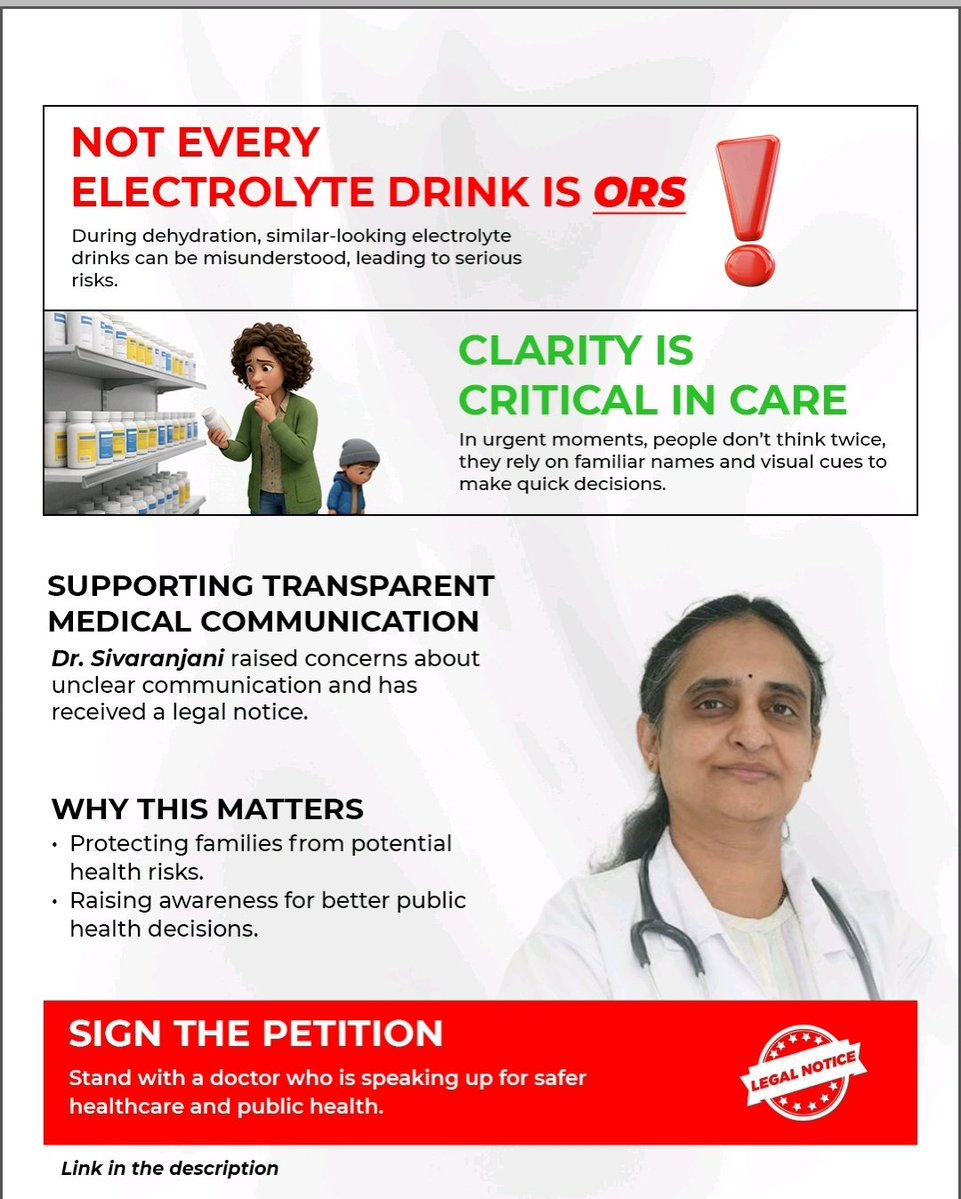
I am Dr. Sivaranjani, a pediatrician , raising concerns about how ERZL is being marketed and positioned in pharmacies, and the risk it creates for consumers making critical decisions during dehydration.
This issue is not about whether ERZL is safe in isolation.
It is about how it is presented, perceived, and potentially misunderstood in real-world settings.
ERZL is a commercially marketed electrolyte drink. However, its branding and advertising raise serious concerns.
*It should not be using ORSL in its communication.*
Why?
Because:
* ORSL itself is not the original medically recommended ORS
* Referencing ORSL in any form creates brand recall in the minds of consumers
* Instead of reducing confusion, it continues and reinforces it
When ERZL is positioned as a continuation or replacement of ORSL, it keeps that same association alive — especially among parents who may already believe ORSL was equivalent to ORS.
👉 This defeats the very purpose of regulatory action.
In pharmacy settings:
* People are often making quick decisions under stress
* They rely on familiar names and visual cues
* Branding can directly influence what they choose
If ERZL continues to build on ORSL recall, it risks being perceived as a medical solution for dehydration, even when it is not the same as ORS (the medically recommended solution).
There are also concerns around ingredients like sucralose, especially in children and with prolonged use, based on global health guidance.
This makes clear communication even more important.
After raising these concerns, I have received a legal notice from Johnson & Johnson and Kenvue.
This petition is not about conflict.
It is about:
* Clarity in healthcare communication
* Preventing consumer confusion
* Ensuring responsible branding and advertising
* Allowing doctors to raise public health concerns without hesitation
We urge the Food Safety and Standards Authority of India and the Ministry of Health and Family Welfare to:
1 *. Ensure that, since ERZL closely resembles ORSL, Kenvue is directed to rebrand it in a way that does not create recall or association with ORSL.*
2. Prevent misleading positioning that may confuse consumers
3. Strengthen enforcement at the pharmacy level
4. Ensure clear differentiation from medically recommended ORS
5. Protect healthcare professionals raising genuine concerns
In healthcare, even small confusion can have big consequences. Clear choices save lives.
@fssai @JPNadda
@MoHFW_INDIA @narendramodi
Stand for public health. Sign and share this petition to help protect every family from confusion in critical moments.
c.org/4wzT58q4wN

English
Mathew John retweetet

What happens when a patient on semaglutide progresses to dialysis — do you stop it?
📢New pooled RCT analysis (SUSTAIN-6, SELECT, FLOW, SOUL; n=34,064) finally addresses this clinical gap.
📈307 patients initiated dialysis
🟢165 stayed on treatment
🔴SAEs: 45% (sema) vs 57% (placebo)
🫀MACE rate: 9.7 vs 16.1 per 100 PY
☠️All-cause mortality: 13.8 vs 18.1 per 100 PY
✅ Numerically favourable across the board.
Continuation appears safe — not powered for efficacy, but reassuring for a question we face regularly.
🏁A dedicated trial is still needed.
doi.org/10.2337/dc26-0…
English
Mathew John retweetet

Presented at #ACC26:
Among patients with atherosclerotic cardiovascular disease, targeting an LDL cholesterol level below 55 mg per deciliter led to a lower 3-year risk of cardiovascular events than targeting a level below 70 mg per deciliter. Full Ez-PAVE trial results: nejm.org/doi/full/10.10…
Editorial: Paving the Road toward Targeted Lipid Lowering nejm.org/doi/full/10.10…
@ACCinTouch

English
Mathew John retweetet

Pls, your lives are so precious! You are your parents life line! Pls do not throw away your lives! Yes. Being a medical student is very tough, and it gets tougher when there is this toxic culture of humiliating students/residents. Pls, FAIMA is working towards making it better for you! Pls reach out to the 24×7 helpline if you are feeling low or if you are being harassed! Do not throw away your precious lives! Hang in there! We are all there for you. Please!
#harassment #medicalcolleges #suicides #FAIMAhelpline #parents
English