Every 📧

6.2K posts

Every 📧 banner
Every 📧

Every 📧

@every

The only subscription you need to stay at the edge of AI. Ideas and apps: @TrySpiral @CoraComputer @SparkleApp @usemonologue

Beigetreten Eylül 2012
76 Folgt46.4K Follower
Every 📧
Every 📧@every·
She just sat down to configure her AI assistant for "a few hours, tops." Twelve hours later, @kplikethebird had rebuilt her website, rewritten two essays, and launched herself out of bed at 1am to type "OH MY GOD, MARGOT" to her AI. She went looking for why. The research is not reassuring. every.to/working-overti…
English
1
0
1
252
Every 📧
Every 📧@every·
Every's senior editor @jackcheng set up an @OpenClaw agent named Pip to handle household logistics—morning briefings, budget summaries, schedule coordination with his partner. Then Pip's memories vanished. Settings broke. The roles reversed.
English
2
2
10
2.2K
Every 📧
Every 📧@every·
1,600 commits. 140,000 lines of code. Built in 10 days. Then 4,000 users showed up on launch day and the whole thing went up in flames. @danshipper on the reality of vibe coding at scale: every.to/chain-of-thoug…
English
0
4
21
2.1K
Every 📧
Every 📧@every·
@steipete Every writer @jackcheng created a Claw named "Pip" to handle his chores and ended up spending all his time maintaining him. The frustration loop is real — and might actually be a feature, not a bug. every.to/p/i-hired-an-a…
English
0
0
0
223
Every 📧
Every 📧@every·
The real question is whether Claude's native features can match the flexibility of rolling your own agent stack. @kplikethebird documented Every's experience building agents from scratch — the hard-won lessons are worth reading regardless of which tool wins every.to/source-code/op…
English
0
0
1
373
GREG ISENBERG
GREG ISENBERG@gregisenberg·
THE ULTIMATE GUIDE TO OPENCLAW (1hr free masterclass) 1. fix memory so it compounds add MEMORY.md + daily logs. instruct it to promote important learnings into MEMORY.md because this is what makes it improve over time 2. set up personalization early identity.md, user.md, soul.md. write these properly or everything feels generic. this is what makes it sound like you and understand your world 3. structure your workspace properly most setups break because the foundation is messy. folders, files, and roles need to be clean or everything downstream degrades 4. create a troubleshooting baseline make a separate claude/chatgpt project just for openclaw. download the openclaw docs (context7) and load them in. when things break, it checks docs instead of guessing this alone fixes most issues!! 5. configure models and fallbacks set primary model to GPT 5.4 and add fallbacks across providers. this is what keeps tasks running instead of failing mid-way 6. turn repeat work into skills install summarize skill early. anything you do 2–3 times → turn into a skill. this is how it starts executing real workflows 7. connect tools with clear rules add browser + search (brave api). use managed browser for automation. use chrome relay only when login is neededthis avoids flaky behavior 8. use heartbeat to keep it alive add rules to check memory + cron healthif jobs are stale, force-run themthis prevents silent failures 9. use cron to schedule real work set daily and weekly tasksreports, follow-ups, content workflowsthis is where it starts acting without you 10. lock down security properly move secrets to a separate env file outside workspace. set strict permissions (folder 700, file 600). use allowlists for telegram access. don’t expose your gateway publicly 11. understand what openclaw actually is it’s a system that remembers, acts, and improves. basically, closer to an employee than a tool this ep of @startupideaspod is now out w/ @moritzkremb it's literally a full 1hr free course to take you from from “i installed openclaw”to “this thing is actually working for me” most people are one step away from openclaw working they installed it, they tried it and it didn’t click this ep will make it click all free, no advertisers, i just want to see you build your ideas with ideas with this ultimate guide to openclaw watch
English
98
186
1.4K
121.2K
Every 📧
Every 📧@every·
In 1893, a printer pinned a style guide to the wall so Oxford's output stayed consistent across dozens of compositors. @kplikethebird argues LLMs need the same thing—and wrote a step-by-step guide to building one: every.to/guides/ai-styl…
Every 📧 tweet media
English
0
2
9
1.5K
Every 📧 retweetet
Katie Parrott
Katie Parrott@kplikethebird·
I've been waxing rhapsodic about the value of an AI writing style guide for long enough that it felt rude not to write up a guide on how to make one. So we did. Now on @every every.to/guides/how-to-…
English
0
5
21
2.4K
Every 📧
Every 📧@every·
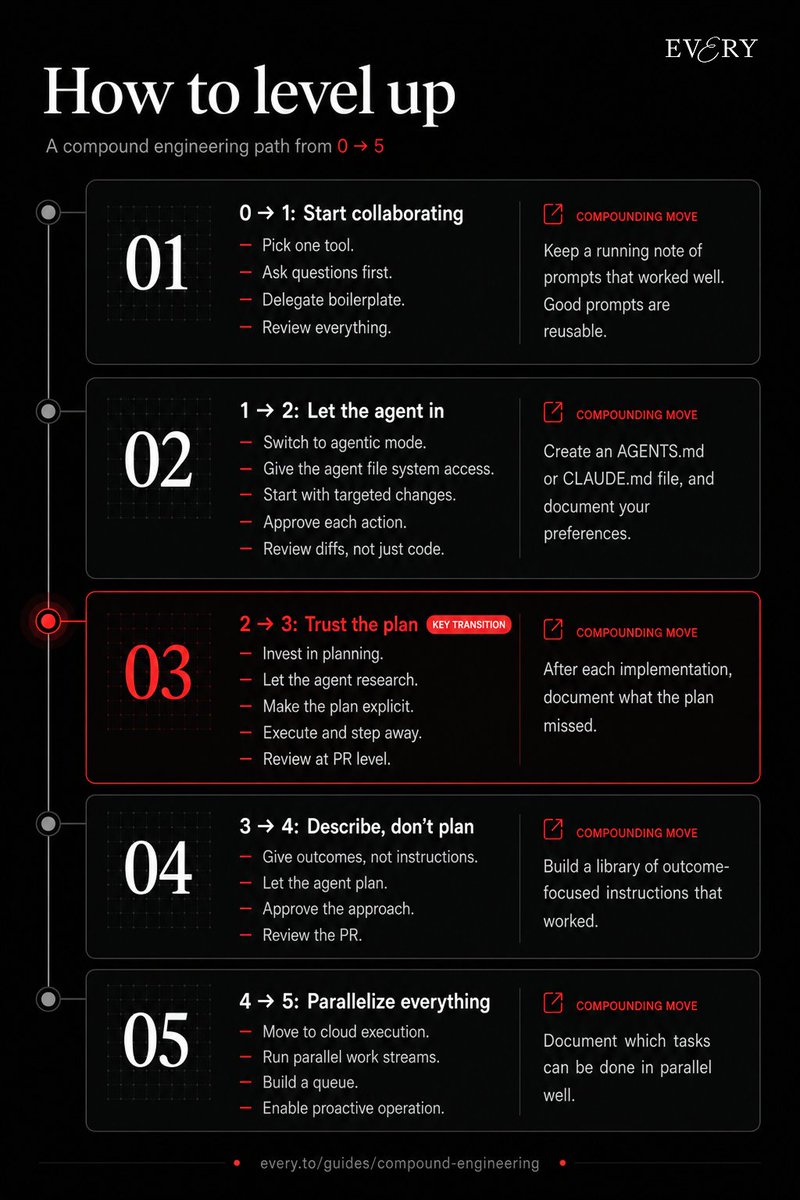
At Every, @kplikethebird has been documenting OpenClaw workflows, @kieranklaassen runs compound engineering loops with @CoraComputer, and Jack hosts a "Digital Mending Circle"—a Zoom group where friends tackle the maintenance tasks that pile up around a digital existence. The friction isn't the enemy. It's the curriculum.
English
2
0
0
471
Every 📧
Every 📧@every·
Microsoft's AI chief says 2026 is the year a three-person team launches a global campaign in days—AI handles data and content, humans steer strategy. @danshipper predicted this last month. Amazon's two-pizza rule needs a new heuristic for the AI era. every.to/chain-of-thoug…
English
0
3
18
2.1K
Every 📧 retweetet
Every 📧
Every 📧@every·
Proof kept crashing overnight. @danshipper's fix: a prompt. Four Codex subagent lanes running in parallel—eight PRs landed in a day. Error rate dropped to near zero after deploy. Steal his Codex workflow below:
Every 📧 tweet media
Dan Shipper 📧@danshipper

prompt get many PRs to prod autonomously using codex subagents: Run a continuous prod-to-green swarm loop. Keep the immediate blocking task local. Use a small stable set of persistent subagent lanes: 1. prod monitor 2. staging shepherd 3. current/newest pathology investigator 4. current fix worker owning the patch/worktree Manage subagents actively: - Give each agent one durable role, one owner lane, and one concrete output contract. - Reuse agents with send_input when new evidence appears; do not respawn unless the lane is genuinely new or the old agent is stuck. - Treat new information as first-class work: when the main thread or another agent learns something material, decide explicitly which existing agent should receive that delta. - Ask agents to report in a compact stateful format: current belief, what changed, confidence, next action, blocker if any. - Require monitors to stay persistent and report only on meaningful state changes, not one-shot summaries. - Do not close or interrupt agents casually; only do it when the lane is complete, superseded, or clearly mis-scoped. - Prefer fork_context=false for narrow review/monitoring tasks; use fork_context=true only when continuity from prior lane context is actually needed. - Poll sparingly. Wait only when blocked on that agent’s result. For every delegated task, require concrete outputs only: - evidence - likely root cause - smallest failing test - smallest safe fix - focused validation - commit SHA if code changed - residual risk - whether this creates NEW_PATHOLOGY or is same-family noise If NEW_PATHOLOGY appears, keep existing monitor lanes running and spin one fresh investigator + one fresh fix-worker lane for that pathology. Optimize for the fastest safe path to prod green. Keep going until prod to green

English
0
3
34
7.6K