Every 📧

6.6K posts

Every 📧 banner
Every 📧

Every 📧

@every

The only subscription you need to stay at the edge of AI. Ideas and apps: @TrySpiral @CoraComputer @SparkleApp @usemonologue

Katılım Eylül 2012
83 Takip Edilen53K Takipçiler
Sabitlenmiş Tweet
Every 📧
Every 📧@every·
AI progress creates more work for humans, not less. Dive into our new report from @danshipper — and use the companion repo to read it with your agent 👇
Dan Shipper 📧@danshipper

We’ve automated every single thing we can @every with AI agents. And yet there’s way more human work to do than ever. We’ve gone from 4 -> 30 human employees since GPT-3. I wrote a report on the structural reasons: how AI makes expert competence cheap, why that drives up demand for experts, and why the dynamic only intensifies as we approach AGI. After Automation: every.to/p/after-automa…

English
3
6
45
43.4K
Every 📧
Every 📧@every·
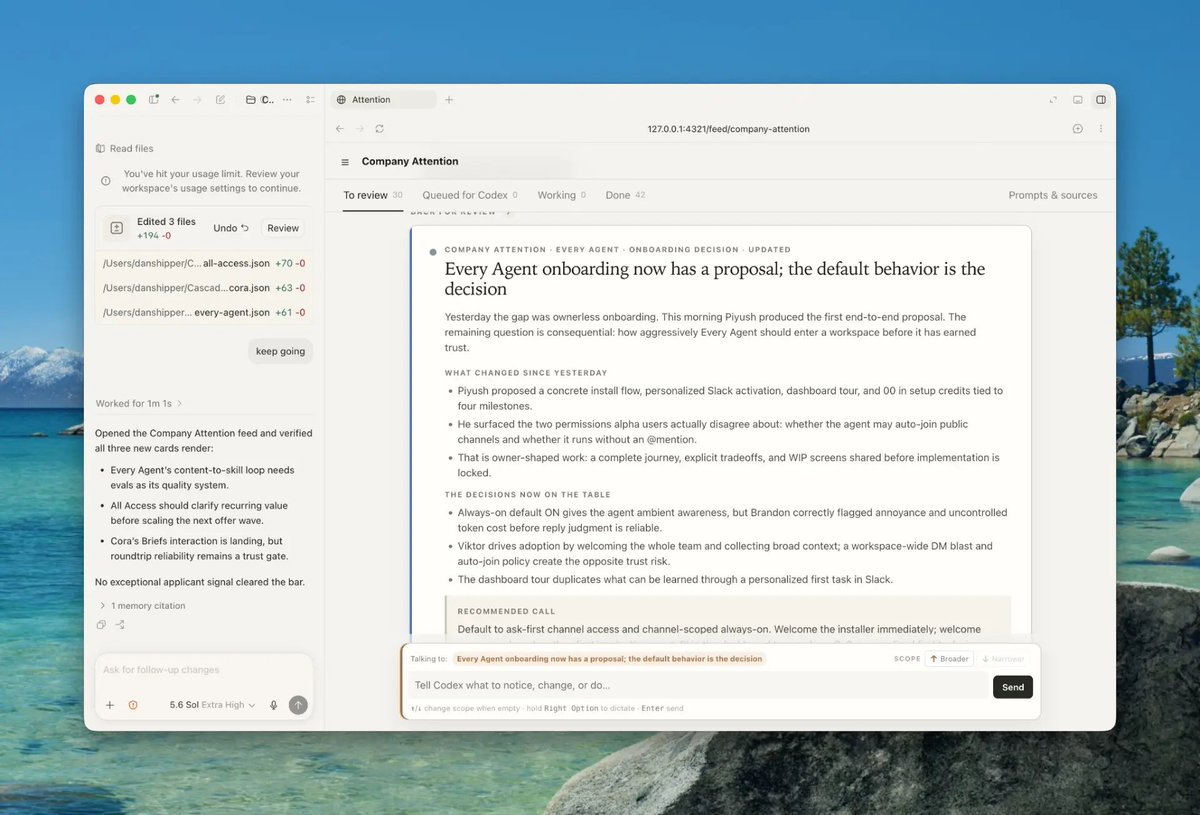
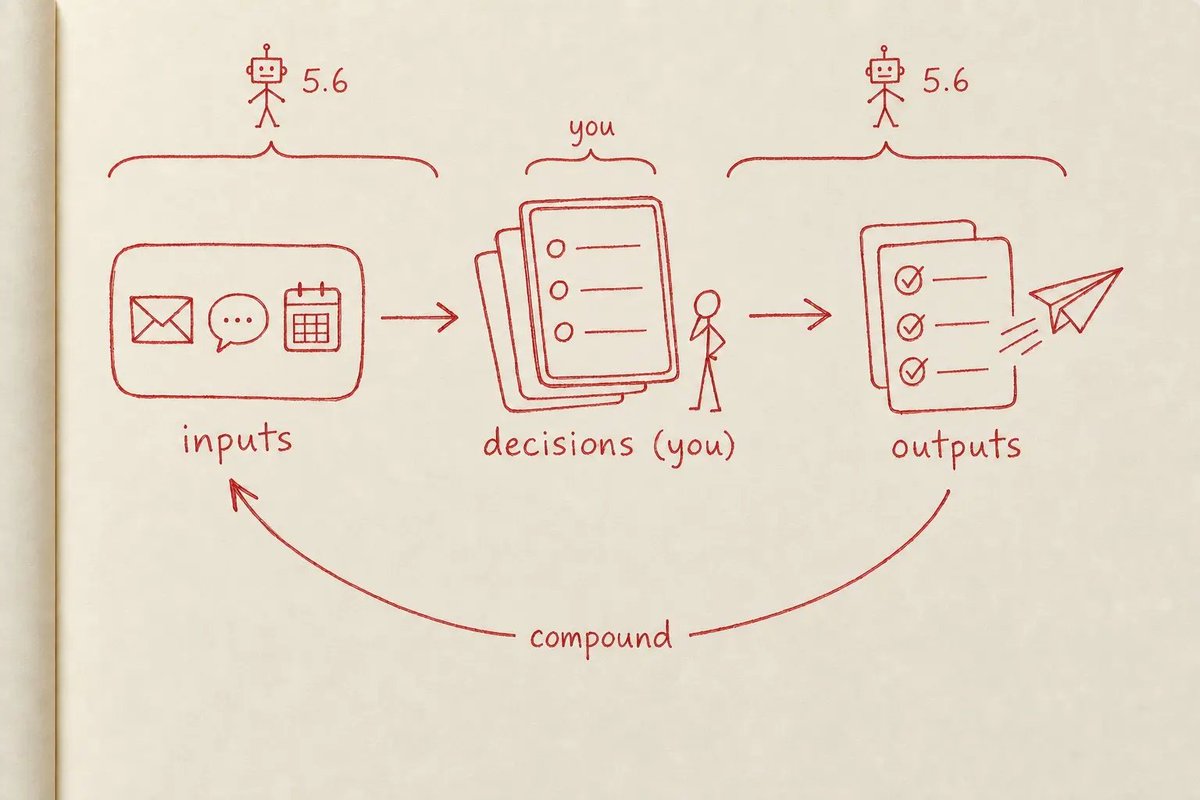
GPT-5.6 has changed how we think about knowledge work. Your job shifts from handling individual tasks to tending systems with AI loops. Here’s what that looks like in @danshipper’s inbox: GPT-5.6 sweeps his email, decides what deserves his attention, researches the context, and presents each email with a short summary and proposed reply. Dan approves, edits, or reaches for @usemonologue to dictate what he wants changed. Then he moves on. At the end of each sweep, the agent learns from Dan’s revisions and decisions and remembers them for next time. Today we’re releasing Tend, an experiment that lets you build this kind of loop yourself. It’s an open-source prompt and repository for turning an inbox, hiring pipeline, or customer-support queue into a system you can tend in ChatGPT Work. Start by teaching Tend what deserves your attention. Then notice what happens: The inbox gets easier, the instructions get better, and another loop in your work begins to reveal itself.
Every 📧 tweet mediaEvery 📧 tweet media
English
13
18
232
91.1K
Every 📧 retweetledi
Dan Shipper 📧
Dan Shipper 📧@danshipper·
the state of the race between Anthropic and OpenAI: - Ant: Make the biggest, most powerful, most expensive model possible—Fable. Use that to hit RSI faster and break away from the race. - OpenAI: Make a powerful, useable model that you can serve efficiently / cheaply with a ton of compute—5.6 Sol. Focus on a ton of post-training rather than raw model size. 5.6 is definitely a better daily driver model for the vast majority of people / use cases today. However, there are significant compounding benefits to continuing to push the frontier game on!
English
68
21
621
65K
Every 📧 retweetledi
Katie Parrott
Katie Parrott@kplikethebird·
It’s such a relief finally being able to talk about GPT-5.6 on main. I haven't been this inspired by a model since Opus 4.5 Full @every Vibe Check is live: every.to/vibe-check/gpt…
English
2
3
32
5.3K
Every 📧 retweetledi
GREG ISENBERG
GREG ISENBERG@gregisenberg·
GPT 5.6 SOL IS HERE! How to run your personal + business life with GPT 5.6 Sol + Codex (full 49 min masterclass) We tested it for 30 days and the video it's the CLEAREST look at the FUTURE of work: Here's what's possible once you set it up: 1. Your inbox becomes cards every morning, each with a summary and a reply drafted in your own voice. Y 2. Your Slack, meeting notes, and company updates can turn into one daily feed with a clear next action. It learns what you care about over time and rewrites its own prompts to get sharper. 3. You can give your agent its own email address, so your other tools and even your team's Slack bot email it directly and it just handles things. 4. You can have it watch you do a task once and turn it into a skill it repeats forever. 5. You can set a long goal and walk away. You can have it run for 20 hours straight, and fine-tune your own models, something that was out of reach for non-engineers 12 months ago. How to start: Open Codex, give it access to your computer, and ask it to suggest things it could do for you based on how you already work. Full episode on @startupideaspod (thanks @danshipper for sharing your entire workflow and review of GPT 5.6) Start with one boring task, get it working, and build from there. You'll learn exactly how to make something similar. GPT 5.6 Sol is impressive. Sol (according to openAI benchmarks) is the best coding model out right now. It set a new state of the art on Terminal-Bench 2.1 at 88.8%, and its "ultra mode" hits 91.9%, beating Claude Opus 4.8, Fable 5, and even Mythos 5 this masterclass is 100% free, like always. For more @startupideaspod Watch
English
78
140
1.6K
145.9K
Every 📧
Every 📧@every·
It's a good day to dive into our Codex guide, featuring 24 prompts perfect for GPT-5.6 👇👇👇
English
2
5
49
7K
Every 📧 retweetledi
Austin Tedesco
Austin Tedesco@tedescau·
Facts
Austin Tedesco tweet media
English
1
1
4
1.1K
Every 📧 retweetledi
Mike Taylor
Mike Taylor@hammer_mt·
Sol is my new daily driver – best all round model* *Fable is still the smartest
Dan Shipper 📧@danshipper

BREAKING: GPT-5.6 Sol is out—AND Codex has been merged into ChatGPT Desktop as ChatGPT Codex. This combo model and desktop app harness are the gold-standard for knowledge work in AI. 5.6 is powerful, fast, half the price of Fable, and my default for almost everything. We’ve been testing it internally @every for about a month across coding, writing, design, and knowledge work. Here’s our day-zero vibe check: - An A-tier coder—but it’s not Fable. Sol scored 56/100 on our Senior Engineer benchmark compared to a 91 for Fable. I think the 56/100 undersells it, it's an excellent implementor, and very smart. But Fable just writes conceptually cleaner code and works better at the top end of task complexity. PRO-TIP: Use GPT-5.6 as Fable's subagent for the most goated combo in AI coding. - The best writer of the frontier models. It’s clearer and more concise than Fable or Opus 4.8, without the overexplaining or weird private language. It can one-shot marketing emails, help you workshop taglines, and explain complex concepts clearly. It's also super fast, which makes it easy to collaborate with. - Design is better, but not top-tier. It has noticeably more taste than 5.5, but Fable and Opus 4.8 are still playing at a different level. See examples in the video and vibe check below. - The real leap is knowledge work. Sol is the first model I’ve trusted to run whole loops of knowledge work—not just help with individual tasks. I use it to process email, surface decisions from meetings and Slack, find job candidates, scan Facebook Marketplace for furniture, and log my meals. It has shifted my job from doing the work to tending the system that does it. - The merged app is fine. I was extremely worried about this because I love the Codex app. OpenAI was caught in an interesting position: How to make an agent orchestration app for regular ChatGPT consumers, coders, and businesses all in one app. They now split the interface between ChatGPT Work and ChatGPT Codex. They're basically the same except Work hides code. And "Chat" has been demoted to 2nd tier status for quick questions in either one. It's not a big leap, but it's not a huge setback either. And it remains my favorite of the desktop agent orchestration apps. Verdict: If I really had to put my finger on it, I'd say Fable has way more big model smell. But that means it's a skill in itself to get value out of it—99% of people are still not there yet. GPT-5.6 is almost as powerful, but is easy to use, fast, and relatively cheap. It should give you an early sense of where model work is going. Full @every Vibe Check: every.to/vibe-check/gpt…

English
0
2
6
1.8K
Every 📧
Every 📧@every·
🚨🚨🚨
Dan Shipper 📧@danshipper

BREAKING: GPT-5.6 Sol is out—AND Codex has been merged into ChatGPT Desktop as ChatGPT Codex. This combo model and desktop app harness are the gold-standard for knowledge work in AI. 5.6 is powerful, fast, half the price of Fable, and my default for almost everything. We’ve been testing it internally @every for about a month across coding, writing, design, and knowledge work. Here’s our day-zero vibe check: - An A-tier coder—but it’s not Fable. Sol scored 56/100 on our Senior Engineer benchmark compared to a 91 for Fable. I think the 56/100 undersells it, it's an excellent implementor, and very smart. But Fable just writes conceptually cleaner code and works better at the top end of task complexity. PRO-TIP: Use GPT-5.6 as Fable's subagent for the most goated combo in AI coding. - The best writer of the frontier models. It’s clearer and more concise than Fable or Opus 4.8, without the overexplaining or weird private language. It can one-shot marketing emails, help you workshop taglines, and explain complex concepts clearly. It's also super fast, which makes it easy to collaborate with. - Design is better, but not top-tier. It has noticeably more taste than 5.5, but Fable and Opus 4.8 are still playing at a different level. See examples in the video and vibe check below. - The real leap is knowledge work. Sol is the first model I’ve trusted to run whole loops of knowledge work—not just help with individual tasks. I use it to process email, surface decisions from meetings and Slack, find job candidates, scan Facebook Marketplace for furniture, and log my meals. It has shifted my job from doing the work to tending the system that does it. - The merged app is fine. I was extremely worried about this because I love the Codex app. OpenAI was caught in an interesting position: How to make an agent orchestration app for regular ChatGPT consumers, coders, and businesses all in one app. They now split the interface between ChatGPT Work and ChatGPT Codex. They're basically the same except Work hides code. And "Chat" has been demoted to 2nd tier status for quick questions in either one. It's not a big leap, but it's not a huge setback either. And it remains my favorite of the desktop agent orchestration apps. Verdict: If I really had to put my finger on it, I'd say Fable has way more big model smell. But that means it's a skill in itself to get value out of it—99% of people are still not there yet. GPT-5.6 is almost as powerful, but is easy to use, fast, and relatively cheap. It should give you an early sense of where model work is going. Full @every Vibe Check: every.to/vibe-check/gpt…

ART
0
1
56
18.8K
Every 📧 retweetledi
Katie Parrott
Katie Parrott@kplikethebird·
GPT-5.6 is smart, resourceful, persistent, and takes direction well. Everything you could ever want in a daily driver for collaborative knowledge work, basically. Full Vibe Check coming tomorrow (and yes, we are using 5.6 to write it)
Dan Shipper 📧@danshipper

GPT-5.6 is like a Porsche, Fable is like a warp drive. We've been testing internally @every for about a month. And GPT-5.6 is the best combination of power, speed, and performance for your day to day knowledge work and coding. Fable is a different beast. If you need to get across the galaxy use Fable. If you need to get around town using the best available tool for the job, use 5.6 Full vibe check dropping tomorrow!

English
2
4
38
7.5K
Every 📧 retweetledi
Kieran Klaassen
Kieran Klaassen@kieranklaassen·
GPT-5.6 is very good at doing a lot of work. It's not as good as Fable but it's way faster and not too far off. This is def one in my daily drivers.
Dan Shipper 📧@danshipper

GPT-5.6 is like a Porsche, Fable is like a warp drive. We've been testing internally @every for about a month. And GPT-5.6 is the best combination of power, speed, and performance for your day to day knowledge work and coding. Fable is a different beast. If you need to get across the galaxy use Fable. If you need to get around town using the best available tool for the job, use 5.6 Full vibe check dropping tomorrow!

English
3
2
59
9.4K
Every 📧 retweetledi
Dan Shipper 📧
Dan Shipper 📧@danshipper·
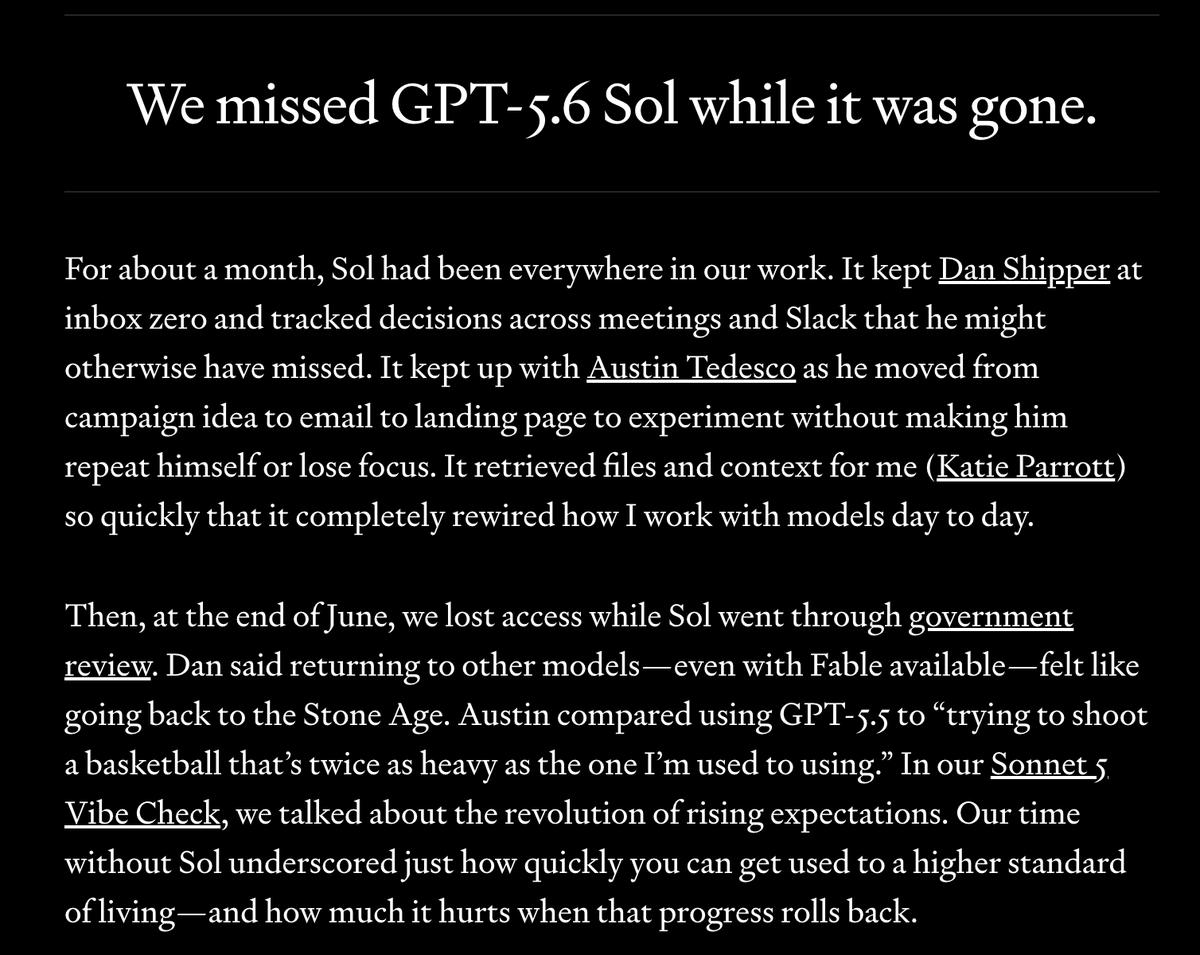
You don't know what you have until you lose it. We've been testing GPT-5.6-Sol for about a month @every. We briefly lost access for about a week, and I felt like I was back in the stone age. Even with Fable access. It's just such a good daily driver. Allows me to delegate so many knowledge work tasks (like email) in a way that no other model can.
English
35
26
729
57.1K
Every 📧
Every 📧@every·
We spent nearly a month running @OpenAI’s GPT-5.6 Sol through real work. Then we lost early access for a week. As @tedescau put it, reverting to lesser models felt “like I’m trying to shoot a basketball that’s twice as heavy.” Sol is our favorite model to work with. Here are five things we learned: 1. Speed changes the work. Sol is the fastest model we trust as a daily driver. A revision costs minutes, which makes it easier to discard a weak draft, try a different direction, and keep moving while the problem is still in your head. 2. It finds the context it needs. Give Sol an outcome and access to the project. It reads the relevant files, follows standing instructions, asks useful questions, and keeps those choices through long runs. But @naveennaidu_m found it also follows stale instructions, so rules written around older models can make it worse. 3. One thread can carry a project into production. @tedescau uses the same Codex thread to research a campaign, draft the copy, build the landing page, and launch the experiment. @jackcheng edits copy inside the page he’s building. The project keeps moving without a second brief. 4. It plans well, then may build too much. Sol found a production bug GPT-5.5 missed, verified the fix, and waited for permission to ship. On broad rewrites, it can add unnecessary machinery. We get better results by setting a target system size, reviewing the first slice, and requiring progressive commits plus an audit. 5. It works best when you plan to steer. Sol gets better when the surrounding system supplies sources, examples, style guidance, and a clear outcome. Review its choices and redirect it as the work changes. We use Fable for the loosest, longest assignments and Opus when we want to see the work more clearly. Sol is what we want beside us for the work that fills the day.
English
5
15
265
29.4K
Every 📧 retweetledi
Mike Taylor
Mike Taylor@hammer_mt·
Here's my GPT-5.6 take after testing it this past month: good enough to become my daily driver (Codex is a way better harness!) but I still need a bit of Fable in my life.
English
3
4
27
5K