La Pierre Group retweetet

A universal neural network for spin–orbit coupling across the entire periodic table
Spin–orbit coupling (SOC) drives some of the most exciting physics in quantum materials—topological insulator phases, spin–momentum locking, valley polarization in 2D systems, and spintronic device concepts. Yet computing SOC electronic structures from first principles is painfully expensive: relativistic DFT with SOC is ~8× slower than non-SOC calculations, and the resulting Hamiltonians are complex-valued matrices with quadrupled dimensions. This has severely bottlenecked high-throughput discovery of SOC-driven materials.
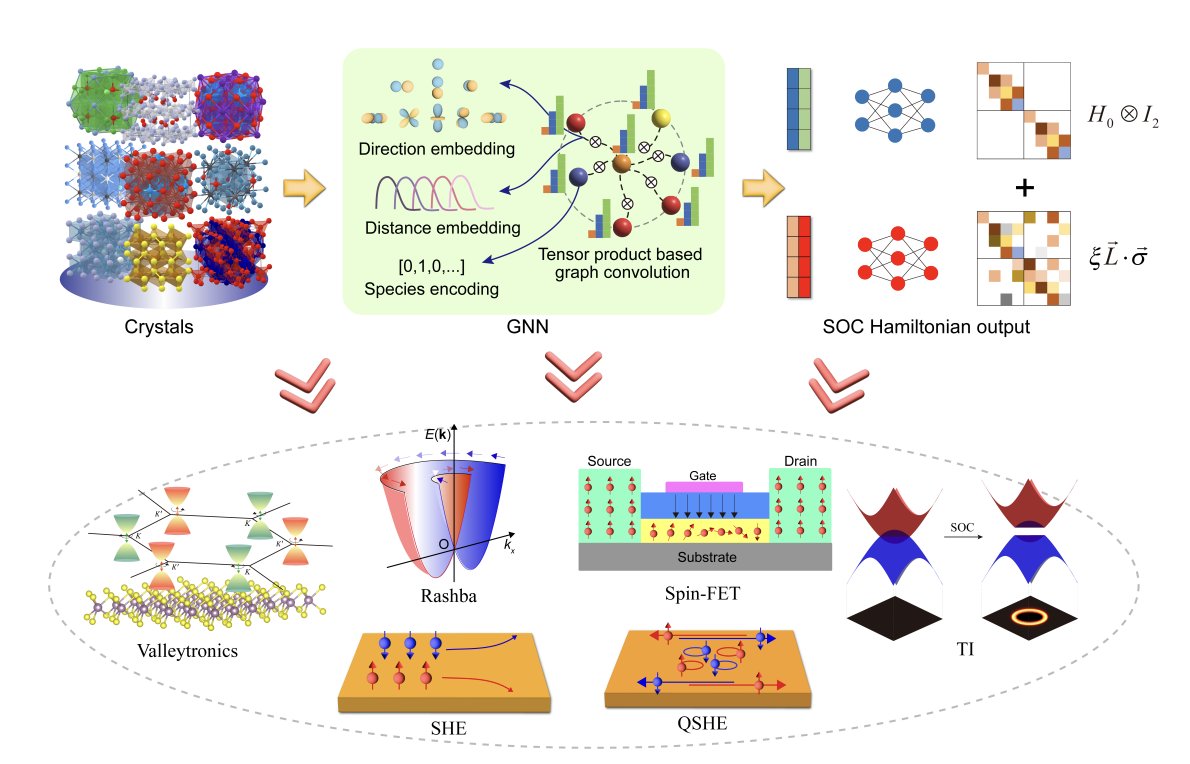
Yang Zhong and coauthors introduce Uni-HamGNN, a universal graph neural network that predicts full SOC Hamiltonians for any element combination across the periodic table, without system-specific retraining.
The core idea is a physics-informed decomposition: rather than learning the full complex Hamiltonian directly, they separate it into a spin-independent component H₀ and a SOC correction ξL̂·σ̂, where ξ is a learnable strength coefficient and the angular momentum–spin coupling matrices are computed analytically. This preserves SU(2) symmetry by construction and dramatically reduces learnable parameters.
The training strategy is equally important. Since H₀ (~tens of eV) and the SOC term (~tenths of eV) differ by two orders of magnitude, joint training effectively ignores SOC. The authors use delta learning: 44,000 non-SOC Hamiltonians train one channel, only ~10,000 SOC matrices train another. A two-stage protocol first optimizes Hamiltonian fidelity, then fine-tunes with band structure eigenvalue consistency—avoiding gradient divergence from differentiating through inaccurate eigendecompositions.
Results on 5,000 test materials: 3.58 meV MAE for real components, 0.0025 meV for imaginary, and SOC spin-splitting errors of just 1.3 meV. High-throughput screening of 10,000+ heavy-element GNoME compounds identified 138 topological insulators, confirmed by independent VASP calculations. Most remarkably, though trained only on 3D bulk crystals, Uni-HamGNN accurately predicts Berry curvature and valley polarization in 2D monolayers and twist-angle-dependent spin splittings in MoSe₂–WSe₂ heterobilayers—with 100–1000× speedup over DFT.
The message: embedding physical symmetry and scale separation directly into network architecture and training enables genuinely universal ML tools for quantum materials discovery, replacing costly relativistic DFT workflows with rapid, transferable predictions.
Paper: nature.com/articles/s4225…
English