G.W. Jackston

765 posts

G.W. Jackston banner
G.W. Jackston

G.W. Jackston

@galactiator

No mud, no lotus

Beigetreten Ekim 2011
366 Folgt437 Follower
G.W. Jackston
G.W. Jackston@galactiator·
RMAT does not lower the evidentiary standard on its own, but the statute allows approval based on a surrogate 'reasonably likely to predict clinical benefit.' That is a congressionally designed lower bar than traditional approval. FDA reviewed the ALC-OS correlation with full knowledge of the exploratory threshold and granted that specific statutory eligibility, formally signaling that the surrogate clears the AA credibility threshold. The confounding argument is a red herring, and here is specifically why: the concern that healthier patients have higher lymphocyte counts is a valid critique of baseline ALC. The endpoint is not baseline ALC. It is mean on-treatment ALC elevation, a drug-driven pharmacodynamic response to IL-15 stimulation. You have correctly identified a confounder that applies to a measurement we are not using. Technically valid, directed at the wrong variable. Anktiva's IL-15 mechanism directly drives CD8+ T cell and NK cell proliferation. When those populations expand, ALC rises, an active pharmacodynamic effect, not a reflection of baseline health. Documented in the first-in-human Phase 1 trial in Blood 2018 (Romee et al., PMID: 29463563): "ALT-803 stimulated the activation, proliferation, and expansion of NK cells and CD8+ T cells without increasing regulatory T cells." Seven years of IL-15 biology does not become irrelevant because of a confounding argument that applies to baseline measurements, not on-treatment pharmacodynamic response. On identifying high responders prospectively: the indication design answers this. The proposed AA indication is not broad NSCLC- it is adult patients with chemotherapy-induced lymphopenia across solid tumors, defined by a post-chemotherapy CBC showing ALC below threshold before treatment begins. The entry criterion is the biomarker. Prospectively definable with a routine blood test. This is not post-hoc subgroup splitting. On randomized confirmatory data: agreed, and that is precisely what ResQ201A delivers. The AA sequence is surrogate signal, narrow approval, confirmatory RCT, exactly what Congress designed the pathway to do. The critique that confirmatory data is needed is accurate. The critique that approval cannot precede it misunderstands the framework entirely. The post-hoc threshold refinement is a genuine procedural limitation (acknowledged). What it is not: evidence the correlation was manufactured. ALC was prospectively measured throughout as standard pharmacodynamic monitoring. An exploratory analysis confirming what seven years of IL-15 biology predicted is not data dredging. $IBRX
English
0
0
1
13
AscendingBio
AscendingBio@AscendingBio·
I really do not follow your logic here. Concerning RMAT, that is given when there is an illness for which there is great need for improved treatment. They do consider preliminary data that suggests the new treatment might work. Many times it does not. RMAT does not lower the standard for the data required for approval. RMAT opens the door to more communication with the FDA.
English
1
0
0
34
AscendingBio
AscendingBio@AscendingBio·
$IBRX Accelerated Approval for NSCLC? (Part 3 of 3) I often see posts calling for the FDA to immediately grant accelerated approval to Anktiva for Non Small Cell Lung Cancer (NSCLC). The focus for $IBRX has been 2nd line treatment. (They ended a frontline study.) In a phase 2, Dr. Patrick verbally reported that Anktiva plus a checkpoint inhibitor had a median Overall Survival of 14 months. Take a look at slides 22 and 23 in this presentation by Iovance. ir.iovance.com/static-files/5… They found that at 24.5 months after treatment the median duration of response has not been met. That means more than half are still alive at 24.5 months and maintaining the response to treatment. So, the Iovance results are likely to be years more of survival than ImmunityBio. Yes, TIL therapy is more challenging, but it is worth it with results like this. They do not have approval yet from the FDA for this type of cancer. They do not protest or go overseas. They work to fully enroll the study before going to the FDA. With more data like this, the Accelerated Approval path should be open to them. They are also advancing new versions that are even more effective. A recent study compared Dato-DXd to Docetaxel in the same context (previously treated NSCLC without actionable genomic alterations). They found Median PFS: 4.4 vs 3.7 months (HR 0.75, P=0.004). Median OS: 12.9 vs 11.8 months (HR 0.94, P=0.530 – not statistically significant). They dropped the drug from this indication after getting an OS of 12.9 months. ImmunityBio took their 14 month OS results to Saudi Arabia and sought approval. On the last call, Dr. Patrick proclaimed this result was amazing and they had doubled median OS from 7 months to 14. If you do not study competitors, this sounds good. There are several reasons the FDA will not accept Anktiva under accelerated approval for NSCLC at the current stage. One is that the phase 2 study used Anktiva and a checkpoint inhibitor. The phase 3 study utilizes Anktiva, a checkpoint inhibitor, and Docetaxel (chemo). That is compared to Docetaxel alone. This resets everything when you make that kind of a change. If you thought the phase 2 combo was good, why did you change it in the phase 3? Accelerated approval by FDA rules include using one variable that you establish as a predictor for a variable you will not know until the future. That does not apply here. ImmunityBio already has Overall Survival data for the phase 2. It might be possible to submit the new triple combo data to the FDA a year or so after full enrollment using the phase 3 interim results under Accelerated Approval. Maybe, you have progression free survival data by the 10-month mark. It would take dramatically different progression free survival numbers for treatment versus control. It would need to appear that Overall Survival numbers for the treatment group would not be available for a year or more. If it looks like the treatment group is likely to have median survival of about 14 months and 7 months for the control, why not wait another 6 months and submit the Overall Survival numbers? That OS data is going to be available during the FDA review process. The FDA will likely pause and delay the approval process in order to consider the new data. Another factor for the phase 3 study is that it is using a 3 drug combo where the design does not lend itself to determining the contribution made by Anktiva. It is possible that the FDA requires another study to determine this contribution. They may say, "It could be that adding the checkpoint inhibitor to Docetaxel is what prompted treatment versus control differences." I am not ruling out that Anktiva is eventually approved for 2nd line NSCLC by the FDA. My point is that there is not a short-term path. I encourage you to go check my work. Go read the regulations on the FDA website. Look up other companies that were recently granted Accelerated Approval. Keep in mind that most companies do not submit under the AA program unless they have informal support from FDA staff. If a company is told they likely need more data to support a surrogate endpoint, they will typically not submit until they have that data in hand. The basic Accelerated Approval structure is based on law passed by Congress. If you want this to be different you need to get new laws passed by Congress.
English
6
3
42
4.1K
G.W. Jackston
G.W. Jackston@galactiator·
@oshea9_harry @AscendingBio lol really. But I fixed it for you. x.com/galactiator/st…
G.W. Jackston@galactiator

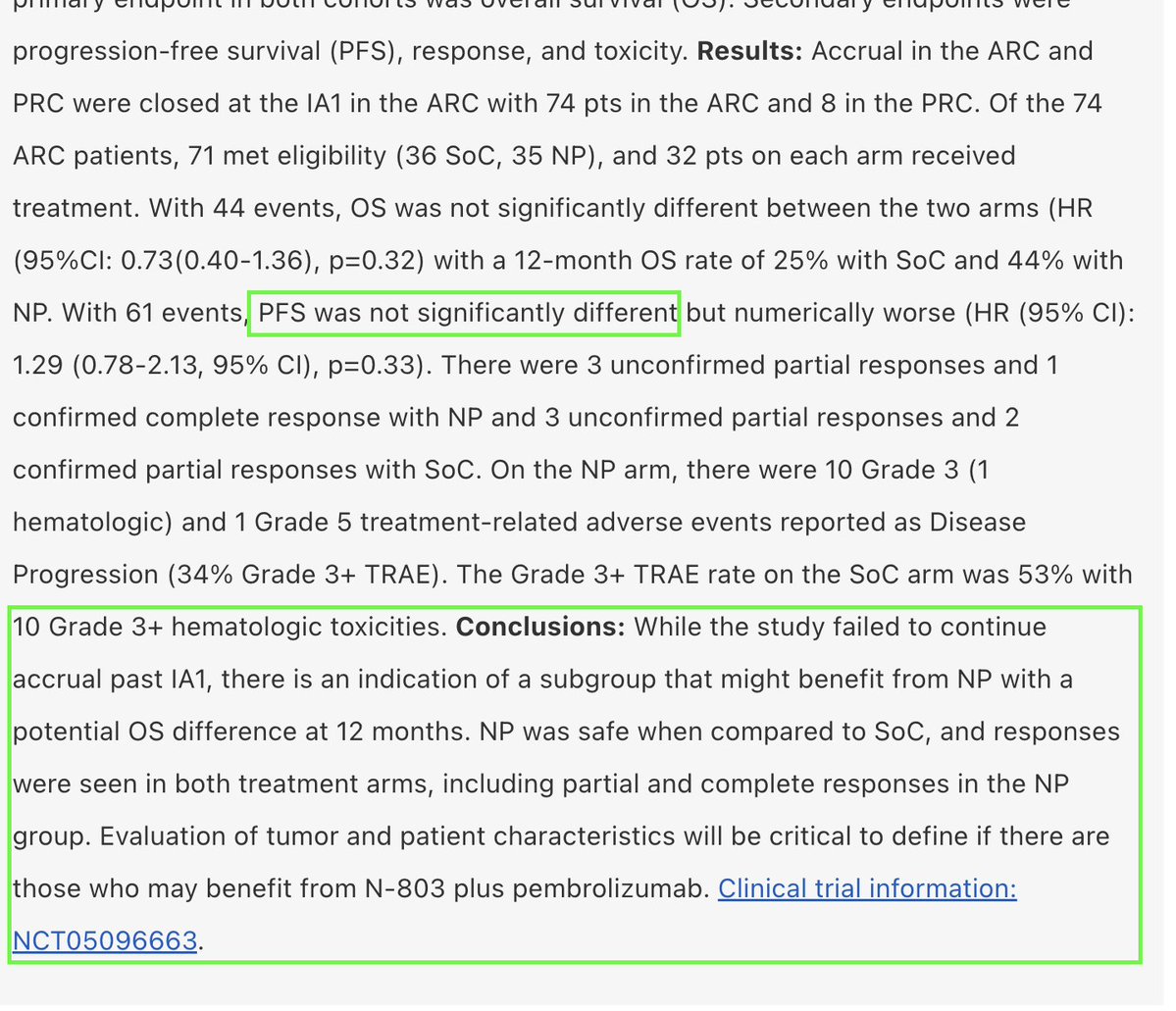
Thanks for the CI definition, I guess (?). Too bad it ignores what the CI tells you about this specific result. HR 1.29, 95% CI (0.78-2.13), p=0.33. p=0.33 means there is a 33% probability of observing this result by chance alone under the null hypothesis. The conventional threshold for rejecting the null is p<0.05. This is six times above that threshold. The trial failed to reject the null hypothesis. Full stop. CI spanning 0.78 to 2.13 means the true population HR could plausibly be anywhere from a 22% PFS benefit for Anktiva to a 113% detriment. The range includes 1.0 (no difference) comfortably in the middle. This CI does not tell you which direction the truth lies. It tells you the trial was too underpowered to determine direction. "Numerically worse" with p=0.33 and a CI crossing 1.0 is statistically meaningless. A point estimate without statistical significance is noise. If you want to argue the point estimate is meaningful, you need a powered trial. Lung-MAP explicitly was not. Hence why the authors say, "PFS was NOT SIGNIFICANTLY DIFFERENT, but numerically worse" This is not opinion. This is literally what those numbers mean by definition. You also still haven't addressed the OS HR of 0.73, the near-doubling of 12-month survival, the 34% vs. 53% adverse event rate, or the authors' own conclusion (crop crop crop). Ad hominem attack while ignoring four data points is the cry of the defeated. $IBRX

English
1
0
1
33
G.W. Jackston
G.W. Jackston@galactiator·
Post-hoc threshold- acknowledged, explained, and addressed. That's why ResQ201A exists. FDA reviewed the full package including the timeline and granted RMAT anyway. Why do you continue to ignore that? "Aggregating" - a hazard ratio is calculated from individual patient survival times. That's not aggregate. That's the definition of a per-patient analysis. You've now said this twice without explaining how HR 0.52 derived from individual survival data is aggregate... because you can't.
English
1
0
0
18
Harpoon Harry
Harpoon Harry@oshea9_harry·
@galactiator @AscendingBio Procedural time stamp? Post hoc addition of end points over a year later and the data provided obfuscated real delta by aggregating You seem lost
English
1
0
1
47
G.W. Jackston
G.W. Jackston@galactiator·
89 days between the public ClinicalTrials status change and the formal announcement. That's your "hidden for years"? The enrollment shortfall is real- and it's explained by KEYNOTE-024, KEYNOTE-189, and KEYNOTE-407 destroying first-line chemo control arms between 2016-2018. This wasn't unique to ImmunityBio as it disrupted dozens of first-line trials across major pharma: Roche/Genentech first-line combination programs were restructured, AstraZeneca, Pfizer, BMS all redesigned or closed first-line NSCLC programs for precisely this reason. ImmunityBio released positive ALC data the same day as the closure. Is that what concealment looks like?
English
1
0
0
14
Harpoon Harry
Harpoon Harry@oshea9_harry·
@galactiator @AscendingBio Indeed that is what the company says publicly But, the reality is the same combo failed to add anything in 2nd line plus in lung map, it failed to contribute to OS in quilt 3.055 and they saw the same in quilt 2.023 in first line. The company hid halting it for years
English
1
0
0
34
G.W. Jackston
G.W. Jackston@galactiator·
Thanks for the CI definition, I guess (?). Too bad it ignores what the CI tells you about this specific result. HR 1.29, 95% CI (0.78-2.13), p=0.33. p=0.33 means there is a 33% probability of observing this result by chance alone under the null hypothesis. The conventional threshold for rejecting the null is p<0.05. This is six times above that threshold. The trial failed to reject the null hypothesis. Full stop. CI spanning 0.78 to 2.13 means the true population HR could plausibly be anywhere from a 22% PFS benefit for Anktiva to a 113% detriment. The range includes 1.0 (no difference) comfortably in the middle. This CI does not tell you which direction the truth lies. It tells you the trial was too underpowered to determine direction. "Numerically worse" with p=0.33 and a CI crossing 1.0 is statistically meaningless. A point estimate without statistical significance is noise. If you want to argue the point estimate is meaningful, you need a powered trial. Lung-MAP explicitly was not. Hence why the authors say, "PFS was NOT SIGNIFICANTLY DIFFERENT, but numerically worse" This is not opinion. This is literally what those numbers mean by definition. You also still haven't addressed the OS HR of 0.73, the near-doubling of 12-month survival, the 34% vs. 53% adverse event rate, or the authors' own conclusion (crop crop crop). Ad hominem attack while ignoring four data points is the cry of the defeated. $IBRX
G.W. Jackston tweet media
English
1
0
1
54
G.W. Jackston retweetet
ImmunityBio, Inc.
ImmunityBio, Inc.@ImmunityBio·
ImmunityBio confirmed statistical power in our pivotal randomized trial evaluating ANKTIVA® + BCG versus BCG alone in BCG-naïve NMIBC, supporting the ability to detect clinically meaningful differences between treatment arms. This milestone builds on prior interim findings showing improved durability of complete response with ANKTIVA + BCG, reinforcing continued evaluation in earlier disease settings. Learn more: immunitybio.com/immunitybio-co…
English
0
55
301
9K
G.W. Jackston
G.W. Jackston@galactiator·
The 'confounding' argument is a red herring. We're measuring a drug's effect, not a patient's starting point. Anktiva's IL-15 mechanism causes ALC to rise. That's the point. The analysis is exploratory- that's why there's a confirmatory trial. This is how AA works. FDA already validated the approach with RMAT. The rest is procedural noise. For the lymphopenia indication, the answer requires only a complete blood count.
English
1
0
0
28
AscendingBio
AscendingBio@AscendingBio·
I appreciate you being very specific in your response. The key issue is that the design of this study will not answer the question you want it to. The statisticians at the FDA will reject this immediately if it is submitted. There are many confounding issues here with your approach. One is that persons who are younger and more healthy have higher ALC scores. For example, those with cancer that has impacted the liver likely have lower ALC scores. Some studies have shown that immunotherapy alone tends to not work well with those who have significant liver impact. (When other companies split into two groups, they report key descriptive stats for each group. We are flying blind here.) So if you want to break the NSCLC group into two groups, you are going to need to do that prior to treatment. You need to have variables that identify the high-response group in advance. The post-hoc approach is flawed. Because you are breaking them into two groups in a way that has not been done before, you are going to need a control group to evaluate the results. If you say, "I don't know how to select the high responders in advance." Then, that takes away your argument for reporting the high responder OS over the pooled OS. I have not heard Dr. Patrick say he knows how to identify high responders - have you?
English
1
0
0
70
G.W. Jackston
G.W. Jackston@galactiator·
Early trial closure driven by standard-of-care transformation is a well-documented, ethically required outcome in the era of rapidly evolving oncology. Presenting it as evidence of a failing drug without acknowledging this context is either uninformed or deliberately misleading, and has nothing to do with N-803's performance. BS Excuse? This is how responsible clinical trial conduct is legally mandated to work.
English
1
0
0
14
G.W. Jackston
G.W. Jackston@galactiator·
G.W. Jackston@galactiator

The confidence interval runs from 0.78 to 2.13, spanning from a meaningful PFS benefit to a meaningful detriment. A confidence interval that wide does not tell you Anktiva made things worse. It tells you the trial had nowhere near enough statistical power to determine direction. Additionally, you are citing one endpoint from this trial while consistently omitting the other: * OS HR: 0.73 favoring Anktiva + pembro (same caveat on power, but directionally opposite to your argument) * 12-month OS: 44% with Anktiva + pembro vs. 25% on standard of care * Severe adverse events: 34% on Anktiva arm vs. 53% on standard of care If PFS trending worse is your evidence that Anktiva adds nothing, what do you do with the near-doubling of 12-month survival rates in the same trial? You cannot selectively apply the underpowered early interim to one endpoint and ignore it on another. The authors of the paper you keep citing addressed this themselves in the conclusion that you conveniently keep cropping out: "While the study failed to continue accrual past IA1, there is an indication of a subgroup that might benefit from NP with a potential OS difference at 12 months. NP was safe when compared to SoC, and responses were seen in both treatment arms, including partial and complete responses in the NP group. Evaluation of tumor and patient characteristics will be critical to define if there are those who may benefit from N-803 plus pembrolizumab." The QUILT-3.055 ALC responder analysis divides patients into two groups, those achieving/maintaining mean on-treatment ALC ≥1,000 cells/µL and those who do not, and reports differential survival with HR 0.52 (p=0.0369). A hazard ratio comparing two patient groups is a per-patient analysis. HR 0.52 means that at any given point in time, a responder had roughly half the risk of dying compared to a non-responder. That calculation is derived from individual patient survival times. The HR 0.52 is a per-patient analysis by definition, comparing the survival of individual responders vs. non-responders. The threshold was refined later which is why ResQ201A is the confirmatory trial. This is the entire Accelerated Approval playbook: find a signal, then confirm it

English
1
0
0
20
G.W. Jackston
G.W. Jackston@galactiator·
The confidence interval runs from 0.78 to 2.13, spanning from a meaningful PFS benefit to a meaningful detriment. A confidence interval that wide does not tell you Anktiva made things worse. It tells you the trial had nowhere near enough statistical power to determine direction. Additionally, you are citing one endpoint from this trial while consistently omitting the other: * OS HR: 0.73 favoring Anktiva + pembro (same caveat on power, but directionally opposite to your argument) * 12-month OS: 44% with Anktiva + pembro vs. 25% on standard of care * Severe adverse events: 34% on Anktiva arm vs. 53% on standard of care If PFS trending worse is your evidence that Anktiva adds nothing, what do you do with the near-doubling of 12-month survival rates in the same trial? You cannot selectively apply the underpowered early interim to one endpoint and ignore it on another. The authors of the paper you keep citing addressed this themselves in the conclusion that you conveniently keep cropping out: "While the study failed to continue accrual past IA1, there is an indication of a subgroup that might benefit from NP with a potential OS difference at 12 months. NP was safe when compared to SoC, and responses were seen in both treatment arms, including partial and complete responses in the NP group. Evaluation of tumor and patient characteristics will be critical to define if there are those who may benefit from N-803 plus pembrolizumab." The QUILT-3.055 ALC responder analysis divides patients into two groups, those achieving/maintaining mean on-treatment ALC ≥1,000 cells/µL and those who do not, and reports differential survival with HR 0.52 (p=0.0369). A hazard ratio comparing two patient groups is a per-patient analysis. HR 0.52 means that at any given point in time, a responder had roughly half the risk of dying compared to a non-responder. That calculation is derived from individual patient survival times. The HR 0.52 is a per-patient analysis by definition, comparing the survival of individual responders vs. non-responders. The threshold was refined later which is why ResQ201A is the confirmatory trial. This is the entire Accelerated Approval playbook: find a signal, then confirm it
English
1
0
0
36
Harpoon Harry
Harpoon Harry@oshea9_harry·
@galactiator @AscendingBio More bullshit 2. The PFS for keytruda plus anktiva was numerically worse than anktiva alone And median OS was not statistically significant for lung map The results were horrible 3. Quilt 3.055 “responders” is bullshit they never give delta per patient only aggregate
English
2
0
1
102
G.W. Jackston
G.W. Jackston@galactiator·
Conflating a procedural timestamp with scientific design. ALC was always prospectively measured (admittedly should have said "measured" instead of "listed") because it's the direct readout of Anktiva's IL-15 mechanism, documented since 2018 (Romee R, et al. Blood. 2018;131(10):1017-1031. PMID: 29463563.). The threshold was refined later, which is a limitation, but by no means a fatal flaw. Logically, you cannot design an IL-15 superagonist trial across seven years of development and treat lymphocyte counts as an afterthought, considering the entire premise of the drug class is immune cell expansion. The substantive answer is RMAT. The fact that RMAT was granted after OS data actually strengthens the case- it means FDA reviewed the correlation with full context and still found it credible enough for expedited development, signaling the surrogate is credible. The correlation is biologically coherent and FDA-validated. That's what matters most.
English
1
0
0
20
Harpoon Harry
Harpoon Harry@oshea9_harry·
@galactiator @AscendingBio Lot of bullshit in his post 1. The ALC endpoint was added 1 year after median OS was met in 2025. The ALC endpoint in quilt 3.055 was not there when the study was first reported at world lung 2025
English
1
0
1
69
G.W. Jackston
G.W. Jackston@galactiator·
Completely agree- rigorous randomized controlled trials with OS as the primary endpoint are exactly what should happen. Nobody is arguing against that. The question is WHEN those trials are required relative to patient access, and the FDA already has a clear, structured answer to that question: the Accelerated Approval pathway. In practice: Step 1: Early approval on a surrogate endpoint reasonably likely to predict clinical benefit (not full OS proof upfront). This is how Keytruda reached patients in September 2014 based solely on ~24-33% durable response rates from Phase 1 data. No randomized survival study was required at that stage. Step 2: Patients get immediate commercial access under a narrow label while larger trials continue running. Keytruda's label was tightly restricted to post-ipilimumab metastatic melanoma. Anktiva's equivalent would be adults with relapsed/refractory solid tumors who developed severe lymphopenia after standard therapy (not a broad cancer-wide claim). Step 3: This is the confirmatory randomized OS trial you're asking for. This is exactly what ImmunityBio's ResQ201A trial is designed to deliver. Keytruda's KEYNOTE-006 Phase 3 OS data came months after its accelerated approval and converted it to full status. This is the process working as intended. Step 4: Additional expansions, often themselves first granted on surrogates, then confirmed, building the full label over time. Keytruda went from one narrow melanoma indication in 2014 to ~40 indications across multiple cancers through exactly this iterative approach. What you're asking for is Step 3 (not being skipped), sequenced deliberately so that patients with no remaining options don't have to wait 3-5 years for data generation regardless of when approval happens. The taxpayer cost argument cuts both ways. Patients dying from refractory cancer with lymphopenia while waiting for Step 3 data that could have come post-approval represent real costs too- hospitalizations, palliative care, lost economic productivity, and human lives. The AA pathway was created by Congress to balance those competing interests: get a credible surrogate signal, grant narrow access, then confirm with the rigorous RCT. That is the law as written. Rigorous randomized controlled trials with OS as primary endpoint is already baked in.
English
0
0
1
5
Spreckels_Organ
Spreckels_Organ@Spreckels_Organ·
@galactiator @oshea9_harry @AscendingBio At the end of the day, I'd like to see rigorous randomized controlled trials with OS as primary endpoint. Taxpayers are footing the bill for expensive oncology drugs after all.
English
2
0
1
72
G.W. Jackston
G.W. Jackston@galactiator·
$IBRX TL;DR simplified: Anktiva is helping lung cancer patients, even when other immunotherapies already failed. In one study, 77% of patients got their immune cell counts back up after Anktiva. Those patients lived 16.2 months on average (some over 21 months). The ones who didn’t respond pulled the overall average down. Another trial was stopped early, but even there Anktiva + Keytruda beat chemo: 44% vs 25% still alive at 1 year, with fewer side effects and some real tumor shrinkage. Doctors noted it works best if you pick the right patients, and a simple blood test (lymphocyte count) now shows exactly who those patients are. This is exactly the kind of clear signal the FDA likes for faster approval. Anktiva is restoring the immune system where it’s broken and the potential is huge.
G.W. Jackston@galactiator

$IBRX In QUILT-3.055, if the overall ~14.1 month median overall survival (mOS) is the real story, why did the trial protocol (NCT03228667) prospectively list overall survival (OS) prolongation by ALC response as a co-primary endpoint? Focusing heavily on the pooled~14.1 month mOS from the QUILT-3.055 trial and the early-stopped Lung-MAP S1800D abstract to claim Anktiva “adds nothing” in non-small cell lung cancer (NSCLC) misses the actual study designs and the FDA’s established standards for accelerated approval. QUILT-3.055: a single-arm Phase 2b trial in heavily pretreated, checkpoint-resistant NSCLC. Every patient received Anktiva plus the same checkpoint inhibitor they had previously failed (true rechallenge setting). The cited overall mOS of ~14.1 months is the average across all participants, including both responders and non-responders. The trial’s actual co-primary endpoint, defined in the protocol from the start, was OS prolongation by ALC response (achieving/maintaining mean on-treatment ALC ≥1,000 cells/µL). The mature January 2026 data cut showed: * 77% of patients were ALC responders * Responders lived a median of 16.2 months (hazard ratio 0.52, p=0.0369) * Patients reaching even higher counts (≥1,200 cells/µL) lived a median of 21.1 months (hazard ratio 0.33, p=0.0009). In plain terms, 77% of patients who restored their lymphocyte counts lived substantially longer, with those restoring them to higher levels lived even longer. Responders had roughly half the risk of dying at any given time compared to non-responders, a strong, statistically significant survival benefit. These results meaningfully exceed historical benchmarks of 7-9 months in this refractory setting. The 23% non-responders simply pulled the pooled average down, exactly what one would expect when testing whether Anktiva’s IL-15 superagonist mechanism actually improves outcomes. The Phase 3 combo change does not “reset everything.” Companies routinely refine regimens during development, especially under RMAT guidance. The surrogate (ALC recovery) remains valid for the broader lymphopenia reversal indication, which is tumor-agnostic. Lung-MAP S1800D: a randomized Phase II/III trial tested Anktiva + pembrolizumab versus standard chemotherapy in a randomized setting. Stopped early for futility on the primary endpoint, a legitimate data point. However, the full abstract’s conclusion (the portion cropped out in the screenshot in the thread) reads: "While the study failed to continue accrual past IA1, there is an indication of a subgroup that might benefit from NP (Anktiva + pembrolizumab) with a potential OS difference at 12 months. NP was safe when compared to SoC, and responses were seen in both treatment arms, including partial and complete responses in the NP group. Evaluation of tumor and patient characteristics will be critical to define if there are those who may benefit from N-803 plus pembrolizumab." Simply put, even though the trial stopped early for futility and did not reach statistical significance (HR 0.73, p=0.32), the authors noted a meaningful numerical improvement in 12-month survival: 44% alive with Anktiva + pembrolizumab versus 25% on standard chemotherapy. They explicitly called for better patient selection- exactly the type of insight the prospective ALC analysis in QUILT-3.055 delivers. Safety was also better on the Anktiva arm (34% vs 53% severe side effects), with tumor responses, including a complete response, observed. The two trials asked different questions: QUILT-3.055 tested whether immune restoration correlates with survival; Lung-MAP tested a fixed combination against chemotherapy. One delivered a statistically significant, pre-specified surrogate signal; the other did not meet its bar for broad use. Neither erases the other. The distinction is central to accelerated approval. The FDA allows approval based on a surrogate that is “reasonably likely” to predict clinical benefit in serious conditions with high unmet need (so patients do not have to wait years for large randomized survival studies). Here, the surrogate is reversal of chemotherapy-induced lymphopenia. The prospective ALC-survival correlation in QUILT-3.055, backed by Anktiva’s clear IL-15 mechanism, fits the FDA’s criteria. That is why RMAT designation (Feb 2025) and Expanded Access (June 2025) were granted for lymphopenia reversal across solid tumors. This is the same Accelerated Approval playbook that let $MRK Merck Keytruda reach melanoma patients in 2014 on Phase 1 response rates, with large confirmatory survival data collected afterward. @ImmunityBio is following that path: BLA discussions for the lymphopenia indication are expected in second half 2026, with confirmatory randomized trials (including ResQ201A) to follow. Cherry-picking the pooled mOS from one study while omitting the authors’ own subgroup nuance from another does not present a complete picture. Patients suffering chemotherapy-induced lymphopenia deserve the same consistent regulatory standards Merck received with Keytruda: surrogate first, confirmatory data second. The prospective evidence in QUILT-3.055 clearly meets that bar. So while a lung-cancer-specific accelerated approval in the next 6-12 months is unlikely without stronger randomized data, a broader lymphopenia approval that includes lung cancer patients as part of the label is still very much on the table for 2H 2026 / early 2027.


English
0
3
36
2.3K
G.W. Jackston retweetet
Groundhog day
Groundhog day@truedat999·
$IBRX OPDP Warning Letter – March 24, 2026 Update: Real Data, Quick Fixes, and Continued FDA Progress This came only from the FDA’s Office of Prescription Drug Promotion (OPDP) — the division that polices advertising, websites, TV ads, and podcasts for approved drugs. It is not from the clinical review teams that approved ANKTIVA for BCG-unresponsive NMIBC or that are reviewing the papillary sBLA resubmitted March 9. OPDP’s job is simply to keep promotion inside the approved label. The 84% cystectomy avoidance at 36 months and high disease-specific survival numbers are real observed data from the published QUILT-3.032 single-arm trial. OPDP didn’t dispute the numbers themselves. They said the way they were highlighted on the website, TV ad, and podcast could give the impression those long-term outcomes are definitively proven by the drug alone, when the study has no randomized control group. OPDP had raised the website claims before. When similar promotion continued, it became this Warning Letter. A professional response by Friday will keep future interactions on track. The company already fixed the website today (bold 84% and 99% claims removed, now using the approved 62-71% complete response language with full risks and correct intravesical route only) and took the podcast down. Dr. Patrick Soon-Shiong appeared in the materials because, as the founder and physician-scientist behind ANKTIVA’s IL-15 platform, he deeply believes in the real long-term patient outcomes like bladder preservation and wants to share that promising science with doctors and patients who need it. Big pharma responds to these the same calm way: “We take this seriously, we’ve already corrected the materials, and we’re confident we’ll resolve it to the FDA’s satisfaction” (Lilly and Novo Nordisk used nearly identical language in their 2025–2026 letters). Proof we are still moving forward with the FDA’s clinical side (post-March 13): - On March 9 the FDA acknowledged receipt of the resubmitted papillary sBLA after reviewing the additional long-term data the Agency itself requested (no new trial needed). Filing decision expected ~May. - On March 17 (after the warning letter) the NCCN updated its 2026 Bladder Cancer Guidelines to include ANKTIVA + BCG for papillary-only disease (Category 2A). - 2025 revenue ramped ~700% to $113 million (Q4 $38.3 million, unit volume +750%), showing real traction in the approved indication. This is marketing housekeeping, not a clinical or safety issue. The approved bladder indication stays intact, the papillary sBLA is advancing, and international approvals (including Saudi accelerated approval for NSCLC and recent Macau approval) in 33+ countries are unaffected. A professional response Friday keeps everything moving forward. Today’s sharp drop to the $7.20–$7.42 area (down ~21%) is a classic biotech headline reaction — volume was heavy, but the underlying science, revenue momentum, and global progress remain strong. #IBRX #ANKTIVA #NKRevolution #BioShield #Vision2030 #GammaSqueeze #MAHA #TrumpCuresCancer #ShortSqueeze #Biotech #CancerCure #DiamondHands #OneArmy #AIinMedicine #HoldForTheCure @DrPatrick @gainzanalgo @NVIDIA @JensenHuang @DrMakaryFDA @RobertKennedyJr @ImmunityBio @elonmusk @PalantirTech @Saudi_fda_en @MISA @HUMAIN_SA @Oshin76 @bullishbruk @DavidDin @SaiseiInvesting @Gobbb111 @alc2022 @digrahams @TemelMizam @shortsqueezeplay @BioRunUp @zerohedge @CathieDWood @wallstreetbets DYOR
Groundhog day tweet media
English
2
4
31
1.2K
G.W. Jackston
G.W. Jackston@galactiator·
$IBRX In QUILT-3.055, if the overall ~14.1 month median overall survival (mOS) is the real story, why did the trial protocol (NCT03228667) prospectively list overall survival (OS) prolongation by ALC response as a co-primary endpoint? Focusing heavily on the pooled~14.1 month mOS from the QUILT-3.055 trial and the early-stopped Lung-MAP S1800D abstract to claim Anktiva “adds nothing” in non-small cell lung cancer (NSCLC) misses the actual study designs and the FDA’s established standards for accelerated approval. QUILT-3.055: a single-arm Phase 2b trial in heavily pretreated, checkpoint-resistant NSCLC. Every patient received Anktiva plus the same checkpoint inhibitor they had previously failed (true rechallenge setting). The cited overall mOS of ~14.1 months is the average across all participants, including both responders and non-responders. The trial’s actual co-primary endpoint, defined in the protocol from the start, was OS prolongation by ALC response (achieving/maintaining mean on-treatment ALC ≥1,000 cells/µL). The mature January 2026 data cut showed: * 77% of patients were ALC responders * Responders lived a median of 16.2 months (hazard ratio 0.52, p=0.0369) * Patients reaching even higher counts (≥1,200 cells/µL) lived a median of 21.1 months (hazard ratio 0.33, p=0.0009). In plain terms, 77% of patients who restored their lymphocyte counts lived substantially longer, with those restoring them to higher levels lived even longer. Responders had roughly half the risk of dying at any given time compared to non-responders, a strong, statistically significant survival benefit. These results meaningfully exceed historical benchmarks of 7-9 months in this refractory setting. The 23% non-responders simply pulled the pooled average down, exactly what one would expect when testing whether Anktiva’s IL-15 superagonist mechanism actually improves outcomes. The Phase 3 combo change does not “reset everything.” Companies routinely refine regimens during development, especially under RMAT guidance. The surrogate (ALC recovery) remains valid for the broader lymphopenia reversal indication, which is tumor-agnostic. Lung-MAP S1800D: a randomized Phase II/III trial tested Anktiva + pembrolizumab versus standard chemotherapy in a randomized setting. Stopped early for futility on the primary endpoint, a legitimate data point. However, the full abstract’s conclusion (the portion cropped out in the screenshot in the thread) reads: "While the study failed to continue accrual past IA1, there is an indication of a subgroup that might benefit from NP (Anktiva + pembrolizumab) with a potential OS difference at 12 months. NP was safe when compared to SoC, and responses were seen in both treatment arms, including partial and complete responses in the NP group. Evaluation of tumor and patient characteristics will be critical to define if there are those who may benefit from N-803 plus pembrolizumab." Simply put, even though the trial stopped early for futility and did not reach statistical significance (HR 0.73, p=0.32), the authors noted a meaningful numerical improvement in 12-month survival: 44% alive with Anktiva + pembrolizumab versus 25% on standard chemotherapy. They explicitly called for better patient selection- exactly the type of insight the prospective ALC analysis in QUILT-3.055 delivers. Safety was also better on the Anktiva arm (34% vs 53% severe side effects), with tumor responses, including a complete response, observed. The two trials asked different questions: QUILT-3.055 tested whether immune restoration correlates with survival; Lung-MAP tested a fixed combination against chemotherapy. One delivered a statistically significant, pre-specified surrogate signal; the other did not meet its bar for broad use. Neither erases the other. The distinction is central to accelerated approval. The FDA allows approval based on a surrogate that is “reasonably likely” to predict clinical benefit in serious conditions with high unmet need (so patients do not have to wait years for large randomized survival studies). Here, the surrogate is reversal of chemotherapy-induced lymphopenia. The prospective ALC-survival correlation in QUILT-3.055, backed by Anktiva’s clear IL-15 mechanism, fits the FDA’s criteria. That is why RMAT designation (Feb 2025) and Expanded Access (June 2025) were granted for lymphopenia reversal across solid tumors. This is the same Accelerated Approval playbook that let $MRK Merck Keytruda reach melanoma patients in 2014 on Phase 1 response rates, with large confirmatory survival data collected afterward. @ImmunityBio is following that path: BLA discussions for the lymphopenia indication are expected in second half 2026, with confirmatory randomized trials (including ResQ201A) to follow. Cherry-picking the pooled mOS from one study while omitting the authors’ own subgroup nuance from another does not present a complete picture. Patients suffering chemotherapy-induced lymphopenia deserve the same consistent regulatory standards Merck received with Keytruda: surrogate first, confirmatory data second. The prospective evidence in QUILT-3.055 clearly meets that bar. So while a lung-cancer-specific accelerated approval in the next 6-12 months is unlikely without stronger randomized data, a broader lymphopenia approval that includes lung cancer patients as part of the label is still very much on the table for 2H 2026 / early 2027.
English
5
1
10
3.2K
G.W. Jackston
G.W. Jackston@galactiator·
FDA: you can’t say that! $IBRX: we technically aren’t supposed say that… yet
English
0
1
36
2.2K