

Gert Bollen
7.9K posts
@gertbollen What about infrastructure and education, and transport and education?
English
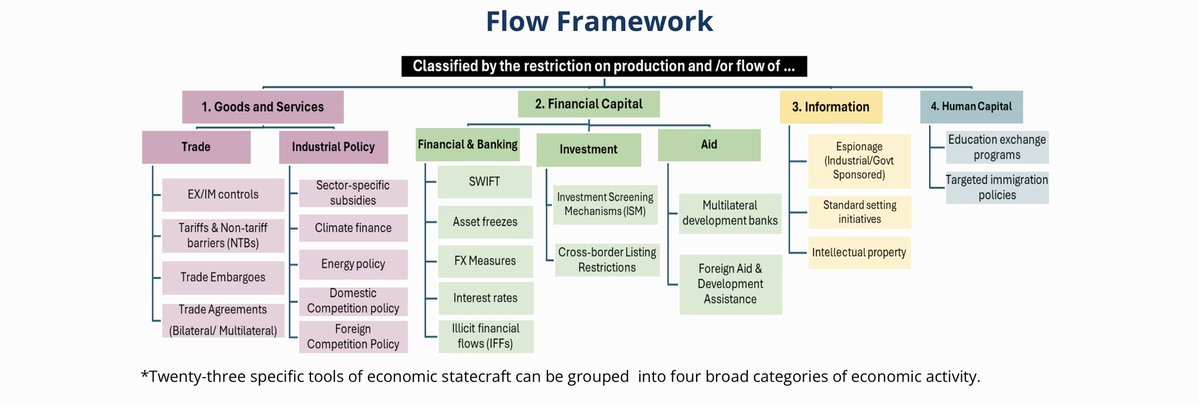
All economic statecraft tools fall, non-exclusively, into one of four categories of economic activity:
1) The flow of goods and services,
2) The flow of financial capital,
3) The flow of information,
4) And the flow of human capital.
Source: Columbia SIPA Capstone Team
English
Gert Bollen retweetet

The shipping squeeze on world's largest oil tankers has a primary cause and it is actually NOT the Iran War.
Two years ago, a mysterious Korean billionaire predicted that Israel would attack Iran and started quietly buying Very Large Crude Carriers (VLCCs), @ed_fin explains.
After approaching the largest VLCC owners and making them "offers they couldn't refuse" (20% above market), he now controls a staggering 30-35%+ of (active compliant & bookable) VLCCs and started refusing to take cargoes unless firms paid him very expensive contracts.
This has pushed VLCC rates to all-time highs BEFORE the Iran War, and has led to some analysts to say this this Korean billionaire-visionary was trying to "corner the market" in VLCCs (Ed acknowledges this term but does not use it himself).
Now that the predictions of this man (Ga-Hyun Chung of SINOKOR) have come true, the VLCC market is at a critical juncture.... For the consequences in greater depth, not just on VLCCs but all tanker vessels, I recommend you watch Ed's full interview which is available below (some exceptionally unusual things are going on). For even more greater detail (much, much more), check out Ed's research service which includes his private X (Twitter) account. Discounted subscriptions are available to Monetary Matters subscribers until April 17th (7 days remain).
Apple🔊shorturl.at/IFwJ5
Spotify📽️shorturl.at/RqUgE
YouTube📽️rb.gy/uonwc0
Misadventures in Shipping🚢shorturl.at/d63ZF
English
Prof. Dr. Fritzi Köhler-Geib
Vorständin der Deutschen Bundesbank
Für Europa ist die Lage noch einmal besonders: Rund 99 Prozent der Stablecoins sind aktuell auf den US-Dollar denominiert. Das heißt, das private digitale Geld, das weltweit an Bedeutung gewinnt, ist für den Euroraum zum aktuellen Zeitpunkt ein Fremdwährungsinstrument. Wenn Dollar-Stablecoins tatsächlich zunehmend in den europäischen Zahlungsverkehr und digitalen Handel eingebettet werden sollten, hätte dies weitreichende Folgen: Die geldpolitische Steuerung der EZB könnte geschwächt werden, die Abhängigkeit von außereuropäischen Plattformen nähme zu, und Europas Einfluss auf das eigene Zahlungssystem würde sinken.
#tar-5" target="_blank" rel="nofollow noopener">bundesbank.de/de/presse/rede…
Deutsch
Gert Bollen retweetet

Virtually every student in my 'Politics of Global Energy' class at UiO could tell you that the EU is in profound trouble.
Is the EU Commission’s coordination group designed to confront reality, or is it merely coordinating the distribution of sedatives to quiet global anxiety?

English
Stablecoins: what strategic choices for Europe?
Speaking points of Denis Beau, First Deputy Governor Banque de France
How should the EU respond to the opportunities and challenges presented by the emergence of stablecoins, which at least for the moment are predominantly USD-denominated?
SNIPPET:
“These adverse consequences would certainly materialize if the diffusion of stablecoins as settlement assets would lead to a “stablecoinisation” and “dollarisation” of a significant part of our payment system.”
English
This setup creates an efficient crypto corridor linking three key flows:
•Russia → Kyrgyzstan: Russian businesses and individuals use Kyrgyz platforms to convert rubles into USDT, bypassing sanctions-related restrictions on direct international transfers.
•Kyrgyzstan → China: USDT is often routed onward to Chinese counterparts for settlement of trade in goods (including dual-use items).
•China → Kyrgyzstan → Russia: The reverse direction helps close trade loops when traditional banking channels are slow or unavailable.
…
Soldatov puts it bluntly: “The main driver of this explosive growth is the sanctions restrictions on Russia.”
According to Soldatov, crypto has become not an alternative, but the only functioning solution for thousands of companies and freelancers.
Kyrgyzstan’s geographic position and relatively open regulatory environment have turned it into one node in a broader sanctions-resistant corridor that connects Russia with Central Asia and, indirectly, with Chinese supply chains. USDT flows frequently move in both directions: incoming from Russian ruble conversions and outgoing toward Chinese counterparts for trade settlement. Some analysts describe this as part of a wider “parallel financial architecture” developing in response to the fragmentation of the global dollar-based system.
English
Welcome to Cryptostan: Kyrgyzstan and the Emerging Crypto Corridor
Kyrgyzstan has become a de facto “crypto corridor” linking sanctioned Russian flows with trade in Central Asia and supply chains from China.
…
“According to various estimates, up to 90 percent of crypto exchange in Kyrgyzstan consists of ordinary conversions into stablecoins. USDT is simply the equivalent of the dollar. The buyer is not investing in crypto — they are simply settling their obligations,” notes Almaz Shabdanov, founder and head of Envoys Vision Digital Exchange, one of the first licensed VASPs in Kyrgyzstan that combines traditional brokerage with crypto conversion services.
Maksim Soldatov, a financial expert and CEO of the investment company Banca, identifies the true driver as the present geopolitical circumstances: “The main driver of this explosive growth is the sanctions restrictions on Russia. Since 2022, Russian banks have effectively been cut off from international transfers. B2B settlements and freelance payments have moved to crypto not out of love for technology, but because there is simply no alternative.”
As a result, Kyrgyzstan has become a de facto “crypto corridor” linking sanctioned Russian flows with trade in Central Asia and supply chains from China, allowing money to move outside traditional banking channels amid sanctions and limited correspondent relationships.
thediplomat.com/2026/04/welcom…
English
Honda Reacts To China's Supplier Strength: 'We Have No Chance Against This'
Honda’s CEO delivered this stark verdict after touring an auto supplier factory in Shanghai.
motor1.com/news/792130/ho…
English
Gert Bollen retweetet

I think there is a lot of truth to this but let me try and be clear with my words.
1. Europe simply does not see a lot of similar security interest with the United States. Probably the only common security interest they see is wanting the US to protect them from Russia. Europe does not see China as a security risk and even if they did would be highly unlikely to do anything. So when you are discussing scale, scale for what? If it is anything to do with global security threats, there is little reason to work with Europe.
2. Europe does not share common economic interests with the US. Europe wants to remain a net surplus exporter to the US while becoming a deficit block to China. They do not see China as a threat which goes directly to the heart of any argument for allied economic scale.
3. Europe does not move quickly. I mean those 25 hour work weeks and high internal tariff market (see the Draghi report) and lack of advanced tech in most areas simply don't lend themself to rapid reindustrialization and work. EU tech parody accounts don't arise from a black hole.
The reality is we are already seeing (See Fed research) growth in investment in the United States, reshoring, and some friend shoring. The reality is the scale and industrialization we are talking about is probably a decade long under taking and not measured in months. Maybe Europe will change in time.
My personal belief is when the US starts racking up wins, that's what matters. Not soft power. Not a presidents charisma. For all the talk of values, Europe (somewhat understandably so) is purely mercenary without values and purely driven by interest. Rack up the wins and Europe will change their tune fast.
Michael Lucci@Michael7ucci
@BaldingsWorld The Palantir guy @ Pentagon Shyam Sankar made an interesting argument against allied scale saying that concentration of industry clusters creates the conditions for industrial innovation. He said reshoring is better than spreading across allies. Any thoughts on that?
English
Gert Bollen retweetet

🚨Scoop: An official from one of the mediating countries tells me that the 11th hour deal between US and Iran came together after the involvement of two unlikely actors: Vice President J.D. Vance and China 👀 Vance was looped in late Tuesday and China helped get Iran on board
English
Gert Bollen retweetet

There are so many layers to the dollar story that transcend conventional market economic dynamics. Until investors realise this I do believe they will be caught out by narratives that serve political agendas not reality.
Crucially, most “end of the dollar” takes completely miss the point and purpose of why the system came to be in first place. This had much less to do with Americans living beyond their means and much more to do with protecting capitalism and its open, property-rights-based economic order from rival systems that did not have to be accountable to such free market forces.
The central challenge emanating from the Cold War was not simply ideological or military — it was structural.
Command economies could direct resources at scale into strategic and military priorities without regard for market signals, profitability, or consumer welfare. Market democracies, by contrast, were constrained by inflation, capital costs, voter expectations, and financial discipline. Left on their own, market economies risked being outcompeted over time by rivals that could forcibly allocate capital into dual-use industrial capacity and military buildup without internal resistance.
The American “statecraft” solution was not to abandon markets, but to reorganize how they operated at the system level thanks to the cunning use of allies with guilty consciences due to historic war debts. And later petro states. The dollar-based order, and the alliance structure built around it, was designed to distribute economic roles in a way that neutralized those constraints.
Industrial allies such as Japan were encouraged — implicitly and explicitly — to pursue state-guided, export-led growth, building high-quality manufacturing capacity and running persistent surpluses.
Those surpluses were then recycled (on a gentleman’s agreement basis) back into dollar denominated private sector assets but also, crucially, into US government issued debt in a way that suppressed funding costs enough to ensure the U.S. could maintain its very substantial military industrial complex advantage.
That in turn allowed the United States to maintain an edge - even in a capitalist free market system - in defense, advanced research, and system integration, without having to bear the full economic burden domestically.
By externalizing parts of the industrial base and anchoring global finance in dollar demand, the system allowed market-based democracies to sustain a level of military competition that would otherwise have triggered destabilizing inflation, rising interest rates, and political backlash.
The dollar’s role was therefore not simply a privilege, but a mechanism: a way of converting allied industrial output and savings into strategic capacity.
From the allies’ perspective, the bargain was equally clear — access to U.S. markets, security guarantees, and the protection of property rights within a stable global framework. This was something they would not get from the other super power in the mix: the USSR.
Seen this way, the system was never about excess consumption or imbalances for their own sake. It was a deliberately constructed architecture to ensure that an open, capitalist order could compete with — and ultimately outlast — closed systems capable of mobilizing resources without constraint. The durability of the dollar is therefore not an accident of history, but a reflection of the enduring logic of that arrangement.
English
Will private capital and disruption reshape the defense industrial base?
breakingdefense.com/2026/04/will-p…
Defense investing is not software investing. Development timelines are traditionally long and procurement pathways are opaque. Investor discipline and patience will determine industrial base outcomes and encourage further capital inflows.
…
VC-backed defense technology firms (excluding SpaceX, which is so big it would skew the numbers, and adjusting for dual-use revenue) had a combined valuation of roughly $130 billion at year-end 2025. At a five-times revenue multiple, consistent with more mature defense tech companies, that valuation implies $25-30 billion in annual revenues by 2030.
Put differently, new entrants would need to capture roughly 3 percent of procurement, RDT&E, and O&M spending combined from the US, NATO and allied nations—about $1 trillion to achieve those revenue levels. To provide a sense of scale, that’s in the range of than the US Navy’s fiscal 2026 shipbuilding budget.
English
Gert Bollen retweetet

🇪🇺🇺🇸 Most European deep tech startups end up being sold to the US (70%)
Once we find the solution to allow them to scale in Europe, we’ll unlock a new European super cycle.
But meanwhile, European creations mainly benefit long term US economy
Lukas Ziegler@lukas_m_ziegler
70% of deep tech startups in last years were sold to US-owned companies top acquirer companies of european deep tech startups by number from 2019-2025
English
European strategic autonomy, or German strategic autonomy👇 ?
Frankreich will zum führenden Standort in Europa für Rechenzentren werden.
Kann das Land Deutschland abhängen – und sorgt dafür ausgerechnet die Atomkraft?
handelsblatt.com/politik/intern…
Deutsch
Gert Bollen retweetet

Which begs the question: who bought the French gold in US Custody, and from who bought France the gold in Europe ?
Sari Arho Havrén@SariArhoHavren
French central bank nets €13bn by pulling gold out of US reserves: The gold was the last of the French reserves held in New York. It was replaced with the equivalent amount bought in Europe and held in Paris. (Rfi.fr)
English
Gert Bollen retweetet

FRANCE’S CENTRAL BANK SOLD 129 TONNES OF FRENCH GOLD STORED IN NEW YORK, BOUGHT EQUIVALENT GOLD IN EUROPE THAT MEETS CURRENT STANDARDS, AND RECORDED A €12.8BN GAIN DUE TO HIGHER GOLD PRICES.
English
Gert Bollen retweetet

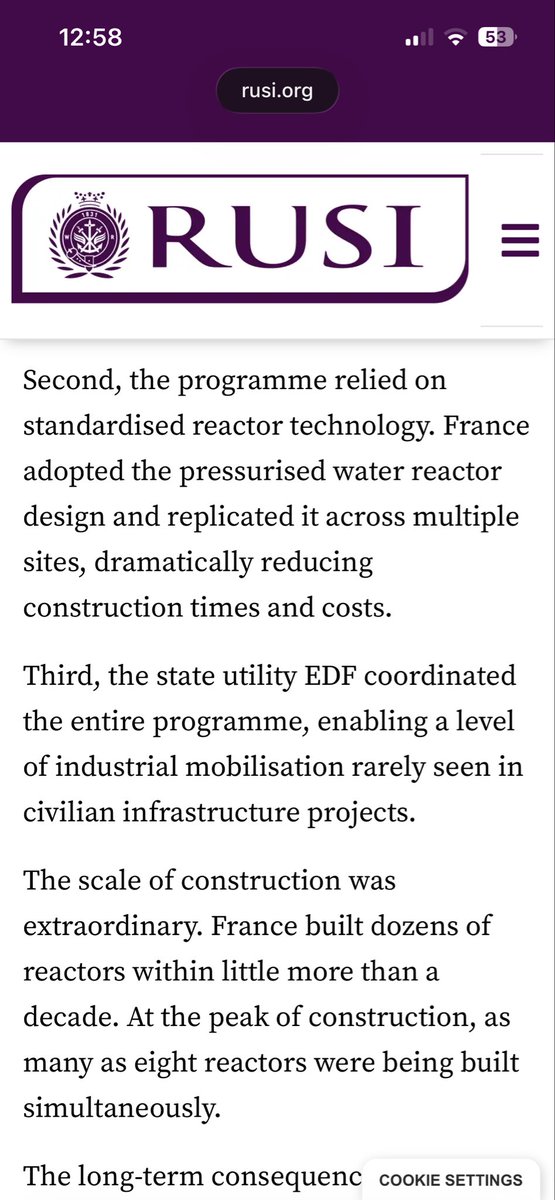
Following the 1973 oil crisis, France launched the massive "Messmer Plan" to achieve energy independence. Under the slogan "all electric, all nuclear," the government rapidly built 58 nuclear reactors in 2 decades, transforming its electricity grid & fostering energy independence


English
Gert Bollen retweetet

And most of the US’ European spending goes through the US' industrial-military complex.
Joel Willans@VFinnishProbs
Getting really bored of MAGA ranting about "freeloading" Europeans. The US does not spend a trillion dollars "on NATO." It spends it on a vast global military empire, with a mere 3.6% going toward their bases in Europe. Meanwhile us "freeloading" Europeans spend $454 billion on our own defence. The "freeloading" story is and always has been a lie to keep Americans angry and Europeans compliant.
English