
Angehefteter Tweet
The Institutional Limited Partner
1.5K posts

The Institutional Limited Partner
@holistic_pm
Institutional Investor. Private Markets (PE, PD, Infra, Real Estate): €1Bn+ invested. Primaries & direct Secondaries. Sharing insights on markets, deals & GPs
Paris, France Beigetreten Nisan 2020
356 Folgt9.7K Follower

@DutchmanCapital @junkbondinvest It’s the first sector of both
English

@junkbondinvest I didn’t realize software was the largest sector of the loan market. Are you taking BSLs or PC?
English

Every cycle, distressed funds raise early and wait. The Fed intervenes. The opportunity never comes.
This time: $1.2T in leveraged debt maturing 2027-2029. AI disrupting the largest sector in the loan market. Lenders pulling back on software. No Fed put.
Maybe this time the dry powder actually gets used.
junkbondinvestor@junkbondinvest
The 10 largest opportunistic credit funds ever raised below Blackstone just closed the newest entry last week
English

@pvtcreditguy On my side, I have been rather disappointed with real recoveries in the last 24/36 months for restructured deals
English

@Bruce_Markets All the data I have doesn’t suggest that spreads are wider. They might be in the future but recent new issues are not.
English

Direct Lending’s First Industry Correction:
Direct Lending has seen tremendous growth until recently.
2026 is the reset year, some fund gates are up, seeing capital outflows for the first time.
While open-ended fund structures are generally well constructed, redeeming investors who are gated are unhappy.
Investors focused on risk within the underlying portfolios, now recognize the heavy concentration of leveraged software companies.
Prior to the GFC (2008-2009), DL was a cottage industry with just $100 billion AUM.
Over the past 18 years, DL has grown 18-fold, to $1.8 trillion ($1.5T invested, $300B dry powder).
Europe does not have this issue, since the software industry is less than 50% of the U.S., and fund managers showed greater discipline.
In the U.S., software is ~26% for many of the leading DL managers (52% of investor capital assuming 1x leverage).
BDC and Fund investors may seek greater clarity on performance, which is simply a function of time.
The good news is that spreads are wider, documentation and covenants will be tighter, and the industry is here to stay.
The correction for DL has arrived.
Corrections are healthy, they serve to cleanse the excesses.
Direct Lending is an essential component of finance, is here to stay, and will be better from the learnings of this correction.
English

@PITTI_FI We are LPs of Fund I, and honestly, they have done a pretty good job. The first one was $ 2.5 bn deployed and recycled in a bit more than 4 years. But they offered tons of co-invest capacity.
English

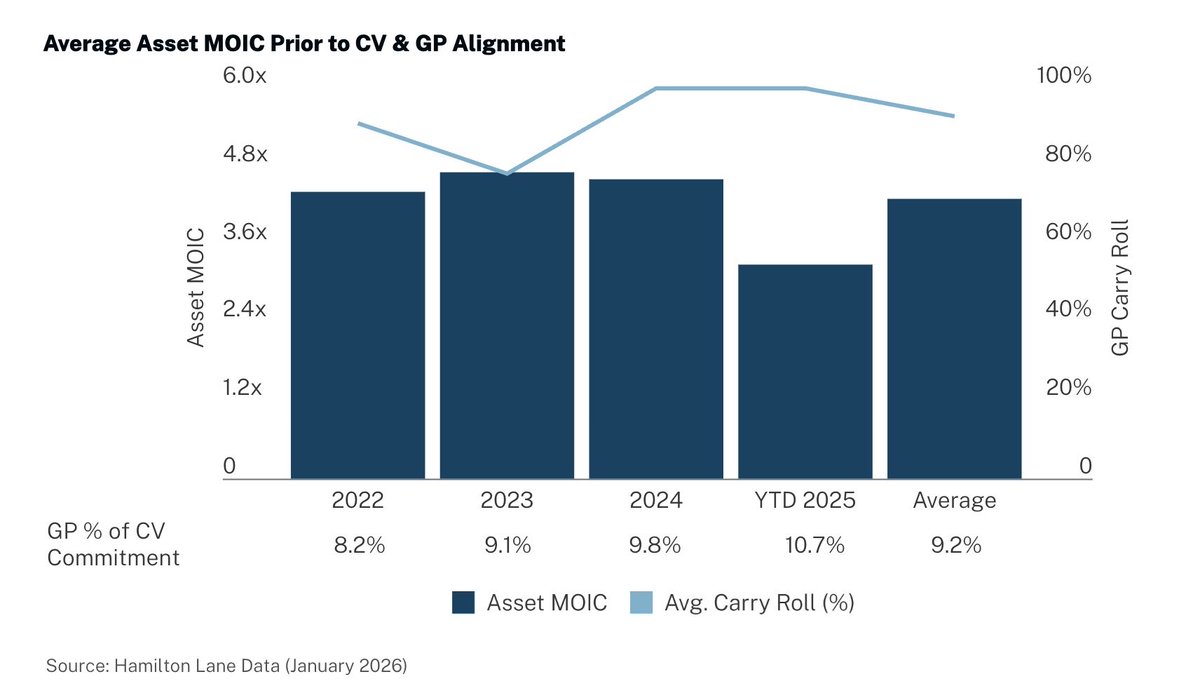
@plsfix4life @Will_Schryver The average opt out rate is 90%, most initially LPs take liquidity and do not roll into the CV
English

@Will_Schryver Any sense of selling volume by existing LPs? Assume this varies quite a bit based on vintage. MOIC pre-CV is shocking unless there’s very little DPI baked in.
English

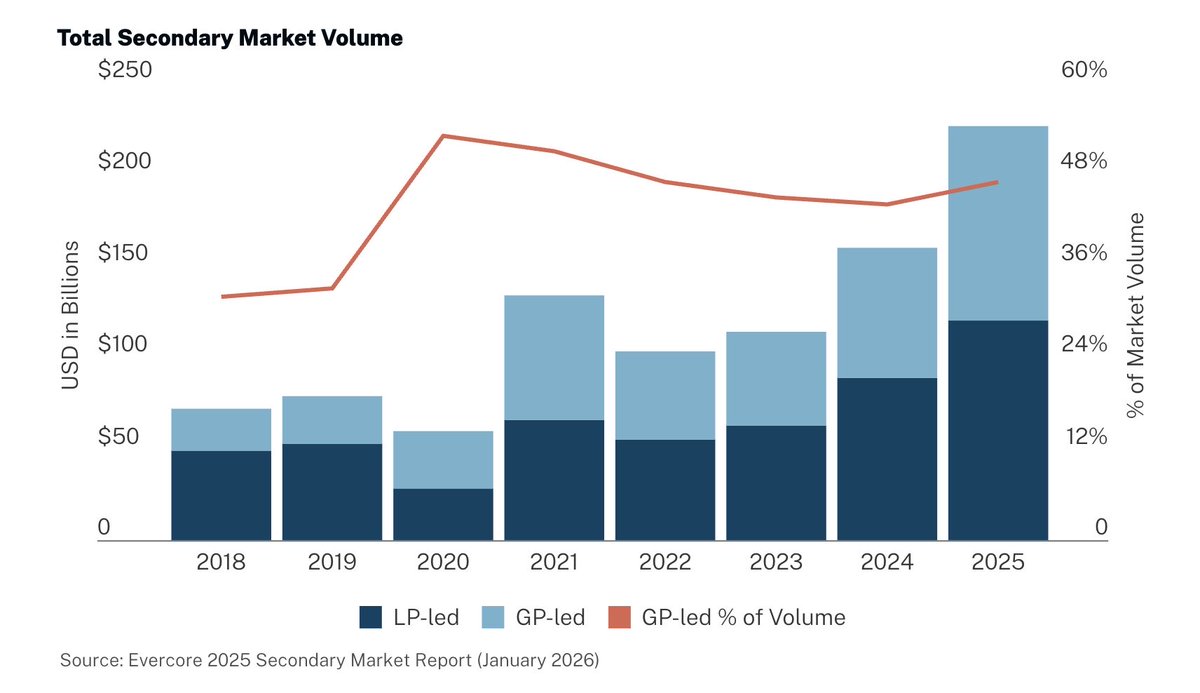
Private Equity secondary market volume hit a record $226 billion
~50% of the market is GP-led volume
Average MOIC ~4.3x prior to CV with an average ~93% GP carry roll
The supply of opportunities exceeds capital chasing these deals
Creating a buyer’s market filled with high quality deals
Data suggests GP-led deals are not filled with inherently bad companies and GPs attempting to kick the can down the road
Source: Hamilton Lane


English

It's bad, and it shouldn't be the feature of a secondary fund. These are mainly problems with the large secondary funds, which take 5/6 years to deploy and use NAV financing at the fund/deal level with cash sweeps that can delay LPs' distributions. There are alternatives to that type of fund in secondaries with people with smaller/niche funds
English

🚨As we prepare the launch of our Private Equity Secondaries fund dedicated to small deals (target Sept 2026) and given the current prolific deal flow, I’m looking for a partner able to provide ~€10 to 15m of warehousing capacity to seed initial transactions.
These deals would be transferred into the fund at launch (avoiding a blind pool for incoming investors and making it more appealing).
Economics are negotiable but ideally: pre-agreed yield and exit through inflows or option to convert into the fund with no fees and no carry.
DMs open, feel free to reach out
English

@BigJohn043 Isn’t it a bit skewed by the large funds that collect the majority of fundraising nowadays and generally have lower management fees?
English

@AsAllocated LMAO 😂 they just need to deploy quicker because the capital is fully drawn day 1
English

@holistic_pm It's possible that evergreen appears to be overpaying since they could be targeting assets of higher quality
English

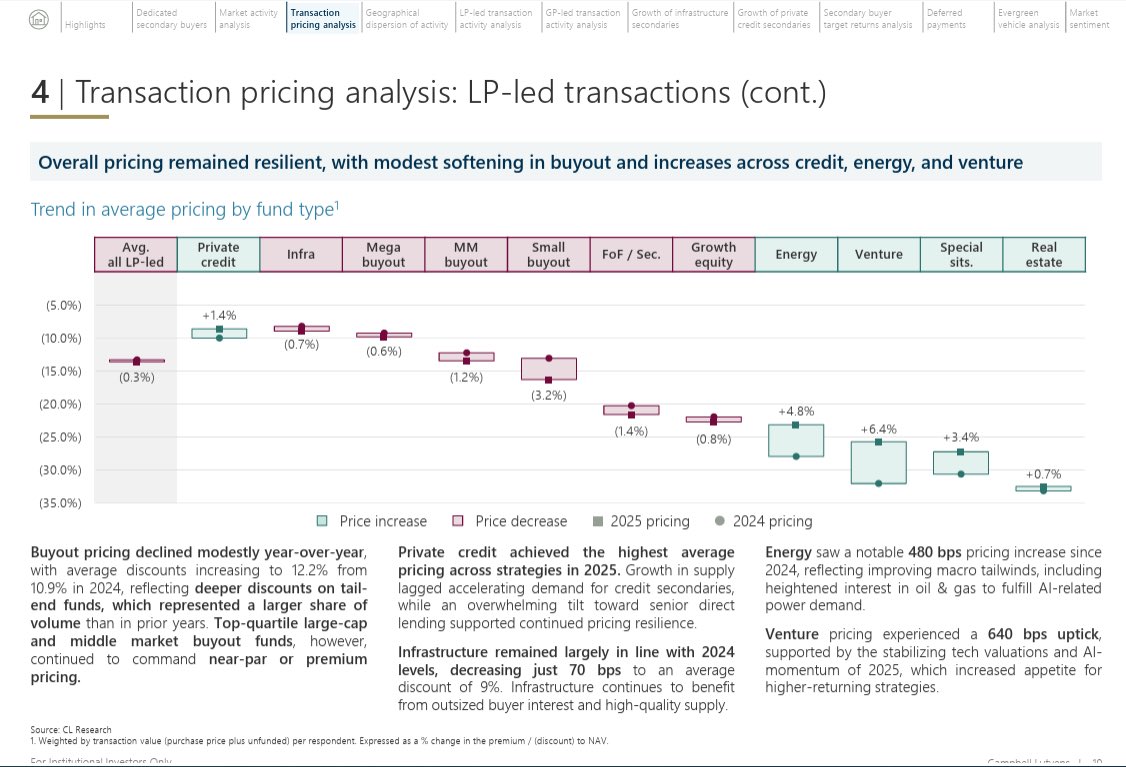
Another good report from Campbell Lutyens on secondaries. Some stats that caught my attention 👇
1. Average pricing and size by underlying strategy
2. Trend in pricing by underlying strategy
3. Evergreen still overpaying 330bps on average vs traditional closed funds
4. GP-led activity by sector and valuations


English

@JCassidyHogan Yeah, effectively, you need a strong co-investor base. Generally speaking, it’s family offices that are prone to taking the risk because they are more used to take concentrated bets or FoF which have a dedicated bucket
English

@holistic_pm Interesting. There are pros and cons to both models. If you have access to a reliable set of co-investors and can make the fee arrangement work then it can be GP friendly / preferred to stick with SPVs.
English

@JCassidyHogan While I don’t disagree, I am seeing more and more experienced IS with a good track without any desire to converge to a fund structure.
English

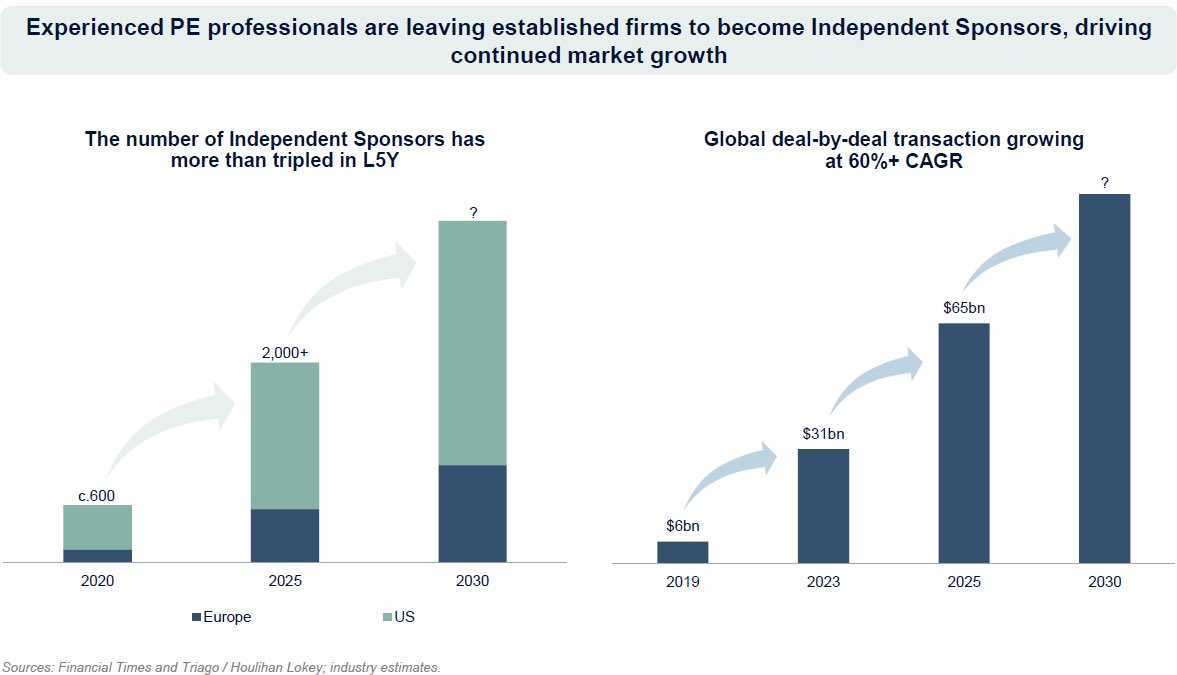
The rise of independent sponsors includes a fundraising story.
Many emerging managers follow this approach to build track record + some fundraising experience (raising for each SPV).
It can be long-term approach but typically GPs are hoping to move to a Fund structure to 1. remove execution risk (corralling cats into each SPV can be a risk) and 2. secure a diversified portfolio.
A fund model is optimal for both LPs and GPs (if you assume constant fees...).
English

@investing_law Blackstone acquired Moonbug for 30x
English