Jason Doctor
18.5K posts

Jason Doctor
@jasndoc
Norman Topping Chair in Medicine & Public Policy, USC, Sol Price School of Public Policy
Los Angeles, CA Beigetreten Ağustos 2014
1.9K Folgt2K Follower


@KeithNHumphreys I knew your wife Lorraine. She was always cold and wearing winter clothes even in the summer.
I wan't to know, have you ever seen Lorraine,
wearing down on a sunny day?
English

Wanted to date Claire Lee but was afraid my wife Lorraine would find out. But she just moved out!
I can see Clare Lee now Lorraine has gone.
English
@arpitrage Set up incentives to have them compete for the lowest number of "qualifying " absences (where qualifying means no doctor's note, no car accident report etc...)
English
This is the weird part of administrative bloat, from the faculty perspective
It would be one thing if all the administrators were doing things to facilitate teaching and research. Instead there are a lot of people, doing various other things, while we do the teaching + research?
English
Proposal: there should be a University-wide office whose job it is to manage student absences.
If you have a good reason for being absent, you talk to them; and they inform the relevant faculty (passively through some dashboard) what students have good reasons to be gone.
English
Jason Doctor retweetet


This is an important paper. One concern with the "good news" is if a researcher makes a sequence of choices that produce a significant result, then the code and the result are reproducible.
That is: reproducibility "stands on the shoulders" of researcher degrees of freedom.
I4R@I4Replication
🧵1/ Our first meta-science paper (with 350+ coauthors) is published today in Nature. It presents one of the largest-ever reproducibility projects in economics & political science. Here’s what we found 👇
English
The *real* dirty little secret is that all the math in social sciences (psychology, economics, sociology) comes from Math PhDs! These are people like Duncan Luce, Gerard Debreu, and John von Neumann. Sorry, but that is the truth. There is no "better math".
talmon joseph smith@talmonsmith
"The dirty little secret is that what distinguishes economics as a field, right now, is a mix of higher standards, harder work, better math, and higher IQs" is very much something an economist would say
English
@ben_golub @MatthewGNagler Under EU, adding then subtracting $k wealth from all outcomes cancels; only final wealth matters. Under PT, the reference point shifts, so preferences depend on gains and losses. Nematode neurons encode change relative to a current reference, r, firing tracks deviations from r.
English

@MatthewGNagler i must be missing something obvious, but how can these things be different?
English
Jason Doctor retweetet

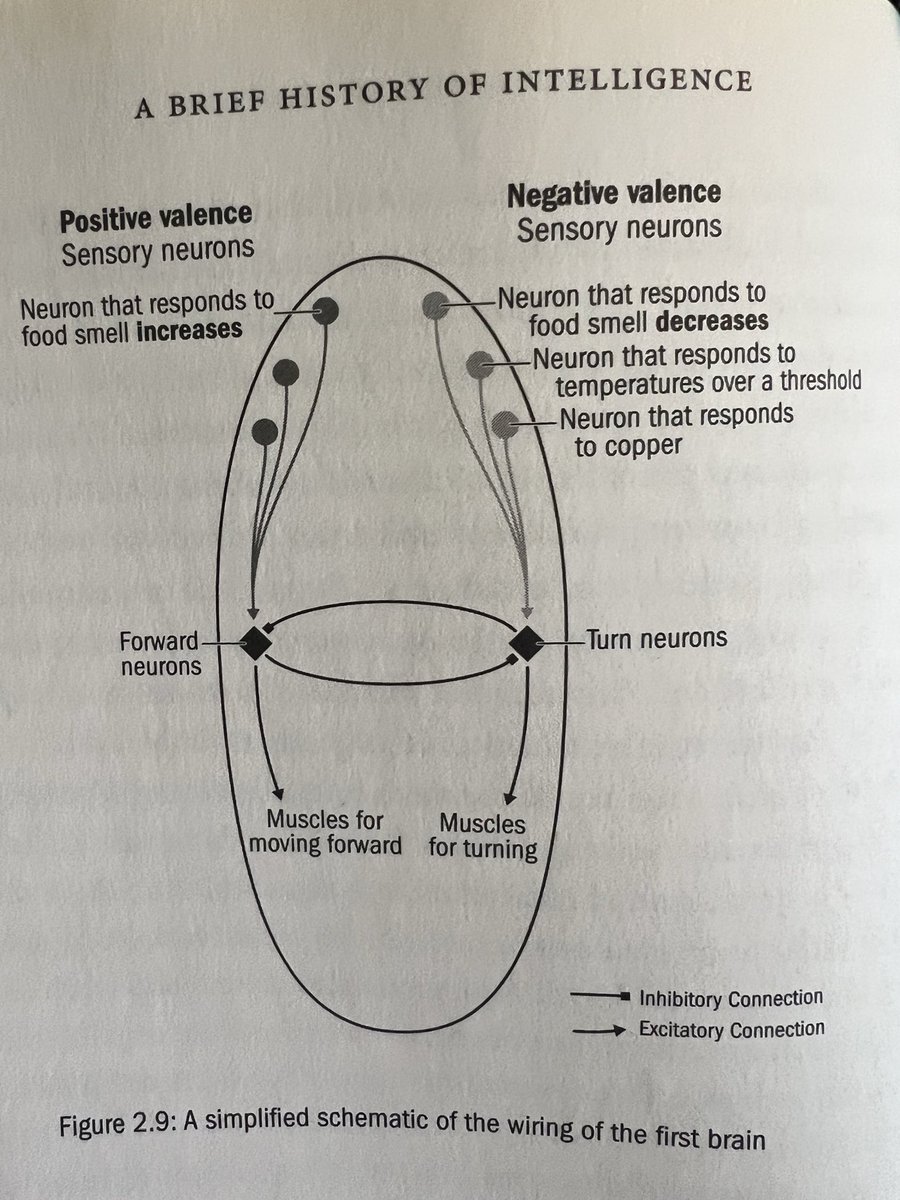
Nematodes’ brains induce them not to move in the direction of food smells, but to move in the direction in which food smells *increase*
We are neurologically wired for reference dependence. It’s amazing it took economists so long to figure out that utility works in this way.
English

Are paper rejections really that bad? My papers get read by ~3 people on average. Each rejection means a resubmission, which means 3 more readers. After 4 rejections, that's double-digit readership.
English
Jason Doctor retweetet

loved her work but this is really disappointing. i hope she can clear this up
Benji@WrnrWrites
To confirm, this “100% AI generated” passage is the opening of chapter 5 from Mary Shelley’s Frankenstein
English
This was tweeted about the time the statistical paradises paper came out showing with random sampling you do not need large N.
I often wonder if he meant random sampling, but my recollection was that he meant causal claims.
Khoa Vu@KhoaVuUmn
This was peak econ twitter.
English
This is important. That creativity is not a faucet that you turn on and off once you have the time and lack of distraction. Instead you are wandering doing other things and you find it.
Dwarkesh Patel@dwarkesh_sp
Terence Tao spent a year at the Institute for Advanced Study - no teaching, no random events of committees, just unlimited time to think. But after a few months, he ran out of ideas. Terence thinks that mathematicians and scientists need a certain level of randomness and inefficiency to come up with new ideas.
English
Jason Doctor retweetet

Tenure-track job alert: Assistant Professor of Public Policy and Management at the Price School. Review of applications is happening immediately. Hope to have fly outs in about a month. (I'm on the committee.) See here: usccareers.usc.edu/job/los-angele…
English
@ben_golub "Often progress has to be made not by adding more theories but by deleting some assumptions."
Psychology: Adds more theories
Economics: Refuses to delete assumptions
English
this, incidentally, is the only thing modern social science has to hang onto -
being a high-temperature incubator for ideas in a pre-scientific age of its development
Dwarkesh Patel@dwarkesh_sp
When Copernicus proposed heliocentrism in 1543, it was actually less accurate than Ptolemy's geocentric model - a system refined over 1,400 years with epicycles precisely tuned to match observed planetary positions. It took another 70 years before Kepler, working from Tycho Brahe's unprecedentedly precise observations, replaced Copernicus’s circles with ellipses - finally making heliocentrism empirically superior. Terence Tao's point is that science needs a high temperature setting. If we only fund and follow what's most state of the art today, we kill the ideas that might need decades of work to surpass some overall plateau.
English
@KeithNHumphreys They've got a lot of perspectives to cover, even in one relationship. I think it makes sense.
English
BREAKING: The number of journalists writing about polyamory has now surpassed the number of people engaging in it. Congratulations to all.
English
I firmly believe someone invented "Box 1" because they did not want to renumber all their tables.
English
Jason Doctor retweetet
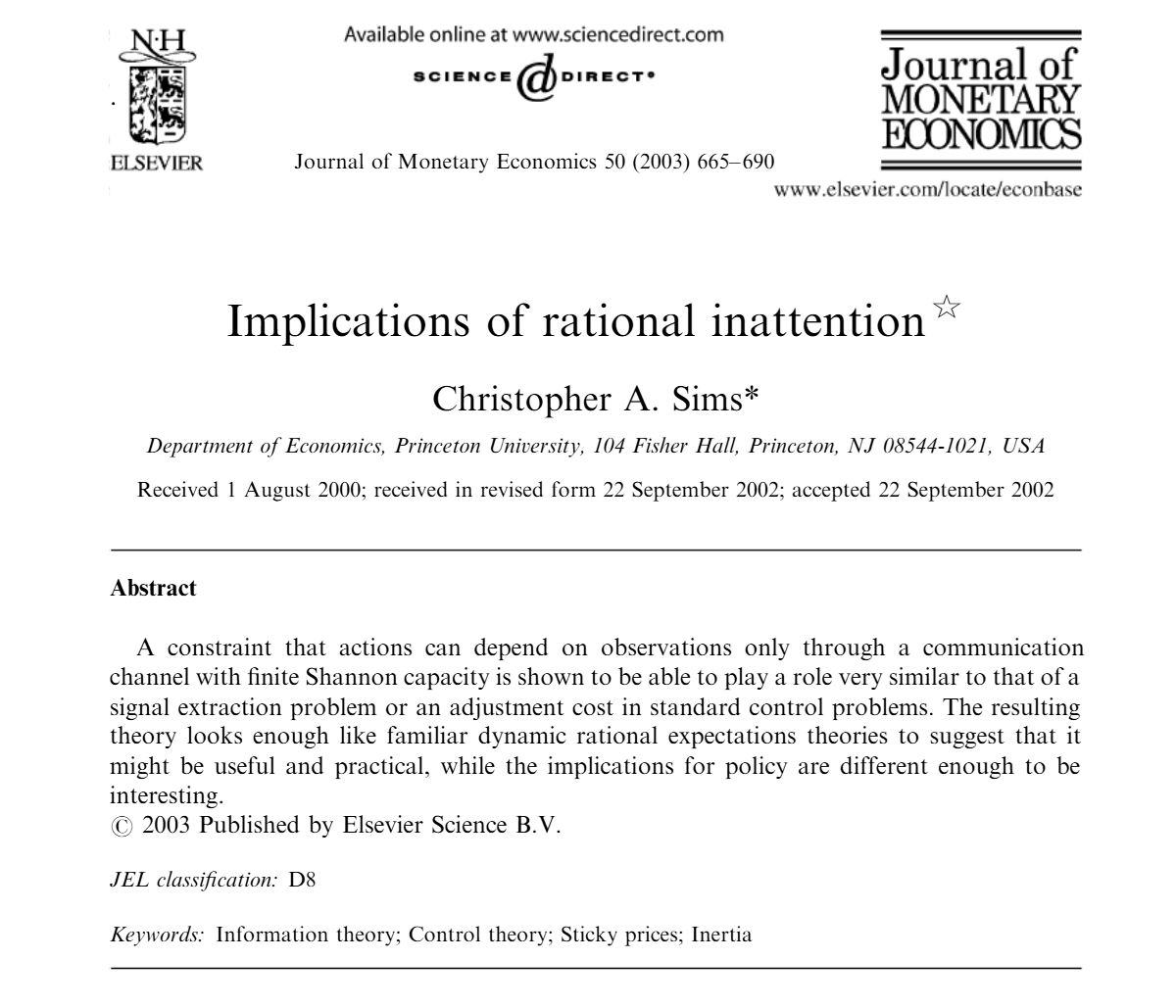
9/ Sims was also early to behavioral macroeconomics; see "Implications of Rational Inattention" (JME, 2003) — one of his most cited and creative contributions. Sims modeled agents as having limited information-processing capacity, not just limited information. This spawned an entire literature on how attention constraints shape macroeconomic dynamics. Basic intuition: people can't process everything happening in the economy; agents optimize how to allocate their attention & this has profound implications for price-setting, consumption, and why monetary policy works through expectations in subtle ways
English
@KeithNHumphreys Also HR for HIV (a success) does not map completely to opioids. E.g., condom use is not a "near fatal miss" the same way naloxone is. With condom use learning has already happened--you've updated risk appraisal. Naloxone can mean learning didn't happen and someone saved you.
English
Harm reduction started in the 1980s when HIV was infinitely more deadly than opioid (heroin) use, so stopping the latter was de-prioritized to prevent the former. Today HIV is completely treatable and opioid use (fentanyl) is deadlier than ever. Need to update thinking to match.
English
"Guy uses Pepper from Chipotle to cure his dog's cancer" Then he sits down and finishes his burrito."
Daniel Litt@littmath
People/companies promoting the “guy used ChatGPT to cure his dog’s cancer” story lack instinctive skepticism in a way that is quite difficult for me to understand.
English
@DavidUbilava Because - Inf is a place and we are going to get there.
English