N
9.4K posts

$SPY
Fresh notes out this morning:
Morgan Stanley - Correction nearly over. Cautiously bullish.
JP Morgan - V shape bounce underway. Bullish.
English

@TradersConf Sure and you know what?
Most still underperform S&P 500.
Now go back and trade whatever you do lol.
English

I've managed over $3 billion for 2 decades at various asset managers and fund houses. Never in my career have I ever seen technical lines on the chart being the decision criterion for any trade decision. Retail lives in a completely different world
English
@BeardoTrader I personally think it’s gonna play out roughly this way yes - too much fear right now and low volume. No newer lows quite yet.
Besides I don’t think Iran will be causing a crash. It’s the private equity that could be the culprit.
English

Let me tell you a story.
$SPY rallies back to all time highs.
The gap below never fills and oil prices remain elevated.
The bears short the whole move back up and get destroyed.
Then sentiment flips. Everyone calls for a blow off top and gets long.
It doesn’t happen.
The odds that retail accurately predicts the top of a multi decade bull cycle are zero.
Price sells off into year end, closing the gap and making new lows.
Bears, already morally and financially bankrupt, miss the move.
New longs from all time highs get wiped out.
And everyone who reads this post gets rich and we all live happily ever after.
English
@trading_axe Ha was thinking along same lines lately
Just funny we are all trying to think in 4D chess here
English

Best trader I know told me that the US and Iran negotiations are purposely being delayed to make Vance’s “negotiation skills” perceived as a miracle.
Make it seem like an IMPOSSIBLE task with no light at the end of the tunnel and THEN Vance is the one who “somehow” establishes peace.
Puts him as the front runner for 2028 elections with a massive schelling point,
And consequently becomes a construct for Musk/Thiel/Sacks/Palantir [you’ve seen Trump shill this already] etc. etc.
PayPal mafia will shill Vance hard for ending the war in a few weeks,
Then we rip everything back BIGLY for Elon to become a trillionaire with SpaceX IPO at the PICOTOP.
Stay bullish.
~ Dr. Axius.
English

The crash is loading and its worse than most expect, I am daily adding more and more shorts on SP500, Nasdaq and Dow Jones. The mother of all crashes is coming, something that will go in the history books!
English

$CRWV : un bull flag massif avec un range Wyckoff accumulation à l'intérieur, c'est du très très lourd. Je vous en parle beaucoup de cette action mais c'est une cocote minute explosive 💣
Avec la phase de SOS en sortie de bull flag, ça va péter violement


GIF
Français

Ottawa wants us emasculated, depressed and poor
Don't forget your roots boys.
Don't forget.
English
@EvanLuthra Doomers and gloomers are almost never right
Disruption will happen yes - but long term wise this will be beneficial
English

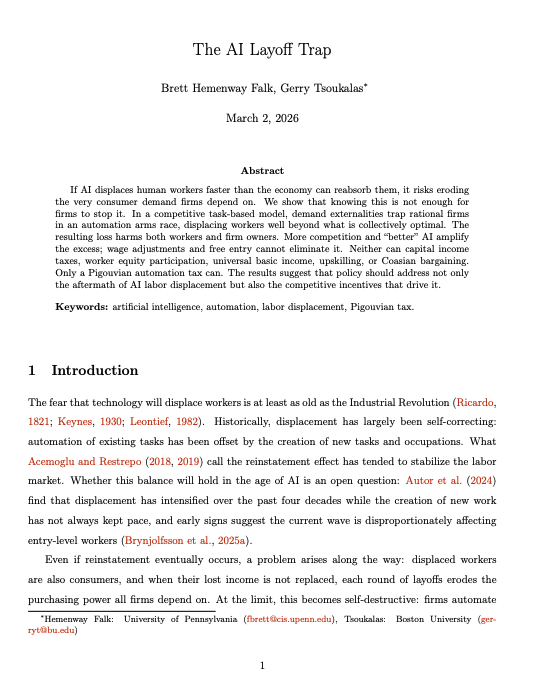
🚨RESEARCHERS JUST MATHEMATICALLY PROVED THAT AI LAYOFFS WILL DESTROY THE ECONOMY.. AND EVERY CEO ALREADY KNOWS IT.. BUT NONE OF THEM CAN STOP..
Two researchers from UPenn and Boston University just published a paper called "The AI Layoff Trap"..
They proved something terrifying..
Every company replacing workers with AI is also firing its own customers.. Every laid-off employee is someone who used to spend money.. When enough people lose their jobs.. Nobody can afford to buy anything.. And the companies that fired everyone go bankrupt selling products to an economy with no purchasing power..
Every CEO can see this coming.. The math is obvious.. Fire workers.. Lose customers.. Lose revenue.. Collapse..
But here's the trap..
No company can afford to stop..
If you don't automate.. Your competitor will.. They cut costs.. Undercut your prices.. Steal your market share.. And you die anyway..
So every company automates.. Knowing it's collectively suicidal.. Because the alternative is dying alone while everyone else survives..
It's a Prisoner's Dilemma.. And the researchers proved it mathematically..
The numbers are already stacking up..
Block cut nearly half its 10,000 employees this year.. CEO Jack Dorsey said AI made those roles unnecessary and that "within the next year, the majority of companies will reach the same conclusion"..
Salesforce replaced 4,000 customer support agents with AI..
Goldman Sachs deployed an AI coder that lets one senior engineer do the work of a five-person team..
Over 100,000 tech workers were laid off in 2025 alone.. AI was cited as the primary driver in more than half the cases..
80% of US workers hold jobs with tasks susceptible to AI automation..
And here's what should scare policymakers..
The researchers tested every proposed solution..
Universal Basic Income.. Doesn't fix it.. It raises living standards but doesn't change a single company's incentive to automate..
Capital income taxes.. Don't fix it.. They change profit levels but not the per-task decision to replace a human..
Worker equity and profit sharing.. Narrows the gap but can't close it..
Collective bargaining.. Can't fix it.. Because automating is a dominant strategy.. No voluntary agreement between companies is self-enforcing..
Only one thing works.. A Pigouvian automation tax.. A per-task charge that forces every company to pay for the demand it destroys when it fires a worker..
The researchers call it a "Red Queen effect".. Better AI doesn't solve the problem.. It makes it worse.. Because every company sees a bigger market share gain from automating faster than rivals.. But at the end.. Everyone automates equally.. The gains cancel out.. And the only thing left is more destroyed demand..
The paper's conclusion is devastating..
This isn't a transfer from workers to company owners.. Both sides lose.. Workers lose their income.. Companies lose their customers.. It's a deadweight loss that harms everyone..
And no market force can break the cycle..
The AI layoff trap isn't a prediction.. It's already happening.. And the math says it won't stop on its own.
English

‼️MAJOR ALERT
At the Liberal Party convention in Canada
they are proposing LOCKING Canadian workers in Canada by forcing them to pay $500,000 dollars to work in the USA!
....which only the elite can afford.
Canada is turning into a leftist PRISON CAMP! .. FAST!
English
@felixprehn Misleading
“$1.3 trillion down to $650 billion” framing implies a recent dramatic dump. It actually happened gradually over a decade, not suddenly
English

China just dumped half its US Treasury holdings. $1.3 trillion down to $650 billion. Lowest since the 2008 financial crisis.
They're not selling to raise cash. They're converting it into gold.
17 consecutive months of gold purchases. 2,313 tonnes in reserves. The largest buyer of physical metal on earth and they're speeding up.
22 central banks bought 1,045 tonnes of gold last year. France is pulling gold home from foreign vaults. Germany already did. India is pulling reserves out of London.
The countries that stored their wealth in dollars are quietly converting it into metal they can hold in their own hands.
This started the day the US froze $300 billion in Russian central bank reserves in 2022.
Every country on earth watched that and processed one thought: the dollar is a weapon and our reserves are a hostage.
The dollar has lost 20% of its purchasing power since 2021. Largest five-year drop since 2005. A $100 bill from 2021 buys $80 of goods today.
Your savings didn't shrink on paper. They shrank at the register.
Gulf states are exporting less oil and recycling fewer petrodollars into US assets. The loop that kept the dollar dominant for 50 years is breaking. Saudi Arabia is pricing oil in yuan for Chinese buyers. India is buying Iranian oil outside the dollar system. Japan is settling Russian energy in yuan.
The dollar's share of global reserves fell from 72% in 2000 to 57% today. Still dominant. But the trajectory is a straight line down and hasn't reversed once in 25 years.
Judy Shelton just proposed gold-convertible 50-year Treasury bonds backed by America's 8,133 tonnes of gold reserves.
When former Fed advisors start publicly discussing tying the dollar back to gold, the conversation has shifted from "if" to "how."
What I'm doing about this.
Gold and gold miners are the core position. When central banks are buying physical metal at the fastest pace since the 1960s, I want to own what they're buying. GLD for spot exposure. GDX for miners with operating leverage. Franco-Nevada (FNV) and Wheaton (WPM) for royalty streams that scale with price.
International equity exposure as a dollar hedge. VXUS or country ETFs in nations with strong commodity reserves. Australia. Canada. Brazil. If the dollar weakens, foreign assets appreciate when converted back.
Commodity producers broadly. Dollar weakness makes all commodities more expensive in dollar terms. BHP, Rio Tinto, Freeport-McMoRan. These companies sell global commodities priced in dollars. When the dollar falls, their revenue rises mechanically.
Short-duration Treasuries over long-duration. If you hold bonds at all, stay inside 2 years. Long bonds get destroyed when the dollar weakens because foreign buyers demand higher yields to compensate for currency risk. The 10-year yield rising isn't the Fed. It's foreign central banks selling.
I'm not predicting the dollar collapses tomorrow. I'm reading what every major central bank on earth is doing with their own reserves and positioning accordingly.
When the entities that print money are trading it for metal, you should probably pay attention to that.
The market is always changing and you don't have the time to track it.
I've decided to run a 100% FREE webinar to discuss market moves and how to adapt and make money from real world events. Link is in comments.
English
@StonkChris @NoLimitGains Ya sitting on the sidelines and not trading charts is the way to go. Then FOMO if the crash doesn’t material. Close to the exhaustion level. Human nature.
English

🚨 IMPORTANT 🚨
The AI Repricing Is Coming. Most Won’t Survive It.
Let me be direct: you’re late on AI stocks.
We’re not at the start of a new tech cycle, we’re already deep inside it. Gartner officially put generative AI in the trough of disillusionment last year. The average enterprise spent $1.9 million on GenAI in 2025, and fewer than 30% of CEOs said they were satisfied with the ROI. That’s a BIG warning.
Still, the market values these companies like every single one will win in the long run.
Do the math. The total market cap of AI‑related public companies sits around $21 to $23 trillion. To justify that at a 10% annual return, they’d need roughly $2.2 trillion in annual profit. Their current combined net income is closer to $420 billion, and most of it isn’t even from AI.
Investors are paying five times future profits that don’t exist, on a timeline nobody can model, in a sector where the unit economics are broken.
OpenAI, probably the most important AI company out there, spends about $1.69 for every $1 it makes. It’s projecting $14 billion in losses this year and $115 billion in cumulative losses before reaching profitability in 2029. The company is raising $100 billion at a valuation near $830 billion. That’s more than the GDP of Argentina for a business still losing money at a WeWork pace.
Meanwhile, hyperscalers are planning to pour $650 to $690 billion into AI capex this year. Amazon alone is spending $200 billion. The issue is simple: data centers commissioned in 2025 cost $40 billion a year in depreciation but generate only $15 to $20 billion in revenue at current utilization. That math doesn’t come close to working.
In Deutsche Bank’s global markets survey, 57% of investors said an AI valuation crash is the biggest risk heading into 2026. One of their strategists put it bluntly: “AI and tech bubble risk towers over everything else.”
This looks like the dot‑com era all over again, only with different letters. In 1999, adding “.com” to your name added billions in market cap overnight. Today, just mention “AI” on an earnings call and the same thing happens. The sentiment is identical. Morgan Stanley estimates retail investors have pushed about $700 billion into equities since January, five times faster than during the 2000 bubble.
The dot‑com bust didn’t prove the internet was wrong. It proved that valuations matter, and that picking winners is almost impossible until reality resets expectations. Cisco peaked at $555 billion in 2000 and took two decades to recover. Amazon, trading for pennies in 2001, quietly became a $2 trillion company.
That’s what I will be watching closely.
When the repricing hits, it will be brutal. AI‑only names with no moat or revenue will get crushed. The ones pitching 70 times forward sales on numbers that don’t exist will go to zero.
But what comes after is where the real upside lives. The survivors will be the companies with real ecosystems, sticky products, cash flow outside of AI, and the balance sheets to last. Think of the Amazons and Googles of this cycle. The infrastructure players that power the entire stack.
When the dust settles and real monetization starts, those survivors won’t just be worth hundreds of billions. They’ll be measured in trillions. The technology is transformational, just not as fast or as universally as the market assumes.
I’m not bearish on AI. I’m bearish on how certain people are about something that’s still uncertain.
Be patient. Let the cycle do what it always does. The real move is knowing which stocks to own once everyone else gives up.
When that time comes, I’ll tell you where I’m putting my capital.
Many will wish they had followed me sooner.
English
@mandmgirl4 @globeandmail I doubt it
And check the EUR/CAD
Canada is structurally weak. And it’s being priced in. Also our currency got decoupled from oil. Big big big red flag.
But EU would need to accept Canada and that’s where it will fail.
Canada is fucked and will need to work with US.
English

@globeandmail There are countries wanting to exit the EU. It is not the powerhouse low info voters think it is.
English

Majority of Canadians open to joining EU, new poll suggests theglobeandmail.com/canada/article…
English
If the Middle East peace deal holds, here's the sectors JP Morgan expects money to flow (in this order):
- Gold and silver goes up
- Typically can get into miners
- Then small caps will move first in the stock market
- Then the Nasdaq
- Then the S&P
- After that, home builders and retailers pick up as confidence returns
- Then financials, especially banks, as rate cuts come back into play
The thread below covers the sectors that will win if the peace deal doesn't happen:
Felix Prehn 🐶@felixprehn
JP Morgan just sent their institutional clients a report with their full playbook on the Middle East peace deal. It includes which sectors to buy if the deal upholds and to sell if it falls apart. I’ve read the full report and I’m breaking it down for you here:🧵
English
English

@yallacoolio @DigipowerX Does this guy actually work at all or just sell shares and collect salary?
English