Toby Sterling
4.4K posts


Lost remains of French musketeer d'Artagnan may have been found in Dutch church - reuters.com/world/lost-rem…
English

@gavinandresen Is saying “epistemic humility” better than saying “looks like somebody has a case of the Mondays”?
GIF
English


Apple can be sued in a Dutch court for antitrust damages, EU's top court says reuters.com/sustainability… @AlexanderNL
English

Corporatism vs. socialism: an awful dichotomy, like Odysseus having to choose between having his ships destroyed by rocks if he steered them a bit too far north, and being sucked in by a whirlpool if they went a bit too far south.
Innovations at large social scales -- and I daresay I helped a bit with that myself -- have often been a great economic boon for mankind. Innovations in contract law, property law, financial markets, and related areas have, after maturation, often turned out to be quite beneficial, with a net benefit when non-beneficial innovations are discarded. Currently, more trust-minimized institutions at global scale, taking advantages of blockchains, smart contracts, AI, and many other innovations, will continue to improve global economies.
But in some ways the focus on large scales in politics and economics alike has gone too far, especially in the form of remote trust-based institutions, especially remote governments and global corporations. The 20th century emphasis on steering peoples' lives into the maws of corporations and remote governments alike has caused most of the cultural ills for which we now seek solutions.
Besides innovations that, for certain important functions, substitute verification and nonviolent security for trust in strangers at arge social scales, we also need to reduce trust in strangers by refocusing our political attentions, and cultural attentions more generally, on smaller social scales.
The main way to avoid the hazards of corporatism and large-scale socialism alike, is instead of obsessing so much over useful but narrow desiderata of the large social scales, such as GDP, economic productivity, and the like, let's pay more attention, politically and otherwise, to the many other important aspects of our lives and cultures -- particularly the ones that are closer to ourselves, the ones we can observe directly and have more immediate and legible influences over -- life at smaller social scales. Life at home, life in our extended families, life with our friends, life in our churches et. al. Let's obsess less about economics as an abstract goal. Let's do more to ensure that our economic institutions protect our more important smaller scale institutions.
Let's have less of *both* big remote corporations and big remote governments, and more families, more local communities (including online communities) . Let's slowly grow -- it necessarily has to be slow -- the kinds of communities that have a great deal of long-standing shared understandings, i.e. of traditions, and thus of fullsome abilities to *communicate*. Let's protect such communities as we still have after the devastations both corporatism and large-scale socialism inficted in the 20th century. The damages inflicted by strangers, businessmen and politicians alike, pretending to be your friends. Let's have more time and resources devoted to the smaller, more intimate, more legible, more controllable, smaller social scales. Let's put political priority on forming, growing, and protecting families, and protecting actual, communicating, via long-hared understandings, *communities*. Protect long-standing religions, both the ancient beliefs and practices, and protect our other long-standing non-commercial traditions. Protect them from the massive disruptions caused by corporations and remote governments alike. especially protect them from the various manifestations of globalization such as immigration and more general disruptions of communities, cultures, and careers.
Mark Mitchell, Rasmussen Reports@honestpollster
With what? Corporatism?
English
Toby Sterling retweetet

ASML CEO says Dutch-China tension has not hit chip-gear maker reut.rs/4r2ULQJ reut.rs/4r2ULQJ
English

Dutch election tests appetite for far-right government under Wilders reuters.com/world/europe/d…
English

@marcelvandenber @ReutersTech Thx, don't know how that crept in there. Maybe something like the capital is Amsterdam but seat of gov't DH. Will fix.
English

Toby Sterling retweetet

In rare move, Dutch government takes control of China-owned chipmaker Nexperia reut.rs/474KXwG reut.rs/474KXwG
English

@jitsegroen Is this for real ? Move fast and break things not exactly the European way ….
English
Toby Sterling retweetet

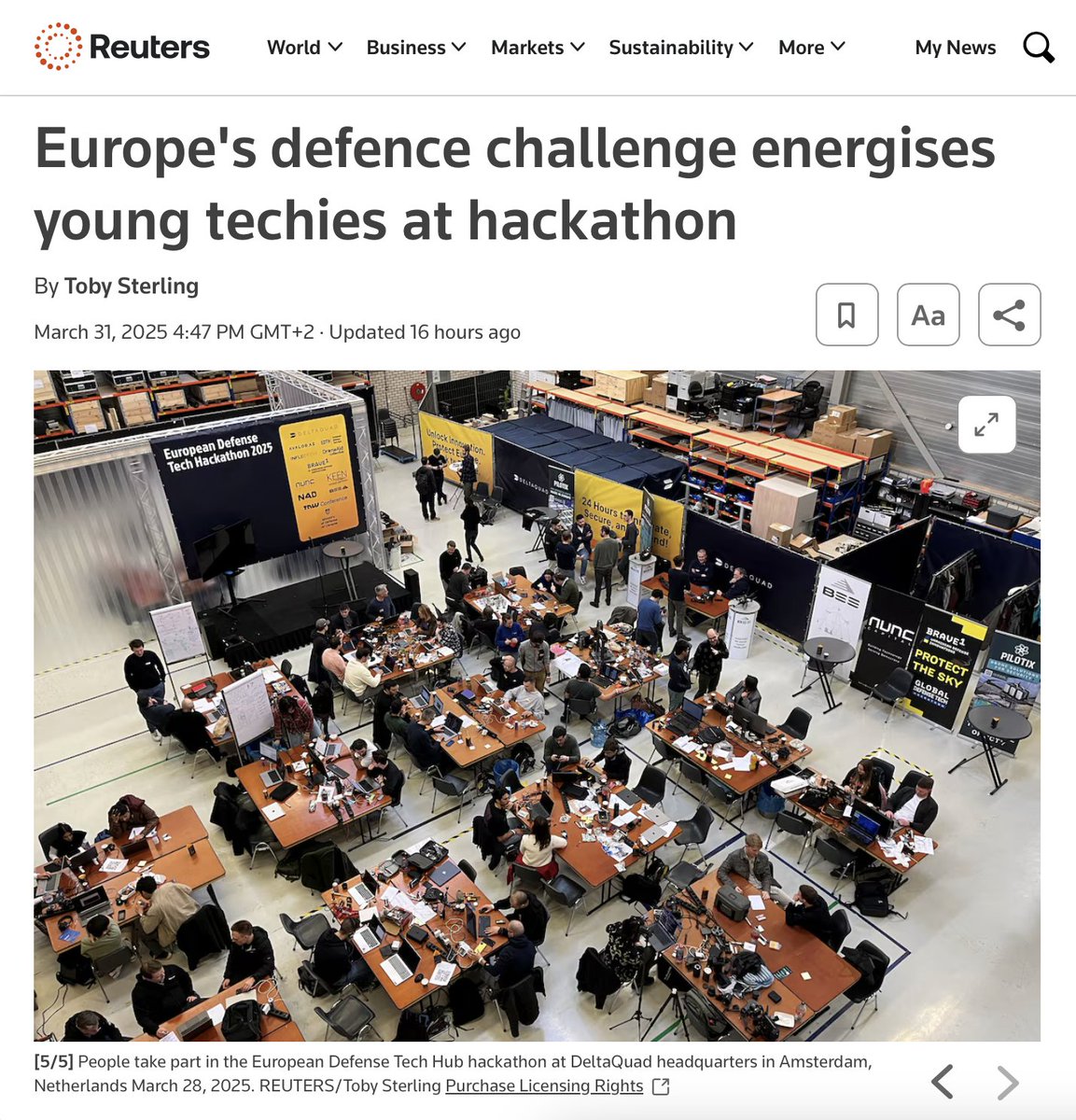
Looks like that was us gathering 200+ folks for the European Defense Tech Hackathon last weekend, hosted by @DeltaQuadUAV 🫡
"A weekend hackathon in Amsterdam aimed at finding fast-and-cheap battlefield solutions for Ukraine drew more than 100 young programmers and engineers, with many saying Europe's rearmament plans were prompting them to consider careers in defence."
Huge thanks to Toby Sterling @lbsterling from @Reuters for covering the event!
And huge thanks to our partners @BRAVE1ua, NUNC Capital, BSS Holland, @DeltaQuadUAV, @NADindustries, @KeenVP, the Ministry of Defence of Ukraine @DefenceU, @Ultimaker, Pilotix, and our co-organizers Avalor AI, DroneAid Collective, and @inflectionxyz

English

Europe's defence challenge energises young techies at hackathon reuters.com/business/aeros…
English
Toby Sterling retweetet

Exclusive: Apple, Meta likely to face modest fines over DMA breaches, sources say ( Reuters, always first with the news that matters) reuters.com/technology/eu-… @Reuters @EUReuters @ReutersBiz @ReutersTech @ReutersLegal @thomsonreuters
English
Toby Sterling retweetet


@AlexanderNL It is incredibly valuable to have someone delivering this message, the big picture, to the Dutch public.
English