Ryan Benmalek

208 posts

Ryan Benmalek banner
Ryan Benmalek

Ryan Benmalek

@lildesertmouse

ceo @talusrobotics 🤖🦊 | scout @a16z @speedrun 🚀 (dm me!) | before: @GoogleDeepMind, @Mila_Quebec, @NSF Fellow PhD @Cornell: Vision, NLP, and some RL

Beigetreten Ağustos 2015
1.2K Folgt950 Follower
Angehefteter Tweet
Ryan Benmalek
Ryan Benmalek@lildesertmouse·
hey i’m a lil desert mouse and i’m excited to be joining this new sand dune :) my background > I’m 3 years old > i dropped out of something > i have silky soft fur looking for more friends - let’s find some water or do other fun grooming activities this fall
Ryan Benmalek tweet media
Chau Vo@chauxvo

heyy i’m chau & i’m excited to be joining @instinct_inc as chief of staff! still in high school and just relocated to sf looking for more friends in the tech / startup scene!

English
1
0
12
1.6K
Ryan Benmalek retweetet
Jim Prosser
Jim Prosser@jimprosser·
8. Hey execs: maybe don't keep diaries? Relatedly, all these constant-ambient-listening AI personal devices are going to be an evidentiary gold mine sooner than later.
English
9
27
513
127.8K
Ryan Benmalek retweetet
Mason Kamb
Mason Kamb@MasonKamb·
This paper was an absolute pleasure to be a part of. We believe– based on accumulating, emerging evidence– that there is a general theory for deep learning on the horizon. Here, we review evidence informs this belief, and try to articulate what such a theory might look like.
Jamie Simon@learning_mech

1/ Deep learning is going to have a scientific theory. We can see the pieces starting to come together, and it's looking a lot like physics! We're releasing a paper pulling together these emerging threads and giving them a name: learning mechanics. 🔨 arxiv.org/pdf/2604.21691 🔧

English
2
3
36
3.6K
Ryan Benmalek retweetet
Teortaxes▶️ (DeepSeek 推特🐋铁粉 2023 – ∞)
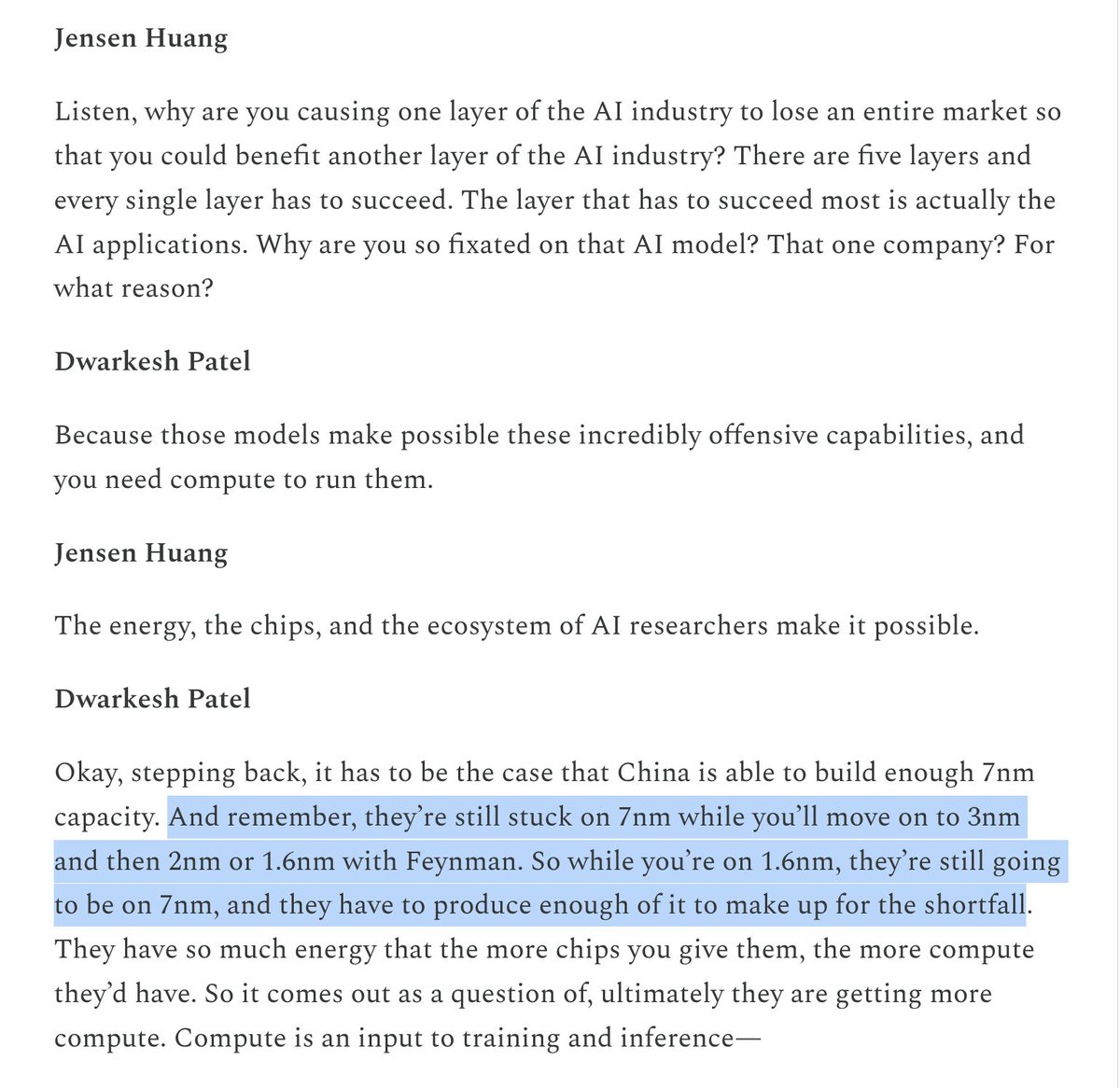
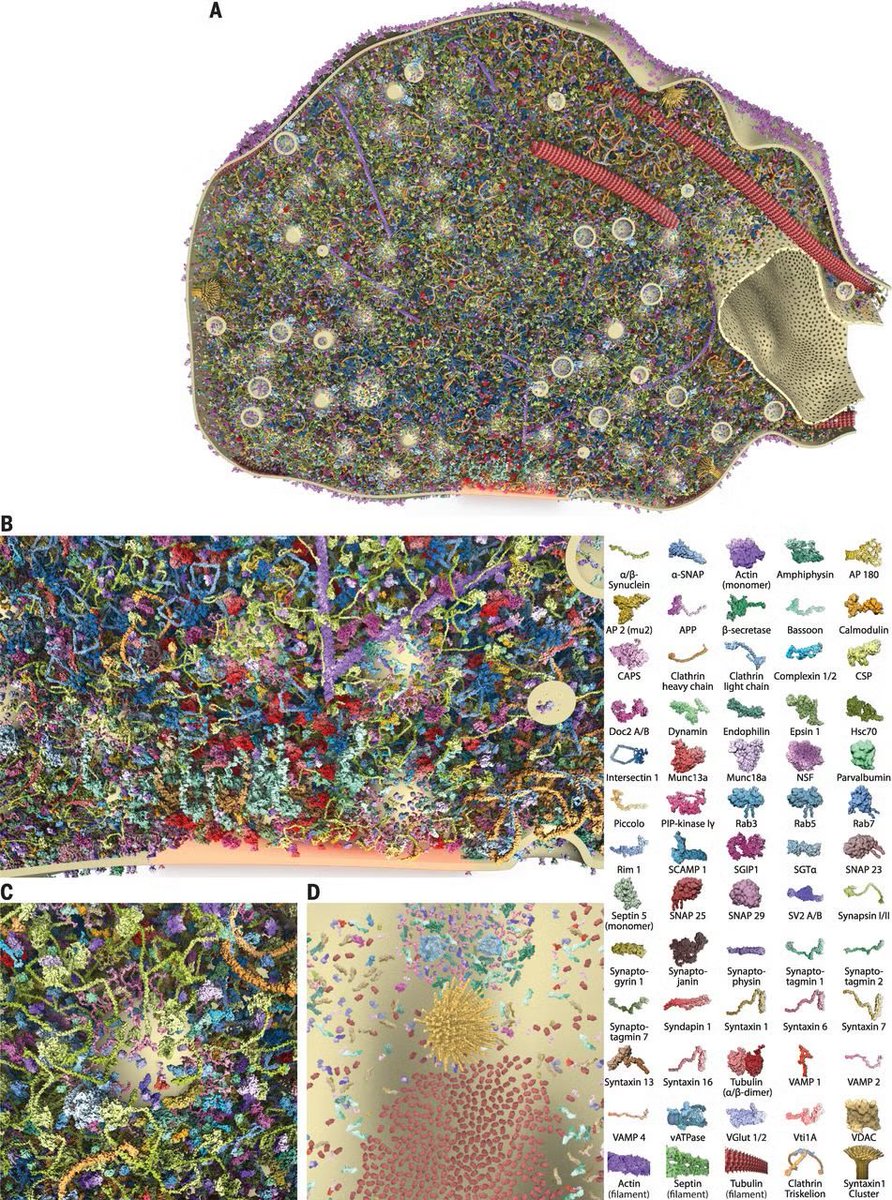
Patriots seem unable to grasp what Jensen is saying, namely: lithography is not the bottleneck *for him*. Almost all progress between Hopper and Vera Rubin Ultra is about clever engineering, not feature size. Huawei is currently at ≤Blackwell level. Jensen likes it this way.
Teortaxes▶️ (DeepSeek 推特🐋铁粉 2023 – ∞) tweet mediaTeortaxes▶️ (DeepSeek 推特🐋铁粉 2023 – ∞) tweet media
retardrutide 💉🧠@retardrutide

@teortaxesTex The only real failure mode is that China develops an alternative to CUDA and future cutting edge research (which all closed labs leech from without seeding) gets developed on Chinese chips and kernels. Jacketman spent basically half the podcast trying to explain this to dwarkesh

English
3
3
72
6.5K
Ryan Benmalek retweetet
Gavin Baker
Gavin Baker@GavinSBaker·
Much of Dwarkesh's argument hinges on this statment which *was* accurate but will be increasingly inaccurate on a go forward basis imo:    “American labs port across accelerators constantly. Anthropic's models are run on GPUs, they're run on Trainium, they're run on TPUs. There are so many things you can do, from distilling to a model that's well fit for your chips.”   As system level architectures diverge (torus vs. switched scale-up topologies, memory hierarchies, networking primitives), true portability is eroding. The Mi300 and Mi325 had roughly the same scale-up domain size as Hopper while Blackwell’s scale-up domain is 9x larger than the Mi355 scale-up domain, etc. Many frontier models are now being explicitly co-designed for inference on specific hardware like GB300 racks. Codex on Cerebras is another example. Those models run less efficiently on other systems and the performance differentials will only widen. A model that runs well on Google’s torus topology will run less efficiently on Nvidia’s switched scale-up topology and vice versa - the data traffic is fundamentally different as a byproduct of the models being parallelized across the different topologies. Google’s internal teams - and increasingly the Anthropic teams as they become the most important customer of almost every cloud - have the luxury of operating across the stack (models, chips, networking) - but that is not the case for the rest of the market and other prospective users. Anthropic is the exception, not the rule. To wit, Anthropic and Google allegedly have a mutual understanding where Anthropic can hire the TPU engineers they need every year to ensure that they can continue to get the most out of the TPU. Given the overwhelming importance of cost per token to the economics of the labs, models will be run where they run best. Most extremely large MoE models will run best on GB300s given the importance of having a switched scale-up network like NVLink for MoE inference. When training was the dominant cost for labs and power was broadly available, labs were optimizing to minimize capex dollars. Model portability was a way to create leverage over suppliers. I think that drove a lot of the focus on portability. Today, inference costs as measured by tokens per watt per dollar are everything. Inference is way more important than training costs (inference is effectively now part of training via RL). Labs are therefore now optimizing for inference. This means increasing co-design and higher go-forward switching costs for individual models between systems. I do think this explains why Anthropic and Nvidia came together: Anthropic needed Blackwells and Rubins to inference at least *some* of their models economically. And Mythos might just end up being released coincident with the availability of Rubins for inference. TLDR: as labs shift their focus from training to inference, the costs of portability and the upside of co-design to maximize tokens per watt per dollar both rise. Portability is likely to begin decreasing as a result.   I think what I might have respectfully added to Jensen’s answer is that systems evolve under local selective pressures. The evolutionary pressure in America is a shortage of watts so it makes sense for Nvidia to optimize, as an American company, for power efficiency and tokens per watt and stay on copper as long as possible. China has a surfeit of watts. Chinese AI systems are already taking advantage of this with the Huawei Cloudmatrix 384 and Atlas SuperPoD having an optical scale-up domain that is much larger than anything offered by Nvidia today at the cost of *much* higher power consumption and much lower tokens per watt. The networking primitives for this Huawei system are very different than those for Nvidia’s systems and a model that runs well on Nvidia will not run well on that system and vice versa. This means that if a Chinese ecosystem gets momentum, Chinese models might stop running well on American hardware. And when Chinese models run best on American hardware, America is in a better position as this gives America a degree of leverage and control over Chinese AI that it risks losing to an all-Chinese alternative ecosystem.   This architectural fork makes porting and distillation less effective and strengthens the pro-American national security case for selling China deprecated GPUs imo. Also I will attest that I did not wake up a loser this morning.
English
79
225
2.2K
718.2K
Ryan Benmalek retweetet
Harsha Goli
Harsha Goli@arshbot·
I'm going to make a prediction that will shock many of you: Going forward, for at least the next few years, MTL licensure in the US will be obsolete. And everyone who has a litany of MTLs will feel the compliance burden of an outdated vehicle they bought and paid for. In it's place will be the occ bank trust charter (which is not the same as a depository bank charter like you'd interact with at JP morgan). The bank trust charter will turn into a kind of federal crypto license. You've seen over the last few months many conditional or full approvals for bank trust. @stablecoin, @coinbase, @bitgo, @nubank, etc That will be the new norm. Bookmark this post.
English
7
6
34
11.9K
Ryan Benmalek retweetet
SPEC
SPEC@___4o____·
Time for Mercor to put this to the test 😂
SPEC tweet media
English
13
20
1.1K
53.3K
Ryan Benmalek
Ryan Benmalek@lildesertmouse·
Had a fun time with @og_doctourist chatting about startups!
Girum Tihtina@og_doctourist

The story of @lildesertmouse is absolutely insane. He skipped high school, started college at 14, got his PhD from Cornell at 23, and is now building robot companions that feel like dragons and fennec foxes. Enjoy the new episode of No Fixed Route, the first ever podcast to be filmed inside @zoox. Link to Episode: youtu.be/6Pg29io7ZuQ My 6 takeaways with @lildesertmouse in the replies.

English
3
0
8
424
Ryan Benmalek retweetet
Hongchi Xia
Hongchi Xia@hongchix·
Here we introduce SAGE: Scalable Agentic 3D Scene Generation for Embodied AI, which can generate sim-ready 3D scenes with agents following user demands at scale, ready for robotic action generation. Paper, code, and SAGE-10k dataset are all released! nvlabs.github.io/sage/
English
4
43
318
27.6K
Ryan Benmalek retweetet
Nicholas Pfaff
Nicholas Pfaff@NicholasEPfaff·
Meet SceneSmith: An agentic system that generates entire simulation-ready environments from a single text prompt. VLM agents collaborate to build scenes with dozens of objects per room, articulated furniture, and full physics properties. We believe environment generation is no longer the bottleneck for scalable robot training and evaluation in simulation. Website: scenesmith.github.io 👇🧵(1/8)
English
18
80
566
72.9K
Ryan Benmalek retweetet
Xindi Wu
Xindi Wu@cindy_x_wu·
New #NVIDIA Paper We introduce Motive, a motion-centric, gradient-based data attribution method that traces which training videos help or hurt video generation. By isolating temporal dynamics from static appearance, Motive identifies which training videos shape motion in video generation. 🔗 research.nvidia.com/labs/sil/proje… 1/10
English
11
119
580
107.5K
Ryan Benmalek retweetet
Francesco Bertolotti
Francesco Bertolotti@f14bertolotti·
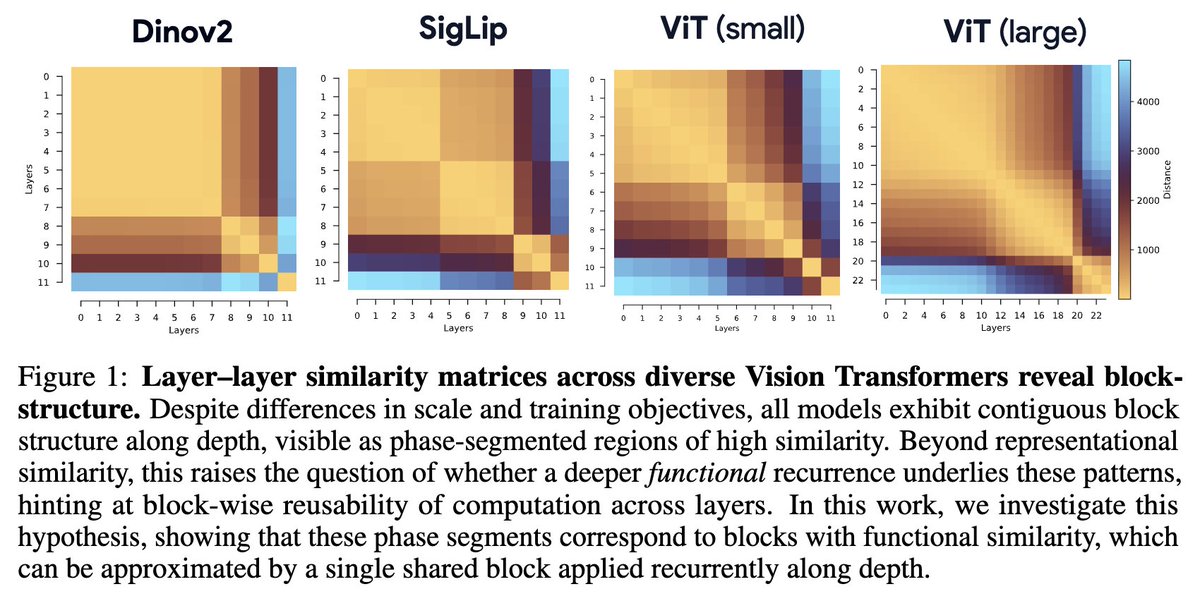
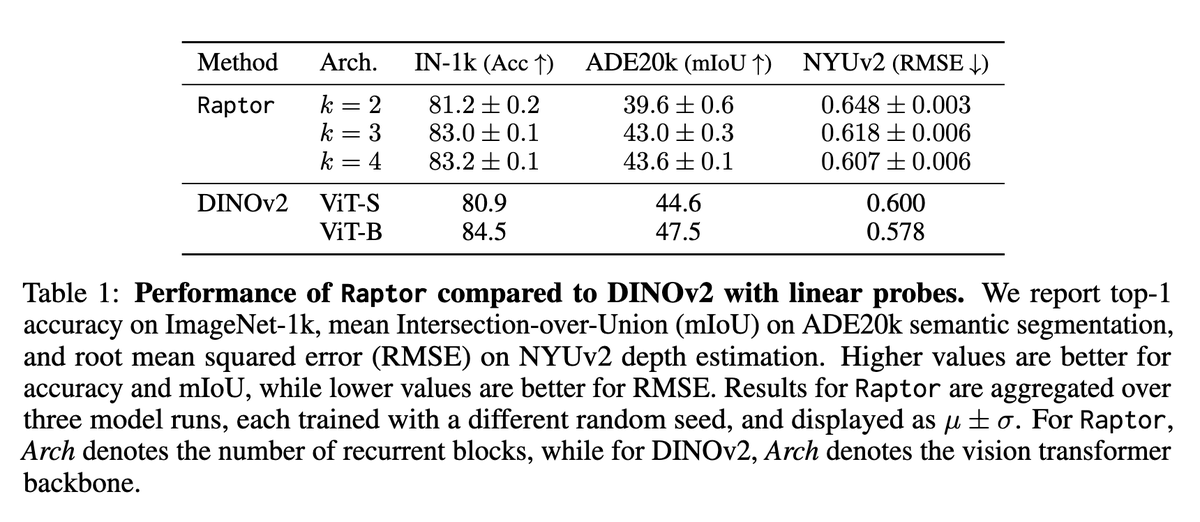
The authors ask whether an N-layer ViT can be rewritten using just K<<N layers by recurring on them. Remarkably, they match DINOv2 performance with only 2-3 layers. The paper also offers rich dynamical-systems analysis. Very cool work! 🔗arxiv.org/abs/2512.19941
Francesco Bertolotti tweet mediaFrancesco Bertolotti tweet mediaFrancesco Bertolotti tweet mediaFrancesco Bertolotti tweet media
English
8
66
656
42.9K
Ryan Benmalek retweetet
PHBD
PHBD@0x50484244·
A lot of people have been saying over the past week that mass egocentric data collection "solves" dexterous robotics. Important to remember that autonomous vehicles was ~15 years of adding 9's to the disengagement rate. We haven't even started that process with dexterous robots.
English
3
3
17
4.5K
Ryan Benmalek retweetet
Arhan Jain
Arhan Jain@prodarhan·
Excited to introduce PolaRiS, a real-to-sim recipe for turning short real-world videos into high fidelity simulation environments for scalable and reliable zeroshot generalist policy evaluation. polaris-evals.github.io (1/N 🧵)
English
8
48
235
65.1K
Ryan Benmalek retweetet
Peter Lin
Peter Lin@peter9863·
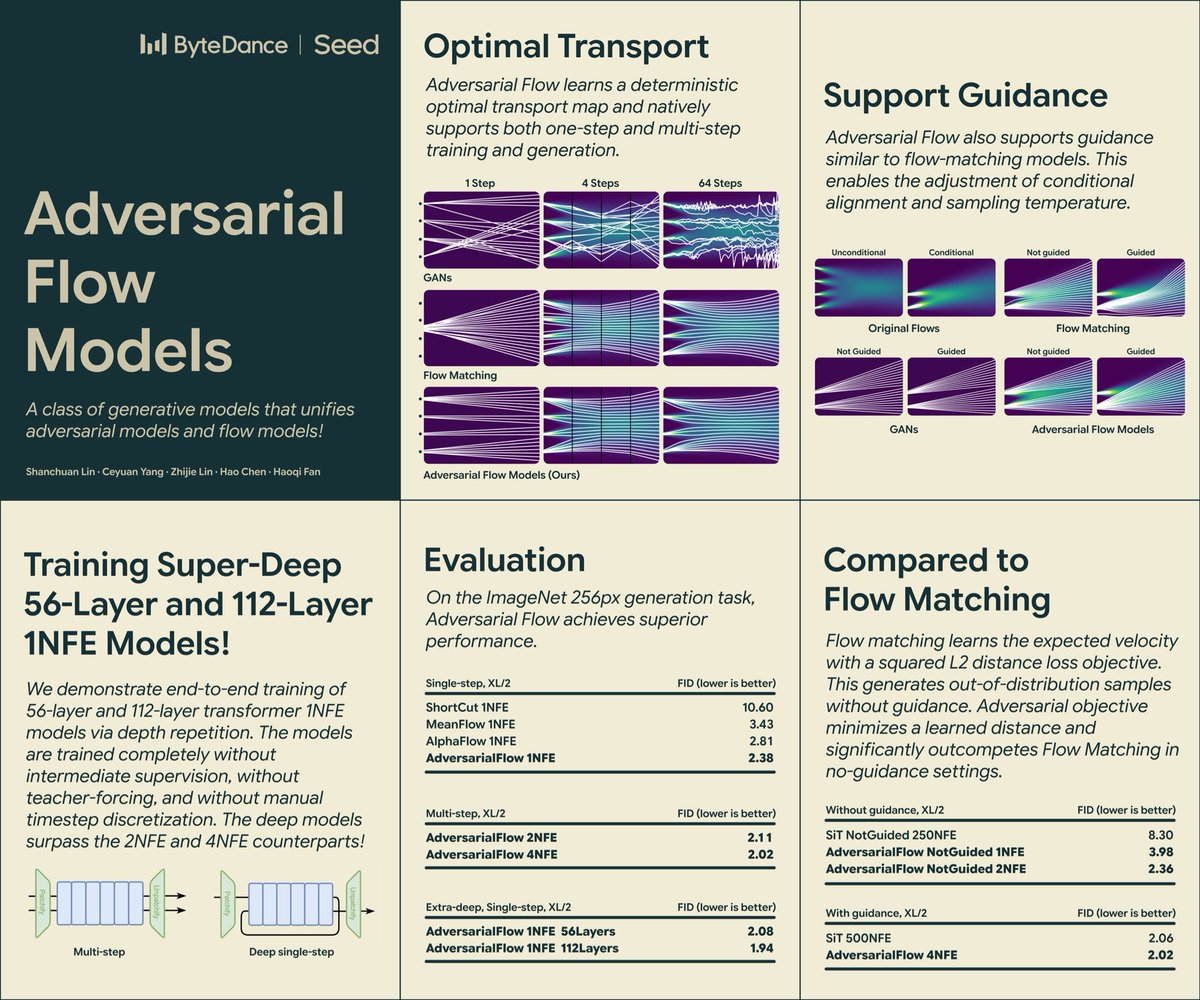
Our research: Adversarial Flow Models (AF) arxiv.org/abs/2511.22475 AF unifies Adversarial and Flow Models. Unlike GANs, AF learns optimal transport (stable). Unlike CMs, AF only trains on needed timesteps (save capacity). We can train super-deep 112-layer 1NFE model! SOTA FIDs!
Peter Lin tweet media
English
13
79
563
42.2K
Ryan Benmalek retweetet
Adam D'Angelo
Adam D'Angelo@adamdangelo·
I think robot pets are going to be a huge market.
English
302
51
1.1K
125K