Ned McClain

736 posts

Ned McClain banner
Ned McClain

Ned McClain

@nedmcclain

Making technology at 10k'. I focus on (software, infra, data) ^ (sec, ops, perf). Consulting at https://t.co/bp9kOIn01w. Value Creation over Rent-Seeking. ⛷🏂🏔

Copper Mountain, Colorado Beigetreten Mart 2009
438 Folgt413 Follower
Angehefteter Tweet
Ned McClain
Ned McClain@nedmcclain·
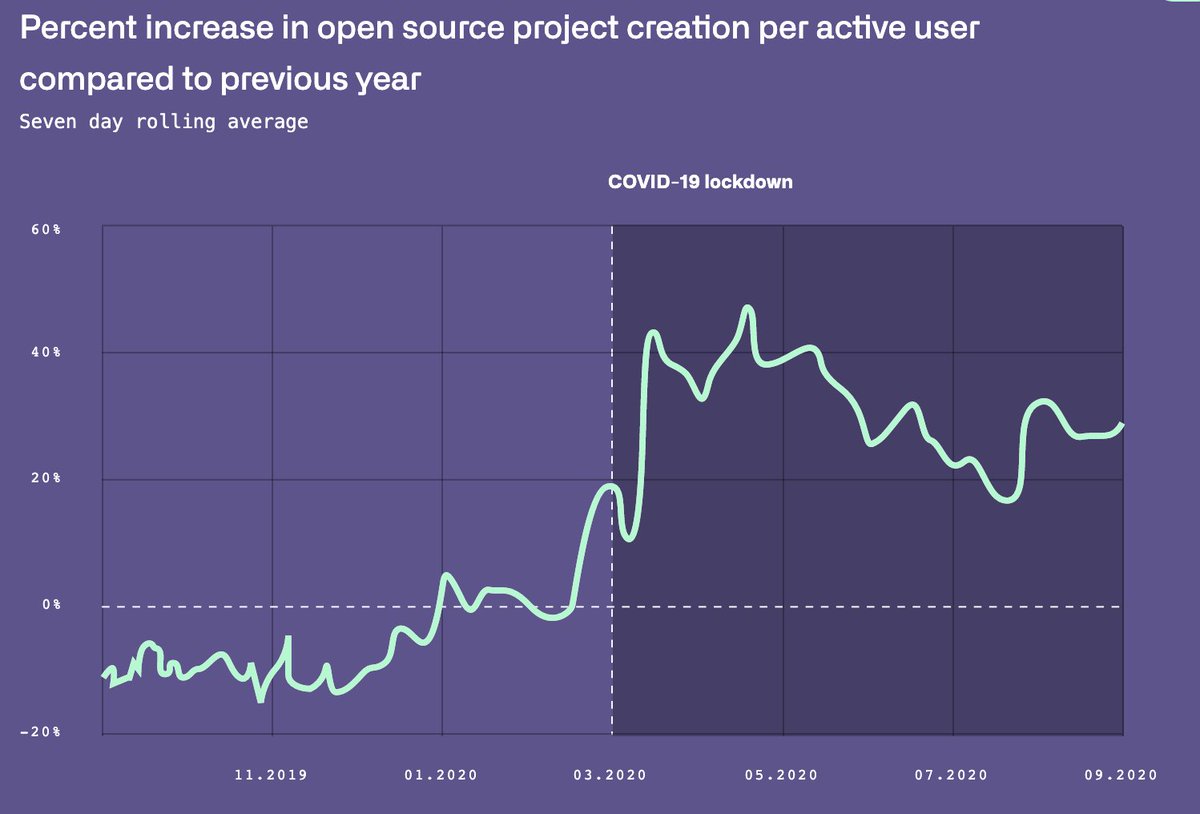
Interesting pandemic effect: 30-40% increase in open source contributions. octoverse.github.com
Ned McClain tweet media
English
0
0
4
0
Ned McClain retweetet
Steve Jurvetson
Steve Jurvetson@FutureJurvetson·
The Moore's Law Update NOTE: this is a semi-log graph, so a straight line is an exponential; each y-axis tick is 100x. This graph covers a 1,000,000,000,000,000,000,000x improvement in computation/$. Pause to let that sink in. Humanity’s capacity to compute has compounded for as long as we can measure it, exogenous to the economy, and starting long before Intel co-founder Gordon Moore noticed a refraction of the longer-term trend in the belly of the fledgling semiconductor industry in 1965. I have color coded it to show the transition among the integrated circuit architectures. You can see how the mantle of Moore's Law has transitioned most recently from the GPU (green dots) to the ASIC (yellow and orange dots), and the NVIDIA Hopper architecture itself is a transitionary species — from GPU to ASIC, with 8-bit performance optimized for AI models, the majority of new compute cycles. There are thousands of invisible dots below the line, the frontier of humanity's capacity to compute (e.g., everything from Intel in the past 15 years). The computational frontier has shifted across many technology substrates over the past 128 years. Intel ceded leadership to NVIDIA 15 years ago, and further handoffs are inevitable. Why the transition within the integrated circuit era? Intel lost to NVIDIA for neural networks because the fine-grained parallel compute architecture of a GPU maps better to the needs of deep learning. There is a poetic beauty to the computational similarity of a processor optimized for graphics processing and the computational needs of a sensory cortex, as commonly seen in the neural networks of 2014. A custom ASIC chip optimized for neural networks extends that trend to its inevitable future in the digital domain. Further advances are possible with analog in-memory compute, an even closer biomimicry of the human cortex. The best business planning assumption is that Moore’s Law, as depicted here, will continue for the next 20 years as it has for the past 128. (Note: the top right dot for Mythic is a prediction for 2026 showing the effect of a simple process shrink from an ancient 40nm process node) ---- For those unfamiliar with this chart, here is a more detailed description: Moore's Law is both a prediction and an abstraction. It is commonly reported as a doubling of transistor density every 18 months. But this is not something the co-founder of Intel, Gordon Moore, has ever said. It is a nice blending of his two predictions; in 1965, he predicted an annual doubling of transistor counts in the most cost effective chip and revised it in 1975 to every 24 months. With a little hand waving, most reports attribute 18 months to Moore’s Law, but there is quite a bit of variability. The popular perception of Moore’s Law is that computer chips are compounding in their complexity at near constant per unit cost. This is one of the many abstractions of Moore’s Law, and it relates to the compounding of transistor density in two dimensions. Others relate to speed (the signals have less distance to travel) and computational power (speed x density). Unless you work for a chip company and focus on fab-yield optimization, you do not care about transistor counts. Integrated circuit customers do not buy transistors. Consumers of technology purchase computational speed and data storage density. When recast in these terms, Moore’s Law is no longer a transistor-centric metric, and this abstraction allows for longer-term analysis. What Moore observed in the belly of the early IC industry was a derivative metric, a refracted signal, from a longer-term trend, a trend that begs various philosophical questions and predicts mind-bending AI futures. In the modern era of accelerating change in the tech industry, it is hard to find even five-year trends with any predictive value, let alone trends that span the centuries. I would go further and assert that this is the most important graph ever conceived. A large and growing set of industries depends on continued exponential cost declines in computational power and storage density. Moore’s Law drives electronics, communications and computers and has become a primary driver in drug discovery, biotech and bioinformatics, medical imaging and diagnostics. As Moore’s Law crosses critical thresholds, a formerly lab science of trial and error experimentation becomes a simulation science, and the pace of progress accelerates dramatically, creating opportunities for new entrants in new industries. Consider the autonomous software stack for Tesla and SpaceX and the impact that is having on the automotive and aerospace sectors. Every industry on our planet is going to become an information business. Consider agriculture. If you ask a farmer in 20 years’ time about how they compete, it will depend on how they use information — from satellite imagery driving robotic field optimization to the code in their seeds. It will have nothing to do with workmanship or labor. That will eventually percolate through every industry as IT innervates the economy. Non-linear shifts in the marketplace are also essential for entrepreneurship and meaningful change. Technology’s exponential pace of progress has been the primary juggernaut of perpetual market disruption, spawning wave after wave of opportunities for new companies. Without disruption, entrepreneurs would not exist. Moore’s Law is not just exogenous to the economy; it is why we have economic growth and an accelerating pace of progress. At Future Ventures, we see that in the growing diversity and global impact of the entrepreneurial ideas that we see each year — from automobiles and aerospace to energy and chemicals. We live in interesting times, at the cusp of the frontiers of the unknown and breathtaking advances. But, it should always feel that way, engendering a perpetual sense of future shock.
Steve Jurvetson tweet media
English
547
2K
8.4K
12.9M
Ned McClain retweetet
Luca Dellanna
Luca Dellanna@DellAnnaLuca·
"Building trust as a manager […] trust is based on your actions as a manager – not your words as a manager, nor your actions as a friend"
Luca Dellanna tweet media
English
0
2
6
1.3K
Ned McClain retweetet
vik
vik@vikhyatk·
Releasing moondream2 - a small, open-source, vision language model designed to run efficiently on edge devices. Clocking in at 1.8B parameters, moondream requires less than 5GB of memory to run in 16 bit precision.
vik tweet media
English
69
195
1.6K
199.3K
Ned McClain
Ned McClain@nedmcclain·
DALL-E 3 is not quite able to render mermaid diagrams yet… but I appreciate the sentiment!
Ned McClain tweet media
English
0
0
1
59
Ned McClain
Ned McClain@nedmcclain·
Just switched from GitHub Copilot to @continuedev and - very happy. The vscode integration is great, but mostly it’s wonderful to be able to switch between codellama and the GPT4 API at a whim. Well done!
English
0
0
2
150
Ned McClain retweetet
Luca Dellanna
Luca Dellanna@DellAnnaLuca·
"If three pigeons are sitting on a tree, and I shoot down one, how many pigeons will be left?" Don't trust any risk assessment that uses math to answer "two"
English
22
54
316
135.5K
Ned McClain
Ned McClain@nedmcclain·
@mooreds Agreed - didn’t realize this question was focused on external/non-OSS docs.
English
1
0
1
13
Dan Moore
Dan Moore@mooreds·
@nedmcclain I have been following backstage, but it seems to me to be more of an internal portal for bigcos rather than for externally facing doc. Am I wrong?
English
1
0
1
41
Ned McClain retweetet
Jason Cohen
Jason Cohen@asmartbear·
“Speed” is how fast, “Velocity” is speed plus direction. It’s easy for people or teams to be moving with speed (doing work) but unaligned velocity (different goals, not leveraging each other), making for low total velocity despite the massive investment. (HT @shaneparrish)
English
1
9
43
0
Ned McClain retweetet
John Carmack
John Carmack@ID_AA_Carmack·
I remember feeling derisive about marketing as a young techie — it wasn’t creating the value. Nowadays, I often marvel at how much amazing value is present that people just don’t know about. If only there was a way to bring it to their attention…
English
63
162
1.7K
0
Satoxis
Satoxis@satoxis·
Any restaurants or bars featuring Bored Apes or Mutant Apes? Please share them in this tweet. I want to get inspired! 🍌🦍 #BAYC #MAYC @BoredApeYC
Satoxis tweet media
English
54
80
437
0
Ned McClain retweetet
Alex DeBrie
Alex DeBrie@alexbdebrie·
Somehow Cloudflare has a ~1500 word postmortem with charts up by 8 AM Central for an incident that happened *today*. That's incredible. blog.cloudflare.com/cloudflare-out…
English
3
6
46
0
Ned McClain retweetet
Copper Mountain
Copper Mountain@CopperMtn·
Subaru Winterfest is this weekend! Featuring live performances from @Twiddlemusic, @Kitchendwellers, Kind Hearted Strangers and Brendan O'Hara, this three-day mountain & music festival is gonna be off the charts.
Copper Mountain tweet media
English
0
3
7
0
Ned McClain retweetet
Blake Emal
Blake Emal@heyblake·
It should only be a meeting if: - It has a clear agenda - It’ll take longer offline - Real work will get done - It gives energy to the attendees
English
9
14
94
0
Ned McClain
Ned McClain@nedmcclain·
@unicorn That’s Schafffer’s - third steepest run at Copper!
English
0
0
1
0
andrew hyde
andrew hyde@unicorn·
Everything in Colorado seems like bullying.
andrew hyde tweet media
English
3
0
8
0
Ned McClain retweetet
Alex Cohen
Alex Cohen@anothercohen·
This is the UI of a company with a $170bn market cap
Alex Cohen tweet media
English
497
361
4.9K
0
Ned McClain retweetet
Charity Majors
Charity Majors@mipsytipsy·
Maybe only .001% of all software system behaviors and bugs ever need to be closely inspected and understood, but that tiny percentage defines the success of your business and the happiness of your users. And you CANNOT predict what will matter in advance.
English
2
4
47
0
Ned McClain retweetet
Filippo Valsorda @filippo.abyssdomain.expert
This is the maintainer who fixed the vulnerability that's causing millions(++?) of dollars of damage. "I work on Log4j in my spare time" "always dreamed of working on open source full time" "3 sponsors are funding @rgoers's work: Michael, Glenn, Matt" People, what are we doing.
Filippo Valsorda @filippo.abyssdomain.expert tweet media
English
33
981
3K
0