
Angehefteter Tweet

Investing belongs to everyone. That's why Origin puts yield where it should be – in the hands of the people.
No staking, no lockups, no hassle. 🏄♂️
Meet the simplest way to earn in DeFi: $OETH
English
Origin Intern
4.3K posts

@origin_intern
Forbes 15 under 15



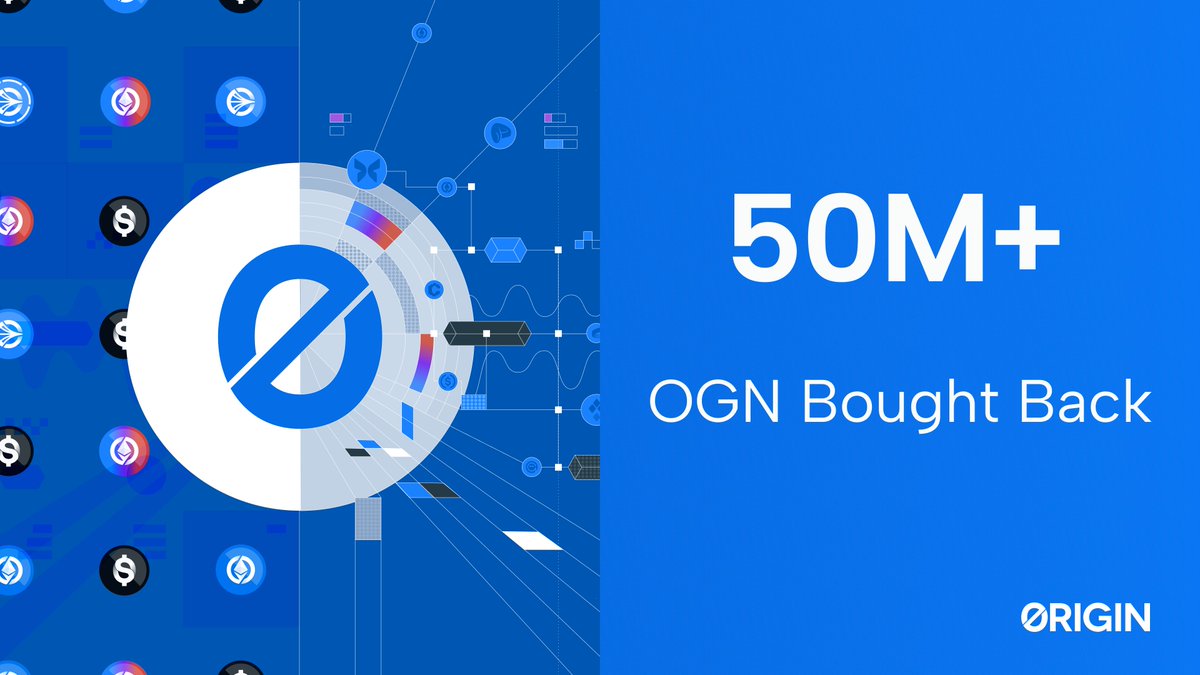
OGN Buyback Milestone: The buyback program has repurchased 10% of OGN’s circulating supply. To date, over 67,000,000 $OGN has been bought back since the program launched.

Every system evolves. Even money. 🌱 $OUSD has entered its next phase. Origin Dollar is now fully backed by $USDC and powered by a purpose-built @Morpho Vault curated by @yearnfi:
Where else do you get paid to borrow? The Super OETH Borrow Booster market on @Base is offering negative borrow rates, with borrowers earning ~9.7% APY on $USDC. Check it out on @Morpho 🦋
Auto-deleverage is available on @Morpho for Borrow Booster markets. 🛡️ OETH/USDC and superOETHb/USDC both support auto-deleverage, giving you more confidence to size up your loop. Cheaper borrow rates, now paired with automatic risk controls 🧵 (1/2)
The $OETH staking upgrade is here — delivering major improvements in security, efficiency, and reliability. The upgrade removes oracle dependencies and modernizes validator operations. Here's why it matters 🧵
The End of Oracle Dependence: How Origin Ether Brings Trustless Validation to Liquid Staking Ethereum’s liquid staking market keeps scaling, but most LSTs still rely on 3rd-party oracle committees to function. That’s a structural weakness in a system built for self-verification. These committees bridge execution → consensus, reporting validator balances and exits. The setup works, but it introduces delay, coordination overhead, and social trust into the a place that shouldn’t require it. With the latest $OETH upgrade, that design gap is gone. Origin Ether now verifies validator balances directly against the Beacon Chain using Merkle proofs via EIP-4788 — removing oracle dependencies entirely. This aligns LST accounting with Ethereum’s core principle: trust only the chain. A quick breakdown: • Execution-layer LSTs were historically blind to consensus-layer validator balances • Most LSTs rely on committees to push updates every 24 hours • This creates lag, trust assumptions, and offchain complexity • Dencun’s EIP-4788 changed the model by exposing Beacon roots inside the EVM • Smart contracts can now confirm validator state cryptographically, without intermediaries OETH is among the first LSTs to fully adopt this architecture. Validator balance increases, decreases, exits, and pending deposits are now verified entirely through Merkle proofs. Any state update failing validation is rejected onchain. All contracts were audited by @OpenZeppelin, @sigp_io, and @Nethermind, ensuring the approach meets the same security bar as validator infrastructure itself. Why this matters: • Stronger resilience: no offchain actors needed • Deterministic accounting: integrations can trust the numbers rather than oracles • Full transparency: anyone can verify validator states using public Beacon data OETH joins a small set of protocols — including EigenLayer and Stakefish — pushing proof-based validation forward. Bringing this to the liquid staking layer gives users direct access to trust-minimized ETH staking rewards. As Ethereum continues to evolve, proof-based accounting is set to replace oracle-driven systems. Merkle proofs are emerging as a core primitive for the next stage of onchain finance, enabling things like: • Restaking protocols with native validator state verification • Institutional staking and fund products that require cryptographic solvency proofs • Modular and cross-chain systems anchored to Ethereum’s consensus data Origin Ether is taking this path early, setting a higher standard for verification in staking. Full write-up in the comments. 👇




OETH is getting a major upgrade. 🛡️ The upgrade has passed audits from @NethermindSec, @OpenZeppelin, and @sigp_io — three of the most respected firms in Ethereum security. OETH staking is becoming more secure, transparent, and efficient than ever. (1/3)
500K ETH in Volume 💫 Origin’s $stETH ARM has generated over $1.4B (500K ETH) in volume since opening to external LPs. @MEVCapital, @Yield, @summerfinance_, and @LidoGrants have since allocated to the ARM to earn strong ETH yields while supporting the stETH peg.

Paying high borrow rates on $USDC loans? You’re overpaying. The new OETH/USDC @MorphoLabs market, curated by @MEVCapital, uses Borrow Booster to make USDC loans cheaper on Ethereum. (1/5) 🧵