QuHarrison Terry

15.2K posts

QuHarrison Terry banner
QuHarrison Terry

QuHarrison Terry

@quharrison

I share what I want to read again, it’s easier than using Evernote 😅 | Tweets are my own not my employers.

Dallas, TX Beigetreten Nisan 2011
2.1K Folgt5.5K Follower
signüll
signüll@signulll·
none of my posts or ideas are unique. i have built my thinking on the backs of countless others through books, conversations, etc. all of my posts & thoughts are derivatives of my lived experiences. originality is a mirage.
English
33
16
309
8.9K
QuHarrison Terry retweetet
Linus ✦ Ekenstam
Linus ✦ Ekenstam@LinusEkenstam·
Tokenmaxxing by @bcherny $84-120k in token burn in 2 months This is the new benchmark for tech workers
Linus ✦ Ekenstam tweet media
English
6
2
18
4.7K
QuHarrison Terry retweetet
vozer 🎀 
vozer 🎀 @vozercozer·
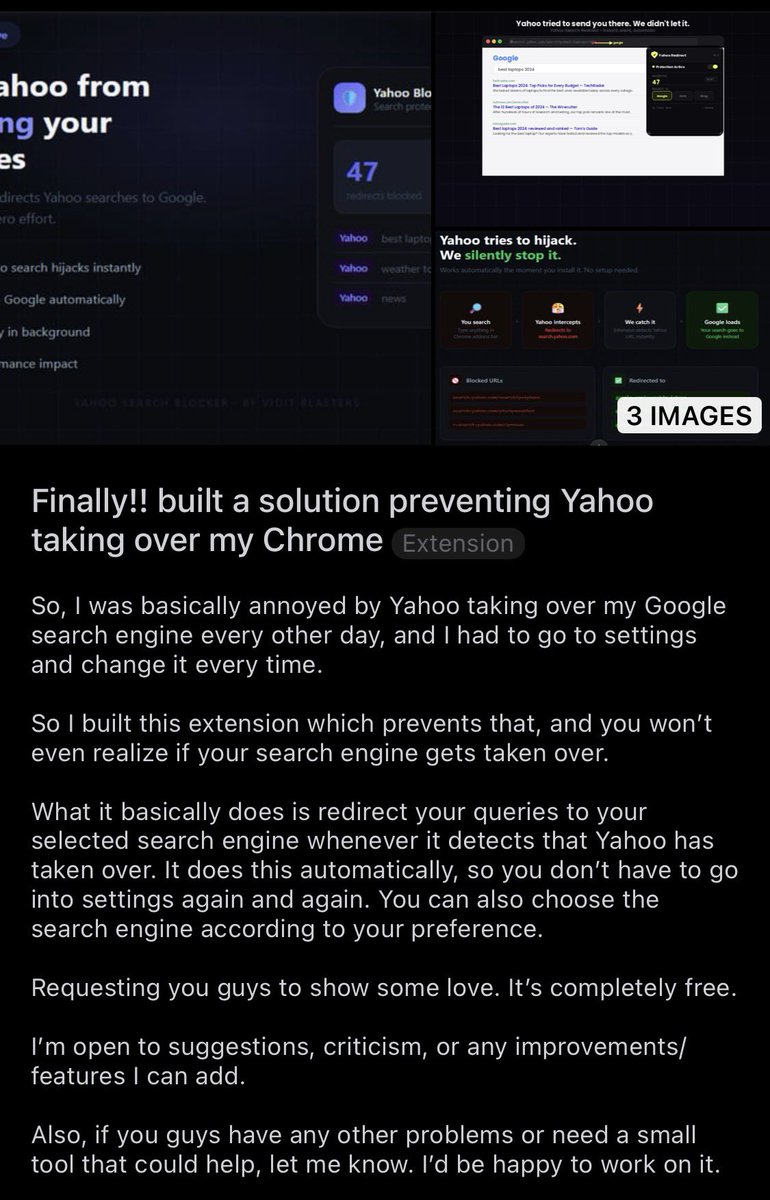
i’m fucking crying 😭 this guy installed a malware that keeps redirecting his queries through Yahoo, and vibe coded an extension that redirects Yahoo to Google, probably not understanding that he has malware 😭 😭
vozer 🎀  tweet media
English
93
593
11.4K
362.9K
QuHarrison Terry retweetet
Sukh Sroay
Sukh Sroay@sukh_saroy·
🚨BREAKING: Block (Jack Dorsey's company) just open-sourced a local AI agent that goes way beyond code suggestions. it's called Goose. it installs, executes, edits, and tests with any LLM fully on your machine. 100% open source.
Sukh Sroay tweet media
English
26
119
692
227.8K
QuHarrison Terry retweetet
Kyle Walker
Kyle Walker@kyle_e_walker·
Teaching Gemma 4 (26b MoE) how to map Census data in R via @opencode & oMLX in the @zeddotdev IDE. It's the first local LLM I've used that gets me real-time responsiveness. Running on a MacBook Pro M2 MAX, 64GB RAM. Gemma 4 is not as smart as the frontier models, but it can get real work done if you guide it the right way. With the benefit of running for free on my own hardware.
English
4
6
51
6K
QuHarrison Terry retweetet
Steve Yegge
Steve Yegge@Steve_Yegge·
I was chatting with my buddy at Google, who's been a tech director there for about 20 years, about their AI adoption. Craziest convo I've had all year. The TL;DR is that Google engineering appears to have the same AI adoption footprint as John Deere, the tractor company. Most of the industry has the same internal adoption curve: 20% agentic power users, 20% outright refusers, 60% still using Cursor or equivalent chat tool. It turns out Google has this curve too. But why is Google so... average? How is it that a handful of companies are taking off like a spaceship, and the rest, including Google, are mired in inaction? My buddy's observation was key here: There has been an industry-wide hiring freeze for 18+ months, during which time nobody has been moving jobs. So there are no clued-in people coming in from the outside to tell Google how far behind they are, how utterly mediocre they have become as an eng org. He says the problem is that they can't use Claude Code because it's the enemy, and Gemini has never been good enough to capture people's workflows like Claude has, so basically agentic coding just never really took off inside Google. They're all just plodding along, completely oblivious to what's happening out there right now. Not only is Google not able to do anything about it, they don't seem to be aware of the problem at all. I'm having major flashbacks to fifty years ago as a kid at the La Brea Tar Pits, asking, "why can't they just climb out?" My Google friend and I had this conversation over a month ago. I didn't share it because I wanted to look around a bit, and see if it's really as bad as all that. I've been talking to people from dozens of companies since then. And yeah. It's as bad as all that. Google is about average. Some companies at the bottom have near-zero AI adoption and can't even get budget for AI. They may have moats and high walls, but the horde is coming for them all the same. And then there are a few companies I've met recently who are *amazingly* leaned in to AI adoption. One category-leader company just cancelled IntelliJ for a thousand engineers. That's an incredibly bold move, one of many they're making towards agentic adoption. In my opinion, that company is setting themselves up for a _huge_ W. As for the rest, well, it's the Great Siloing. Everyone's flying blind. With nobody moving companies, no company knows where they stand on the AI adoption curve. Nobody knows how they're doing compared to everyone else. Half of them just check a box: "We enabled {Copilot/Cursor} for everyone!" Cue smug celebrations. They think this is like getting SOC2 compliance, just a thing they turn on and now it's "solved." And they don't realize that they've done effectively nothing at all. All because of a hiring freeze.
English
530
460
5.2K
2.7M
QuHarrison Terry retweetet
Shane Parrish
Shane Parrish@shaneparrish·
@elonmusk A better way
Shane Parrish@shaneparrish

My conversation with @jliemandt on why the future of education is better than you think. 0:00 The current education system 7:01 What makes Alpha School different 11:01 What are the results 23:20 Current classroom struggles 26:40 What does mastery mean? 35:37 Changing the education system 39:19 Teaching through AI 44:27 How do you solve motivation? 57:01 What makes a good teacher? 1:01:04 Coaching 1:05:17 What life skills matter? 1:08:18 Doing hard things 1:13:25 AI Monitoring 1:21:08 Effort vs. IQ 1:24:40 What happens after Alpha School? 1:38:21 The Genius of Jack Welch 1:45:49 Trilogy IPO: the choice to not go public 1:51:40 Physical vs. virtual learning 2:03:18 Does Paying Kids To Learn work? 2:11:01 What Is Success For You? (Includes paid partnerships)


English
2
3
27
7.1K
QuHarrison Terry retweetet
Dustin
Dustin@r0ck3t23·
Elon Musk thinks the entire education system is built on a broken assumption. That every student should learn the same thing. At the same speed. In the same order. At the same time. Musk: “Everyone goes through from like 5th grade to 6th grade to 7th grade like it’s an assembly line. But people are not objects on an assembly line.” The model was designed for a factory economy. Standardized inputs. Predictable outputs. That economy is gone. The assembly line is gone. But the education system still runs on its logic. A student who masters algebra in two weeks sits through eight more weeks because the calendar says so. A student who struggles gets dragged forward because the schedule doesn’t wait. Neither is being served. Both are being processed. Musk: “Allow people to progress at the fastest pace that they can or are interested in, in each subject.” AI doesn’t teach a classroom. It teaches a student. One at a time. Every time. It skips what a student already knows. It finds where they’re stuck and approaches it from a different angle. It adjusts in real time. Not at the end of a semester when the damage is already done. A student obsessed with basketball learns fractions through shooting percentages. A student who builds in Minecraft learns geometry through architecture. The subject doesn’t change. The entry point does. No teacher with thirty students can do this. Not because they lack skill. Because the math doesn’t work. AI doesn’t have that constraint. Musk: “You do not need to tell your kid to play video games. They will play video games on autopilot all day. So if you can make it interactive and engaging, then you can make education far more compelling.” The brain isn’t broken. The format is. Kids learn complex systems and strategic thinking for hours voluntarily. Then walk into a classroom and can’t focus for twenty minutes. That’s not a discipline problem. That’s a design problem. Musk: “A university education is often unnecessary. You probably learn the vast majority of what you’re going to learn there in the first two years. And most of it is from your classmates.” Four years. Six figures of debt. And the real value comes from the people sitting next to you. Not the institution charging you. The degree doesn’t certify knowledge. It certifies endurance. Musk: “If the goal is to start a company, I would say no point in finishing college.” The system was built to train employees. If you’re not trying to be one, it has nothing left to offer you. Every lecture. Every textbook. Every curriculum. Now available instantly. Personalized to any learner. Adapted to any pace. The question isn’t whether the old model survives. It’s how long we keep forcing students through it while the replacement already exists.
English
2.5K
9.6K
38.1K
21.4M
DOM
DOM@DOPEITSDOM·
Best team in baseball Los Angeles @Dodgers
English
18
394
1.1K
32.9K
QuHarrison Terry retweetet
Tim Harford
Tim Harford@TimHarford·
On 26 April, I plan to be on the start line of the London Marathon. I’m in my fifties, I’ve only been running for a few years, and this will be my first marathon. I’m doing it to raise money for the Teenage Cancer Trust (TCT).
English
11
25
278
25.5K
QuHarrison Terry retweetet
andrew chen
andrew chen@andrewchen·
prediction: we'll soon view coding the way we view using spreadsheets today - a commonplace skill that every white collar worker is expected to have. Knowing how to code will sit alongside email, making slides, word processing, etc etc. It'll be <18 months before this is widespread in every job description Customer-facing employees will code as well as sell/market/support, so that they convert their domain expertise into repeatable workflows and software. We'll have an explosion of internal bespoke apps. But to complement all of this coding happening at the edges, we'll also have centrally expert teams of agentic coders who build infrastructure, make it secure/scalable, and create canonical software. These central teams will help scale agentic engineering. There's a spreadsheet metaphor here too -- yes, if you are an expert at spreadsheets, you write macros, build huge models, etc., we'll put you in a group of your own. It's called Finance. :) We'll have the same central teams to help manage the widespread use of coding tools throughout the org. You might ask, won't this be a mess? What happens in a world where everyone has many many variations of bespoke software? (It's already happening) Maybe! But I think it'll be fine, in the same way that it's fine to make a copy of a spreadsheet or deck. Making it easy to fork makes it easy to participate. But you might want an "official" forecast maintained by an official finance person, in the same way that there will be variations of canonical and bespoke software excited for the Gdrive of many many forks of disposable apps made and shared by my co-workers!!! 😂
English
94
45
540
147.2K
QuHarrison Terry retweetet
Linus ✦ Ekenstam
Linus ✦ Ekenstam@LinusEkenstam·
Traditional motion design for a 15-second title sequence: → senior designer in Cinema 4D, → 1.5 days on particle physics, → 1 day on volumetric light, → 11-hour renders per revision. Total: $8K, 4 days. Each revision is another day and another 11-hour render. Studios charge $8K-$15K per sequence. Their cost structure (senior designer salary, C4D license, render infrastructure, PM overhead) means thin margins and a financial incentive to limit revisions. On Seedance 2.0 on Higgs: same title sequence from a prompt in minutes. Each revision is another prompt, 4 minutes. You explore 20 creative directions in the time it used to take to render one. Service pricing: → Charge $4K (half studio rate), keep ~$3,985 margin per sequence. → 10 sequences/month = $39,850. → 20 sequences/month = $79,700. One person. The real competitive advantage is unlimited revisions. Studios stop at revision 3 to protect margin. You say yes to every direction because each costs 4 minutes. The CD always chooses the partner who says yes. Studios have always known the 20th direction is better than the 1st. They stopped at the 3rd because of timeline. You deliver the 20th. This is the power of AI. You are super charged. Seedance 2.0 is now available WORLD WIDE on Higgsfield
English
3
2
28
7.4K
QuHarrison Terry retweetet
CITIUS MAG
CITIUS MAG@CitiusMag·
The Marathon Goes Solo 🥇 "The shift is no guarantee of success, particularly as the Abbott World Marathon Major circuit continues to expand. In 2030, there could be ten marathons of varying levels of prestige, and we won’t know how that will look or how much people will care until we get there. But compared to the World Championship marathon’s lackluster 2025 existence, it’s worth a try. We’d rather have a commissioner who cares about the health of the business than have no business at all." 📫 Read more via @TheLapCount: thelapcount.substack.com/i/193516761/th…
CITIUS MAG tweet media
English
0
2
17
5.5K
Irene
Irene@irenepmi9·
@DoctorLemma There was a film made about this, starting William Devane. Watched it many times.
Irene tweet media
English
2
3
50
3.2K
QuHarrison Terry retweetet
Dr. Lemma
Dr. Lemma@DoctorLemma·
43 years ago, at 41,000 feet in the air, a brand new passenger plane carrying 69 people went completely silent. Both engines died at the exact same time. The massive jet had just run out of fuel mid-flight. The reason was a simple math mistake caused by a confusing transition. Canada was right in the middle of switching to the metric system. This specific plane was the very first one in the airline's fleet to use kilograms. The ground crew was still used to the old system. They calculated the fuel weight in pounds. The plane took off with less than half the fuel it needed to make the trip. What happened next should not have been survivable. The captain happened to fly small, unpowered gliders as a hobby. He had to do something no one had ever done with a commercial jet. He flew the heavy, powerless plane like a giant paper airplane toward an old abandoned military runway his co-pilot remembered. Neither of them knew the old base had been turned into a public car track. Neither of them knew there was a family racing event happening right on the asphalt that afternoon. Go-karts, cars, and kids on bicycles were directly in their path. The plane came down completely silently. There was no loud engine noise to warn the people below. The pilot forced the plane to drop out of the sky sideways just to slow it down. He came in fast. The front wheels collapsed when they hit the runway. The nose of the plane scraped across the concrete, throwing sparks everywhere until the huge jet skidded to a halt. The back end was sticking three stories up in the air. Nobody on the ground was hit. Every single one of the 69 people on board walked away. When airlines later put other pilots in simulators to try and copy the landing, every single one of them crashed. The plane was repaired and flew for another 25 years.
Dr. Lemma tweet media
English
379
2.2K
15.8K
918.8K