secretsig

3.7K posts

secretsig

secretsig

@secretsig

The unwitting godfather of Atlanta angel investing.

Atlanta Beigetreten Mart 2008
715 Folgt4.6K Follower
secretsig retweetet
Aubrey Lenyard
Aubrey Lenyard@aubsATDC·
Good conversation with @GeoffDuncanGA tonight in Atlanta. Asked about his support for Georgia farmers who've been hit hard by recent policies—really appreciated his response. Important conversations for Georgia’s ag community.
Aubrey Lenyard tweet media
English
0
1
3
55
secretsig retweetet
David Cummings
David Cummings@davidcummings·
With the new year upon us, it is a great time to reflect on last year’s accomplishments and set new goals for the year ahead. As I read various “lessons learned” articles and annual recaps, I often think about what my single most important piece of advice for entrepreneurs would be. Advice is extremely stage- and journey-specific. Many entrepreneurs consume a wide range of guidance that is simply not applicable to their situation. It may be too big, too small, too early, too late, or designed for an entirely different type of market. It is always important to understand the background of the person giving the advice and who it is really meant for. That said, my number one piece of advice for entrepreneurs in the new year is simple: write and send a weekly or monthly update to anyone who cares about what you are doing. This could include employees, advisors, investors, mentors, family members, friends, or fellow entrepreneurs. Who receives it matters far less than the fact that you do it consistently. Ideally, you set aside 30 to 60 minutes each week to write down what you accomplished last week, what you are working on this week, your main goals for the quarter and the year, your top priorities, and any specific asks, such as introductions, advice, or feedback. This update should be a recurring event on your calendar. Each one can live in its own Google Doc and be sent to a BCC list maintained in a simple Google Sheet. You can certainly use email marketing software or a dedicated app, but I recommend starting with this straightforward, brute-force approach and adding tools later if needed. Writing this regular update is incredibly valuable for your own clarity. It forces you to organize all the ideas swirling in your head, the highs and lows, and the messages you want to communicate. At the same time, it is one of the best ways to keep your network informed and to make it easy for them to help you. Entrepreneurship is filled with extreme highs, deep lows, and long stretches of wandering in the desert. A recurring written update brings clarity, both internally and externally, through that entire journey. As a bonus, after years of doing it, you end up with a detailed journal of your entrepreneurial life that can one day become a book or something you pass down to your children and grandchildren. My recommendation is simple: send a weekly or monthly update email. Include anecdotes, metrics, projects, and the things you need help with. Make it a habit, and make sure your audience receives it at the same time every week or month.
English
2
3
10
847
secretsig
secretsig@secretsig·
The Siggie Awards are pleased to announce that Tami McQueen, Chief Marketing Officer at BIP Capital, will be the emcee for their signature event on November 11 at Emory University. Don’t miss your chance to be part of this special evening. Get your tickets today.
English
1
0
6
125
secretsig
secretsig@secretsig·
TiE Atlanta, Emory University’s Goizueta Business School are excited to announce that Jack Markwalter, Chief Executive Officer of VIVA Finance, will be the keynote speaker for the group’s Siggie Awards celebration during AngelCon ATL on November 11, 2025.
English
0
0
5
131
secretsig
secretsig@secretsig·
The Siggie Awards are back. Hosted by TiE Atlanta, with support from Emory University’s Goizueta Business School, the 2025 Siggie Awards will be announced during AngelCon ATL on November 11, 2025. Hope to see you in November.
English
0
0
9
193
Jack Cable
Jack Cable@jackhcable·
AI revolutionized coding. Security hasn't kept up–until now. Introducing @CorridorSecure: the future of secure coding. We just raised a $5.4M seed from @Conviction and hired @alexstamos. Corridor is trusted by leading companies like @cursor_ai–and we’re just getting started. 🧵
English
40
78
575
122.2K
secretsig retweetet
David Cummings
David Cummings@davidcummings·
Last month, I was talking to an entrepreneur about his experience with a variety of investors over multiple rounds of funding. Toward the end of the conversation, I asked which investor provided the most value and why. Without missing a beat, he said one of the investors stood out, and that the main driver of value was simply responsiveness. Anytime the entrepreneur had a question, the investor would respond immediately with an email or a phone call, regardless of the time of day or day of the week. At first, when an investor gets involved, there's a period of time where the entrepreneur and investor feel out the relationship. What’s appropriate? What’s a good cadence for checking in? What areas does the investor like to work on or help with? And so on. From an investor’s perspective, they might invest in a couple of startups per year, up to dozens depending on their style. Whereas an entrepreneur might have a handful of serious investors and several casual investors on their cap table. The ratios of relationships are nowhere near the same. As an entrepreneur goes through an issue, or opportunity for the first time, having an investor who has been there before in a similar situation can be invaluable. Only, the investor has to want to share and spend time with the entrepreneur for it to be mutually beneficial. Thinking about this entrepreneur’s comment—that his most valuable investor was the one who was most responsive—makes sense. The entrepreneur is in the trenches, working hard to make progress, and having an on-demand sounding board with experience and knowledge is invaluable. My recommendation for entrepreneurs when talking to potential investors is to ask how they like to work with the entrepreneurs they invest in. Entrepreneurs would do well to have a go-to person they look forward to talking with, who has relevant experience and, crucially, is super responsive.
English
1
2
13
1K
secretsig retweetet
Chris Klaus
Chris Klaus@cklaus1·
Georgia Tech founders #2 in YC's latest batch. GO Yellow Jackets!
Chris Klaus tweet media
English
16
26
322
39.8K
secretsig retweetet
Dan Gray
Dan Gray@credistick·
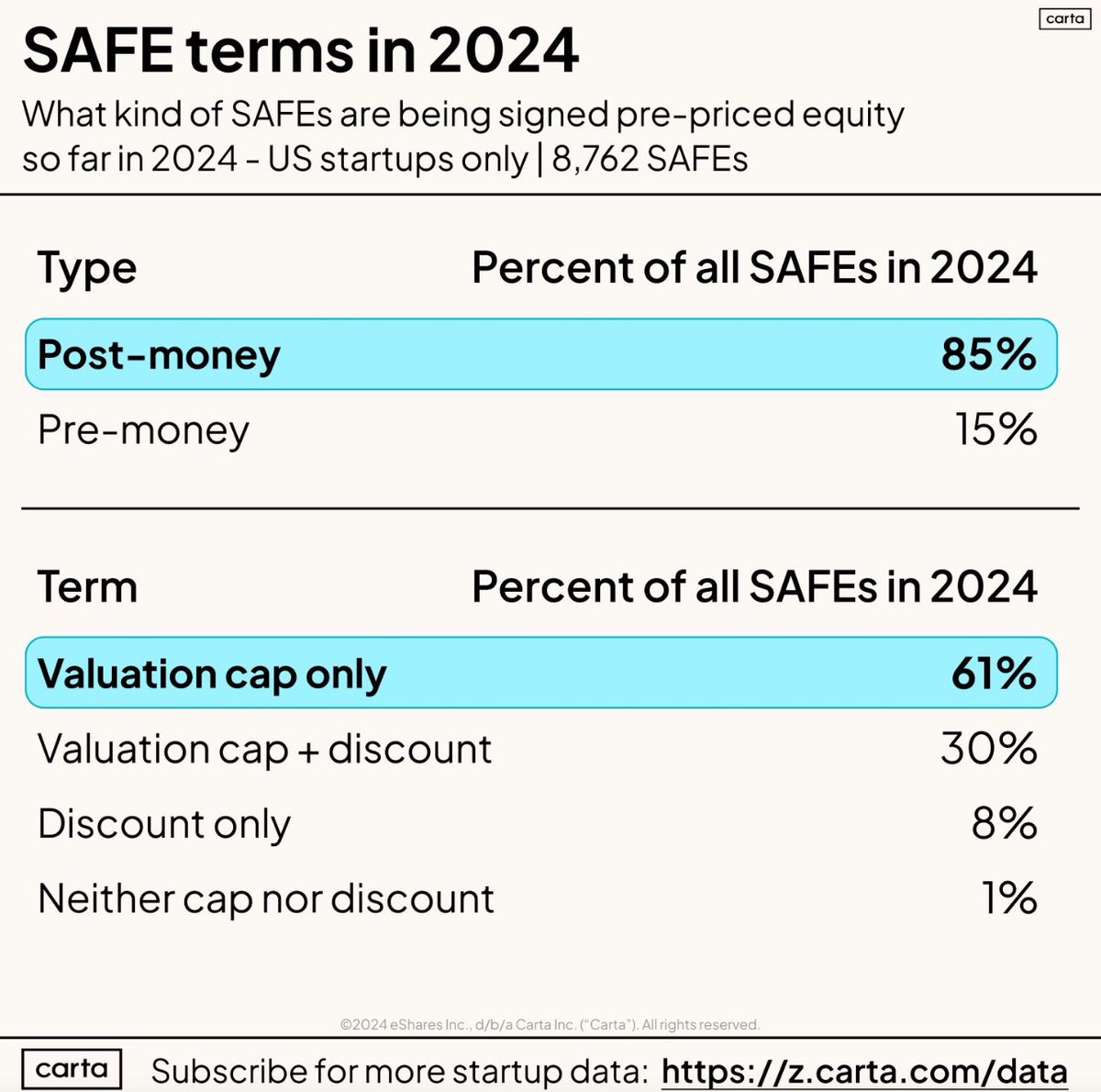
The YC discount SAFE standard has some practical applications, but it barely gets used. Why? Investors have an aversion to uncapped terms because of how badly they worked out in hot markets; a few scary anecdotes of runaway pricing. Thus, we’ve seen adoption of a flat discount of 20% as the default, which only makes sense in addition to a cap. Indeed, the cap + discount SAFE is relatively popular despite the fact that it isn’t a YC standard and they actually advise against combining terms. If the discount SAFE has any legs, it is with an ROI based discount. That means whenever the SAFE converts, it ensures investors are adequately compensated for risk and time. So much time is wasted on fuzzy thinking about caps, what they represent and how to calculate them. A post money SAFE (guaranteeing a particularly level of ownership) might as well be a priced round. If we could make early priced rounds as simple and clean as a SAFE, that would clear up a lot of messy cap table issues. Meanwhile, discount SAFEs would more competently serve the purpose that SAFEs were designed for.
Dan Gray tweet media
Patrick Ryan@ry_paddy

Having structured over 50 investments across 8 YC batches can confirm this is an issue - YC companies often raise a priced seed at or around the SAFE cap ~18 months or so later. You effectively get nothing for investing earlier. Better to invest x% discount no cap.

English
10
6
70
17.7K
secretsig retweetet
Peter Walker
Peter Walker@PeterJ_Walker·
4,369 startups founded in 2018 -where are they now? All US companies that used Carta for their cap tables. 4.4% have gotten to Series C. 1.1% to Series D or later. 0.34% have IPO'd, 5.5% have gotten acquired, and 1.3% are currently private unicorns. 61.9% have closed down
Peter Walker tweet media
English
18
55
235
40.2K
secretsig retweetet
Elizabeth Yin 💛
Elizabeth Yin 💛@dunkhippo33·
Founders, let's talk about QSBS – the tax policy that could save you a ton when your startup exits (IPO or acquisition). Yes, I know. Taxes are not usually the most exciting topic. But this one’s pretty cool. Stay with me >>
English
11
21
115
21.5K
secretsig retweetet
Russell Innovation Center for Entrepreneurs
2024 was extraordinary at RICE Transformative moments, and uncommon access fueled businesses & boundless possibilities. From VP Kamala Harris’ visit to Walmart Open Call pitches, we proved: Readiness + Access = Growth. Let’s celebrate our wins—what was YOUR top 2024 moment?
Russell Innovation Center for Entrepreneurs tweet mediaRussell Innovation Center for Entrepreneurs tweet mediaRussell Innovation Center for Entrepreneurs tweet mediaRussell Innovation Center for Entrepreneurs tweet media
English
0
1
4
252
secretsig retweetet
secretsig retweetet
David Cummings
David Cummings@davidcummings·
Last week, I was talking to an investor about an entrepreneur he really enjoyed working with. Hearing the joy in his voice, I inquired about what made the experience so delightful. He said it was the quality of the entrepreneur’s interactions. This idea has been on my mind ever since: the quality of interactions. After asking more questions and exploring the idea myself, here are a few examples of quality interactions between an entrepreneur and an investor: 1. Timeliness of Response Whether it’s a phone call, email, or text, responsiveness matters. Of course, there’s always a lot going on, but some people manage their responsiveness better. Even if they don’t have time for a full conversation, a quick message like, “I’m tied up for the next few hours (or the day), but here are some good times to catch up,” or “I’ll get back to you by [specific time],” goes a long way. Quick, clear communication builds trust. 2. Thoughtfulness on Unknown Questions Investors frequently ask entrepreneurs questions they might not immediately know the answers to: What does this customer cohort look like? How has this spend changed over time? Where is the market headed in this sub-segment? It’s normal not to have all the answers. However, some entrepreneurs try to answer everything, even when it’s clear they don’t know. It’s much better and more thoughtful to respond with something like, “Great question. I don’t know the answer to that, but I’ll research it and get back to you.” Acknowledging what you don’t know and committing to follow up shows maturity and professionalism. 3. Enthusiasm and Passion While entrepreneurs are generally optimistic—sometimes to a fault—those who demonstrate genuine passion and excitement are more enjoyable to interact with. That said, entrepreneurs shouldn’t fake enthusiasm, but ramping up energy and excitement within a natural spectrum of authenticity can make a big difference. 4. Effort in Materials Investors often request board decks, data room access, financial models, etc. Everything an entrepreneur sends to an investor reflects their leadership, even if they didn’t create the document themselves. Typos, grammar mistakes, or low-quality work can reflect poorly on the business. With today’s AI tools, it’s easier than ever to ensure high-quality output. Taking the time to deliver polished, accurate materials builds credibility. 5. Rhythm of Communication Investors value reliability and consistency in communication. Regular updates, such as a weekly email or monthly snapshot, can keep investors informed and confident in the business’s progress. Unfortunately, most entrepreneurs don’t take this proactive approach, leaving investors to request updates. Entrepreneurs who develop a consistent communication rhythm—showing transparency and reliability—provide peace of mind and demonstrate that these habits will continue as the business grows. People like to work with others who are thoughtful, conscientious, and care about the quality of interactions. This dynamic is especially important in relationships between entrepreneurs and investors, which often span many years or even decades. Recognizing the importance of timeliness, thoughtfulness, enthusiasm, effort, and consistent communication can significantly strengthen these relationships. Entrepreneurs would do well to evaluate their current level of interaction and look for opportunities to enhance or improve it.
English
3
3
14
1.7K
secretsig retweetet
Hypepotamus
Hypepotamus@hypepotamus·
Siggie Statue: Missed out on the night’s festivities? No worries! We are have a round up of the Siggie Award winners for 2024: buff.ly/4eCfy6s @secretsig
Hypepotamus tweet media
English
0
1
4
255
secretsig
secretsig@secretsig·
All eyes on Emory's GBS last evening as the 2024 Siggie Awards were announced. This year’s event included the inaugural class of the Siggie Investor Hall of Fame, Horizon Award, Investor’s Choice, Founder’s Choice, Conscious Capital, and Social Enterprise Award Winners.
English
1
0
6
137
secretsig retweetet
Aubrey Lenyard
Aubrey Lenyard@aubsATDC·
Continued.
Aubrey Lenyard tweet mediaAubrey Lenyard tweet media
Candler-McAfee, GA 🇺🇸 English
0
1
3
145