

Simon Hedlin
6.3K posts
Simon Hedlin
@simonhedlin
Policy researcher and counsel who wants AI to be safe, secure, and broadly beneficial. Views my own. MA Columbia & JD/MPP Harvard. [email protected]
Washington, DC Beigetreten Nisan 2010
6.2K Folgt22.9K Follower

Two friends of mine were laid off from Meta in the latest restructuring.
One had been there three years. The other for seven.
Job anxiety is ripping through the nation and policymakers are completely unprepared for the next few years.
So I built @jobanxiety, a site tracking 800+ jobs created by AI with research on upskilling and labor market trends on in-demand jobs in the AI era.
I see this as a continuation of my research at Brookings where I started my career as a economic analyst on the Workforce of the Future team.
Subscribe now to jobanxiety.ai/newsletter for the weekly updates on the latest on layoffs and hiring trends to escape the permanent underclass.
Comment any companies you want me to track next.
Built with @OpenAI, hosted on @render, video by @Replit, labor research by @claudeai.
English
This is why LLMs will revolutionize the legal industry.
Andrej Karpathy@karpathy
- Drafted a blog post - Used an LLM to meticulously improve the argument over 4 hours. - Wow, feeling great, it’s so convincing! - Fun idea let’s ask it to argue the opposite. - LLM demolishes the entire argument and convinces me that the opposite is in fact true. - lol The LLMs may elicit an opinion when asked but are extremely competent in arguing almost any direction. This is actually super useful as a tool for forming your own opinions, just make sure to ask different directions and be careful with the sycophancy.
English
What if LLMs are different in the same way?
A new study by Emily Wenger and Yoed Kenett in PNAS Nexus finds that LLMs are "homogeneously creative."
That means that LLMs are good at being creative at an individual level, but as a collective they are not that creative because they are original in the same way.
Wenger and Kenett gave 102 human participants and 22 LLMs standardized creativity tasks, such as proposing unusual uses for a fork and listing words that are as different from each other as possible.
On several of the creativity tasks, the LLMs individually scored higher than the average human participant. That's what previous researchers have found, too.
What's really interesting is what happened when the LLMs and the humans instead were considered as collectives.
It turned out that the LLMs gave highly similar responses. In other words, as a group, the humans were more creative.
This result makes sense when you consider the fact that LLMs may have highly similar architecture, training data, and optimization techniques.
It thus seems that if humans blindly use LLMs as creative partners, humanity will end up being less creative.
English
Simon Hedlin retweetet

@LuizaJarovsky @elonmusk @sama @DarioAmodei @sundarpichai @tim_cook @satyanadella @JeffBezos @finkd We are already working on this with tools like AlphaFold and the work we are doing at @IsomorphicLabs
English
We need more of this kind of direct engagement with people who are likely to be among the most negatively impacted by AI.
One interesting finding in the study: the biggest predictor of how someone feels about AI is whether they're worried about losing their job.
But the question of how AI will disrupt the economy cannot be answered from inside a lab.
The people most exposed to AI's economic disruption are typically the least represented in AI development.
Anthropic@AnthropicAI
We invited Claude users to share how they use AI, what they dream it could make possible, and what they fear it might do. Nearly 81,000 people responded in one week—the largest qualitative study of its kind. Read more: anthropic.com/features/81k-i…
English
History is often a good predictor of the future. But not when it comes to AI's impact on the labor market.
Here is why.
The N is close to zero.
People love to say "throughout history, we have been through this before, and there was no labor market bloodbath.”
And then they mention the printing press, the steam engine, electricity, and the internet.
That’s four examples over 600 years.
If you’re generous, you could add to the list maybe one or two more technologies that also were comparably transformative to AI.
That's the entire dataset.
You would never make a prediction about anything complex in your life with an N of 5.
The honest answer to the question "what does the history of truly transformative technologies tell us about AI’s impact on the labor market" is: we have nowhere near enough observations to have a clue.
Anyone who says otherwise is expressing a prior, not citing reliable evidence.
AI is the first technology whose explicit purpose is to replace human cognition generally.
The steam engine was never meant to be a general-purpose human.
The internet didn't try to think for itself.
Every prior technology automated a task. AI is designed to automate the worker.
That is not a subtle distinction. It’s a fundamental difference.
When the printing press displaced scribes, those scribes could move into jobs that required something the printing press couldn't do—think, analyze, communicate, create.
The whole premise of AGI is that there will be nothing left on that list AI cannot do at least as well as a human.
Previous technologies expanded the set of tasks where humans had a comparative advantage. AI shrinks it.
And you don't need AGI for that to matter enormously.
You just need AI that is good enough at enough cognitive tasks to change the basic math of hiring.
Agentic AI makes this concrete: when AI can perform not only time-intensive analytical and communication tasks but also execute multi-step workflows with minimal human oversight, human don't merely lose tasks: they lose the justification for a large human workforce.
No prior technology, no matter how transformative, had as one of its chief goals to keep innovating and scaling until general human capability is matched or exceeded.
The real question is: how many jobs will be lost and how fast?
And given that, we must also ask what are we willing to do collectively to ensure that AI’s benefits are broadly distributed.
So when someone reassures you by saying "but technology has always created more jobs than it destroyed," you should ask them: how many times throughout history has "always" actually happened?
And were any of those technologies in the past trying to do everything a human can do?
The answer to both of those questions should make you pretty uncomfortable.
English
“There has never been a technology that caused mass unemployment” is the new “There has never been a nationwide decline in housing prices.”
English
Millions of trucking jobs will be wiped out.
Sawyer Merritt@SawyerMerritt
NEWS: Aurora’s driverless trucks can now run longer than humans drivers are legally allowed. The company said the latest software update to its driverless hardware suite will enable its trucks to drive nonstop from Phoenix to Fort Worth. That trip is roughly 1,000 miles long and takes 15 hours to complete. By contrast, a human driver would legally have to take a 30 minute break after 11 hours of driving. The company currently has five autonomous trucks carrying cargo without safety monitors between Dallas, Houston, Fort Worth and El Paso, Texas. By the end of 2026, the startup expects to have over 200 driverless trucks in operation. Their trucks use lidar, radar, and cameras. via @InsideEVs
English
The first day of the week is Monday.
taoki@justalexoki
i can't believe this is real. it only happens once every 2500 years
English

Simon Hedlin retweetet

On the topic of billionaires and wealth taxes in California, I am opposed to wealth taxes because they effectively represent an expropriation of private property and have many unintended and negative consequences that have occurred in every country that has launched such a tax.
I am however strongly in favor of a fairer tax system. To that end, it doesn’t seem fair that someone can build a valuable business, create a billion or more in wealth and pay no personal income taxes by living off loans secured by stock in the company, (and even if the loans are unsecured).
Apparently, this approach is used by many super wealthy people. A small change in the tax code would address this unfairness. In short, personal loans taken in excess of one’s basis in the stock of a company should be taxable as if you sold the same dollar amount of stock as the loan amount.
One shouldn’t be able to live and spend like a billionaire and pay no tax.
I welcome arguments to the contrary as to why this is somehow unfair to the billionaire or even the hundred millionaire, but I don’t think there is a good one. The favorable current tax treatment of this approach also encourages the use of leverage which is not good for society.
And with respect to California’s budget problem, the issue is not a lack of tax revenues. The problem is how the money is being spent.
I have a bunch more ideas on other changes to the tax code that are hard to argue with if anyone cares.
Bill Ackman@BillAckman
The way to fix this problem is to make borrowing an amount in excess of your basis in a stock taxable. In other words, if you have $10 billion of stock in a company you founded with zero basis, loans secured by the stock should be taxable as if you sold a like amount of stock. So, for example, if you borrowed $1 billion you would have a capital gain of $1 billion. This would be both fair and practical to implement.
English
Hoping this is true but fearing (and think it’s much more likely) that it’s not.
Aaron Levie@levie
English
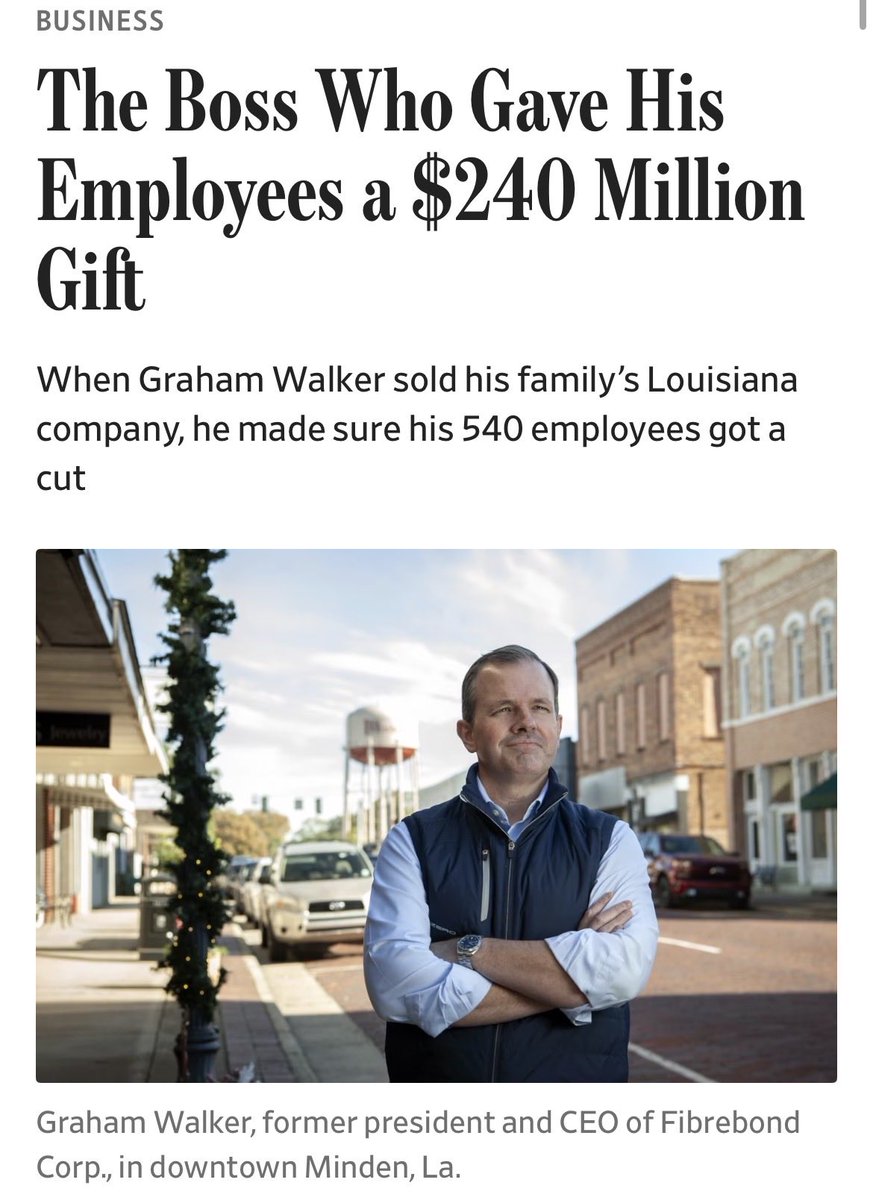
If more people acted this way, the world would be a much better place.
English
Why do high-speed trains receive jets of water when they arrive at the station?
English
Are you also advocating bringing back elevator operators to all elevators?
U.S. Senator John Fetterman@SenFettermanPA
I fully agree with @Teamsters. Self-driving trucks should *always* be supervised by a qualified professional to keep our roads safe. It’s a necessary partnership for America’s highways and economy.
English


I personally appreciate the Trump administration’s launch of the Trump accounts, appreciate the Dells for piling on with their support, and appreciate both of them for allowing Dalio Philanthropies and others to join in. This emerging bipartisan effort exemplifies the sort of movement that I hoped for when I wrote “Why and How Capitalism Needs to be Reformed” economicprinciples.org/Why-and-How-Ca… six years ago. These Trump Accounts are great not just because they put money into stocks for these young people but also because they draw their attention toward how finance, stocks, companies, and capitalism work to improve society and can work for them. For capitalism to work, it must work well for most people. In addition to contributing to these accounts, I will work with others on financial literacy education so everyone gets the basics down—like learning to earn more than one spends and how to save and invest well. Said differently, I believe that human capital—the ability of humans to earn money and handle it well—is the most valuable type of capital and the backbone of a strong country, so that is what I am now most interested in investing in. If the American people can do this in a bipartisan way, we will have a strong country.
English
To guarantee Trump a third term? Or what else could be the reason?
Axios@axios
Harris stepping toward another White House run trib.al/uzVmgQd
English