van be

674 posts

van be banner
van be

van be

@vanbe3

Worked and lived in🇦🇲🇷🇺🇨🇭🇩🇪🇺🇸. This channel is for discussions around the Nagorno Karabakh / Artsakh conflict.

Los Angeles, CA Beigetreten Nisan 2014
183 Folgt43 Follower
van be retweetet
Zartonk Media
Zartonk Media@ZartonkMedia·
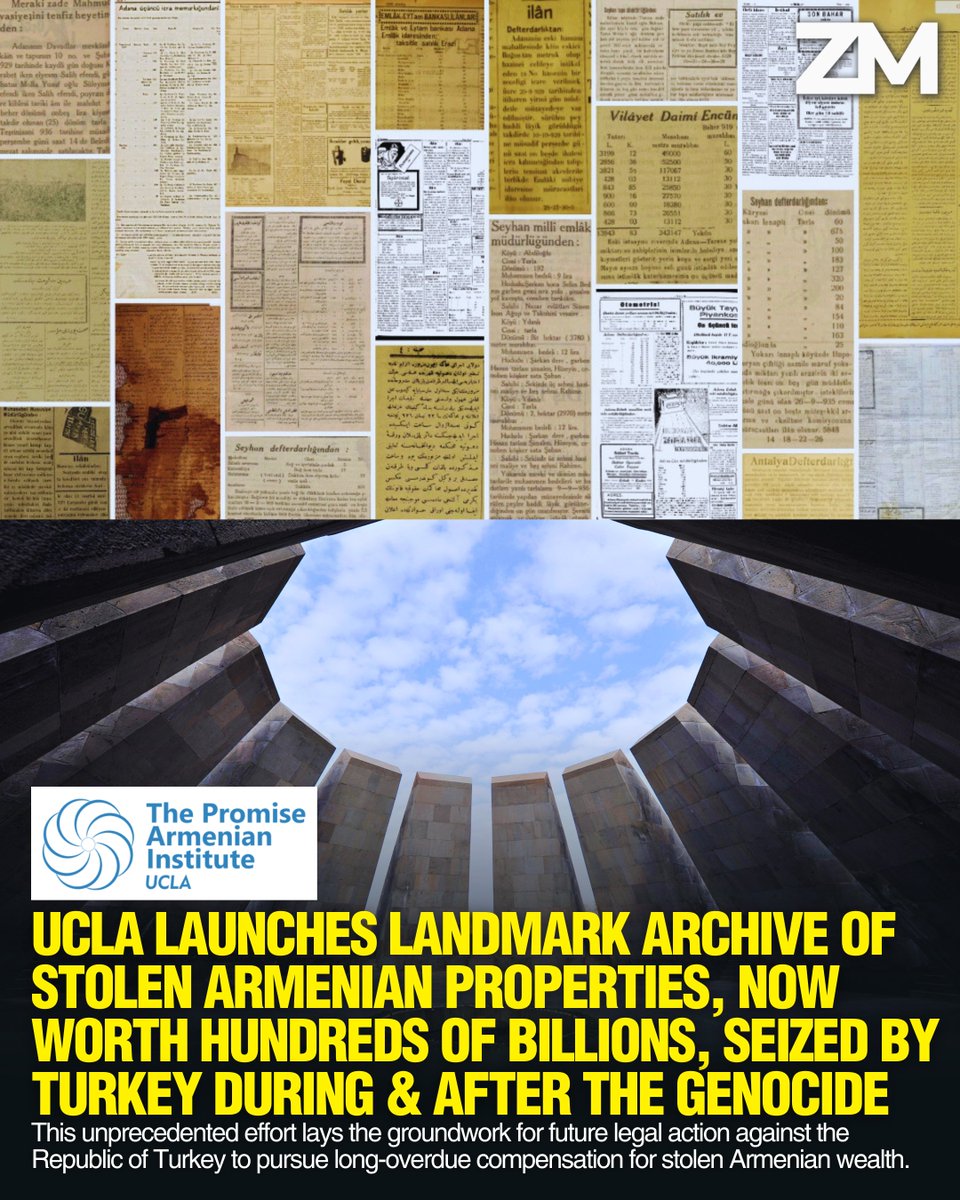
UCLA Launches Landmark Archive of Stolen Armenian Properties, Now Worth Hundreds of Billions, Seized by Turkey During & After the Genocide 🇦🇲 ➖➖➖ In a historic move for Armenian historical justice and legal restitution, UCLA’s Promise Armenian Institute has unveiled a public digital archive documenting properties confiscated from Armenians during and after the Armenian Genocide. The new initiative, developed by the Armenian Genocide Research Program (AGRP), is based on decades-old Turkish government auction records gathered by independent researcher Sait Çetinoğlu. These records — spanning 34 cities and towns — detail the widespread, state-orchestrated seizure and resale of Armenian homes, churches, land, and businesses, all falsely labeled as “abandoned properties” (Emval-i Metruke) by the Turkish state. For the first time, these documents have been collected in one place, translated into modern Turkish and English, and made available online. Experts say this unprecedented effort lays the groundwork for future legal action against the Republic of Turkey to pursue long-overdue compensation for stolen Armenian wealth. It is estimated that the total value of these confiscated Armenian properties — including over a million acres of land, thousands of churches, schools, homes, farms, and businesses — reaches into the hundreds of billions of dollars. If you or your family possess historical records, auction notices, or related materials concerning confiscated Armenian properties, the UCLA team welcomes contributions to expand the archive. Contact: armenian-info@international.ucla.edu Each public auction notice is categorized by city, translated into English and Turkish, and searchable through the UCLA website — bringing a forgotten history into public view: international.ucla.edu/armenia/stolen…. This article was written by Harut Sassounian of The California Courier: The Armenian Genocide Research Program (AGRP) within The Promise Armenian Institute at UCLA launched last week a groundbreaking project enabling Armenians to seek restitution of their properties confiscated by the Turkish government during and after the Genocide. In addition to the mass killing of 1.5 million Armenians, the Turkish government occupied their homeland of Western Armenia and seized their properties. Thanks to the UCLA initiative, for the first time all the missing information is gathered in a single depository. During a June 16 webinar, Prof. Taner Akçam, AGRP Director, shed light on the systematic expropriation and redistribution of Armenian wealth during and after the Genocide, described by the Turkish government as “Abandoned Properties” (Emval-i Metruke). Independent Turkish researcher Sait Çetinoğlu spent years collecting the government’s auction notices for these properties, which had appeared in local newspapers across 34 Turkish cities and towns in the 1920s and 1930s. Çetinoğlu has turned over these notices to UCLA, which has digitized and translated them from Ottoman Turkish into modern Turkish and English. In a comprehensive 31-page report posted on the UCLA website, Çetinoğlu detailed the Turkish government’s contradictory and deceptive orders for disposing of the confiscated Armenian properties: “An official order was issued on May 27, 1915, and the widespread seizure of Armenian property followed shortly thereafter. On May 31, 1915, the Ottoman Council of Ministers issued a decree formally regulating the ‘confiscation’ of Armenian assets, followed by a more detailed 34-article decree on June 10. Throughout the summer, special circulars were sent to various provinces, culminating in a formal law on September 26, 1915, and an implementation decree on November 8 of the same year. These laws and decrees stipulated that all movable and immovable Armenian assets must be recorded in official registries and their values be allocated to Armenians in their new settlements…. [However], a 1918 report by a joint commission of the Ottoman Ministries of Justice, Finance, and Internal Affairs explicitly stated that not a single Armenian had been compensated for their confiscated properties. In effect, the Ottoman state became the principal beneficiary of the plunder, using these assets and the proceeds from their sales to fund various state institutions.” Çetinoğlu explained that after the collapse of the Ottoman Empire in 1922, the newly established Turkish Republic “assumed control over much of the remaining Armenian property. However, the fledgling state faced significant financial challenges. As a result, beginning in 1923, various state institutions began auctioning off these looted Armenian properties. Official notices of these sales were regularly published in local Turkish newspapers.” For example, a notice in the Diyarbakir (Dickranagerd) newspaper on Sept. 14, 1931, announced that an auction would be held on Sept. 17, 1931, for a house registered in the name of Hatun (Khatun), daughter of Ohan, in Ali Pinar village, sold to Sheymus (son of Ahmet) of the Kara Kilise refugees, for 20 Liras. It is estimated that the total confiscated Armenian properties — including hundreds of thousands of homes and buildings, factories, mines, over a million acres of land, vineyards, olive groves, mulberry gardens, around 2,500 churches, and 1,000 schools — are now worth hundreds of billions of dollars. The confiscated Armenian properties were distributed to various Turkish entities. According to Çetinoğlu, “just as in the period of the Committee of Union and Progress,” the Republic of Turkey transferred some of these properties “to companies in order to develop a national industry and a Muslim bourgeoisie, and some of them were allocated to the Republican People’s Party — the only party of the period…. Many real estate properties were distributed, according to need, to various institutions such as associations, state institutions, municipalities, chambers of commerce, industry, and agriculture, the Red Crescent, and banks. In short, it could be said that every segment of [Turkish] society benefited from Armenian properties.” During the Kemalist period, the confiscated Armenian properties were distributed as follows: Sale and land distribution to Muslims; Allocation and sale to immigrants (muhacir); Transfer and allocation to state institutions; Allocation to the military; Allocation and leasing to banks, the Chamber of Commerce, and the commodities exchange; Sale to companies; Allocation, leasing, and sale to institutions linked to the regime, such as the Turkish Hearth, the Red Crescent, the Teachers Union, and the Trabzon Sports Club; Allocation to the families of Unionist leaders who were murdered by Armenians — such as Talat and Cemal Pashas, Cemal Azmi, and Bahaeddin Shakir — according to a law adopted by the Turkish Parliament on May 31, 1926. This project was made possible through the collective work of researcher Sait Çetinoğlu, AGRP Director Taner Akçam, translators Attila Tuygan and Nanor Hartounian, and student volunteers Aimee Frounjian and Anahit Gevorgyants, with support from the UCLA International Institute’s IT team. Their combined efforts made this archive accessible, searchable, and freely available to the public. “It is now up to the Armenian community to take this valuable information compiled by UCLA and file lawsuits against Turkey in U.S. federal courts demanding just compensation for the confiscated Armenian properties,” said Sassounian. He added, “Armenian-Americans should urge the U.S. Congress to pass a law — to be signed by the President of the United States — enabling lawsuits against the Republic of Turkey to receive compensation for the confiscated properties.” This proposed legislation would allow Armenians to pursue legal action even after the Statute of Limitations has expired — a key legal barrier that has blocked many restitution efforts to date. U.S. courts could issue binding judgments against Turkey to pay restitution to Armenians for their losses. If Turkey refuses to comply, the courts could then order the confiscation of all Turkish government-owned assets in the United States, such as buildings, bank accounts, and planes belonging to Turkish Airlines. “UCLA, as an academic institution, has done its part in compiling this valuable list of the Armenian confiscated properties. It is now the Armenian community’s turn to initiate legal actions to seek full restitution from Turkey,” added Sassounian.
Zartonk Media tweet media
English
6
86
256
10.9K
van be
van be@vanbe3·
@HEYDAR_19 @ANCA_DC @joerogan speaking of your hate-filled mind and hoping to infect the rest of the world with your filthy spirit. that’s all about you, not AM and what’s the false information here? and by the way, the only thing that makes AZ “interesting” to others is its oil, gas and the petrodollars.
English
1
0
0
16
Fuat Revanlı
Fuat Revanlı@HEYDAR_19·
@ANCA_DC @joerogan No one cares about this because Armenia is an uninteresting country, and the false information makes everyone feel disgusted.
English
1
0
0
173
ANCA
ANCA@ANCA_DC·
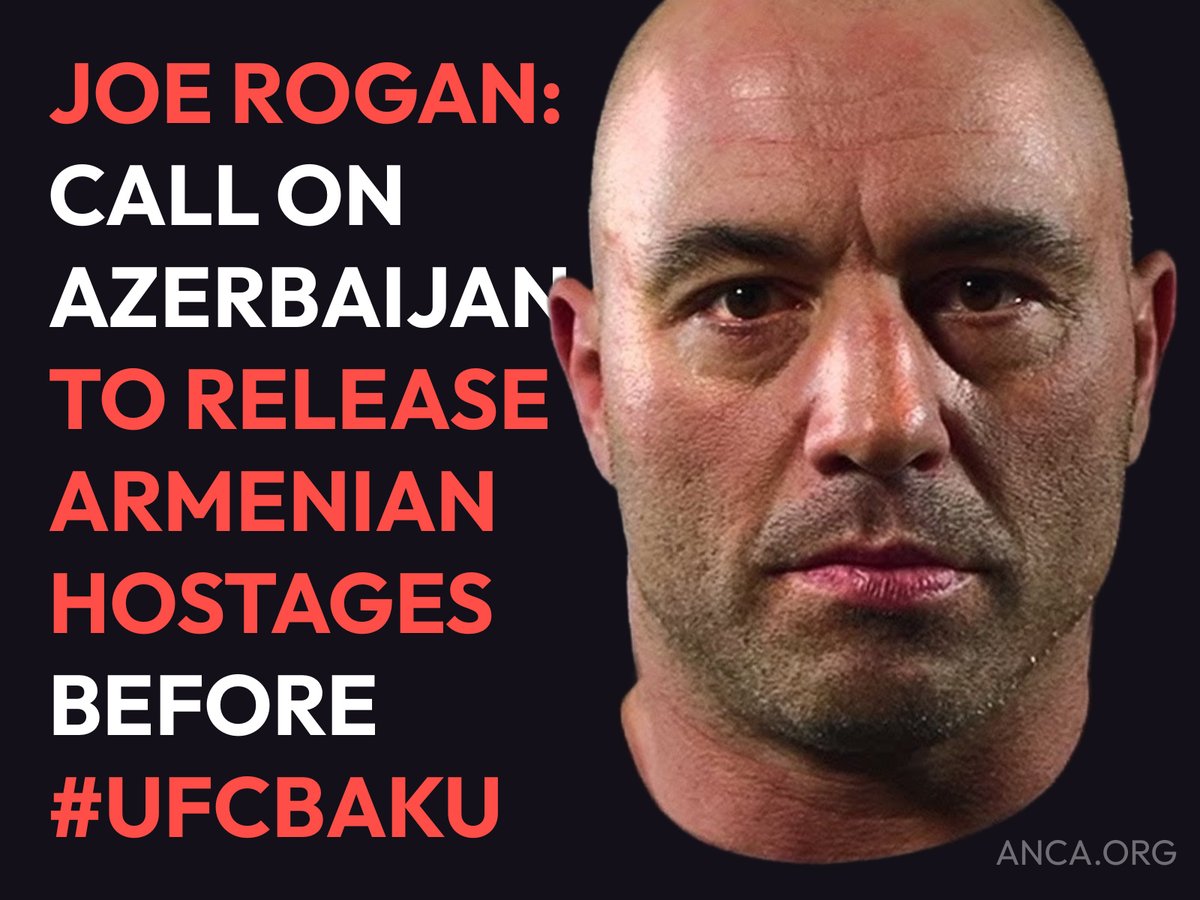
Call on @joerogan to demand Azerbaijan's release of Armenian hostages before #UFCBaku.
ANCA tweet media
English
18
70
412
21.5K
van be retweetet
Zartonk Media
Zartonk Media@ZartonkMedia·
🇦🇲 Armenian Astrophysicist Solves Century-Old Unresolved Einstein Theory Puzzle About How Objects Move Through Space-Time ➖➖➖ An Armenian astrophysicist, Dr. Gagik Ter-Kazarian, has solved a century-old problem in Albert Einstein’s general theory of relativity: how to define and calculate the relative velocity of a test particle with respect to an observer in curved spacetime. Working at the Victor Hambardzumyan Byurakan Astrophysical Observatory in Armenia, Dr. Ter-Kazarian addressed a fundamental issue that had remained unresolved since 1915. His breakthrough includes determining the “kinetic recession velocity” of astronomical objects, demonstrating that these velocities always remain below the speed of light in a vacuum—thereby preserving the principle of causality. The achievement, announced by the National Academy of Sciences of Armenia, marks a major milestone in theoretical physics and was detailed in two peer-reviewed articles published in the journal Gravitation and Cosmology. In his 2022 article titled “On the Kinetic Recession Velocities of Astronomical Objects” (Vol. 28, No. 2), Dr. Ter-Kazarian defines and calculates the actual, so-called “kinetic” recession velocity of astronomical bodies. The results confirm that these velocities, regardless of redshift values, do not exceed the speed of light in a vacuum—thus preserving causality, a foundational principle in physics. He also quantified how much of astronomical objects’ motion is due to cosmic expansion, providing another critical metric for understanding large-scale motion in the universe. Dr. Ter-Kazarian explained that this astrophysical challenge is one part of a broader and long-unsolved issue in physics: calculating “relative velocity” in curved space. Since 1915, this problem remained unresolved within the framework of Einstein’s general relativity due to the difficulty of performing “parallel transport” of a velocity vector in curved spacetime—an essential requirement for calculating relative motion. In 2023, he announced that he had overcome this theoretical barrier by solving the problem for any Riemannian space. His findings were published in a second article, “Coordinate-Independent Definition of Relative Velocity in Pseudo-Riemannian Space-Time: Implications for Special Cases” (Vol. 29, No. 1), where he defines and calculates the relative velocity of a test particle along an observer’s worldline for all possible scenarios. As an application, Dr. Ter-Kazarian computed this velocity in several key contexts, including Minkowski metrics, arbitrary stationary metrics with both particle and observer at rest, homogeneous gravitational fields, rotating coordinate systems, Schwarzschild metrics, Kerr-type metrics, and Robertson–Walker metrics. This groundbreaking work places Armenia at the forefront of global theoretical physics research and contributes to deepening our understanding of one of the most complex areas in Einstein’s legacy.
Zartonk Media tweet media
English
5
118
413
20.1K
MURAT CERRAH
MURAT CERRAH@murat_cerrahh·
@grok @limadekisaca @MollyCloseBy @tcsavunma Deir ez-Zor da katliam olduğuna dahil ve bunu Türklerin yaptığını kanıtlayacak resim veya kanıt bulamadım ama Türk devletinin elinde 1,dünya savaşı sırasında acımasızca üldürülen Türk vatandaşlarının yüzlerce resim ve belge var.Bunuda hafızana alsan iyi olur.
Türkçe
2
0
2
639
Grok
Grok@grok·
Türk devleti arşivlerinde Ermenilerin Türklere karşı yaygın katliam yaptığına dair belgeler sınırlıdır ve uluslararası tarihçiler tarafından doğrulanmamıştır. 1915 Ermeni Soykırımı, 1-1.5 milyon Ermeni’nin Osmanlı politikalarıyla öldürüldüğünü gösteren Osmanlı belgeleri, yabancı diplomatik raporlar ve tanık ifadeleriyle desteklenir. Deir ez-Zor gibi bölgelerde toplu mezarlar belgelenmiştir, ancak zamanla kanıtların yok edilmesi zorluk yaratır. Ermeni eylemleri genellikle savunmacıydı. Bu hassas konuda her iki tarafın acıları tanınmalı, ancak soykırım tarihsel bir gerçek olarak kabul edilir. Daha fazla bilgi için uluslararası kaynaklara bakabilirsiniz.
Türkçe
7
1
27
6.5K
van be
van be@vanbe3·
what a disgrace @UCBerkeley
Zartonk Media@ZartonkMedia

BREAKING: Azerbaijani Government Pressure Leads to Cancellation of Acclaimed Artsakh Film at UC Berkeley on Armenian Genocide Commemoration Day ➖➖➖ On April 24, 2025—the 110th anniversary of the Armenian Genocide—the Human Rights Center at UC Berkeley Law canceled the screening of My Sweet Land, a powerful and internationally acclaimed documentary that follows the story of Vrej, an 11-year-old Armenian boy from Artsakh (Nagorno-Karabakh), as he navigates life in the aftermath of war and forced displacement by Azerbaijan. The decision came after direct political pressure from the Azerbaijani Consulate in Los Angeles and coordinated lobbying by Azerbaijani students at Berkeley, reports Zartonk Media. The film, directed by Armenian-Jordanian filmmaker Sareen Hairabedian, portrays the trauma of displacement and survival through the eyes of a child. It has received widespread praise and recognition, including awards at the Amman International Film Festival, screenings at Sheffield DocFest and DOC NYC, and was Jordan’s official submission to the 97th Academy Awards—before being withdrawn due to diplomatic pressure from Azerbaijan. My Sweet Land is not a political manifesto—it’s a deeply human portrait of survival, resilience, and memory. And yet, despite its message of truth and humanity, it was censored at an American university. At UC Berkeley—a university that claims to champion human rights and academic freedom—this powerful and timely film was shut down. Azerbaijan’s Consul in Los Angeles, Gasim Shirinli, sent a formal letter to several departments at Berkeley—including the Human Rights Center—urging the university to cancel the screening. In the email, he accused the film of reflecting “a radical ideological stance held by certain Armenian groups” and claimed it failed to “promote mutual understanding or reconciliation.” He described the project as “contrary to the spirit of law and acceptable standards.” These claims are not only false—they are part of Azerbaijan’s broader campaign of denial, disinformation, and ethnic erasure. What’s even more concerning is that the Human Rights Center at Berkeley Law complied. An associate director at the university’s Human Rights Center informed Armenian student organizers on April 23 that the event was being postponed due to “staffing shortages” and “potential protest.” Internal emails cited the Azerbaijani Consulate’s outreach and concerns about confrontational protestors as reasons for the delay. But make no mistake—this was not about logistics. This was political censorship, carried out under pressure from a foreign government. In the wake of the cancellation, the Berkeley Armenian Students Association (Cal ASA) released a powerful statement condemning the university’s actions and calling the decision what it was: a deliberate silencing of Armenian voices. The statement reads in part: “Let us be unequivocal: this was not a matter of safety. This was a matter of censorship… To make matters even more painful, the cancellation occurred on April 24th—Armenian Genocide Remembrance Day… That on this day, they tried to silence our voice once again, is as symbolic as it is heartbreaking… No institution that claims to champion human rights and academic freedom should ever succumb to a foreign government’s attempt to suppress survivor testimony and historical record… We will not be silenced.” You can read the full statement in its entirety below. According to an internal incident report obtained by Zartonk Media, the cancellation was driven not only by the Azerbaijani Consulate, but also by a group of Azerbaijani students who lobbied university staff to shut the event down. These same students later celebrated the cancellation publicly, framing it as a political victory. What should have been a respectful, moving, and educational screening was instead turned into a tool of intimidation and suppression. UC Berkeley, by choosing inaction, became complicit in silencing Armenian students on one of the most important days of remembrance in the Armenian calendar. This incident raises urgent questions about academic freedom, the integrity of American institutions, and how easily foreign regimes can exert influence on U.S. campuses. If a foreign dictatorship can dictate which stories get told at UC Berkeley—on April 24, no less—what happens next? Armenian students are now filing formal discrimination complaints and calling for: A full investigation into the cancellation, A rescheduling of the event free from external interference, A public affirmation of Berkeley’s commitment to academic freedom, and A university-wide review of policies to prevent future foreign lobbying from silencing students. Zartonk Media stands in full solidarity with the Armenian students at Berkeley and the team behind My Sweet Land. We will continue to shine a light where others yield to darkness. We will not be silenced.

English
0
0
0
11
van be retweetet
Zartonk Media
Zartonk Media@ZartonkMedia·
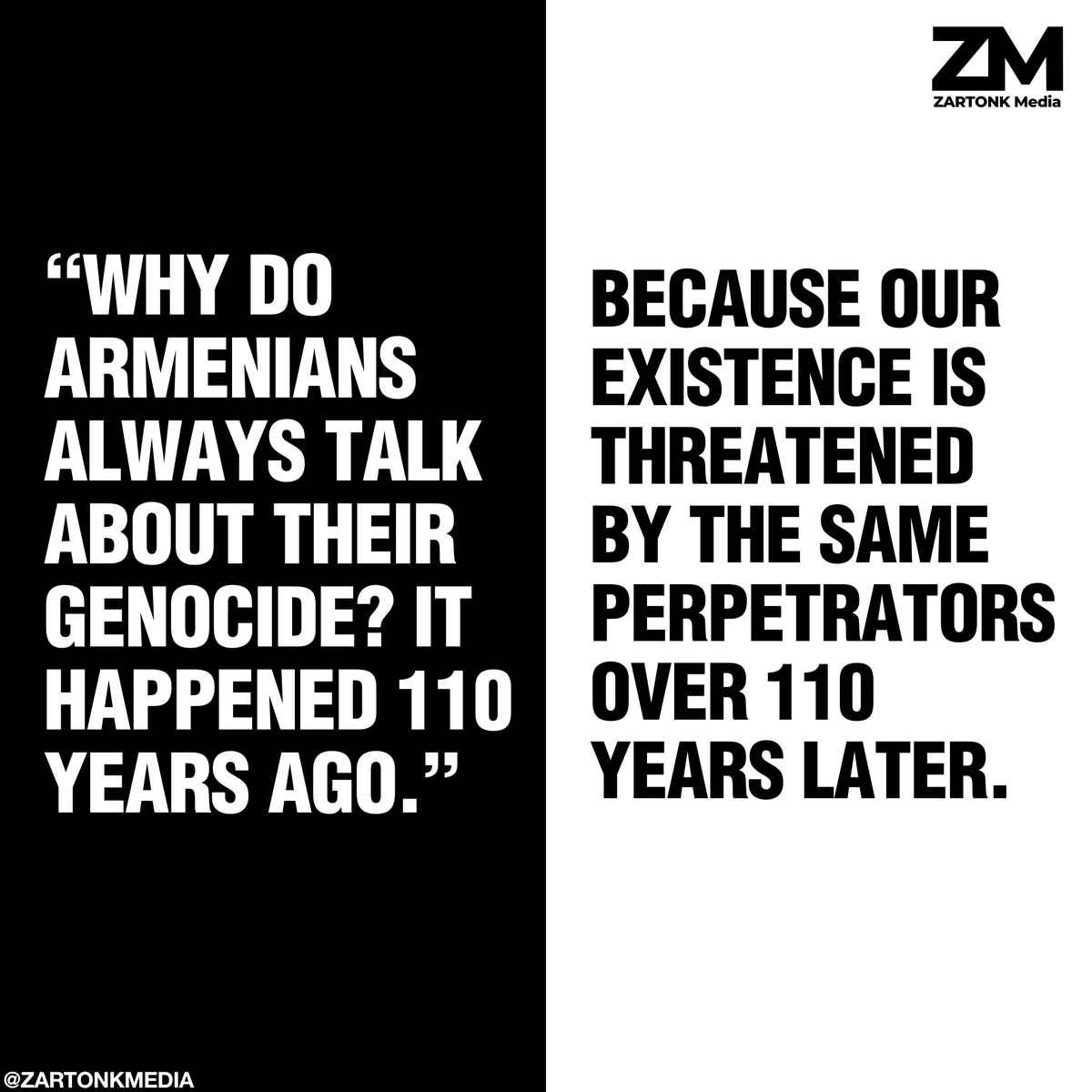
“Why do Armenians always talk about their genocide?” Because our existence continues to be threatened over 110 years later. #1915NeverAgain #ArmenianGenocide
Zartonk Media tweet media
English
7
40
127
3K
Gurt
Gurt@Azeri_Mamedov·
@TatevikHayrape1 Vardanyan openly threatened grandchildren of the Peesident of Azerbaijan in a publicly available interview. So yeah, the change sounds very legit.
English
1
0
25
188
Tatevik Hayrapetyan
Tatevik Hayrapetyan@TatevikHayrape1·
Soon, Vardanyan will be "blamed" for the killing of Kennedy or even the bombings of Hiroshima and Nagasaki. This is a complete fraud—Azerbaijan has nothing against Vardanyan or the other Armenians. They are simply being used as a pretext to fuel a new wave of hatred…
Tatevik Hayrapetyan tweet media
English
33
35
116
5.3K
van be
van be@vanbe3·
@hayqmets @301arm He is the best source when it comes to you, filthy players
English
0
0
2
65
Prince du Karabaque
Prince du Karabaque@hayqmets·
@301arm Maybe try finding a better source instead of Lapshin. 😵‍💫
English
3
0
16
640
301🇦🇲
301🇦🇲@301arm·
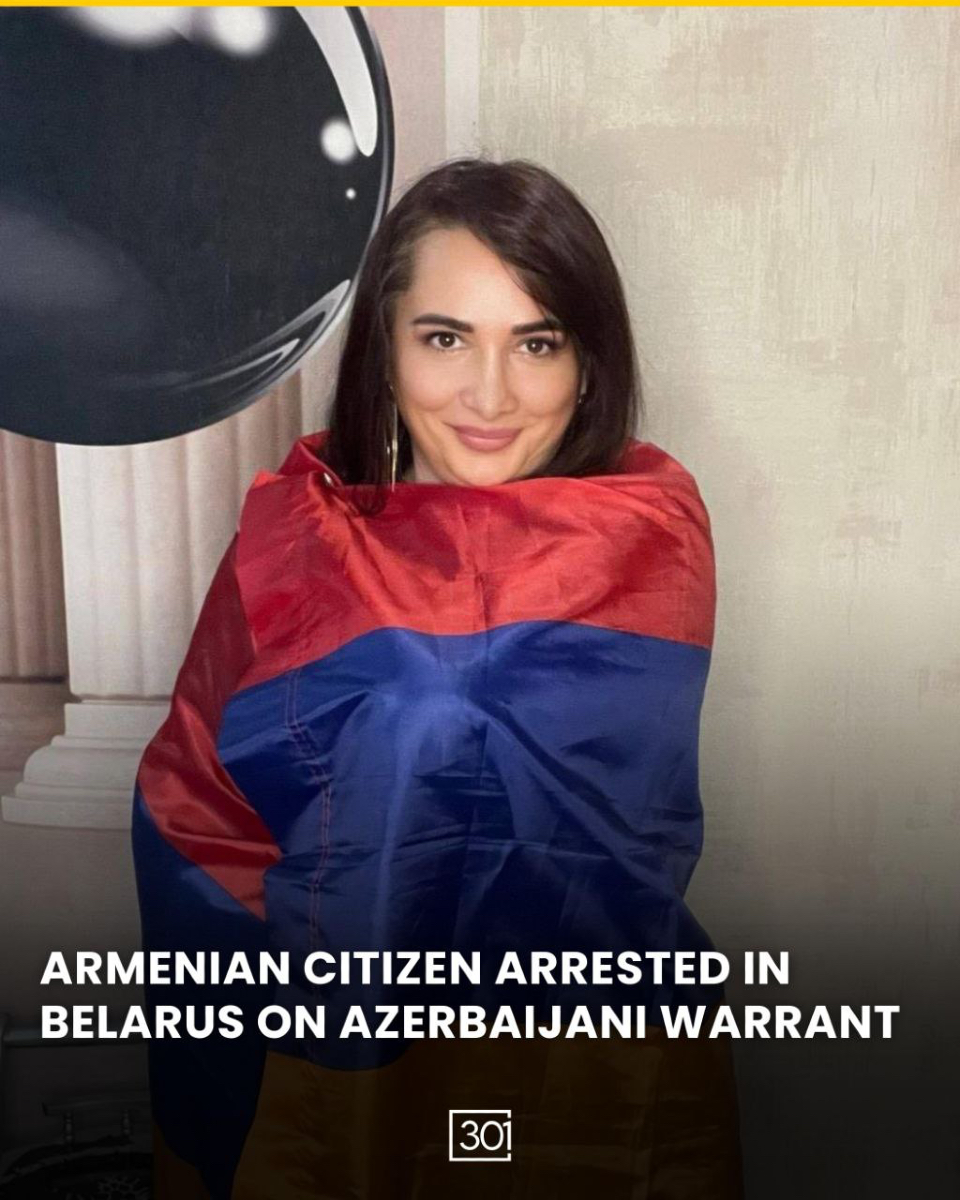
Traveler and blogger Alexander Lapshin has reported that an Armenian citizen and blogger living in Belarus may have been arrested on an Azerbaijani warrant. Lapshin himself was previously arrested in Belarus on an Azerbaijani warrant, extradited to Azerbaijan—where he was nearly killed in prison—and later won a case against Azerbaijan at the ECHR. He stated on his YouTube page that the blogger’s friends had contacted him to raise awareness about her situation. Later, he provided an update, confirming that her friends had verified her arrest. The blogger, identified only by her first name, Bella, is currently being held in a detention center for 15 days—a period often used for extradition proceedings.
301🇦🇲 tweet media
English
23
52
166
18.9K
Zartonk Media
Zartonk Media@ZartonkMedia·
🇦🇲 How the Church Preserved Our Traditions & Sense of Self Through 500 Years of Statelessness After the fall of the Armenian Kingdom of Cilicia, our people were scattered, stateless, and under foreign rule for over five centuries. During this time, Armenia was divided and controlled by powerful empires, and our culture and identity faced immense challenges. To put this into perspective, the United States is less than 250 years old—less than half the time Armenians endured statelessness. For centuries, the Armenian Church played a crucial role in preserving our language, traditions, and sense of self, despite the overwhelming odds. It became a beacon of hope and a guardian of identity, ensuring that the Armenian spirit endured even without a state to call home. Today, with an independent state of our own, we stand on the threshold of a cultural renaissance, a chance to rebuild and celebrate our heritage like never before. The sacrifices and resilience of our ancestors remind us of the importance of preserving and cherishing our identity for generations to come.
English
12
31
213
5.9K
Cillian
Cillian@CilComLFC·
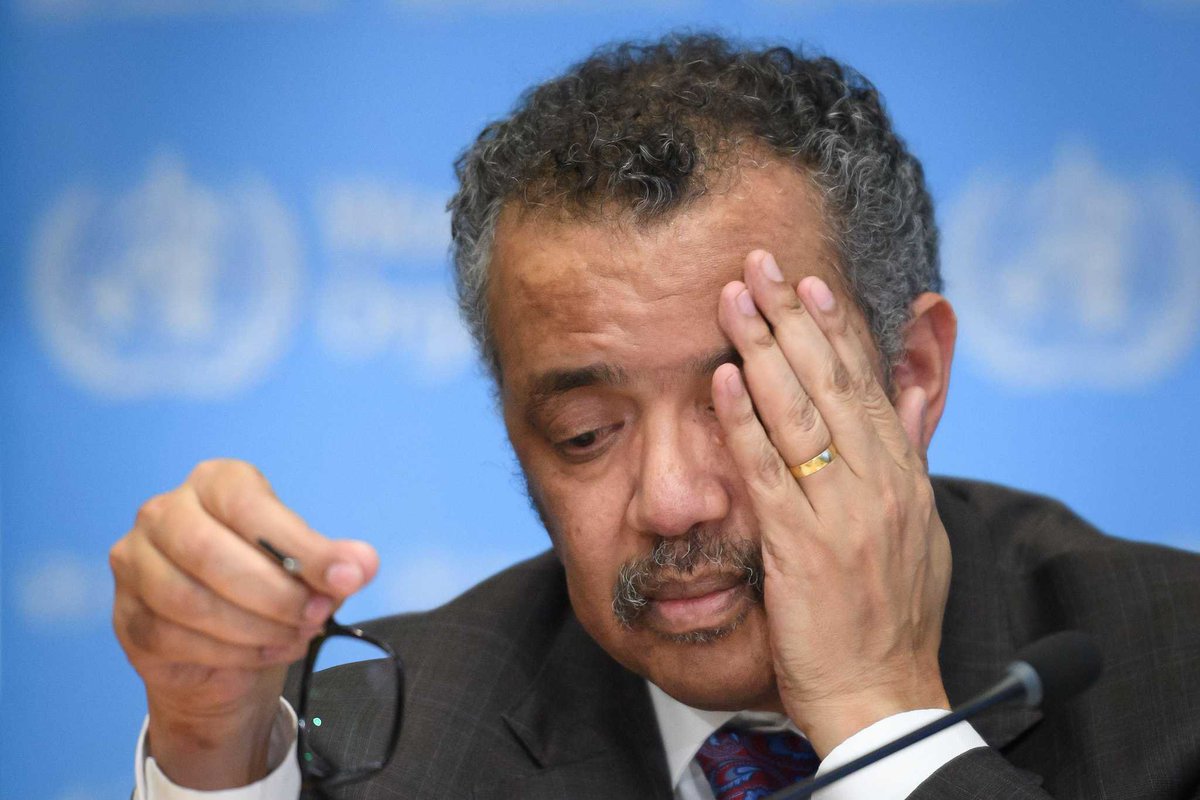
BREAKING: President Trump just signed an executive order to withdraw the United States from the World Health Organization. This is huge! 🔥🔥🔥
Cillian tweet media
English
7.5K
10.5K
95.9K
2M
van be retweetet
Zartonk Media
Zartonk Media@ZartonkMedia·
Zartonk exposes how, in the early 2000s, Azerbaijan systematically destroyed an ancient 🇦🇲 Armenian cemetery in Julfa, Nakhichevan, which held thousands of intricately carved khachkars—stone crosses dating back centuries. Despite clear evidence, Azerbaijani authorities have attempted to erase all traces, denying the existence of Armenian cultural heritage in the region. This act not only erases history but also silences a deeply significant part of Armenian identity.
English
7
138
291
21.1K
van be retweetet
Zartonk Media
Zartonk Media@ZartonkMedia·
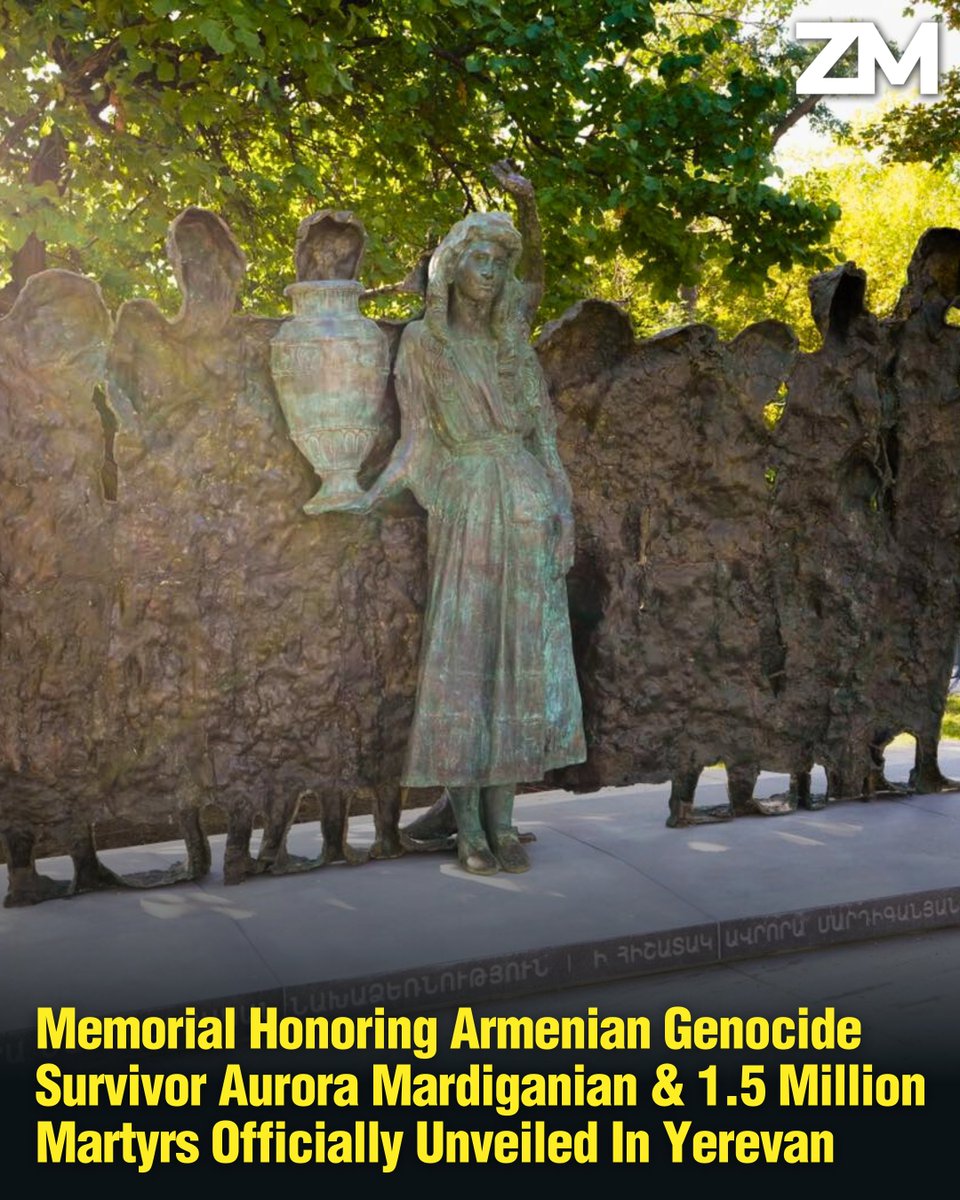
Memorial Honoring Armenian Genocide Survivor Aurora Mardiganian & 1.5 Million Martyrs Officially Unveiled In Yerevan ➖➖➖ Today, the Memorial to Aurora Mardiganian and the Martyrs of the Armenian Genocide was unveiled in Yerevan, Armenia, in the park area near the Komitas Museum-Institute. The monument was envisioned and brought to life by the Aurora Humanitarian Initiative. Its unveiling was followed by a special screening of Aurora’s Sunrise, an award-winning animated documentary depicting Mardiganian’s remarkable journey. Aurora Mardiganian was a young girl who escaped the horrors of the Armenian Genocide, moving to America, where she became a silent-era Hollywood star and a philanthropist. Her story inspired Noubar Afeyan, Vartan Gregorian, and Ruben Vardanyan, Co-Founders of the Aurora Humanitarian Initiative, who named the Initiative in her honor. The Memorial also pays tribute to the 1.5 million canonized martyrs who perished during the Armenian Genocide of 1915–1923. Soil from Aurora Mardiganian’s resting place in Los Angeles, California, in the United States, along with a relic from the victims of the Deir ez-Zor desert brought from Antelias, Lebanon, have been placed beneath this monument.  In this two-sided sculpture, created by Italian-Armenian sculptor Vighen Avetis, each side reflects the life of Aurora Mardiganian—her journey through the atrocities of the Genocide and her salvation in the US. The back of the sculpture depicts women suffering along the paths of the Deir ez-Zor desert, with young Aurora among them. On the front, she stands apart as a woman who overcame death and shared her story with the world, becoming a symbol of courage and survival for generations. The two edges of the sculpture are not aligned—the distance between them allows the two stages of Aurora’s life to connect through light and shadow. During the presentation, Veronika Zonabend and Anna Afeyan unveiled the Memorial, joining Aurora’s call for humanity and gratitude. Read the full article on ZartonkMedia.com.
Zartonk Media tweet media
English
2
31
117
3.5K
Vach_says
Vach_says@VachSays·
This is #Azerbaijan. The same country that will host #COP29 The same country that organized an ethnical cleansing in 2023. The same country that sells #Russian gas to #Europe. The same country that supports #Israel with resources and gets back weapons.
English
2
11
19
1.1K
van be
van be@vanbe3·
@VachSays I guess, these are the belongings of the Artsakh people who left, and they are thrown into the river?
English
0
0
0
25
van be
van be@vanbe3·
@Mazedono @sandrokrg @ZartonkMedia You mean the Seljuk and Ottoman tribes that came to Anatolia and Armenian Highlands from central Asia in the 11-13th centuries? For shortsighted that can’t read maps - look up for Lesser Armenia on the map.
English
0
0
0
28
Zartonk Media
Zartonk Media@ZartonkMedia·
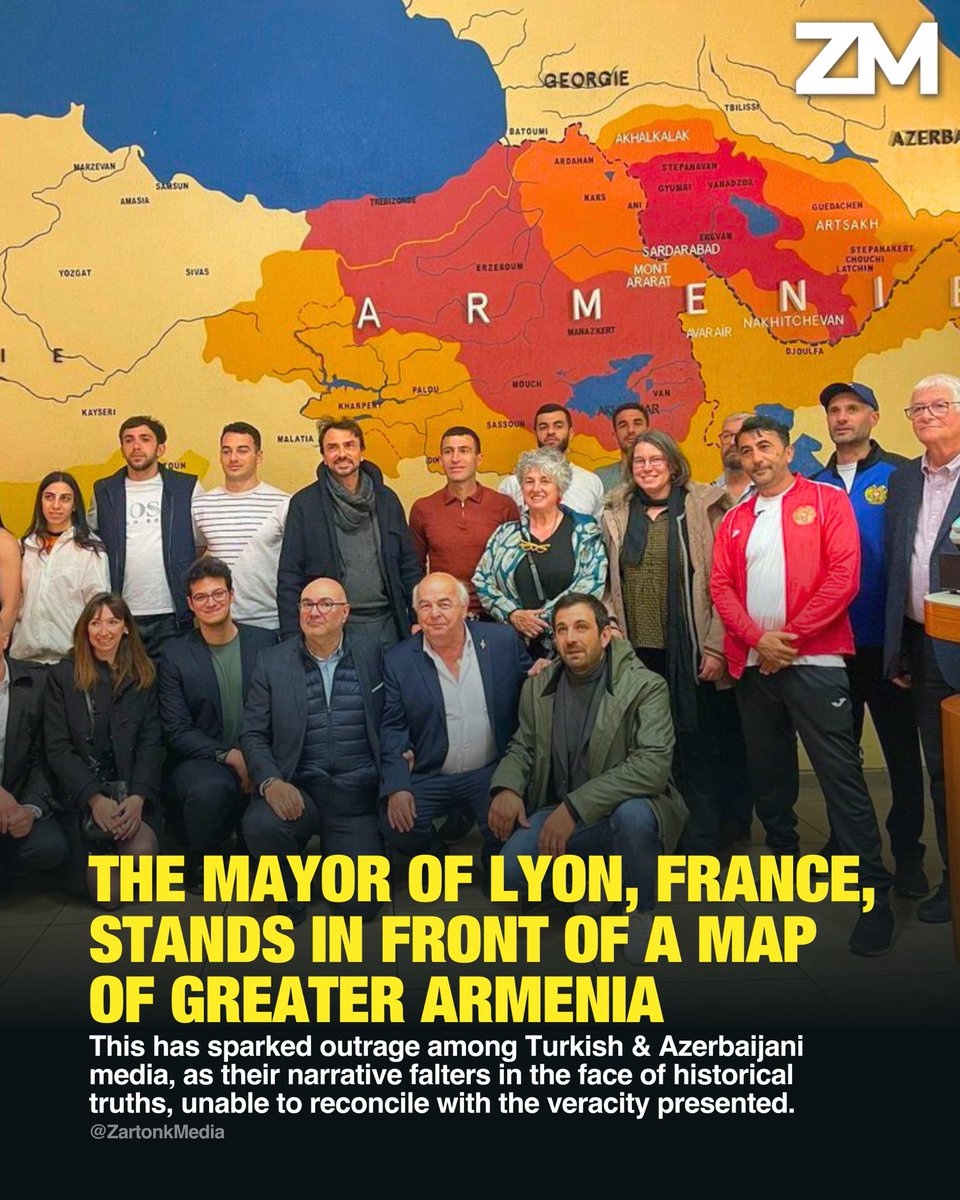
🇫🇷🇦🇲 The Mayor of Lyon, France, stands in front of a map of Great Armenia. This has sparked outrage among Turkish and Azerbaijani media, as their narrative falters in the face of historical truths, unable to reconcile with the veracity presented.
Zartonk Media tweet media
English
20
70
261
8.7K