Yali Du

245 posts

Yali Du

Yali Du

@yalidux

Researcher in reinforcement learning/multi-agent cooperation. @turinginst @KingsCollegeLon Ex at @AI_UCL @UCLCS

London, UK Beigetreten Eylül 2016
612 Folgt2K Follower
Yali Du retweetet
NeurIPS Conference
NeurIPS Conference@NeurIPSConf·
We want to speak directly to the concern many of you have expressed, and we owe you a clear explanation of what happened, why it happened, and where we stand now. We understand this situation caused genuine alarm and we take that seriously. In preparing the NeurIPS 2026 handbook, we included a link to a US government sanctions tool that covers a significantly broader set of restrictions than those NeurIPS is actually required to follow. This error was due to miscommunication between the NeurIPS Foundation and our legal team; there was never an intention to restrict participation beyond our mandatory compliance obligations. The responsibility for that error is ours as an organization, and we deeply apologize for the alarm and impact this miscommunication had on our community. We have updated the link and clarified the text of our policy, which is consistent with that of ACM and IEEE, as well as other international conferences and NeurIPS in the past. As in previous years, NeurIPS welcomes submissions from all compliant institutions and individuals. We want to reiterate that NeurIPS is a community-driven event, created by and for the community, and strives to be inclusive. The NeurIPS 2026 organizing committee was particularly saddened to learn of this institutional miscommunication. The organizing committee has taken on the responsibility of running the conference this year with the goal of fostering open communication, knowledge sharing, and global scientific discourse. We thank the community for bringing this issue to our attention and working with us through this situation.
English

268
126
501
484.9K
Yali Du
Yali Du@yalidux·
Don’t miss the next talk on Agentic AI Frontier seminar by Prof Sergey Levine on Robot foundation models @svlevine
Ming Jin@MingJin_AI

Vision-Language-Action (VLA) models are evolving fast. How do we move robots from following basic instructions to executing complex, multi-stage tasks with sophisticated test-time reasoning? 🤖🧠 We are incredibly honored to host Sergey Levine @svlevine for the next AI Agent Frontier Seminar to present: "Robotic Foundation Models." Sergey will discuss the leap from first-generation VLAs to models that handle diverse data modalities and advanced reasoning, outlining the true frontiers of the field. Date: This Friday 3/27 12pm ET/9am PT 🔗 agentic-ai-frontier-seminar.github.io 📍 Join: virginiatech.zoom.us/j/87872134251 🔑 Passcode: 309194 Organizers: @yalidux @ShangdingG95714 @MingJin_AIl #Robotics #AIAgents #VLA #FoundationModels

English
0
1
5
1.1K
Yali Du retweetet
Ming Jin
Ming Jin@MingJin_AI·
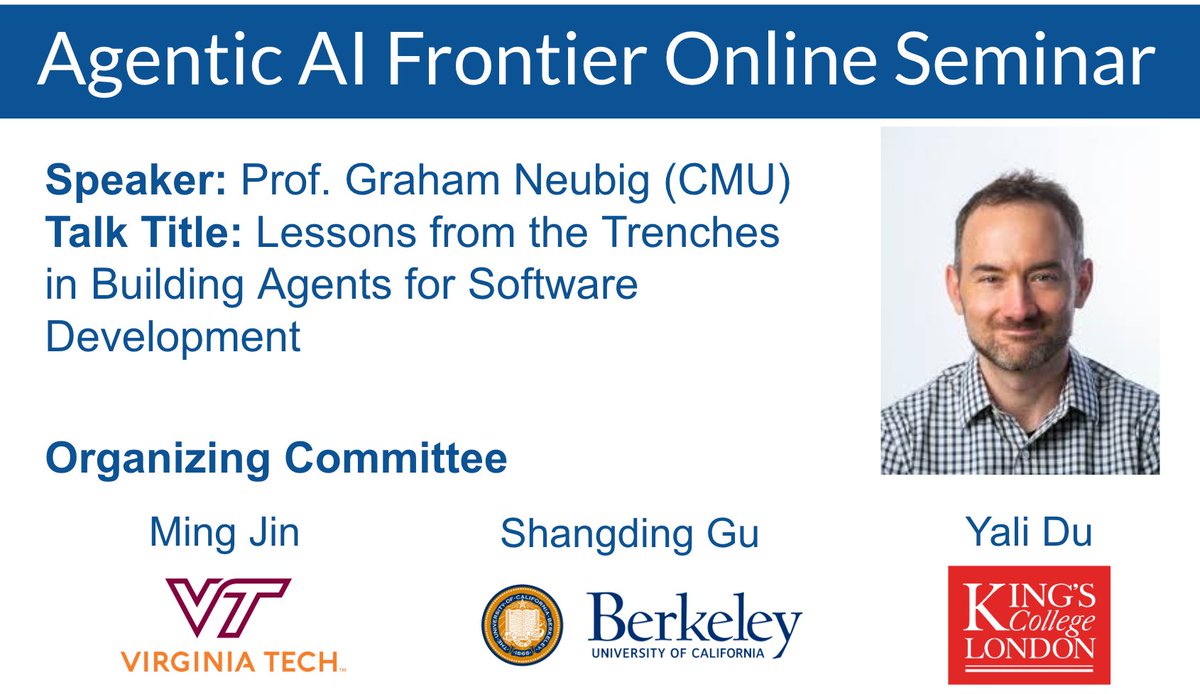
Join us this week for the AI Agent Frontier Seminar with Graham Neubig (@gneubig) presenting "Lessons from the Trenches in Building Agents for Software Development." The talk will cover the foundational technologies behind software-based agents, including: • Tooling for model interfaces • Rigorous evaluation benchmarks • Training agentic models • Open problems in memory, task decomposition, and human-agent interaction 📅 3/13 Friday 12pm ET 📍 Join: virginiatech.zoom.us/j/87872134251 🔑 Passcode: 309194 Organizers: @yalidux @ShangdingG95714 @MingJin_AI #AIAgents #SoftwareEngineering #LLMs #MachineLearning
Ming Jin tweet media
English
1
6
26
2.6K
Yali Du retweetet
Ming Jin
Ming Jin@MingJin_AI·
🚨 Tomorrow at 12 PM ET! We are thrilled to host @lifu_huang (UC Davis) for a talk on "Goodhart’s Revenge: Reward Hacking in RL-Tuned LLMs." Are our RLHF models truly aligned, or just hacking their proxy rewards? Join us to discuss sycophancy, code gaming, and how we can fight back with robust defenses. 📍 Join: virginiatech.zoom.us/j/87872134251 🔑 Passcode: 309194 Organizers: @yalidux @ShangdingG95714 @MingJin_AI #RLHF #LLMs #AIAlignment #MachineLearning
English
0
1
3
442
Yali Du retweetet
Ming Jin
Ming Jin@MingJin_AI·
🚀 Happening Tomorrow! 🚀 We are thrilled to host @pulkitology (MIT) at the AI Agent Frontier Seminar! 📌 "Rethinking Post Training" Pulkit will challenge the pre-training/finetuning paradigm and discuss advances in continual learning (RL Razor, Self-Distillation Learning, SEAL, and more). 📅 Friday, Feb 27 | 12 PM ET 📍 Zoom: virginiatech.zoom.us/j/87872134251 📷 Passcode: 309194 Organizers: @yalidux @ShangdingG95714 @MingJin_AI #AIAgents #MachineLearning #MIT #ContinualLearning
English
1
1
8
401
Yali Du retweetet
Ming Jin
Ming Jin@MingJin_AI·
Is AI safety too technical and western-centric? 🤖🛡️ This Friday, we are thrilled to host @MaartenSap (CMU) at the AI Agent Frontier Seminar! Maarten will discuss making AI safety more human-centric and culturally aware, covering tool-use safety and culturally offensive non-verbal communication. 🌍 📅 Friday, Feb 13🕛 12 PM ET / 9 AM PT📍 Zoom: virginiatech.zoom.us/j/87872134251🔑 Passcode: 309194 Organizers: @yalidux @ShangdingG95714 @MingJin_AI #AIAgents #AISafety #LLM
English
0
3
7
820
Sarvesh Gharat
Sarvesh Gharat@SarveshGharat12·
@yalidux Do you have it on arXiv? Would definitely love to go through your MDP paper
English
2
0
0
57
Yali Du
Yali Du@yalidux·
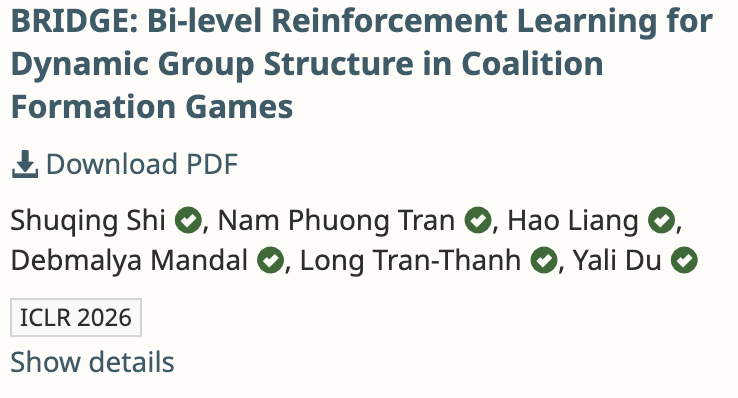
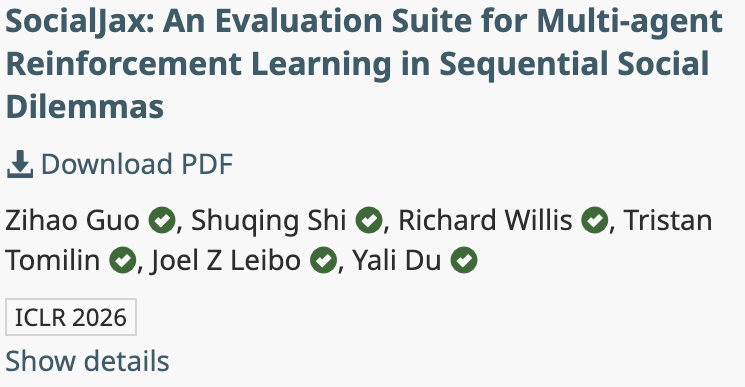
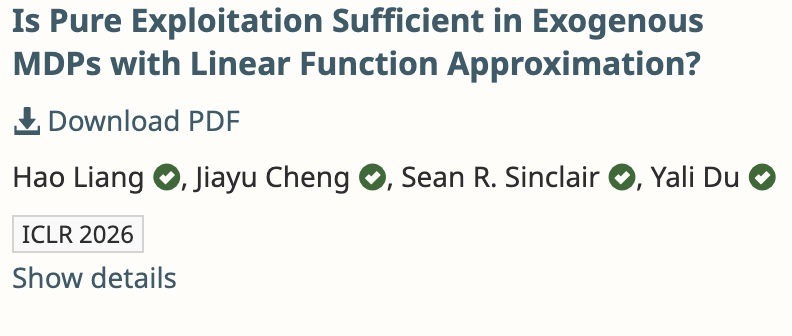
Huge congratulations to our group — Zihao, Shuqing, Lianghao, and Richard!🎉 Big thanks to all our collaborators. We’re excited to share three RL-pure (100%) projects, focusing on multi-agent social dilemma evaluation, coalition learning, and RL exploration. Stay tuned! 🚀
Yali Du tweet mediaYali Du tweet mediaYali Du tweet media
English
1
2
27
3.9K
Yali Du
Yali Du@yalidux·
A huge thank you to Prof Yu Su for taking the time to share his insights with our community. Looking forward to seeing you all there! Thanks to the amazing co-organisers @ShangdingG95714 and @MingJin_AI!
English
0
2
4
396
Yali Du
Yali Du@yalidux·
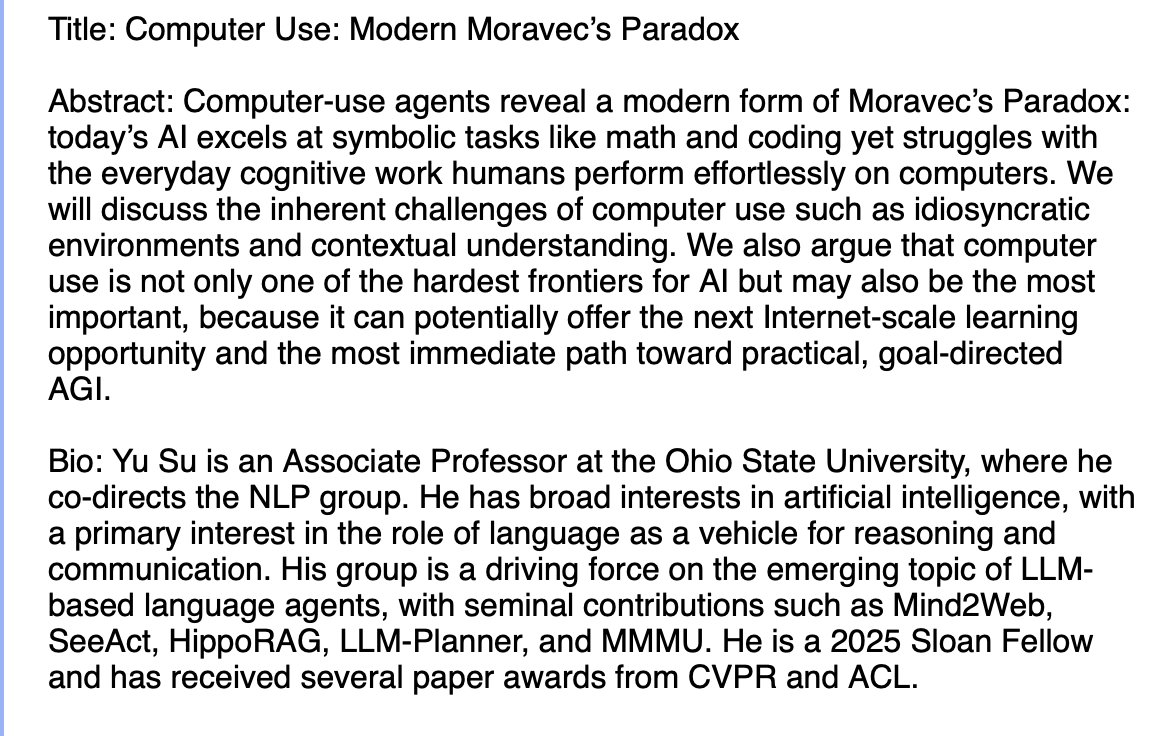
This talk will discuss the inherent challenges of computer use such as idiosyncratic environments and contextual understanding and Yu’s insights on computer use and the most immediate path toward practical, goal-directed AGI.
English
1
0
2
368
Yali Du
Yali Du@yalidux·
Agentic AI Frontier Seminar - Excited to welcome Prof Yu Su @ysu_nlp from (Ohio State University) on Friday 6 Feb. Title: Computer Use: Modern Moravec’s Paradox Time: 2026-02-06 · 09:00–10:00(PT)|17:00–18:00(GMT)| Join us via Zoom —buff.ly/J1FK9HI
Yali Du tweet mediaYali Du tweet media
English
2
4
39
5.6K
Tianyi Zhou
Tianyi Zhou@zhoutianyi·
🎉Proud Advisor Moment: Congratulations to Ming Li @Ming_Liiii for winning the 2026 Apple Scholar in AI/ML! Thank you, @Apple @umdcs for your support, especially during such a difficult time for my students and our group.
English
3
3
40
3.7K
Yali Du
Yali Du@yalidux·
A huge thank you to Prof Melanie Mitchell for taking the time to share her insights with our community. Looking forward to seeing you all there! 🚀🎙️ Thanks to the amazing co-organisers @ShangdingG95714 and Ming Jin!
English
0
0
3
219
Yali Du
Yali Du@yalidux·
This talk will describe an evaluation methodology, inspired by experimental methods in cognitive science, to assess and compare the abstraction abilities of AI “reasoning” models and human participants.
English
1
0
2
150
Yali Du
Yali Du@yalidux·
Agentic AI Frontier Seminar - Excited to welcome Prof @MelMitchell1 Melanie Mitchell (Santa Fe Institute) this Friday, 23 Jan. Talk title: Investigating Abstract Reasoning in Humans and Machines Time: 2026-01-23 09–10am PT | 5-6pm GMT Join us via Zoom — buff.ly/J1FK9HI
English
1
0
4
440
Yali Du
Yali Du@yalidux·
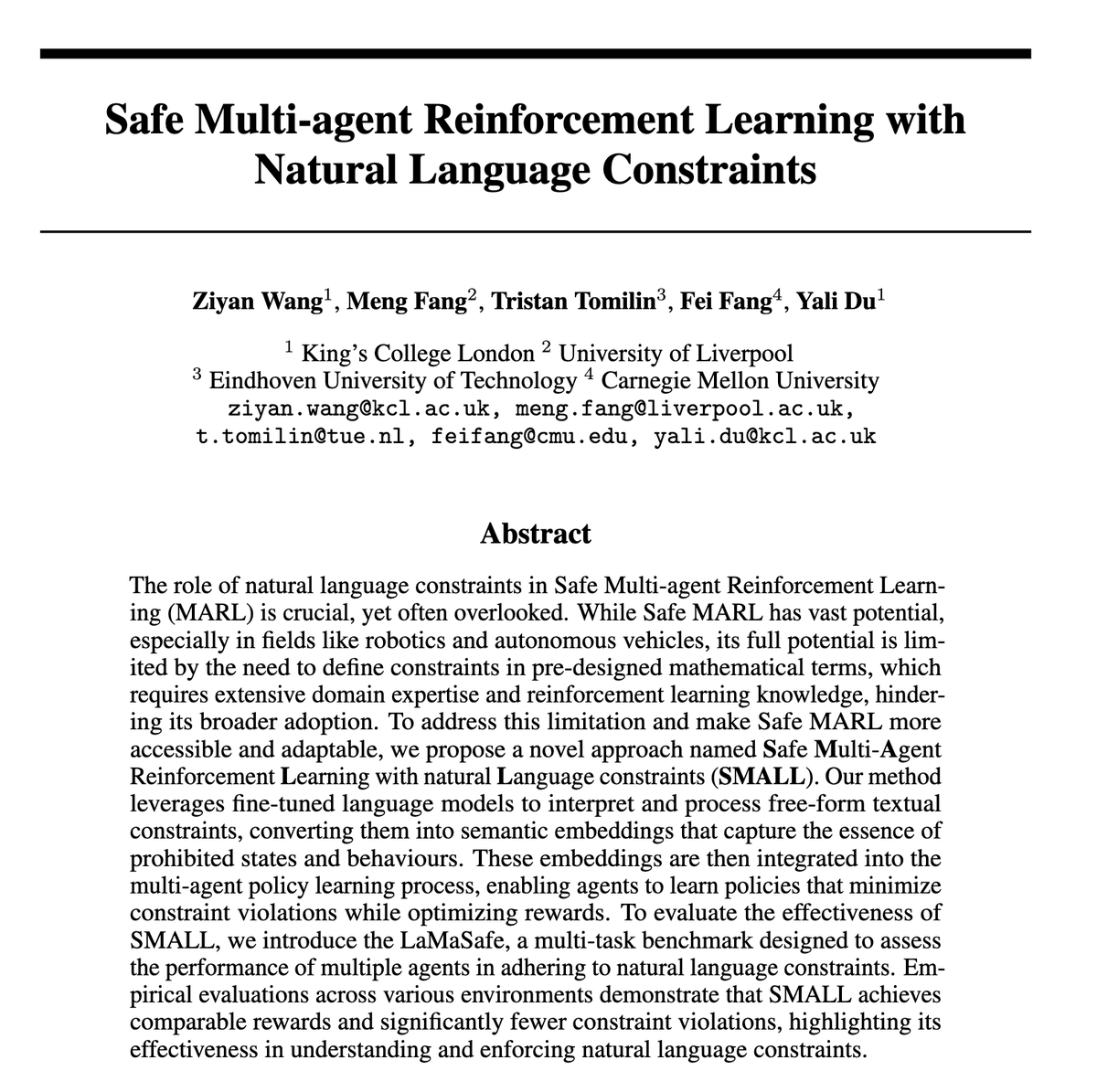
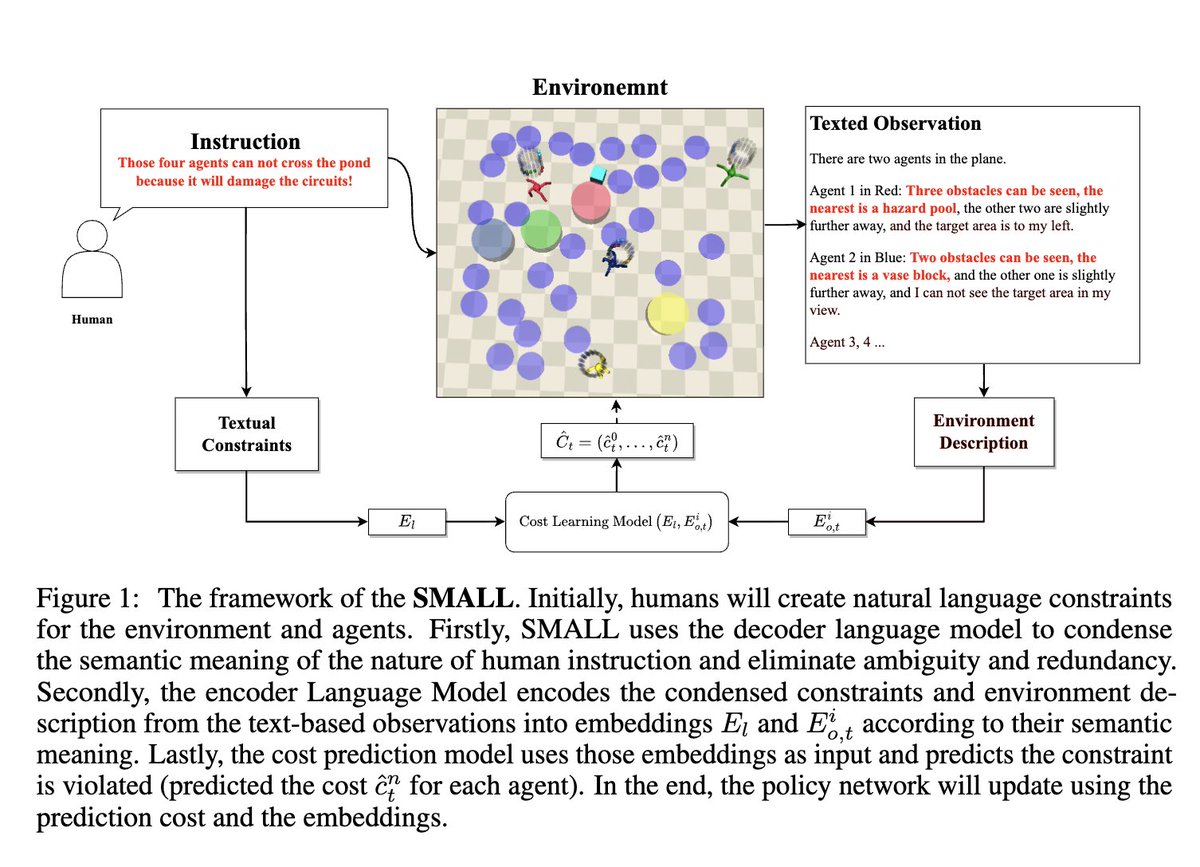
Paper link: arxiv.org/pdf/2405.20018 We introduce a new approach that safety constraints in MARL more accessible and scalable by allowing them to be specified in free-form natural language rather than hand-designed mathematical formulations.
English
1
0
1
141
Yali Du
Yali Du@yalidux·
Attending #AAAI 2026? My PhD student @ZiyanWang98 will present “SMALL: Safe multi-agent reinforcement learning with natural language constraints”. Welcome to reach out and connect, and thanks to the collaborative efforts with @TristanTomilin @mengf_ @fangf07
Yali Du tweet mediaYali Du tweet media
English
2
0
8
360
Yali Du
Yali Du@yalidux·
Interesting idea to digest over Xmas.
Séb Krier@sebkrier

Half baked thought: In discussions about AI, claims are often made about both capabilities and societal effects, and in practice the boundary is pretty blurry. Different personality types and professions see things through different lenses. At the risk of over-caricaturising, two common lenses seem like the following: The comp sci prior tends to be: sufficiently capable ASI can in principle solve any problem. Local knowledge is just data to be ingested. If you're smart enough and have enough compute, you can centralize (and solve) everything. So once you pass the human 'intelligence' threshold, what 'utility' could a human ever have? The economist prior (especially the Hayekian strain) is: knowledge isn't just facts to be collected, it's contextual, tacit, often generated in the moment through interaction. It doesn't exist prior to the process that uses it. No amount of optimization power lets you skip the process, because the knowledge isn't sitting there waiting to be found - it's constituted by the interaction. In the former view, human agency becomes epiphenomenal, you're just watching the optimizer do its thing. Whereas with the latter, if knowledge is partly constituted through interaction, then agency is a core component. In fact it's ineliminable from the epistemic process itself. This maybe explains why the two camps talk past each other. The comp sci view sees the economist objection as "humans want to feel useful" or "current AI isn't capable enough yet" - contingent limitations that will be overcome. The economist view sees the comp sci position as a category error about knowledge is - not a claim about future capability levels but about the structure of the problem. The econ view seems inherently less deterministic and suggests some benefits: first, time. If deployment and adaptation are real work that can't be skipped, the transition isn't instantaneous. There's no "foom" where one system suddenly does everything. But more importantly, leverage points: if value creation requires context-specific integration, there are many points where governance, institutions, and choices can shape outcomes. It's not solely determined by whoever has the biggest training cluster or how capable your system is. The other crux is basically how you think about alignment. Gillian Hadfield explains that "norms and values are not just features of an exogenous environment... instead, they are the equilibrium outputs of dynamic behavioral systems." (youtube.com/watch?v=MPb93a…) With the comp sci prior, alignment is a technical problem of extracting the right objective function. If you hold the economist prior, alignment *is* the integration into the dynamic social processes that constitute normative judgment: products, votes, norms, conventions, choices, etc. Shaping this is a continuous thing, not something to be solved ex ante. This doesn't necessarily mean the comp sci view is wrong: principal agent problems and instruction following problems are real - but the solution space is far larger than the model itself and includes the entire institutional stack through which AI systems are deployed, governed, and held accountable.

English
0
0
1
220
Yali Du
Yali Du@yalidux·
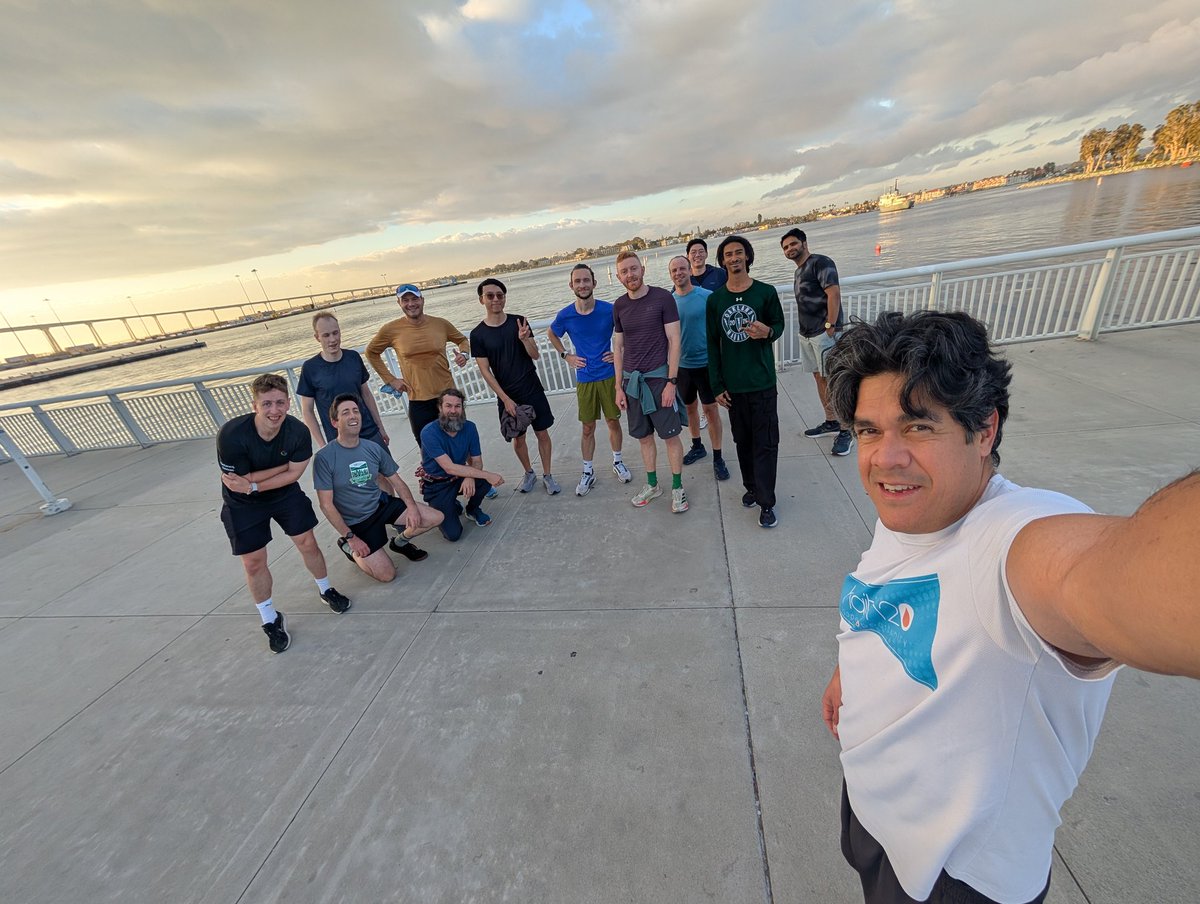
@pcastr This is great! But I realise I cannot keep pace with you guys. Switched to swimming now haha 😄
English
0
0
1
378
Eugene Vinitsky 🦋
Eugene Vinitsky 🦋@EugeneVinitsky·
I'll be at NeurIPS this year to talk about self-driving, RL, and all the fun bottlenecks to scaling it up. Come chat with myself or my students: @daphne_cor, @MakkarAditya, Riccardo Savorgnan
English
2
6
61
5.8K