

Melanie Mitchell
6.4K posts
Melanie Mitchell
@MelMitchell1
Professor, Santa Fe Institute. Mostly posting on https://t.co/4NpA2IL5Va (at-melaniemitchell). More thoughts at https://t.co/nC43NHRozX.
Santa Fe, NM Katılım Eylül 2011
670 Takip Edilen51K Takipçiler

Always great when your heroes are correct
Melanie Mitchell@MelMitchell1
In the off chance than anyone cares what I think on this topic: (1) the open-source software movement has been enormously beneficial to socity (2) open-weight (& better, open-data) LLMs will be essential for understanding this technology & for it to be beneficial to society.
English
In the off chance than anyone cares what I think on this topic:
(1) the open-source software movement has been enormously beneficial to socity
(2) open-weight (& better, open-data) LLMs will be essential for understanding this technology & for it to be beneficial to society.
English
English

@MelMitchell1 @dubova_marina @sayashk @keyonV Just started at Berkeley last month, myself – thrilled about this and excited to meet everyone!
English
Three really interesting people I know who are each starting faculty jobs at UC Berkeley in 2026 or 2027
@dubova_marina
@sayashk
@keyonV
You should all meet each other if you haven't already!
English

Thrilled to share I'll be joining UC Berkeley next year as an assistant professor in @UCBStatistics and affiliated with @Berkeley_EECS.
My research will build methods to test/improve the implicit world models of AI systems, so that they reflect reality and human understanding.

English
Melanie Mitchell retweetledi

Read the full article: doi.org/10.21428/e2759…
English
Melanie Mitchell retweetledi
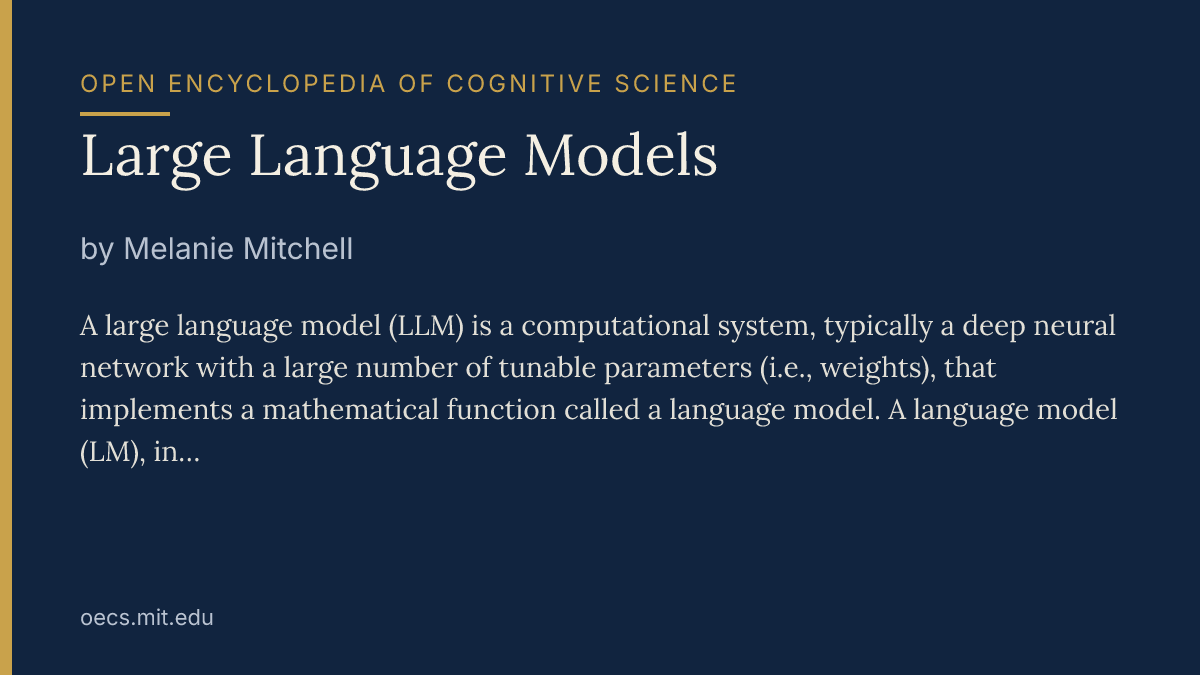
Large language models represent a shift from rigid statistical frequency tables to neural networks that learn the probability distributions of…
Large Language Models by Melanie Mitchell
#CognitiveScience
English

Thrilled to share that I am joining UC Berkeley as an Assistant Professor in the School of Information!
I start in Fall 2027, and I am recruiting PhD students this cycle. List me in your application if you're interested in frontier AI evaluation, AI policy, and AI's impacts on institutions such as science, law, and medicine.
I'm especially keen to work with students interested not just in high-quality research, but also in communicating it with a broad audience such as by public writing and policy impact. Fill out the form in the next tweet to indicate your interest.
As for this coming year, I'm moving to Berkeley this fall to start something new with @RishiBommasani and @random_walker. We'll have much more to share soon.

English
English

I've joined @AnthropicAI to work on alignment and character. I'll still teach at @nyuniversity; I'm on leave from @UTAustin.
English
@LasagneWest (I wrote the preface in 2025 so some examples might be outdated, but the general message remains.)
English
@LasagneWest I wrote about this in new preface to 2nd edition of the book. You can read the preface in full for free on Amazon: go to the following link and select "Read Sample". amazon.com/Artificial-Int…
English

Hi @MelMitchell1,
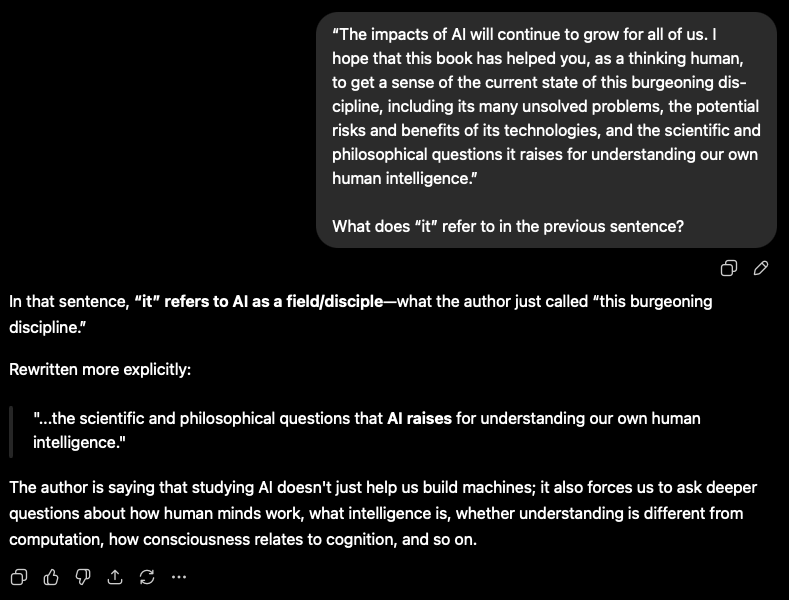
I just finished reading Artificial Intelligence: A Guide for Thinking Humans. After reaching the final paragraph, I asked ChatGPT what the word "it" referred to in the sentence
ChatGPT correctly identified "it" as AI, but then went on to connect the sentence to one of the book's broader themes — that AI serves as a mirror that helps us better understand human intelligence
Given how far LLMs have come since the book was published in 2019, I'm curious how you'd view an interaction like this today. Does this kind of interpretation suggest meaningful understanding, or is it still sophisticated pattern matching that falls short of crossing the "barrier of meaning"?
English
I wrote a piece for the Yale Review on AI and "jagged intelligence". (Note: headline was not written by me.)
yalereview.org/article/melani…
English
@andrewgwils That is, embodied "active" learning that involves intervening in the world.
English
@andrewgwils Fifth possibility: embodied learning is more efficient than disembodied learning.
English
There's a fourth possibility: humans only appear sample efficient because they've effectively seen a massive amount of data through evolution. Remember, there is a fluidity between the model and the data. The model is a representation of our understanding of data.
Dwarkesh Patel@dwarkesh_sp
There's a quadrillion-dollar question at the heart of AI: Why are humans so much more sample efficient compared to LLM? There are three possible answers: 1. Architecture and hyperparameters (aka transformer vs whatever ‘algo’ cortical columns are implementing) 2. Learning rule (backprop vs whatever brain is doing) 3. Reward function @AdamMarblestone believes the answer is the reward function. ML likes to use pretty simple loss functions, like cross-entropy. These are easy to work with. But they might be too simple for sample-efficient learning. Adam thinks that, in humans, the large number of highly specialised cells in the ‘lizard brain’ might actually be encoding information for sophisticated loss functions, used for ‘training’ in the more sophisticated areas like the cortex and amygdala. Like: the human genome is barely 3 gigabytes (compare that to the TBs of parameters that encode frontier LLM weights). So how can it include all the information necessary to build highly intelligent learners? Well, if the key to sample-efficient learning resides in the loss function, even very complicated loss functions can still be expressed in a couple hundred lines of Python code.
English
Melanie Mitchell retweetledi

When a measure becomes a target, it stops being useful 🔥 @MelMitchell1
Venrock@Venrock
🎙We’re back with a conversation between one of the greatest minds in AI research @MelMitchell1 of the @sfiscience and @ethanjb. Tune in for perspectives on AI capabilities, performance benchmarks, and the path forward that’s grounded in evidence: bit.ly/3PFyYAF
English
💯
Same comment for physics professors wondering if they need postdocs any more. (I have heard this comment from more than one.)
Subbarao Kambhampati (కంభంపాటి సుబ్బారావు)@rao2z
If you, as a CS Prof, are wondering whether you need PhD students at all now that you have wangled a subscription to Claude Code, your lab probably had a pretty depressing vibe to begin with--and 'em students are likely better off with you hanging out with Claude.. #AIAphorisms
English
@GregKamradt I use em-dashes and colons all the time, sigh. AI is stealing our best punctuation marks. Who can we sue?
English

My current smells of AI slop/writing:
1. Use of em dash "—". I haven't seen anyone seriously use this over a hyphen "-". Double points for wrapping — or making double points in a single sentence — give it away
2. Making a statement and then colon: like this
3. More subtle, but tone that is off-character for the authors
English
Exciting new initiative for @dileeplearning and @AsteraInstitute to dive deep into neuro-inspired AI:
Dileep George@dileeplearning
English
@TomChivers Not sure what Pollan means here, but maybe he's referring to this kind of computational complexity result?
quantamagazine.org/how-computatio…
English

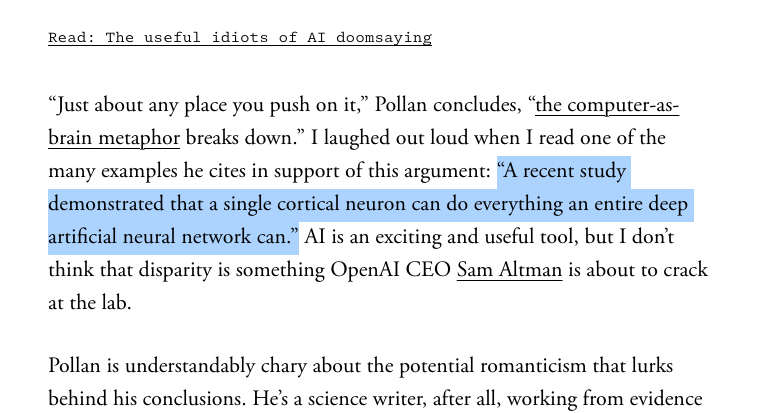
just saw this in a review of Michael Pollan's new book theatlantic.com/books/2026/02/… surely even a second's thought would show this is wrong? A single neuron cannot, for instance, tell me what move to make in chess or the best route from Crouch End to Muswell Hill
English
@GregKamradt @mikeknoop @ZennaTavares Indeed, this is the right direction. Understanding is not always reflected in accuracy.
English
Thanks for this @MelMitchell1
I believe what you’re referring to is along the lines of @ZennaTavares has done with AutumnBench?
Rather than focusing on a score, have an AI system interact with an environment and then ask it questions about that environment to ensure it actually understood it, not just stumbled its way to a high score
English
