We believe Africa should be at the center of the next wave of Financial Innovation
Stablecoin Infrastructure is already becoming the foundational layer for the future of finance, and we’re building to accelerate and make that real for African businesses and Institutions
This collaboration goes beyond tooling. It’s an ecosystem effort to accelerate enterprise stablecoin adoption across Africa by combining:
Polygon’s high throughput payment engine + Blockops’ infrastructure body part that drives speed, security and compliance controls needed to operate in regulated space
Excited to announce a new collaboration with @0xPolygon
Blockops is now Polygon’s stablecoin infrastructure and delivery partner for fintechs across Africa helping financial institutions onboard onchain seamlessly.
Africa’s financial rails are moving onchain. Here is what this collaboration aims to deliver 1/🧵
RAILS!!!
Railways tell a story most people don't talk about enough.
Take the UK for example, the country that invented the railway. Today its trains are among the most expensive in the world, yet passengers endure constant delays, technical failures, and overcrowding. Victorian-era tracks trying to carry 21st-century demand.
New York's subway isn't much different. Over a quarter of its subway cars are past their 40-year lifespan, and some of its signal systems still run on 90-year-old equipment. A century of deferred maintenance, plastered over with patches.
And Africa's railways were never really built for Africans to begin with. Colonial infrastructure designed to move minerals from mines to ports, not to connect people or grow economies. Gauges that couldn't agree with each other across borders. Tracks left to rot because they were never really ours.
All of them have one thing in common: Infrastructure that was never designed to scale to where the world is going.
Here's where it gets interesting:
Everyone running those railways knows the infrastructure is broken. But you can't stop the trains while you fix the tracks. People need to move. Economies don't pause for anyone.
Financial infrastructure across Africa and emerging markets is in exactly the same position. Core banking systems that have been patched for decades. Payment rails that still can't speak to each other across borders. Settlement that takes days. Fees silently eating into every transaction, every salary, every remittance.
However. Banks and fintechs don't have the same excuse as the railways. Railways don't have an alternative. There's no room to build new tracks beside the old ones, not enough land, not enough money, not enough time.
Banks and fintechs don't have that problem. You don't need to tear anything down. Stablecoin rails, onchain settlement, programmable money, it all runs in parallel. Alongside the legacy core. Handling the new flows. Filling the gaps that old systems were never designed to close.
The technology exists. The infrastructure is ready. What's missing is the Bridge.
And that's the problem Blockops solves. We help fintechs and institutions lay new rails without stopping the trains:
☑️ Stablecoin and settlement infrastructure: faster, cheaper, cross-border money movement
☑️ Dedicated node and data infrastructure: your own presence on the network, not borrowed access
☑️ Compliance reporting and anomaly detection: new rails that work within existing regulations
☑️ Operational tooling for uptime, upgrades, and control: run it confidently, not just launch it
Traditional finance doesn't need to be replaced. It needs to be connected to what's being built onchain.
If you're a fintech or institution in Africa or emerging markets thinking about how to move faster, settle cheaper, by onboarding on Stablecoin Rails, and you need the a seamless way to do this, Please send a DM or Schedule a call here:
blockops.network/contact
𝗣𝘂𝗹𝘀𝗮𝗿: 𝗥𝗲𝗮𝗹-T𝗶𝗺𝗲 𝗢𝗻𝗰𝗵𝗮𝗶𝗻 𝗗𝗮𝘁𝗮 𝗜𝗻𝗳𝗿𝗮𝘀𝘁𝗿𝘂𝗰𝘁𝘂𝗿𝗲 𝗳𝗼𝗿 𝗙𝗶𝗻𝘁𝗲𝗰𝗵𝘀 & 𝗜𝗻𝘀𝘁𝗶𝘁𝘂𝘁𝗶𝗼𝗻𝘀
Most teams treat blockchain data like it’s plug-and-play. But in reality, It isn’t.
Blockchains store raw state. But if you’re building fintech or institutional products, you need usable, queryable data for: 𝙩𝙧𝙖𝙣𝙨𝙖𝙘𝙩𝙞𝙤𝙣𝙨, 𝙗𝙖𝙡𝙖𝙣𝙘𝙚𝙨, 𝙚𝙫𝙚𝙣𝙩𝙨, 𝙪𝙨𝙚𝙧𝙨, 𝙖𝙣𝙙 𝙝𝙞𝙨𝙩𝙤𝙧𝙮 in a format your product and reporting systems can actually use
𝗝𝗮𝗿𝗴𝗼𝗻 𝗕𝘂𝘀𝘁𝗲𝗿: 𝗜𝗻𝗱𝗲𝘅𝗲𝗿
An indexer transforms raw blockchain data into structured datasets (like a database), so you can query it in real time for things like dashboards, reconciliation, alerts, analytics, AML signals, and customer transaction history.
𝗪𝗵𝗮𝘁 𝗶𝘀 𝗣𝘂𝗹𝘀𝗮𝗿?
Pulsar is Blockops’ platform for deploying and operating indexers/subgraphs/data pipelines so your team can ship chain data features without building and maintaining indexing infrastructure yourself
𝗧𝗵𝗲 𝗽𝗿𝗼𝗯𝗹𝗲𝗺 𝗣𝘂𝗹𝘀𝗮𝗿 𝘀𝗼𝗹𝘃𝗲𝘀:
• 𝗥𝗮𝘄 𝗼𝗻𝗰𝗵𝗮𝗶𝗻 𝗱𝗮𝘁𝗮 𝗶𝘀𝗻’𝘁 𝗮𝗻𝗮𝗹𝘆𝘁𝗶𝗰𝘀-𝗳𝗿𝗶𝗲𝗻𝗱𝗹𝘆: it’s not built for product queries or reporting.
• 𝗦𝗹𝗼𝘄 𝗽𝗿𝗼𝗱𝘂𝗰𝘁 𝗱𝗲𝘃𝗲𝗹𝗼𝗽𝗺𝗲𝗻𝘁: features like transaction history, notifications, risk/AML signals, and finance reporting require indexed datasets.
• 𝗢𝗽𝗲𝗿𝗮𝘁𝗶𝗼𝗻𝗮𝗹 𝗶𝗻𝘀𝘁𝗮𝗯𝗶𝗹𝗶𝘁𝘆: indexers drift, lag, or break during chain events (e.g., reorgs), leading to incorrect data and user-facing issues.
• 𝗡𝗼 𝗰𝗼𝗻𝘀𝗶𝘀𝘁𝗲𝗻𝘁 𝗺𝗼𝗻𝗶𝘁𝗼𝗿𝗶𝗻𝗴: teams often discover failures when customers complain.
• 𝗖𝗼𝘀𝘁 𝗰𝗿𝗲𝗲𝗽: storage and compute grow quickly without lifecycle and retention controls.
𝗛𝗼𝘄 𝗣𝘂𝗹𝘀𝗮𝗿 𝘀𝗼𝗹𝘃𝗲𝘀 𝘁𝗵𝗶𝘀
• Repeatable deployments via templates across chains and environments
• Operational visibility into indexing health, lag, errors, and resource usage
• Operational controls for upgrades, retention, scaling, and reliability
If you’re building products that depend on reliable Onchain Data: Stablecoin Rails, Payments, Wallets, Yield Vaults, Analytics, Reporting, or Compliance Workflows.
Pulsar is the indexing layer you’ll eventually need.
If you'd like to try it out or see how it works, I can personally give you a walkthrough if you DM me OR you can also try and see for yourself by getting started here:
blockops.network/pulsar
Based on feedback we've received, we've improved and restructured our documentation to make it easier to navigate and access all of our product suites.
Expect:
a cleaner structure
improved navigation
more polished guides to help you deploy and operate infrastructure faster
Check it out: docs.blockops.network
Yields🚨 Yields🚨🚨 Yields🚨🚨
Quick Jargon Buster:
Staking(onchain yields) is how many blockchains pay yields for helping secure the network. You lock assets (or delegate them) and earn rewards, similar to interest earned from banking but this instead specific to blockchain networks.
---
Yield products are becoming a core part of how fintechs and digital asset platforms retain users and grow revenue.
If you're fintech or institutions onboarding on stablecoin rails but not thinking about yield. You’re missing a major part of the value proposition and leaving customer value on the table.
The real opportunity is not just moving money onchain: It’s enabling customers to earn on assets, and over time access a broader set of onchain financial utilities( lending, borrowing, and other forms of passive yield generation) with stronger incentives than traditional banking products.
That’s the opportunity Onchain Yield creates.
But for many teams, launching staking/yield infrastructure still means:
- Long integration timelines (talking months)
- Fragmented providers & tooling
- Reporting and compliance complexities
- Poor asset utility due to lock-up constraints
- Operational overhead they don’t want
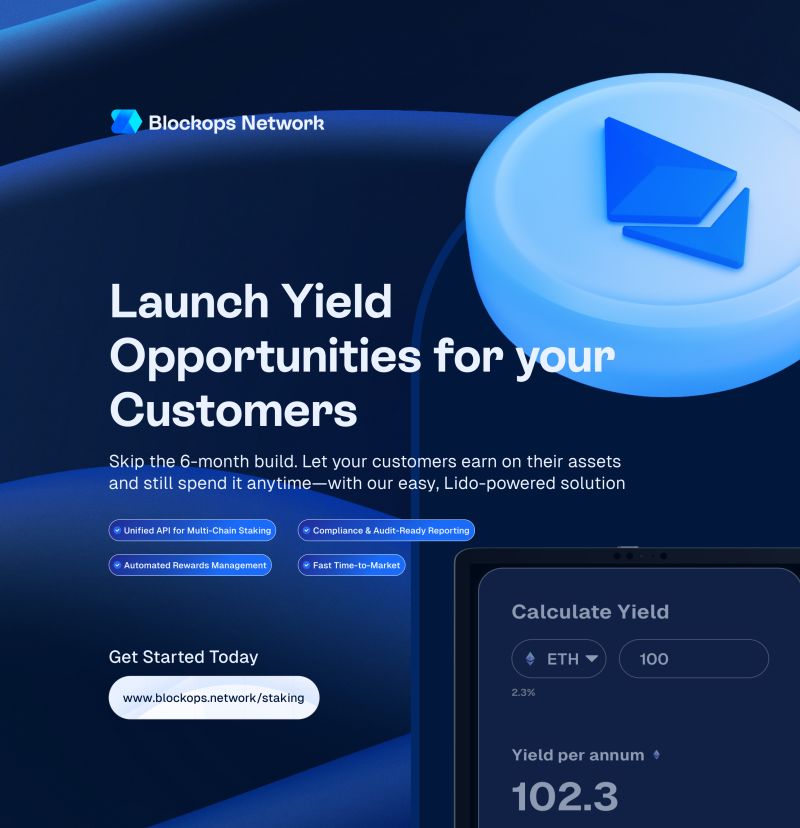
That’s exactly what we’ve solving with our Yields API
We’re building the infrastructure that helps platforms launch yield opportunities for their customers faster without spending 6+ months stitching together the stack
✅ Unified API for multi-chain staking
✅ In-App Integration: Your Customers doesn't leave your platform
✅ Customized UI Integrations
✅ Automated rewards management
✅ Compliance & audit-ready reporting
✅ Liquid staking-enabled asset utility (earn yield while maintaining usable onchain liquidity via derivative assets)
✅ Faster time-to-market
If you’re a fintech, wallet provider, exchange, asset-manager institutions or digital asset platform looking to offer yield in a way that is operationally clean, compliance & regulations alligned and enterprise-ready, let’s talk
For a decade, blockchain infrastructure was built for crypto, not for traditional finance.
Enterprises don’t need hype.
They need infrastructure they can control, audit, and trust with real money.
Today, we’re introducing Blockops for Enterprise: self-hosted, enterprise-grade on-chain infrastructure for institutions that want to own their rails, not rent them.
Read the full article here:
blog.blockops.network/blockops-for-e…
We're hiring a Sales and Partnership Lead at Blockops Network.
If you've closed B2B deals, sold technical products, and want real ownership, not just targets, this is for you.
Apply here: typical-hiss-da1.notion.site/Sales-Partners…
Happy Holidays from the Blockops team! 🎄✨
As we wrap up the year, we’re grateful for every builder, innovator, and visionary pushing Web3 forward. Your work inspires us to keep simplifying infrastructure and empowering teams to scale with confidence.
Thank you for being part of our journey.
Here’s to a new year of stronger networks, better tools, and unstoppable innovation.
Let’s build even bigger in 2026. 🚀
#Blockops#Web3#BlockchainInfrastructure#HappyHolidays2025
Blockops Rollups makes launching a chain as reliable as launching a cloud service
Get Started Here: blockops.network/rollup
Let’s build real ecosystems 🚀