
Tweet fijado
Alex
43.9K posts


Alex
@AnalysisOp
M. Eng. Electronic ⚡ 〰️ Financial data & analysis. Value investing. Growth? at a reasonable price. Jokes (some) are allowed 🦔 🧔🏻
EU Se unió Şubat 2023
136 Siguiendo1.8K Seguidores

Alex retuiteado

“We mostly just sit around reading, thinking and waiting.” – Stanley Druckenmiller

English

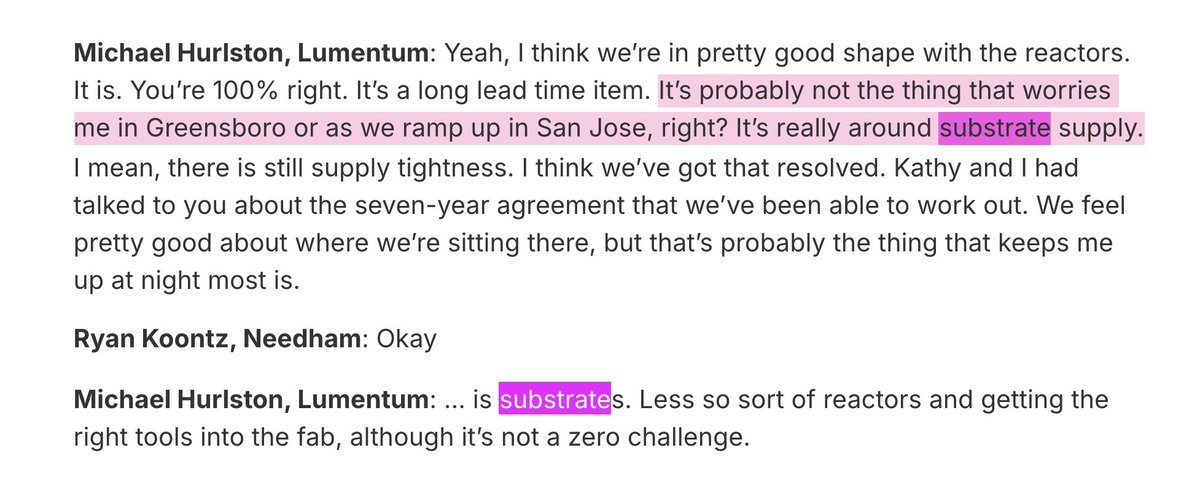
$LITE Transcript from Conference Call:
"The thing that keeps me up at night most is: Substrates.
Less so sort of reactors and getting the right tools into the fab, although it’s not a zero challenge."
They basically went out and said $AXTI is the bottleneck for photonics.
Especially if InP substrates keeps $LITE's CEO up at night.
I've been mentioning it for the past few months, if AXT they control the substrate supply, they have a lot of pricing power over $LITE to $COHR and America's AI buildout.
I've seen a ton of misinterpretation on X saying: "Seven-year agreement with Sumitomo". But they literally said there was supply tightness Today. And the agreement doesn't mean there will be enough supply for 7 years, especially when China export controls start to kick in on upstream feedstock/materials required by Japanese supply chains to make then.
This is before Photonics has even started to ramp up.
My $AXTI bottleneck thesis is playing out real time and we got new confirmation from $LITE that InP substrates is a bottleneck.
English

Magnificent Seven discount? Or much needed correction?
Which one would you buy?
$NVDA $GOOG $AAPL $META $TSLA $MSFT $AMZN
Charlie Bilello@charliebilello
All 7 members of the Magnificent Seven are down on the year and underperforming the average stock in the S&P 500.
English
@vikramskr Fantastic vid guys 🫡 Loved the explanation of how microLEDs work
And I agree about Credo. It has a great portfolio of products well placed for the future
English




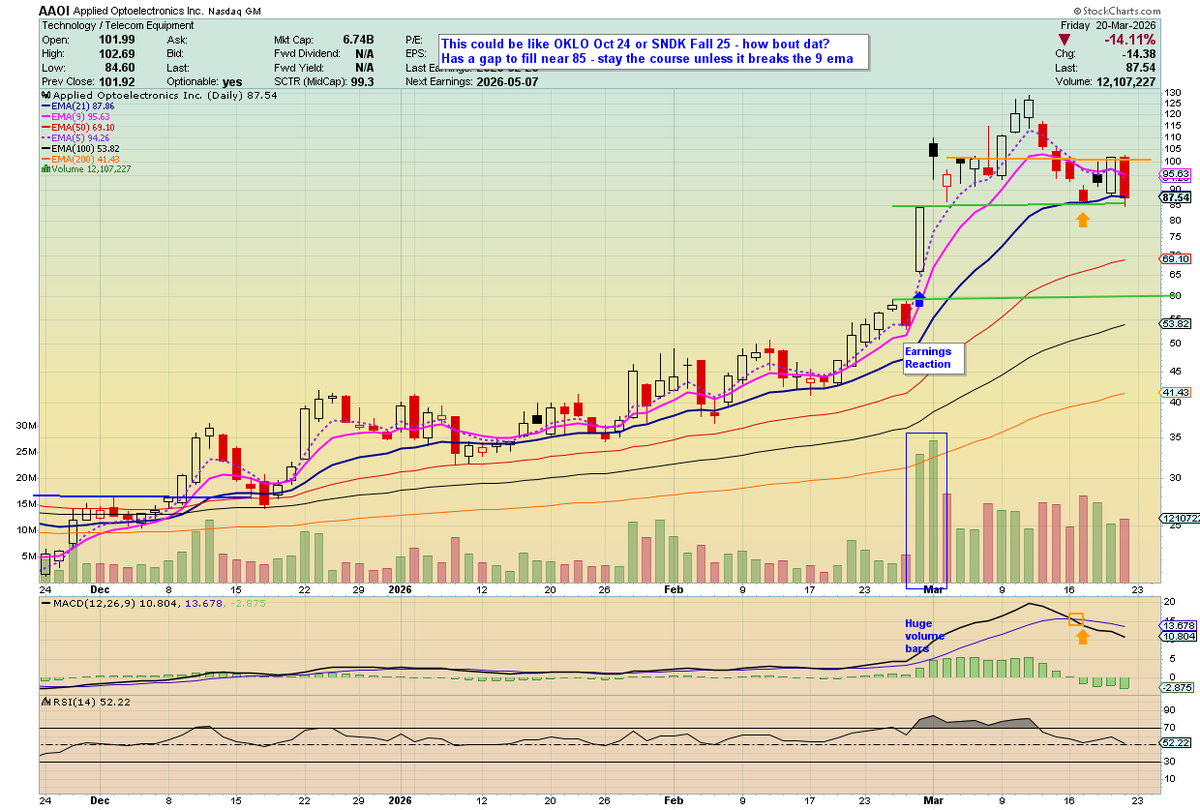
$AAOI has a negative MACD cross as of mid week - let's see if it matters near term
Been talking about the $84s gap but imagine the one near $60s fillin'
Would love that myself
🦄 Fund.Drone.DefenseTech.Photonics $LPTH $UMAC 🐋@fundmyfund
$AAOI hah good sense of humor algos $84.60 Fri low Gap fill would be $84.31
English

@rubicon59 None. USA has not enough labor force not even in dreams (see the Army submarines situation)
English

So what’s the plan to change it?
60 Minutes@60Minutes
Shipbuilding in the United States has been in shambles due to decades of shortsighted policies and neglect. Today, the U.S. rolls out about three large cargo ships a year while China does around 1,000. The Trump administration has called this a national security crisis. Sunday.
English

@EslariusdelEsla Es que no se fijan ni en las tildes (que la IA siempre patina ahí).
Español

Cuando yo era guaje recuerdo que me fijaba en las banderas y en ciertos detalles (como todo guaje) que absorbía como una esponja.
Quizá tenemos que empezar a plantearnos qué les estamos haciendo absorber a los guajes de hoy cada vez que publicamos algo en el lenguaje de la IA.
La8 LEÓN@La8Leon
Sábado 21 de marzo Desde las 17:15h “Día de León en Sevilla” En directo
Español
"Unitree plans Shanghai IPO" 🤖🇨🇳
"Unitree shipped over 5,500 units last year, occupying 32.4% of the global humanoid market"
Gross profit margins(of humanoid robots) @ 62.91% 😱 Price reductions, units delivered 📈 Positive net profits... is this magic?
reuters.com/world/asia-pac…
English
@rubicon59 MBA Ivy League dudes (wrong in everything in this field since 2024 btw) vs. a tech king who practically has invented (or more rightly, put the pieces together) the AI compute.
Imagine my side.
English
Alex retuiteado
🔥🔥🔥🔥
A must read:
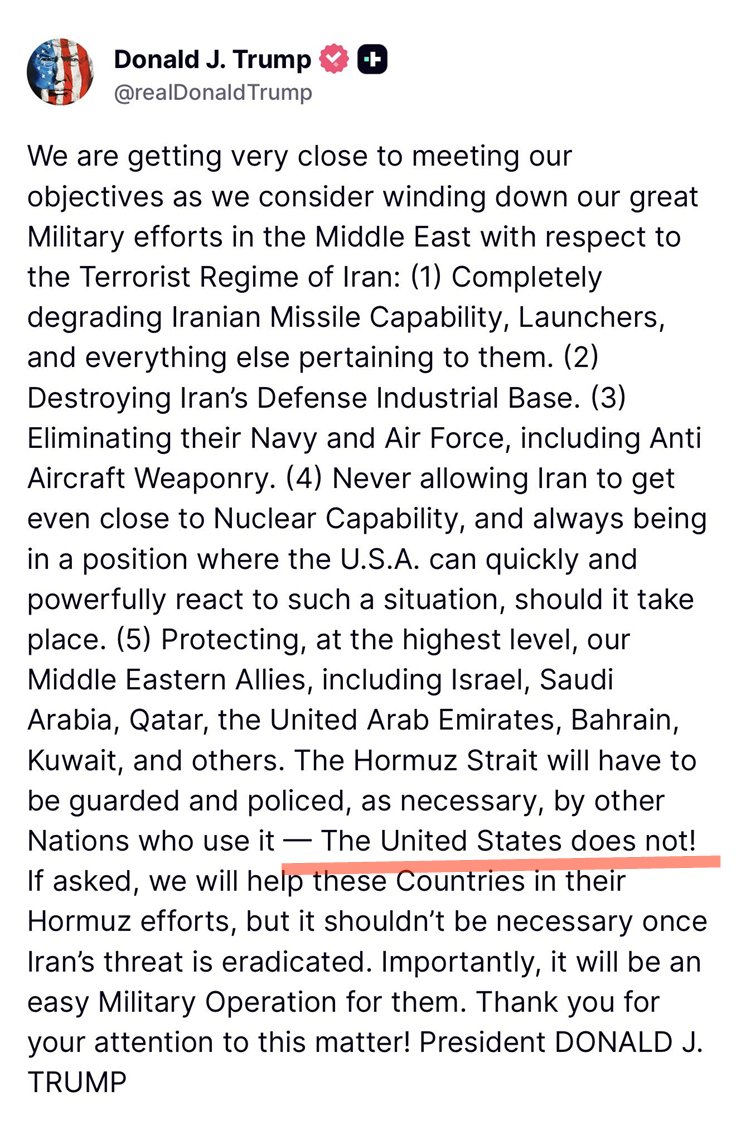
President Trump reverts to old thinking and statements from his first presidency in 2019, downplaying the significance of oil in the Middle East and talks about shipping in Hormuz Strait.
You can evaluate what I wrote in this column in World Oil Magazine in July 2019 in light of current events and Trump's statement below:
Link: worldoil.com/magazine/2019/…
Trump is wrong on the declining significance of the Strait of Hormuz.
Speaking about the Strait of Hormuz and the Persian Gulf, President Trump asserted recently that “We don’t even need to be there, in that the U.S. has just become the largest producer of energy anywhere in the world.” He also questioned the role of the U.S. in the region: The U.S., he said, is “protecting the shipping lanes for other countries” for “zero compensation.”
Here is why he is wrong:
🔴Throughout history, superpowers have always tried to control trade routes and secure them. Protecting waterways is well-entrenched in U.S. foreign and defense policies.
🔴U.S. control of the flow of Middle Eastern oil means its control of Europe, Japan and China. Russia will be more than happy to take over such a position.
🔴Being the largest oil producer in the world does not shield the U.S. from a price shock resulting from instability in the Middle East in general, and from the vacuum caused by the absence of the U.S. from the region.
🔴The U.S. needs Middle Eastern oil because of crude quality issues: All the increase in U.S. shale production is light crude, super-light, and condensates, while several U.S. refineries need the heavier, more sour crudes. From a policymaking point of view, crude quality matters, probably more than quantity at this stage, especially after the loss of the Venezuelan heavy crude because of U.S. sanctions on that country.
🔴The cost of protecting the Strait of Hormuz should be compared to the potential losses, if the U.S. were to withdraw from the region, not to the current benefits. That is how U.S. military leaders viewed the role of the U.S. in the Middle East, in recent decades.
🔴Those countries in the Gulf region can crash the oil market for a long period and reduce U.S. oil production by more than 3 MMbpd, making the U.S. more dependent on the Middle East again.
I will conclude with this statement: Who will be happy to see the U.S. either withdrawing from the Gulf region or reducing its presence? Here is a list: Iran, ISIS, AL Qaeda, Russia and China. I rest my case!
English


Lol so Elon might actually make EUV after all
I joked about this before, didnt see it coming anytime soon
Elon Musk@elonmusk
@LimitingThe True
English

If true, then this means that CXMT will be using domestic litho tools
3X Long Labubu@labubu_trader
Heard from some folks from China at GTC: CXMT will expand capacity by 100% and YMTC by 50% in 18 months, as required by the Chinese government for strategic supply chain security. CC @jukan05
English

"No Choice" — Samsung's 'Bold Gambit' Deepens SK Hynix's Dilemma
"Our stance is to dramatically increase supply of premium HBM4 (6th-generation High Bandwidth Memory) to NVIDIA."
These were the words of Samsung Electronics' Hwang Sang-joon, EVP and Head of Memory Development overseeing HBM, spoken on March 16 (local time) at NVIDIA's GTC 2026. The "premium HBM4" he referred to is a high-performance product operating at 13 gigabits per second (Gbps) — significantly exceeding NVIDIA's requirements of 10–11 Gbps or above. He added: "100% of our output comes out as high-performance, so we will supply accordingly."
Samsung: "Our HBM4 is 100% high-performance"
Samsung Electronics is currently understood to be the only company capable of producing HBM4 at 13 Gbps. Both SK Hynix and Micron officially cite "11.7 Gbps" for their respective HBM4 products.
If Samsung expands its high-performance HBM4 supply to NVIDIA, its HBM4 market share with NVIDIA could potentially exceed the industry consensus estimate of 30%. On the question of market share, Hwang said, "I'm an engineer, so I honestly don't know much about our share with NVIDIA," declining to elaborate.
Hwang's confidence stems from Samsung's technological edge in the base die — often called "the brain of HBM" — which governs performance and power management. Today's HBM customers demand high performance and low power consumption simultaneously. While demand for high-performance HBM is surging alongside the advancement of AI services, concerns about rising power consumption and potential heat dissipation persist.
Samsung addressed this by leveraging its near-cutting-edge 4nm foundry process. The company maximized power capacitors, which are critical to power stability. The new application of a logic-process-based MIM (metal-insulator-metal) capacitor is also highlighted as a key improvement in Samsung's HBM4. An MIM capacitor — structured as metal–insulator–metal — offers high capacitance per unit area and serves as a power stabilization element that maintains stable performance even amid voltage and temperature fluctuations.
Hwang noted: "Starting with HBM4, balancing performance and power efficiency has been the hardest challenge. Using an advanced process does add cost pressure, but there's no other way if we want to meet the conceptual goals HBM is aiming for."
23% performance gain with identical power draw
At the event, Samsung also offered hints about HBM4E (7th generation) — the next product after HBM4, slated for inclusion in NVIDIA's upcoming "Vera Rubin Ultra" AI accelerator expected next year. HBM4E is currently undergoing internal evaluation, with samples targeted to be sent in Q3 this year and initial mass production scheduled for Q4.
HBM4E's base die uses the same 4nm process as HBM4 — but Samsung stresses it is "a different 4nm." Samsung's HBM4E achieves an operating speed of 16 Gbps, a 23% improvement over HBM4's 13 Gbps, while maintaining identical power consumption. Hwang explained: "The 4nm process has meaningfully advanced. We designed it quickly using the same architecture to align with NVIDIA's aggressive timeline."
Starting with HBM5 (8th generation), Samsung plans to manufacture its base die on a 2nm process. The core die (the underlying DRAM) will be based on 10nm 6th generation (1C). From HBM5E onward, the 2nm base die will be paired with 10nm 7th generation (1D) DRAM.
SK Hynix wrestles with TSMC 3nm
SK Hynix's dilemma is deepening. The company has already submitted its final HBM4 samples to NVIDIA — products refined through design modifications and optimization work beginning in Q4 last year to meet NVIDIA's required data transfer speed of 11.7 Gbps.
SK Hynix produced its HBM4 base die at TSMC's 12nm process — widely regarded as an older-generation node relative to the 4nm Samsung utilized.
Having fallen behind Samsung in the pace of NVIDIA qualification for HBM4, SK Hynix is preparing a counteroffensive for HBM4E. Unlike HBM4, which used 10nm 4th generation (1B) DRAM for the core die, HBM4E will adopt 1C — the same generation as Samsung.
On the foundry side, SK Hynix had originally planned to stick with TSMC's 12nm for HBM4E as well — but reports are now emerging that the company is evaluating a switch to 3nm, one of TSMC's leading-edge nodes.
Originally, SK Hynix had intended to apply 3nm only to custom HBM orders. However, following Samsung's preemptive move — achieving 16 Gbps in HBM4E through an improved 4nm process — SK Hynix's internal calculus has reportedly grown more complicated.
Using a 3nm base die could deliver a larger performance improvement, but the unit cost would surge dramatically compared to 12nm. Industry analysis suggests that TSMC's 3nm wafer pricing runs 4 to 5 times more expensive than 12nm.

English
@HyperAICapital Only I tell one, bc the shame of the other is too hard 😅 United Airlines bought at $22 during Covid, sold at $40s, yep a x2 you say, but look where the stonk headed to after..... and the worst thing is that I knew it, leisure travel was (is) VERY strong
English
@TradexWhisperer I read it quickly yesterday and certainly I saw strange the % increase
English

$MU HSBC just set the Street high at $750. Correction: That's 78% upside from here, not 45%.
Trade Whisperer@TradexWhisperer
$MU HSBC just set the Street high at $750. That's 45% upside from here.
English
@TradexWhisperer LOOL so the "no DRAM at all architecture" now cointains 12 TB of DRAM?? 😂😂
$MU winning again the Korean trolls
GIF
English
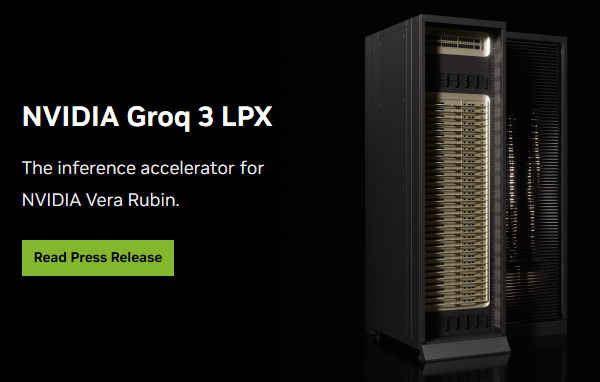
$MU $NVDA The newly announced NVIDIA Groq 3 LPX (Inference Accelator) implements up to 12TB of DDR5 memory per rack.
Groq's 12TB is 3 - 6 times higher than what you'd find in a typical non-AI enterprise setup
The 12TB allows the Groq system to act as a massive "cache" for model weights, meaning it doesn't have to constantly fetch data from slower storage, which is why it can generate tokens so much faster than a standard server rack.
Trade Whisperer@TradexWhisperer
$MU Alerts Customers to Price Hikes, Signaling Robust 2025-26 Demand. Here's the letter from EVP of Sales Valued Channel Partners, Recent market dynamics indicate that the memory and storage markets have started to recover, with growth anticipated through calendar 2025 and 2026. Micron is seeing an increase in un-forecasted demand across various business segments. In response to these tightening conditions, Micron is increasing pricing. The increasing demand for Al-related use cases and associated technologies reflects, among other factors, the growing interest in our product portfolio due to the essential capabilities that our products provide for each of these use cases. As a continued practice, our pricing considers both the value our products deliver to these and other use cases and the return on investment (ROI) required concerning the substantial investments we are making to develop and maintain an industry-leading product portfolio, along with the necessary manufacturing capacity to meet market demands. To help ensure supply availability and continuity, we encourage customers and channel partners to provide long- term forecast visibility and include backlog demand in that forecast. Micron issued a memo today outlining the specific pricing actions we are taking across our channel network. We value our partnership and look forward to continued success together. Should you have questions, please do not hesitate to contact your local Micron sales and service support teams.
English