Edwin

1.3K posts

Edwin banner
Edwin

Edwin

@Edwindoit

Deutsch & Popper’s ideas applied to personal effectiveness 📘 Book: https://t.co/EOiBNPoXNH 🎙️ Podcast: https://t.co/38WwGnHY7G 🗓️ Conference: https://t.co/DtvBoZfdfW

The Netherlands Se unió Nisan 2022
191 Siguiendo326 Seguidores
Tweet fijado
Edwin
Edwin@Edwindoit·
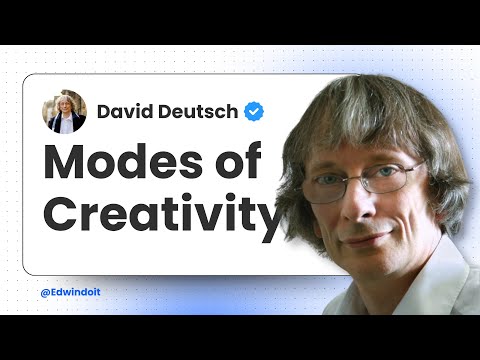
This week I had the pleasure of being joined by @DavidDeutschOxf to explore the intricacies of creativity, the self, the mind, and of course, the Fun Criterion. youtu.be/e7CrXqUcqzs
YouTube video
YouTube
English
14
26
183
30.5K
Edwin retuiteado
Christian Dean
Christian Dean@christiandean_·
Merz has called for the systematic review of all EU legislation. That's over 140,000 regulations. Knowing the EU, that will take over 140,000 days. So, I made bettereu.com where Grok 4.1 will review every document since 1958 -> 2025.
Clash Report@clashreport

Germany's Merz: We must deregulate every sector. I call for a “regulatory clean slate.” Minor corrections to laws are not sufficient. We need to systematically review the whole set of existing EU legislation.

English
245
523
4.3K
324.6K
Edwin retuiteado
Brad Ingarfield
Brad Ingarfield@BradIngarfield·
Your brain also didn't evolve to do calculus. Yet here we are. Evolution explains how we got here. It doesn't explain what we're capable of now that we're here. Every generation thought its information environment was uniquely overwhelming. The printing press. The telegram. The 24 hour news cycle. The answer was never less data. It was better thinking. You're not a caveman drowning in a data storm. You're a universal explainer who was never taught to reason. That's a solvable problem.
English
2
12
79
4.8K
Edwin
Edwin@Edwindoit·
Thank you Brian, I appreciate the remarks and suggestions of areas to look into. It's a fun project. I haven't had a thorough look at all the authors you mention yet, but here are some initial thoughts/questions on your three points: On the social constitution of the self: I agree that other people are a massive factor in the development of the self, even the most important environmental factor. But I'm not yet convinced it's a necessary condition rather than a powerful accelerant. Consider: the first creative being to evolve had no other selves to interact with, yet something like a self must have emerged anyway. If it hadn't, there would be no second self for anyone to interact with either. So at minimum, creativity in interplay with observation of reality has to be sufficient to get some form of self (or multiple selves), or even some completely different form of organisation, off the ground. On World 3: I take your point that the self is anchored in World 3 objects. But I think framing World 3 as inherently social cuts against Popper's own characterization. Isn't the whole point of World 3 is that it consists of objective knowledge that exists independently of knowing subjects? A solitary creative mind (wheter human or not) can generate and engage with World 3 objects — theories, problems, conjectures — without a social context. On selves not having aims: I'd like to understand this distinction better. If the self is a conflict resolution process, that process is necessarily directed at specific problems. If the self isn't what determines that directionality, then what does?
English
1
0
0
32
Brian Moon
Brian Moon@perigean·
Kudos for taking on the project. You seem to be one of the few in your circle who has realized the centrality of the self for explaining people. That said, your current model includes a number of paralyzing errors, both of commission and omission. First, the omission, the major one. While this omission is not surprising given that the model attempts to advance Deutsch's perspective, citing Popper's chapter but making the omission strongly suggests that you did not understand (or are willfully omitting) the most important aspect of Popper's view. That is, that without others, there is no self. You mention others only once in your section one "one self is the default," then completely exclude it during your development section. Here is Popper's view: "we have to learn to be selves…the child learns to know his environment; but persons are the most important objects within his environment; and through their interest in him — and through learning about his own body — he learns in time that he is a person himself." Review his comments about isolation. And the footnotes about Adam Smith, G.H. Mead, and Hegel/Marx/Engels/Bradley. Until this fact is incorporated, your model will be, at best, incomplete. Your problem will be to synthesize this view with Deutsch's -- if you can, you'll have achieved something significant. They are incompatible, in my view. Your commission error lies in the limitations of the computational mind perspective. You've fixed the error that most make by focusing on systems of processes. But you've only replaced that error with another, arguably more egregious one. The processes are situated in the biological, enabled by our physical architecture and its propensities. But the self is anchored in World 3 objects -- another aspect of Popper's perspective you've omitted. By this, Popper meant that our selves are tenuously and continuously maintained through the state of discussion. Mead, Dewey -- and to a much greater extent, Athens -- have articulated how this works and what it means for the development and maintenance of self. I'll again encourage you to follow these rabbit holes -- as Jeremy Shearmur encouraged us all to do by noting to Popper the synergy between his view and theirs. Your model does not describe a system of processes; it describes the system. And it attributes to the self something that a process cannot have -- an aim. People have aims; selves do not. Selves are one of the key enablers that provide for people meeting their aims. And developing their aims. And changing their aims. But it is nonsensical to say that selves have aims. You've got some useful pieces here. But you will need to correct these errors. Doing so will require you to put Deutsch's view to the strongest tests -- which are those Popper and Athens already have. Realizing this view fails these tests will be a test of its own kind, for once these pillars are shown to be made of sand, the rest of Deutsch's theory of evolution of creativity and culture topple. The breadcrumbs are there. I look forward to seeing whether you follow them.
English
1
1
2
82
Edwin
Edwin@Edwindoit·
I’ve been digging deeper into the nature of the self and tried to condense my current view into one working model — largely based on the ideas of Deutsch and Popper. It will evolve as I learn more. Criticism and comments are very welcome: edwindoit.com/writing/theself
English
3
3
19
851
Conjecture Institute
Conjecture Institute@ConjectureInst·
Coming soon Conjecture Institute's fourth book 📚💫 The Farthest Reaches by Conjecture Institute Ambassador @ToKTeacher
Conjecture Institute tweet media
English
8
10
70
10K
Edwin
Edwin@Edwindoit·
@kaurimark I can definitely recognize this. It’s become very easy to tell whether something is AI if you just leave the prompts at their defaults, so prescribing at least some kind of style guide seems mandatory. I’m going to give Every a try!
English
0
0
1
11
kauri markkanen
kauri markkanen@kaurimark·
personally have began to feel nauseous reading any “human” post or piece written with ai. i already get so much exposure reading the answers to my own queries, don’t need any more of it. probably some tools will be eventually made that force more human-like style. haven’t stumbled upon any for now, although the every subscription supposedly includes one one (am yet to try)
English
1
0
1
44
Edwin
Edwin@Edwindoit·
I’m curious about modern AI-assisted writing workflows. What tools excel at copy-editing and maintaining style consistency? Right now I use AI to generate examples and tighten prose, but I lack coherent prompt structure or native-app experience.
English
2
0
1
127
Edwin
Edwin@Edwindoit·
@dela3499 @every Nice, Spiral (from every) looks interesting. I’m going to experiment with it a bit. I’m also vibe coding a minimalist local editor, partly for fun and partly to reduce context switching and avoid copy-pasting
English
0
0
1
37
Carlos De la Guardia
Carlos De la Guardia@dela3499·
@Edwindoit I’ll probably have a better answer in a few weeks or months, once I’m actually doing more longform writing. Atm, I mostly write in my own private notes, and I don’t use much AI for editing that. Perhaps @every has something useful for you?
English
1
0
1
52
Edwin
Edwin@Edwindoit·
Good points! There's clearly much to elaborate upon. In my current view the self is a conflict resolving process that operates over knowledge and maintains continuity over time. Multiple processes can access overlapping memories, but what makes something count as a self is how conflicts get resolved and decisions get produced, not mere access to the same information. Because the mind is universal, it can implement several self-like simulations or role perspectives, and we often do this when we model other people or different roles of ourselves. Still, the stable default is one integrated core self: a unified conflict resolution process that coordinates action and maintains coherence (via memory chaining etc.). When that integrative process breaks down into competing, non integrating decision structures, then it becomes meaningful to speak of "split" selves in the unhealthy way.
English
0
0
4
74
Zakery Mizell
Zakery Mizell@ZakeryMizell·
If the self is a process, then do we all have the same self? You also say the self is individual due to memories, so it may be a process plus memories that is the self. But also you could have multiple selves, which would all have access to the same memories. At which point you would have to define each self as different types of processes with access to the same memories. Each type of self process may have the same aim, but they are differently efficient at some tasks. However, if this is so, even if they are aligned, they are still different selves. So, somewhere there is a conflict in your conception! I don't think process, memory, and aim constrain it enough! But I don't have any alternatives. I like the exploration so far! I wonder if any knowledge creation process is strictly better than another, given that inefficiencies make for different types of variations.
English
2
0
2
135
Edwin
Edwin@Edwindoit·
This first module gives a clear account of the prevailing conception of physics and its explanatory power, while also exposing a key limitation. A preview of the type of problem Constructor Theory aims to address in the modules to come.
Edwin tweet media
Conjecture Institute@ConjectureInst

x.com/i/article/2023…

English
0
0
8
472
Matjaž Leonardis
Matjaž Leonardis@MatjazLeonardis·
Wisdom is the name for knowledge that’s difficult to learn from experience.
English
2
0
6
505
Edwin
Edwin@Edwindoit·
Michael Levin’s work on bioelectric knowledge is fascinating, and it’s great to see it getting broader attention. This episode rightly focuses on the many epistemological mistakes involved, but I’m especially interested in hearing Brett explore the implications of knowledge being encoded in bioelectric patterns rather than only in genes. Practically speaking, this opens up an entirely new line of research, one that is already showing promising results in animal studies for correcting specific developmental defects, promoting limb and organ regeneration, and influencing tumor-like growth in preclinical models. I hope this will be explored in more depth in the next Tim Ferriss episode Bret plans to discuss.
Brett Hall@ToKTeacher

Reacting to @drmichaellevin, Part 1: Categories and continuums. In this part I am reacting to a small part of his second interview with @lexfridman.
English
0
0
10
652
Edwin
Edwin@Edwindoit·
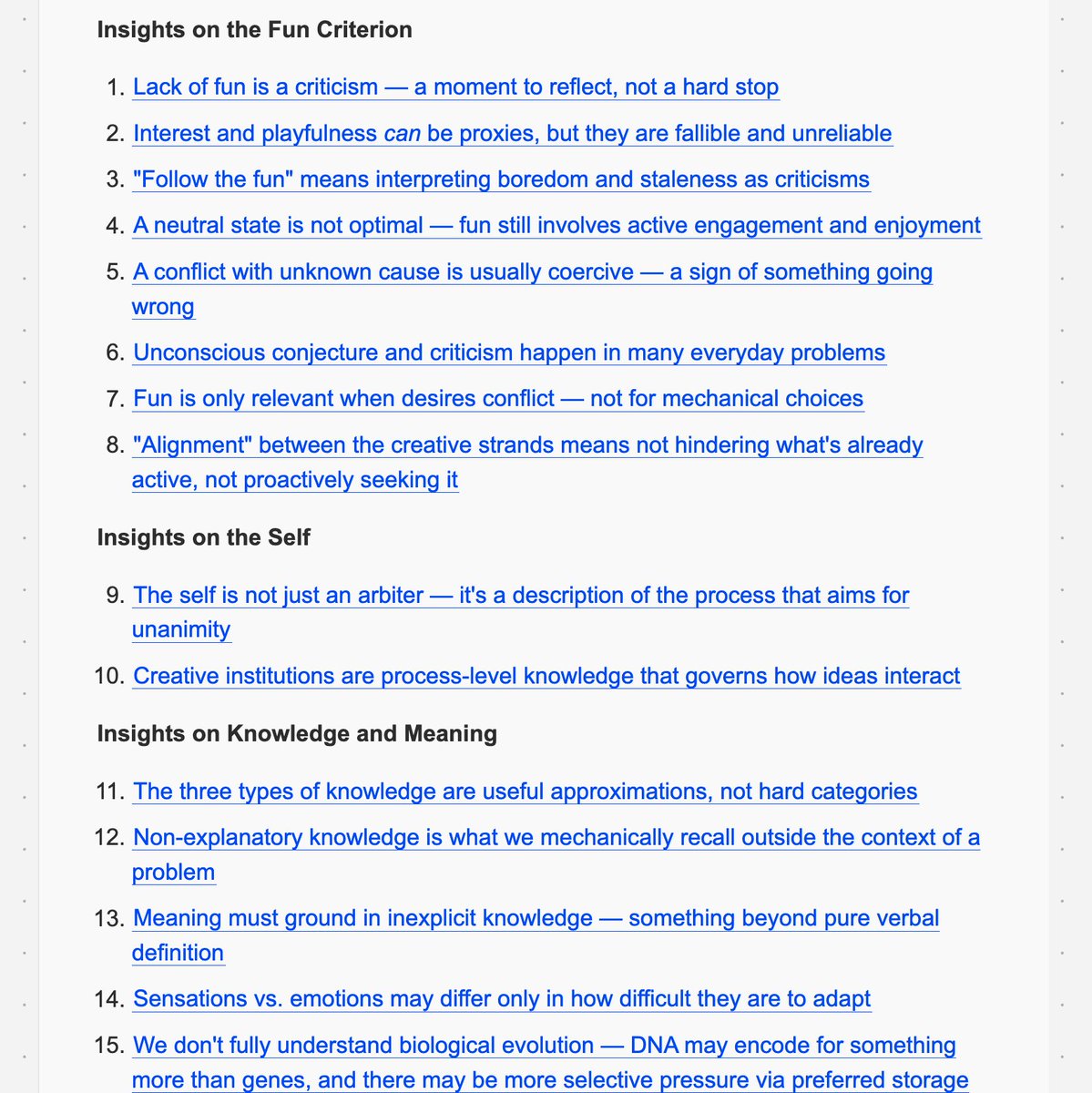
I took some time to reflect and write up what I learned from my conversation with @DavidDeutschOxf I distilled it into: - 8 insights on the Fun Criterion, - 2 on the Self, - and 5 on knowledge and meaning. Read them all here: edwindoit.com/writing/15thin…
Edwin tweet media
English
6
7
65
1.8K
Edwin
Edwin@Edwindoit·
This week I had the pleasure of being joined by @DavidDeutschOxf to explore the intricacies of creativity, the self, the mind, and of course, the Fun Criterion. youtu.be/e7CrXqUcqzs
YouTube video
YouTube
English
14
26
183
30.5K