
HeLa Papi 🔬 retuiteado
HeLa Papi 🔬
276 posts

HeLa Papi 🔬
@HeLaPapi
not a doctor and not financial advice. trust the bioprocess!
omics Se unió Ağustos 2023
741 Siguiendo345 Seguidores


HeLa Papi 🔬 retuiteado

Didn't catch our #JPM26 presentation? Catch the video we presented here
"Either you were in the M&A basket and public markets investors thought you were going to get bought by Big Pharma and your stock traded well, or you weren't...[but] it's great to be in an environment where we have another path forward as a business"
English
@Biohazard3737 I’m the opposite rn, probably using it more than I ever have
English


Okay this market has become incredibly retarded, even for my standards.
English
There's no better feeling than seeing PMs you work (or worked for) who wronged you multiple times getting cucked by the market and their bad stock picks. I'd trust a blind monkey throwing darts than most of these Gen X / Boomer twats.
English
@philly76fan215 Np. Just remember to subscribe to the substack once it launches 😂
English
$DV seems like a sleeper adtech pick. Crushed last quarter - accel'd to 21% y/y (on tougher comp). Stock is at 10x EBITDA. Leader and share-gainer in ad verification/measurement market (only 1 other comp). Also think AI slop + traffic = greater demand for their products over LT
English
@sigmazerocap Agreed generally on headcount / margins, but there is a ceiling: vienna.earth/plate/russell/…
The cost of filing a claim is a feature, not a bug of the system imo.
English
Ignoring the FUD for a second, what better company than $UNH to automate most back-office functions with AI, cut headcount/staff costs and structurally increase margins?
English
I'm thinking of starting a Wall Street Prep / Breaking Into Wallstreet business but for low-wage manufacturing jobs. We'll teach ex-marketers, graphic designers, programmers and paralegals how to lift with their knees, tighten screws and inspect products. Anyone down to seed me?
English


Me, a $U shareholder looking at the $APP result today

English
@Borlaug_ This assumes the $4B goes back into grants right? At the end of the day doesn't Trump want to show absolute savings on spending?
English

Indirect cuts might actually be a net positive for $ILMN $TXG $TECH $RVTY $BRKR $AVTR and $TMO (assuming we're not doing away with the NIH all together).
I've been reading so many responses in the NIH threads over the weekend, both for and against the indirect limits. Takes so far:
1. Indirect costs are not being used to buy sequencing consumables, they're just salaries for admin personnel who are basically personal assistants to the PIs, etc. The one place they might be really benefitting R&D tools is in capex, where it might be driving a willingness to buy new systems.
However, the core lab model already makes it really easy to spread these costs across systems, including the bigger systems who already over-charge by the most.
2. If 15% becomes the limit, and most of this ends up funding more total grants, the napkin math is kind of great.... headline number NIH gave was that ~26% of a total of $35B was indirect (or 35% "indirect rate").
Taking this down to 15% (which becomes the MAX not necessarily what gets charged) puts ~$4B back into the $35B, which is actually a 15% bump to direct grant dollars. (New split would be ~$30.4B/$4.6B ish vs 26/9)
3. This also implies that NIH is a smaller driver of most academic R&D exposure today as a %. This is a good thing, because the other sources, univ endowments/non-profits use the pension model to fund the market, and markets have grown this pie.
4. Zooming out, Trump was pretty good for NIH funding in his first term. Budget grew 6/9/5/6% his 4 years, compares to 3/5/6/3% (worse if you exclude ARPA-H which has been a joke tbh)
Lots of worlds where he leaves the budget alone/keeps it flat. However, let's pretend he cuts ~(LSD%) and it lands equally across NIH budget, including grant dollars. $34B -> split is ~29.6/4.4 -> still +14% to grant dollars for R&D consumables on a (3%) budget hit.
Deutsche also did a survey that said lab managers only spent 88% of their budgets in 2024. If they spend 95% in 2025, it puts an 8% tailwind behind the whole pie, more than offsetting whatever % is NIH and only grows ~1% this year...
Trying to avoid being political here, just being the same old shameless optimist/capitalist who wants to see these guys win.
Would love to hear from science Twitter what I'm missing about indirect costs/where they end up/why big universities would do any less science because of this if the budget total was otherwise the same.

English
@sigmazerocap @peterphan88 There are some in India and China (Wuxi for example) but outside of there Evotec is the main one. CRL is starting to move more into manufacturing as well. None have the $EVT partnered pipeline tho
English
@peterphan88 Only CDMO with CRO and preclinical drug discovery platform with co-owned pipeline? Yes I would think so.
English
$EVO / $EVT is now the only life sciences stock I own. Unique asset as the only vertically integrated CDMO that spans drug discovery, development and biologics manufacturing. Also positioned to be a key enabler for AI-powered drug discovery with their PanOmics and PanHunter applications and the massive amounts of biological data they have access to.
Beyond that the biotech / preclinical cycle is closer to bottoming and AI has the potential to catalyze growth again, new leadership is driving more efficiency, 140 co-owned drug pipeline increasingly reaching later stages, biologics manufacturing continues to ramp (grew 75% y/y last quarter) and will become less margin dilutive to GM as it scales and the stock trades at 2x revenue. Also an obvious takeout candidate (recently turned down ~EUR 12/share offer, stock is at EUR 9 today).
Let's see if I can repeat my life sciences hit rate after $TEM.
English
@KNielsen2000 I don’t think the elastomers/pen mouldings are the bottleneck, it’s more the API and fill/finish right?
English

Will $NVO do another larger M&A within the supply chain?
Less than one hour ago it became public that Gerresheimer is investigating a potentiel sale of the whole Company.
Gerresheimer is one of two external companies that produce two-chamber pen for use in Cagrisema.
I could potentiel see the same model used as with the Catalent buy.
Novo Holding buying Gerresheimer and then Novo Holding selling the production of pens to $NVO
investing.com/news/stock-mar…
English
HeLa Papi 🔬 retuiteado
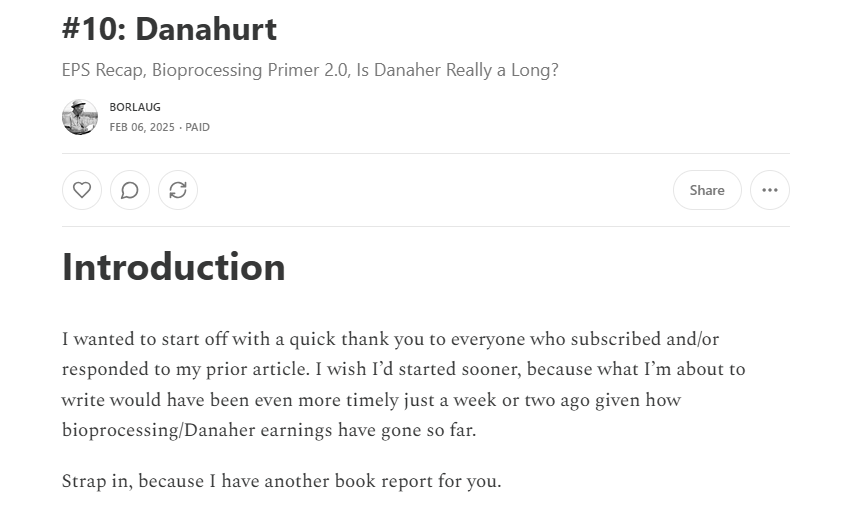
Another 2-in-1 poast out just now. A big thank-you to everyone who came on board after the first one! Absolutely made my week seeing this much interest in subject matter that I'd have expected many to call esoteric.
I think this one more than lives up to its predecessor. Twice as useful if you've read both the original primer and $RGEN thesis.
Free portion has short EPS recap on $DHR $SRT $LONN as well as the tidbits from $TMO $IQV $STE that matter to bioprocessing that ties it all together.
The rest is a big add-on to my original primer on bioprocessing, going a level deeper and showing the key component of why I thought $DHR was a short a couple weeks ago (and a potentially tricky long from here?). Another lengthy one, mostly by necessity.
Feedback welcome. You know where to find it!
English
@AlexHarding7 @NedPagliarulo @monaco_biotech I generally agree. Just 2025’s expectations of $100M in sales seem high. At ~$30/day (and 10 day use on average), this is ~333k patients that need to be treated in one year….
English

@HeLaPapi @NedPagliarulo @monaco_biotech If that’s the case I think it’s too high. For acute pain issues you’re dealing with less specialized docs who aren’t going to be comfortable with dosing and aren’t familiar with the AEs. For all the issues with NSAIDs and opioids, they’re familiar and the risks are understood.
English

FDA approves $VRTX non-opioid drug suzetrigine for acute pain.
Drug will be sold by Vertex as Journavx:
fda.gov/news-events/pr…
English
@AlexHarding7 @NedPagliarulo @monaco_biotech Market seems to be pricing in ~$2-3B in peak sales for acute
English
@NedPagliarulo @monaco_biotech I expect uptake in acute pain to be modest.
English
