
Alex Harding

3.3K posts

Alex Harding banner
Alex Harding

Alex Harding

@AlexHarding7

An internist in biotech

Boston, MA Katılım Mart 2012
150 Takip Edilen3.5K Takipçiler
Alex Harding retweetledi
Nicolas Badre
Nicolas Badre@BadreNicolas·
There have been discussions on federal SSRI restrictions recently. It made me wonder - do we know what would have happened if they did? Well, a just-released publication went over Korea’s prior attempt at doing so. In 2002, there was concern with overprescribing of psychotropics in Korea, and SSRI were significantly restricted for primary care doctors to just short use (60 days). The publication looked at the suicide rate versus the predicted (“synthetic" in the publication) suicide rate. The numbers are striking. The average suicide rate for the 10 years preceding the ban is 15.5 per 100,000 per year, but the 10 years after was 30.9, a doubling rate rendering Korea #1 in suicides among OECD countries. As with all retrospective reviews, this is not a perfect study. (1) There is little data on actual antidepressant prescription at the time. They note that in 2001, 20.8% with depression received meds, and in 2017 Korea had one of the lowest antidepressant prescription rates among OECD countries, but they don’t note prescribing data before and after 2002. (2) An alternative explanation was economic problems in Korea in 1998, 2002, and 2008, which are also reflected in the data. However, Japan had similar economic problems and not nearly as significant of a rise in suicides. I am often critical of what I see as the overprescribing of antidepressants. I also don’t think that anyone in the government is planning to limit antidepressants. However, considering the recent discussion in the media, I thought that this study was of significant interest. Considering reading the publication yourself: DOI - 10.1016/j.ehb.2026.101603. Published online 5/4/26. Few more notes below
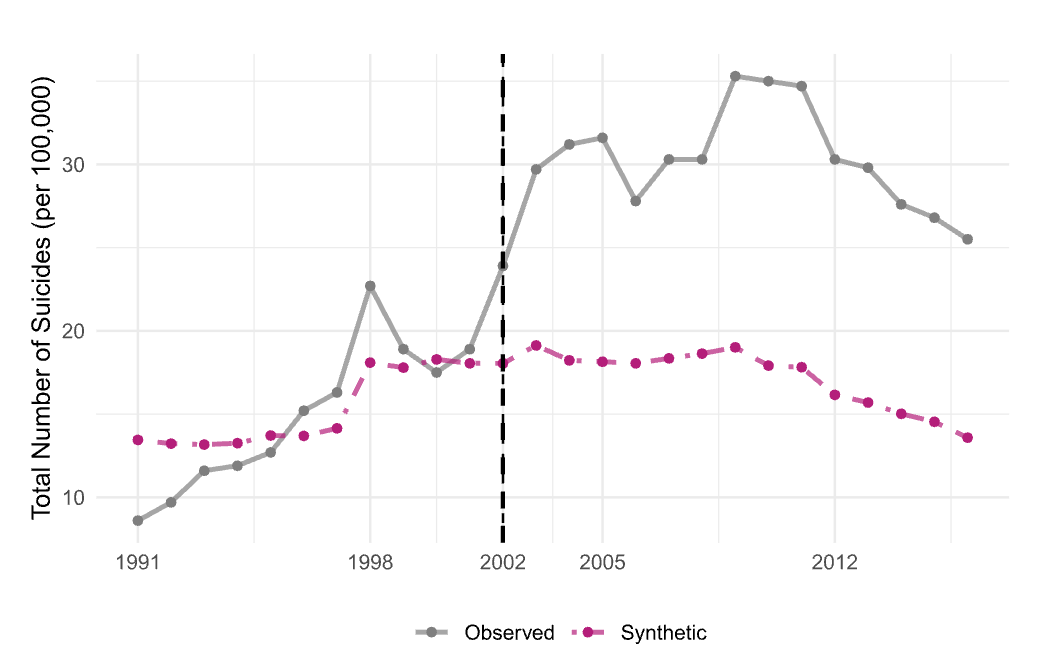
Nicolas Badre tweet media
FactPost@factpostnews

New reporting reveals RFK Jr. is exploring banning certain SSRIs, potentially barring drugs like Zoloft, Prozac and Lexapro. Decades of research shows SSRIs are safe and effective.

English
8
11
58
17.8K
Alex Harding retweetledi
Daphne Zohar
Daphne Zohar@daphnezohar·
An appeal to @realDonaldTrump from those of us developing potentially life changing medicines. The next @US_FDA commissioner should have: deep regulatory experience, a track record of reform, and the ability to lead a scientific institution under political & competitive pressure without compromising speed or rigor nopatientleftbehind.org/fda-recommenda… Rick Pazdur is one exemplary candidate and the industry looks forward to supporting whoever is appointed. Thanks to @NPLB_org & @PeterKolchinsky for initiating - please sign & share.
English
4
15
68
7.7K
Alex Harding
Alex Harding@AlexHarding7·
RevMed is such a cool story. The trip from academia to a failed biotech (WarpDrive) to huge success is a microcosm of the circuitous path often taken in drug development. nytimes.com/2026/05/12/hea… via @NYTimes
English
4
31
182
38.8K
Alex Harding
Alex Harding@AlexHarding7·
@rtnarch I agree NPs and PAs will play a more important role and MDs may be partially displaced.
English
0
0
0
258
Robert Nelsen
Robert Nelsen@rtnarch·
@AlexHarding7 Correct. Need more data. An AI driven system w deep sequencing, proteomics, longitudinal data, and less skilled humans will do this better.
English
3
0
3
841
Robert Nelsen
Robert Nelsen@rtnarch·
Two interesting points. 1. AI will be better than almost all doctors at diagnosis. 2. Doctors are not nearly as good as they think they are now, because the system punishes admission of errors, has little feedback, little learning, lots of moral certainty of correctness.
Science Magazine@ScienceMagazine

Researchers show that a type of #AI known as a large language model often outperformed physicians at diagnosing complex and potentially life-threatening conditions, including decreased blood flow to the heart, even in the fast-moving stages of real ER care when information is limited. In early ER cases, the model identified the correct or a very close diagnosis in about 67% of cases, compared with roughly 50% to 55% for physicians. And the technology is only getting better. Learn more: scim.ag/4w909UX

English
17
20
104
28.1K
Alex Harding retweetledi
Samuel Hume
Samuel Hume@DrSamuelBHume·
The number of public biotech companies has been dropping since 2022 (with a peak of almost 900) -- now it looks like it's now stabilizing, at ~667
Samuel Hume tweet media
English
6
10
38
20.1K
Alex Harding retweetledi
Dan Primack
Dan Primack@danprimack·
Three biotech IPOs this week. Each one raised its number of shares and priced atop range. Suggests that Wall St is slightly underestimating investor interest in new biotech issues.
English
0
2
11
5K
Alex Harding
Alex Harding@AlexHarding7·
@PantaRhai I’m not sure how you define big problem. Maybe you’re looking at it from the POV of revenues vs prior? Believe me it is a big problem in the doctor’s office. I live this every day I’m in clinic.
English
0
0
0
37
Alex Harding
Alex Harding@AlexHarding7·
Just to piss off everyone: is tafamadis IP settlement something to celebrate? It delays generic entry for 2.5 years. Good for PFE and BBIO but not really good for patients.
English
10
2
25
9.6K
Alex Harding
Alex Harding@AlexHarding7·
@PantaRhai I agree acoramidis is a superior drug but very often that choice won’t exist. Taf is a lot better than nothing. As a practicing doc I can tell you access is a real problem.
English
1
0
0
62
Stock junkie
Stock junkie@PantaRhai·
@AlexHarding7 Wouldnt be better for patients to be on generic tafamidis versus superior branded drugs so inwould say good for patients in long run
English
1
0
0
72
Alex Harding
Alex Harding@AlexHarding7·
@A_May_MD @Clarksterh The theory there makes much more sense but implementation can go wrong. Eg, with IRA a clock starts at fist approval, disincentivizing companies from doing fast to market in a rare/niche indication, better to wait for the broad label before launching.
English
1
0
0
153
Adam May
Adam May@A_May_MD·
@Clarksterh @AlexHarding7 Anchoring to the date of invention of a molecule is a huge mistake. It’s the drug development where the IP should come from.
English
1
0
8
608
Alex Harding
Alex Harding@AlexHarding7·
@A_May_MD Yeah the IP was pretty old by the time the drug got approved. I think that’s a fair argument, but worth pointing out the downside as well (decreased patient access) since all the attention has been on upside.
English
1
0
1
1K
Adam May
Adam May@A_May_MD·
@AlexHarding7 FDA approval in 2019 right? Even with the extension this is not even a remotely egregious US exclusivity period for a life extending drug. Protect innovation or we won’t get any more of these!
English
3
1
16
2.4K
Alex Harding retweetledi
Samuel Hume
Samuel Hume@DrSamuelBHume·
These are really really nice data that've gone largely under the radar In people already taking a statin, Enlicitide (an oral PCSK9 inhibitor) was tested head-to-head against other cholesterol medicines — Bempedoic Acid, Ezetimibe, or the combination Enlicitide lowered LDL more than even the combination (and was the only agent to lower lipoprotein(a) too, by ~25%)
Samuel Hume tweet media
Subodh Verma@SubodhVermaMD

Honor to work with this team on the oral PCSK9i - Enlicitide. Now in JACC.

English
11
42
290
146.4K
Alex Harding retweetledi
Baltimore Orioles
Baltimore Orioles@Orioles·
Good news: We can't stop hitting home runs. Bad news: No more fireworks.
Baltimore Orioles tweet media
English
78
854
7.2K
327.5K
Alex Harding
Alex Harding@AlexHarding7·
@EricTopol @AppleHelix @cochranecollab Thanks for posting this, but you also must understand you have a powerful voice in publicizing scientific results to a broad audience. You should do better in your own vetting of such research before you post sweeping conclusions from a flawed analysis.
English
0
0
3
345
Eric Topol
Eric Topol@EricTopol·
A harsh critique of the recent @cochranecollab meta-analysis of the anti-amyloid drugs for Alzheimer's disease thelancet.com/journals/lance… 'These results and their overarching conclusion that “successful removal of amyloid from the brain does not seem to be associated with clinically meaningful effects in people with mild cognitive impairment or mild dementia due to Alzheimer’s disease” are, however, fundamentally undermined by pooling agents with markedly different, and in some cases negligible, target engagement.'
Eric Topol@EricTopol

The effect of current anti-amyloid drugs vs Alzheimer's disease is "trivial" for cognitive function or dementia severity, not clinically meaningful, from a systematic @cochranecollab review of 17 trials, >20,000 patients cochranelibrary.com/cdsr/doi/10.10…

English
12
41
172
56.1K