Constantin Poiana

298 posts

Constantin Poiana banner
Constantin Poiana

Constantin Poiana

@RealConstantinP

Chasing sunsets

Se unió Ocak 2025
116 Siguiendo63 Seguidores
Constantin Poiana retuiteado
Victor Vernissage
Victor Vernissage@tech_mingler·
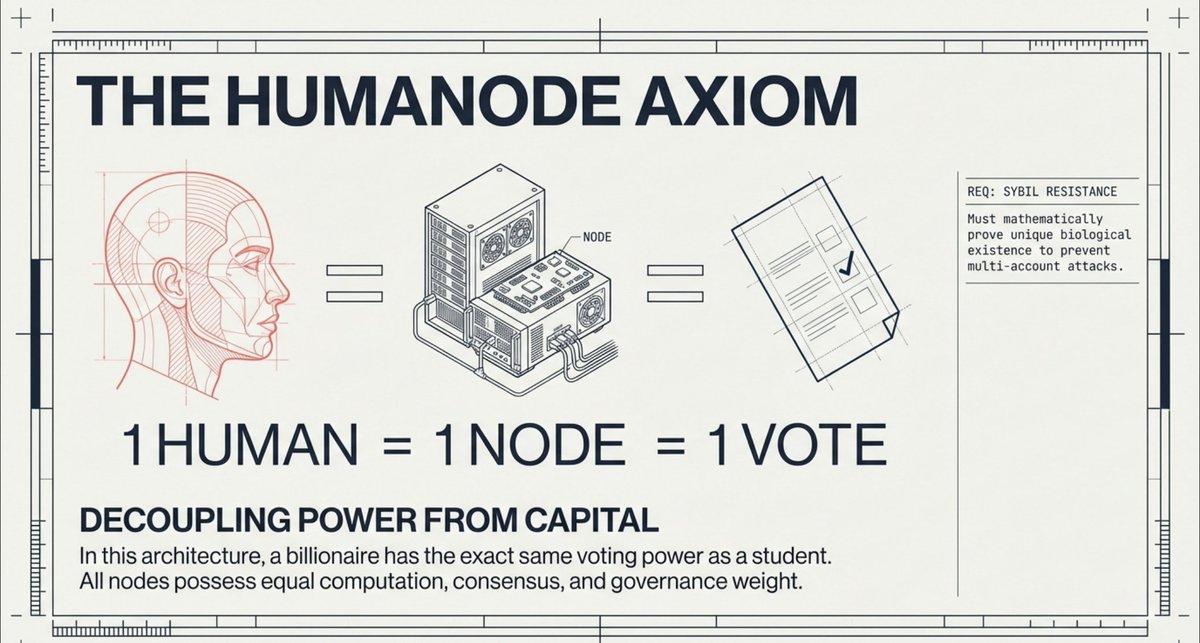
3/ The Humanode solution: One person, one node. By using private biometrics, they ensure that unique human identity, not token wealth, is the foundation of the network.
Victor Vernissage tweet media
English
1
2
6
64
Constantin Poiana retuiteado
Victor Vernissage
Victor Vernissage@tech_mingler·
2/ The problem: In Proof-of-Stake, capital is the only decisive factor. Small groups in private chats often decide the fate of "decentralized" treasuries. This mimics the traditional banking systems crypto was meant to replace.
Victor Vernissage tweet media
English
1
2
7
71
Humanode
Humanode@humanode_io·
This is exactly the problem Humanode DAO Vortex is designed around. Governance anchored to one human = one vote. Coordination happens through chambers, scoped mandates, and contribution-based reputation instead of everyone voting on everything all the time. DAO that can handle subjective decisions, long-term maintenance, and capture resistance without burning people out or handing power to whales. Vortex mockups show the direction: uniqueness-rooted voting, explicit proposal flow, and role-based decision surfaces. …vortex-experimental-mockups.pages.dev/app/chambers Governance as infrastructure, not a popularity contest.
English
2
1
12
772
vitalik.eth
vitalik.eth@VitalikButerin·
We need more DAOs - but different and better DAOs. The original drive to build Ethereum was heavily inspired by decentralized autonomous organizations: systems of code and rules that lived on decentralized networks that could manage resources and direct activity, more efficiently and more robustly than traditional governments and corporations could. Since then, the concept of DAOs has migrated to essentially referring to a treasury controlled by token holder voting - a design which "works", hence why it got copied so much, but a design which is inefficient, vulnerable to capture, and fails utterly at the goal of mitigating the weaknesses of human politics. As a result, many have become cynical about DAOs. But we need DAOs. * We need DAOs to create better oracles. Today, decentralized stablecoins, prediction markets, and other basic building blocks of defi are built on oracle designs that we are not satisfied with. If the oracle is token based, whales can manipulate the answer on a subjective issue and it becomes difficult to counteract them. Fundamentally, a token-based oracle cannot have a cost of attack higher than its market cap, which in turn means it cannot secure assets without extracting rent higher than the discount rate. And if the oracle uses human curation, then it's not very decentralized. The problem here is not greed. The problem is that we have bad oracle designs, we need better ones, and bootstrapping them is not just a technical problem but also a social problem. * We need DAOs for onchain dispute resolution, a necessary component of many types of more advanced smart contract use cases (eg. insurance). This is the same type of problem as price oracles, but even more subjective, and so even harder to get right. * We need DAOs to maintain lists. This includes: lists of applications known to be secure or not scams, lists of canonical interfaces, lists of token contract addresses, and much more. * We need DAOs to get projects off the ground quickly. If you have a group of people, who all want something done and are willing to contribute some funds (perhaps in exchange for benefits), then how do you manage this, especially if the task is too short-duration for legal entities to be worth it? * We need DAOs to do long-term project maintenance. If the original team of a project disappears, how can a community keep going, and how can new people coming in get the funding they need? One framework that I use to analyze this is "convex vs concave" from vitalik.eth.limo/general/2020/1… . If the DAO is solving a concave problem, then it is in an environment where, if faced with two possible courses of action, a compromise is better than a coin flip. Hence, you want systems that maximize robustness by averaging (or rather, medianing) in input from many sources, and protect against capture and financial attacks. If the DAO is solving a convex problem, then you want the ability to make decisive choices and follow through on them. In this case, leaders can be good, and the job of the decentralized process should be to keep the leaders in check. For all of this to work, we need to solve two problems: privacy, and decision fatigue. Without privacy, governance becomes a social game (see vitalik.eth.limo/general/2025/0… ). And if people have to make decisions every week, for the first month you see excited participation, but over time willingness to participate, and even to stay informed, declines. I see modern technology as opening the door to a renaissance here. Specifically: * ZK (and in some cases MPC/FHE, though these should be used only when ZK along cannot solve the problem) for privacy * AI to solve decision fatigue * Consensus-finding communication tools (like pol.is, but going further) AI must be used carefully: we must *not* put full-size deepseek (or worse, GPT 5.2) in charge of a DAO and call it a day. Rather, AI must be put in thoughtfully, as something that scales and enhances human intention and judgement, rather than replacing it. This could be done at DAO level (eg. see how deepfunding.org works), or at individual level (user-controlled local LLMs that vote on their behalf). It is important to think about the "DAO stack" as also including the communication layer, hence the need for forums and platforms specially designed for the purpose. A multisig plus well-designed consensus-finding tools can easily beat idealized collusion-resistant quadratic funding plus crypto twitter. But in all cases, we need new designs. Projects that need new oracles and want to build their own should see that as 50% of their job, not 10%. Projects working on new governance designs should build with ZK and AI in mind, and they should treat the communication layer as 50% of their job, not 10%. This is how we can ensure the decentralization and robustness of the Ethereum base layer also applies to the world that gets built on top.
English
815
535
3.3K
382.3K
Constantin Poiana retuiteado
Dogs of Elon
Dogs of Elon@dogsofelon·
Happy New Year!
English
5
2
11
222
Constantin Poiana retuiteado
Humanode
Humanode@humanode_io·
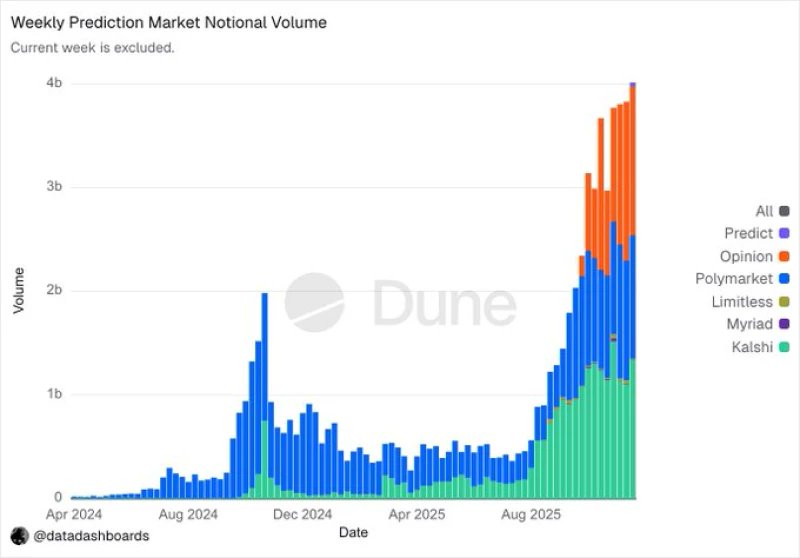
Prediction Markets Are Exploding, but There's a Hidden Flaw. Over the past year, prediction markets have skyrocketed. Monthly volumes surged from under $100M in early 2024 to over $13B by late 2025. Platforms like @Kalshi and @Polymarket now handle billions in trades monthly. Big players are jumping in: Coinbase integrated them, and ICE showed multi-billion-dollar interest. It's mainstream now. But here's the problem: Markets are "deciding" outcomes way too fast, before reality catches up. • Prices converge early. • Liquidity floods in instantly. • Confidence locks in without fresh info. It looks efficient... but it's not. Under the hood? Cheap duplication is warping everything. The Sybil Issue Explained (Like Fake Voters in an Election): When accounts aren't tied to real people, one actor can multiply their influence cheaply. Early prices get anchored by bots or coordinated accounts. On-chain data from Polymarket shows ~25% of activity with signs of artificial behavior. Bots have extracted tens of millions in arbitrage; it's real and operational. Why does this kill markets? Prediction markets thrive on independent human beliefs. Duplicated voices turn aggregation into amplification. Real users bail, confidence drifts from facts, and markets stop evolving. Decentralization doesn't solve it alone; wallets are just accounts, not people. Transparency can even help Sybils coordinate. The Simple Fix: Make Influence Costly Again Don't tweak mechanics like pricing or UIs. Instead, anchor participation to unique humans via Proof-of-Personhood (PoP). • No KYC or identity reveal. • Just enforces "one participant, one voice." • Platforms like Humanode provide infrastructure-level Sybil resistance. Result? Slower, more real convergence. Fake consensus gets expensive. Markets learn at reality's pace. Prediction markets don't fail because people are wrong. They fail when we can't tell how many people are actually speaking. Fix that, and they're game-changers again. What do you think? Could PoP save prediction markets, or is there a better way? Drop your takes below!
Humanode tweet mediaHumanode tweet media
English
4
12
42
1.6K
Constantin Poiana retuiteado
dotmoovs
dotmoovs@dotmoovs·
Merry Christmas, MOOVers! ✨🎄 This year, we’re grateful for an unstoppable community building at the intersection of sports, AI & Web3. 🚀 Enjoy the holidays and recharge your energy... Because we have more MOOVment coming 👀⚡️
dotmoovs tweet media
English
0
6
18
534
FINNT
FINNT@Traderfinn0·
I’m buying into ALL the memecoins I see Shill me
English
204
7
116
10.1K
Constantin Poiana retuiteado
Humanode
Humanode@humanode_io·
SLAVES BY TRAINING: The Unacknowledged Shackles of the Modern Economy & Crypto Market Slavery is historically recognized as one of the oldest methods for generating "big money" by removing workers, using fear and control, providing minimal sustenance, and stripping identity to ensure low pay and high profit. The transatlantic slave trade, which forcibly transported over 12.5 million Africans, created immense wealth for Europe and America, simultaneously establishing fabricated racial hierarchies that continue to fuel pain, suffering, and societal troubles today. The Pervasiveness of Modern Physical Slavery Although many say slavery was abolished, it is believed that over 50 million people are enslaved globally right now. These individuals tragically support the "modern global economy" by producing common consumer items like electronics, clothing, coffee, and chocolate, or by constructing buildings and roads. Today, physical chains are often replaced by financial and psychological entrapment, targeting those born into poverty with promises of a better life. Entrapment begins when a person borrows money from a future employer to travel to their destination. Upon arrival, their documentation is confiscated, they are bound by contracts requiring years of "pay back," they receive less than promised pay, are abused, overworked, and treated as a lower class of human being. The Unacknowledged Modern Slavery of the Consumer Modern slavery doesn't stop with those who physically manufacture products; the marketing that promotes those products is also designed to enslave consumers. Marketing trains us on what we “need” to consume, when, how much, why, and where to purchase. Advertisements use sophisticated psychological controls that are frighteningly similar to how slaves are "trained". This system cultivates an "artificial desire" by projecting an individual's worth and social status through what they "don't have". We are bombarded with conflicting directives: if you are skinny, gain weight; if you are large, get skinny; stop eating X, eat Y, wait, no, eat Z. The underlying psychological ploy is that if you are not "in" or "in sync" with the current trend, you are not worth being around, compelling you to open your wallet and “buy” your way into the norm. We are conditioned to believe our value is determined by how closely we align with the current image projected by corporations. Just like the chains and shackles of the past, we are entrapped by the fear that we may not be accepted by others or by the “current social norm”. The Illusion of Freedom in Crypto The internet and crypto were originally intended to break free of physical limitations and traditional financial control. Crypto was created for decentralization, intending for everyone to be a valued participant. Yet, the current truth is that crypto has become centralized. The “masters” of the traditional financial market now control most chains, using their money and influence to shape the market and bind common investors through rules and regulations. A majority of the market has been "trained" to jump through pre-prepared hoops, seeking instant gratification and expecting the "big boys" to set the rules and provide stability. Those participating in the crypto market often show signs of being “slaves in training,” even if not physically enslaved. Breaking Free Requires Conscious Effort History demonstrates that breaking free of the shackles of slavery requires a conscious effort. The path to a better future will not simply be “airdropped”. An option exists to break free of ruling forces that exploit users: the vision that shaped Humanode emphasizes true decentralization by granting each person equal voting power and an equal share of rewards. This path is an uphill battle against the "market norm" and the demand for instant gratification. However, by putting trust in humankind’s diversity and uniqueness, we can choose not to be ruled by those who have held power for generations or earned wealth through exploitation. We must take a step back, look around, ask questions, and converse with those who may be different to find the spark of truth. That conscious effort, requiring people who share the same vision to work together, is the first step needed to break free of our shackles. Why wait for the overwhelming pain and suffering to realize you have a choice?
Humanode tweet media
English
2
8
36
931
Constantin Poiana retuiteado
xAlex
xAlex@alexd1a·
Hello everybody!! 🚨 I have canceled my check mark since there is no value in it and Elon is on his quest to divide the EU. Waiting for the good Chinese cars to hit the european market to also sell my two teslas 😅😂 Let’s see if this post gets some engagement without it.
English
9
1
58
2K
Altcoin Daily
Altcoin Daily@AltcoinDaily·
Deleting in 24 hrs, whoever Iikes and names an undervalued coin, might just get a surprise DM 👀
English
1.8K
85
2K
150.4K
FINNT
FINNT@Traderfinn0·
What’s the next #memecoin to explode?👇
English
206
19
93
10.9K
Constantin Poiana retuiteado
Eclypse - Launch Without Coding on Ethereum
Eclypse Elaborates 🌑Weekly roundup Another solid week for Eclypse. Steady progress and things are really starting to come together! We’ve been working on the referral dashboard, and it’s looking clean. You’ll be able to track profits, see your unique link, and check which wallets used it. Simple, transparent, and built to help you earn while growing the Eclypse ecosystem 🪐 We also dropped a visual showing the full fee breakdown covering platform fees, sustainability, and creation rewards so developers can actually earn more as their projects grow 🌙 The winners of the refer-a-friend contest have been announced also in our telegram community: This week, we’re integrating the referral system and implementing the fee structure right into the dashboard🚀
Eclypse - Launch Without Coding on Ethereum tweet media
English
4
5
17
468
Constantin Poiana retuiteado
dotmoovs
dotmoovs@dotmoovs·
Most Web3 games are pay-to-win Dotmoovs is different Your skill = your value 🔗 dotmoovs.com
dotmoovs tweet media
English
5
10
20
1.3K
Constantin Poiana retuiteado
EverETH
EverETH@EverETHofficial·
Trick or treat? 🎃
EverETH tweet media
English
3
3
24
609
Constantin Poiana retuiteado
EverETH
EverETH@EverETHofficial·
Meet Omnia — your gateway to 30+ chains. Bridge assets across Bitcoin, Solana, Ethereum, and more — powered by leading bridge and routing providers, all in one dApp. omnia.evereth.net
English
4
5
23
604
Constantin Poiana retuiteado
Humanode
Humanode@humanode_io·
If a chain works as a business - it will never be decentralized.
English
0
5
30
950
Constantin Poiana retuiteado
Humanode
Humanode@humanode_io·
AI agents are starting to blend into the web. They post, trade, bridge funds, join communities, and look just like us. The question is shifting from “what’s real?” to “who’s actually there?” That is why we started this series: Anti-Sybil Approaches. To study how different teams are trying to make sure onchain activity comes from real humans instead of scripts, farms, or agents. We covered Proof of Humanity and Civic. Now we’re looking at @Humanityprot and its approach to keep participation human without revealing personal info. Read the full article: blog.humanode.io/exploring-anti…
Humanode tweet media
English
3
12
39
1.1K