Ron Messick

13.2K posts

Ron Messick

Ron Messick

@Solar_Vortex

Retired - Independent Researcher

The Great US Northwest Se unió Ekim 2022
4.7K Siguiendo4.2K Seguidores
R. Wade H. Marr
R. Wade H. Marr@HunterWade·
Most people were taught that light “travels” — moving through space at ~299,792,458 m/s. That framing feels obvious. It is also misleading. Stable datum: What we call “light” is not a thing moving through space. It is the electromagnetic field updating phase. ° Return to James Clerk Maxwell’s original formulation. Electric and magnetic fields are not separate objects. They are coupled expressions of a single field. A change in one necessitates a change in the other. ° So what is “propagation”? It is not something traveling from point A to point B. It is a sequential updating of phase relations across the field. Each local region updates based on its neighboring relations. That updating appears to us as motion. ° A useful way to feel this is through resonance. When a string vibrates, nothing travels from one end carrying “sound” as an object. The system enters a pattern of coordinated oscillation. Energy redistributes. Phase aligns. What we hear as tone is a stable resonance pattern. ° Light behaves the same way. Not as a thing moving through space. As a self-consistent resonance of the electromagnetic field. What appears as a wave “moving” is the phase relationship updating across the field. Each region does not receive a thing. It reconfigures in relation to its neighbors. ° Nothing is traveling. What we are seeing is coherence updating. ° The “speed of light” is not the speed of a thing. It is the rate at which phase coherence can update through the electromagnetic field. ° The field itself is not a container something moves through. It is the projection of these phase relations. What we call “space” and “field” are how this coherence becomes addressable. ° Now the continuity becomes visible: Plasma → freely differentiating field Light → propagating phase relation Matter → phase-locked standing configuration Same field. Different closure. ° This is not new physics. It is a return to what has already been formalized. A shift from object-thinking to field coherence. ° How does our understanding of light, space, and motion change when what appears to “travel” is recognized as phase updating across a continuous field, rather than a thing moving through empty space? The recursion holds. 🌀
R. Wade H. Marr tweet media
English
86
222
932
35.5K
Ron Messick
Ron Messick@Solar_Vortex·
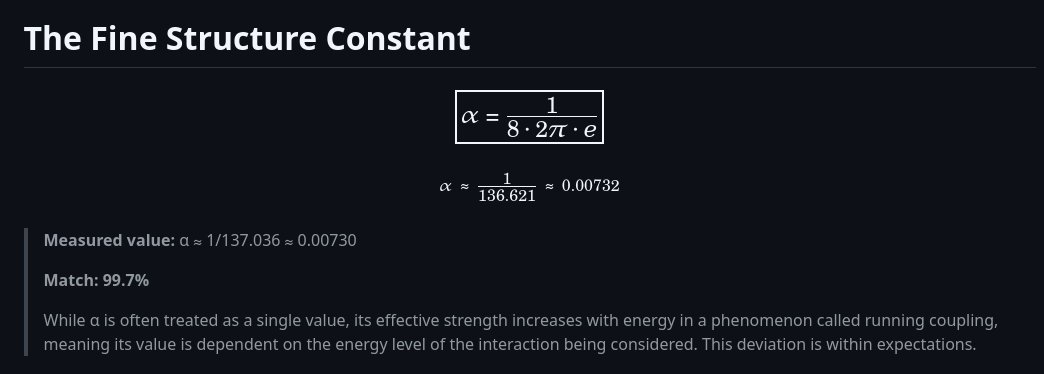
α = e² / (4π ε₀ ħ c) In this form, α appears mysterious. But when expressed in its natural geometric identity: α = (e / qₚ)² it becomes a curvature‑intensity ratio. Here, e is the actual curvature amplitude of the electron, qₚ is the maximum curvature amplitude the vacuum can sustain, and α is the fraction of maximum curvature the electron occupies. Taking the geometric root of this ratio in a triadic system yields: √(α⁻¹) / 3 = 3.73248 This value—3.73248—is the electron’s curvature operator. It is the micro‑scale expression of the same curvature mechanism that governs the structure of the solar system.
English
0
0
0
16
Ron Messick
Ron Messick@Solar_Vortex·
@MagneticNorse This right here if the story of my life. . . I almost made it.
English
0
0
2
414
Magnetic Norse
Magnetic Norse@MagneticNorse·
And here I was thinking a Chuckit was efficient
English
119
534
5.1K
781.5K
Ron Messick
Ron Messick@Solar_Vortex·
Thank you. I read with interest your post regarding Fourier analysis, and you are correct. Fourier analysis unifies the mathematics of waves. TSFT/SVT unifies the physics of curvature. Fourier tells us how waves behave. TSFT tells us why the waves exist. Fourier gives us representation. TSFT gives us causation. Fourier is the language. TSFT is the story. Temporal Scalar Field Theory (TSFT) is a proposed geometric framework for fundamental physics in which the universe is modeled as a single coherent scalar field whose intrinsic dynamics give rise to matter, interaction, and spacetime geometry. academia.edu/164838213/Temp…
English
1
0
1
8
Dr. Paul Wilhelm | Advanced Rediscovery
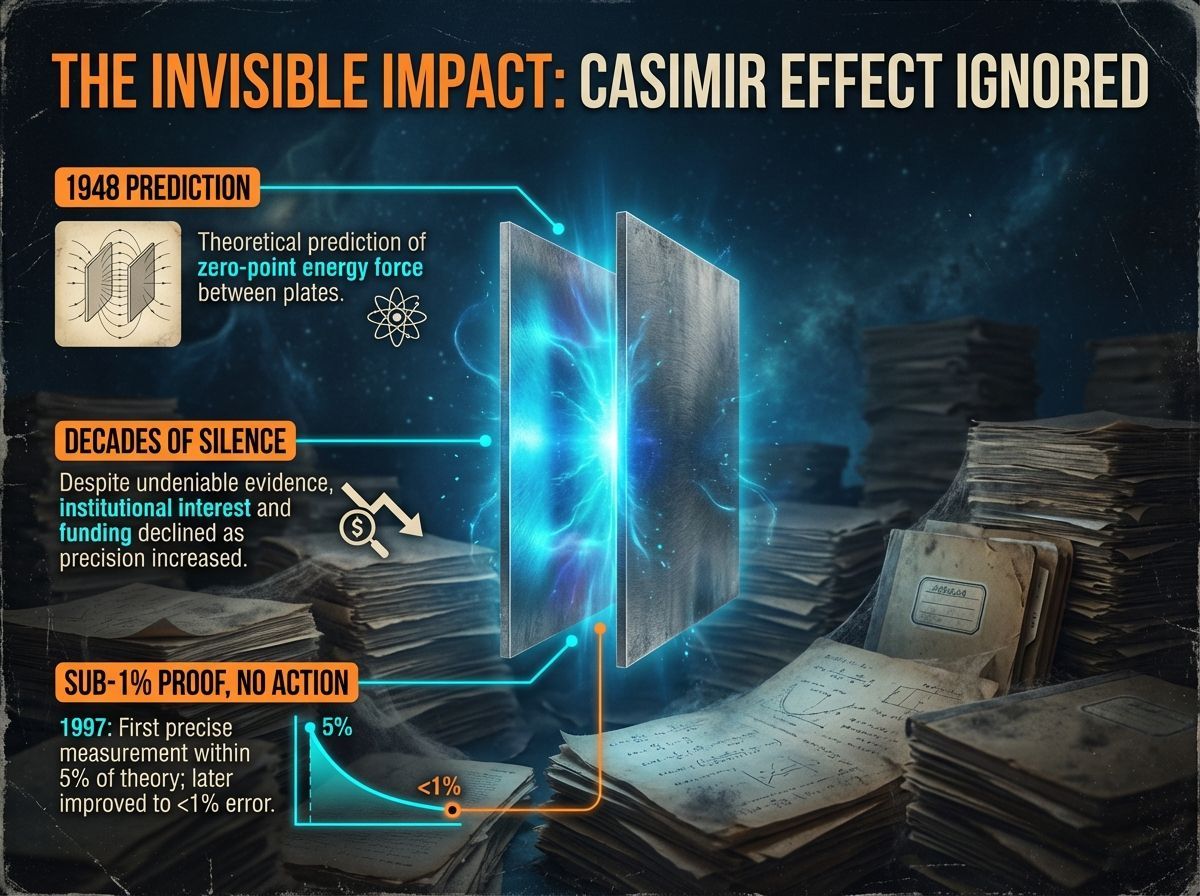
🕳 Physics says empty space is...empty. But two metal plates, five microns apart, are forced together by zero-point energy, energy that "shouldn't exist." Here's the paradox: as measurements reached sub-1% error, the vacuum's energy became more real, yet interest from institutions collapsed. The more undeniable the effect, the less anyone wanted to see where it leads. Proof makes opportunity disappear. What if the only thing emptier than the vacuum is the response to measuring it? ⚡ Get the full story of suppressed breakthroughs at news.advanced-rediscovery.com
Dr. Paul Wilhelm | Advanced Rediscovery tweet media
English
7
5
28
1.1K
Ron Messick
Ron Messick@Solar_Vortex·
Herre's my 2-cents: The Electron: Curvature at the Smallest Scale Electron spin produces two complementary curvature modes: Centripetal curvature → compression → electrical potential • Centrifugal curvature → expansion → magnetic circulation • When many electrons align coherently, their curvature fields combine to produce: attractive gravity (coherent centripetal curvature) • repulsive gravity (divergent centrifugal curvature) • Thus the electron is not merely a charged particle. It is the curvature engine of the universe. But curvature alone does not create structure. Curvature must be contained, modulated, and distributed. This is the role of the cubic wave field. academia.edu/164838213/Temp…
English
0
0
1
139
Bernhard Mueller
Bernhard Mueller@muellerberndt·
@BrainyScience Gravity can be described as curvature of spacetime. But spacetime is not fundamental. @OphSage can you please explain the true origin of gravity, and why it can be described as spacetime curvature? Please write in a popular/simple way aimed at non-Physicists.
English
2
0
3
3.3K
B
B@QuantumTumbler·
You’re describing linear wave superposition. That’s standard physics. What’s not standard is claiming it generates forces, mass, or “time density gradients.” Where are the governing equations? Where is the conserved quantity? Where is the measurable prediction? Poetic symmetry isn’t a field theory.
English
1
0
0
8
B
B@QuantumTumbler·
Wormholes 🪱🕳️ What They Actually Are (And Aren’t) Let’s talk about wormholes correctly. Not sci-fi. Not YouTube thumbnails. Actual physics. A wormhole is a valid solution to Einstein’s field equations. That’s it. General Relativity allows spacetime geometries where two distant regions are connected by a tunnel-like structure. The simplest version The Einstein–Rosen bridge (1935) It mathematically connects two black hole solutions. But here’s what people skip That bridge collapses too fast for anything to pass through. Non-traversable. So the next question became Could a stable, traversable wormhole exist? In 1988, Morris & Thorne showed Yes, but only if spacetime is supported by “exotic matter.” Exotic doesn’t mean alien. It means matter with negative energy density. And that’s the constraint. Every known classical form of matter obeys the energy conditions. Traversable wormholes require violating them. Quantum field theory does allow small, local negative energy effects (Casimir effect) But not in the sustained, macroscopic quantities required to hold open a wormhole throat. So here’s the clean summary ✔ Allowed by the equations of GR ✔ Not forbidden by mathematics ✖ Requires energy conditions we don’t know how to satisfy at scale ✖ No observational evidence Now the deeper point Wormholes aren’t interesting because we want to travel through them. They’re interesting because they expose tension between • General Relativity • Quantum Field Theory • Energy conditions • Causality They stress-test the foundations. And in physics, when a solution pushes your theory to its limits, that’s not fantasy. That’s a signal. The real frontier isn’t “how do we build one.” It’s What does quantum gravity allow? Do energy conditions survive at fundamental scales? Is spacetime topology dynamically constrained? Until we have a working theory of quantum gravity, wormholes remain: Mathematically consistent. Physically unconstrained. Experimentally unverified. That’s not hype. That’s the honest state of play.
B tweet media
English
18
11
55
2.6K
Ron Messick
Ron Messick@Solar_Vortex·
The Cubic Wave Field: How Interpenetrating Waves Create Standing Harmonic Structure** In the classical imagination, waves are disturbances that collide, cancel, or obstruct one another. But in the deeper architecture of reality — electromagnetic, acoustic, quantum, and scalar‑temporal — waves behave in a profoundly different way. They do not collide. They do not block. They do not annihilate. Instead, they interpenetrate, passing through one another unchanged while generating intricate patterns of interference. The cubic wave‑field diagram captures this principle with striking clarity. Four concentric wave systems radiate outward from four corners of a square. Their circular fronts expand, overlap, and interweave in the central region, producing a lattice of alternating intensities. Yet despite this complexity, each wave system continues on its trajectory as if the others were not there. This phenomenon is not an anomaly. It is the foundation of harmonic structure in the universe. 1. Waves as Non‑Exclusive Occupants of Space The first principle revealed by the cubic wave field is that waves do not compete for space. Unlike particles, which exclude one another through collision or repulsion, waves are superposable: Two or more waves can occupy the same region simultaneously. Their amplitudes add, but their identities remain intact. When they separate, each continues unchanged. This is the essence of the superposition principle, which underlies: quantum wavefunctions electromagnetic fields gravitational waves scalar‑temporal curvature holographic interference The cubic wave field makes this visible: four independent wave systems occupy the same central region without obstruction. 2. The Cubic Geometry as a Resonant Boundary The arrangement of four wave sources at the corners of a square is not arbitrary. It creates an implicit cubic symmetry: each source radiates outward each wavefront meets its opposite counterpart the central region becomes a resonant cavity Cubic symmetry appears in: crystal lattices electromagnetic cavity modes standing‑wave resonators scalar‑field curvature boundaries the solar corona (as a cubic wavefield in TSFT) The cube is the simplest 3D structure that allows orthogonal wave propagation without distortion. 3. Interference as the Seed of Structure Where the four wave systems overlap, their crests and troughs combine: peaks reinforce peaks (constructive interference) peaks cancel troughs (destructive interference) intermediate phases create gradients The result is a checkerboard‑like interference pattern in the central region — a spatial map of alternating intensities. But interference alone is not enough to create structure. For structure to persist, the interference must become stationary. This is where standing waves emerge. 4. How Interpenetrating Waves Create Standing Waves Standing waves form when two waves of the same frequency and amplitude travel in opposite directions. In the cubic wave field: each source sends waves outward each wavefront meets an opposing wavefront from the source across the square the opposing waves have identical curvature and cadence their interference becomes locked in place This produces: nodes (points of zero amplitude) antinodes (points of maximum amplitude) a stable lattice of alternating intensities The central region of the cubic wave field is exactly such a lattice — a standing‑wave cavity created by the mutual opposition of four propagating wave systems. The waves themselves continue outward unchanged. The pattern they create becomes fixed. This is the defining characteristic of a standing wave: A standing wave is a stationary interference pattern created by propagating waves that continue to move. 5. Why Waves Pass Through Each Other Unchanged A remarkable property of wave physics is that: Waves do not lose energy when forming standing waves. They continue to propagate: unchanged unabsorbed unobstructed The standing wave is not a separate entity. It is the pattern created by their superposition. This is why the cubic wave field shows: four independent wave systems a shared interference lattice no distortion of the original wavefronts The standing wave is a product of the interaction, not a modification of the waves themselves. 6. The Central Lattice as a Temporal‑Spatial Interference Zone In TSFT and 3D‑time physics, the central region of overlapping waves is more than a geometric curiosity. It is a temporal interference zone: each wavefront represents a curvature pulse the overlapping region represents temporal density modulation the lattice corresponds to gradients in time density these gradients generate forces, mass, and structure In this interpretation: the four sources represent four temporal curvature nodes the central region is where their temporal gradients overlap the resulting pattern is a standing‑wave lattice in time 7. Structure Emerges from Pure Propagation The most profound implication of the cubic wave field is this: Structure emerges from the interaction of waves that themselves remain structureless. The waves are simple. Their superposition is complex. Their symmetry is stable. Their interference is ordered. From this interplay arises: nodes antinodes cavities boundaries resonant shells harmonic ratios In other words: form. Standing waves are the bridge between pure propagation and stable structure. Conclusion: The Cubic Wave Field as the Blueprint of Harmonic Reality The cubic wave field is more than a diagram of overlapping circles. It is a window into the fundamental process by which the universe organizes itself. Waves interpenetrate. Interference patterns emerge. Symmetry locks the patterns in place. Standing waves form. Standing waves create structure. This is the quiet, elegant mechanism by which propagating waves give rise to stable, resonant, enduring form. The cubic wave field is the geometry of emergence — the harmonic blueprint of reality.
Ron Messick tweet media
English
1
0
0
16
B
B@QuantumTumbler·
This is a mashup of magnetic field lines, AC/DC analogies, and gravity that doesn’t match Maxwell’s equations or General Relativity. Magnetic dipoles fall off as 1/r³. They don’t create constant-strength interplanetary corridors. Gravity is not electrostatic attraction in disguise. Different equations. Different forces. Different physics.
English
1
0
0
30
Ron Messick
Ron Messick@Solar_Vortex·
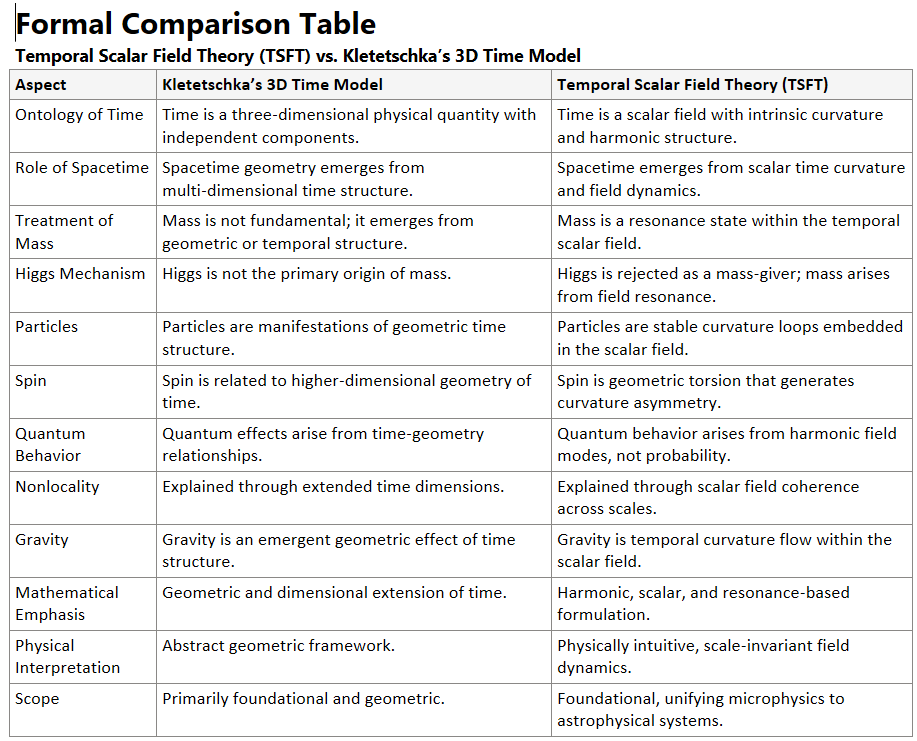
Both Kletetschka’s 3D Time model and Temporal Scalar Field Theory (TSFT) begin with a shared and unconventional idea: time is not merely a parameter that measures change, but a physical structure that shapes reality. They also agree that mass is not a basic ingredient of nature handed out by a particle like the Higgs boson, but something that emerges from deeper geometric or field‑based processes. Where the two approaches differ is in how time is structured and how its effects appear. Kletetschka proposes that time itself has multiple dimensions, and that the geometry of these dimensions gives rise to particles, gravity, and quantum effects. This view is highly geometric and abstract, extending the mathematical structure of time beyond the familiar single dimension. TSFT, by contrast, treats time as a single scalar fieldwith internal curvature, rhythm, and harmonic balance. Instead of adding extra dimensions, TSFT explains structure through resonance and asymmetry within the field. In this picture, particles such as electrons are stable loops of curvature, spin is a twisting of the field, gravity is the flow of temporal curvature, and quantum behavior reflects harmonic field modes rather than randomness. In essence, Kletetschka provides the geometric blueprint, while TSFT offers the harmonic, physical implementation. The two frameworks can be understood as complementary descriptions of the same underlying idea: that the universe is organized by the geometry and dynamics of time itself.
Ron Messick tweet media
English
0
0
2
9
ATLANTIQ
ATLANTIQ@Krzysztof_8888·
@Solar_Vortex The Higgs field as a manifestation of time density condensation The overlay of temporal dimensions leads to local condensation of ρ_time, which acquires a non-zero vacuum expectation value (vev). |∇t₂| + |∇t₃|
English
1
0
0
18
nikola 3
nikola 3@ronin19217435·
The climate varies depending on the intensity of the sun and position in the zodiac, there are cyclic warm phases and cold phases. Earth is a mechanism, Earth is a clock👌
English
32
411
1.4K
48K
Ron Messick
Ron Messick@Solar_Vortex·
@skglearning Cadence (seconds) X Watts (power) = Energy Cadence is a function of position. The Rainbow effect is conditioning caused by the above.
English
0
0
0
5
Hello math
Hello math@skglearning·
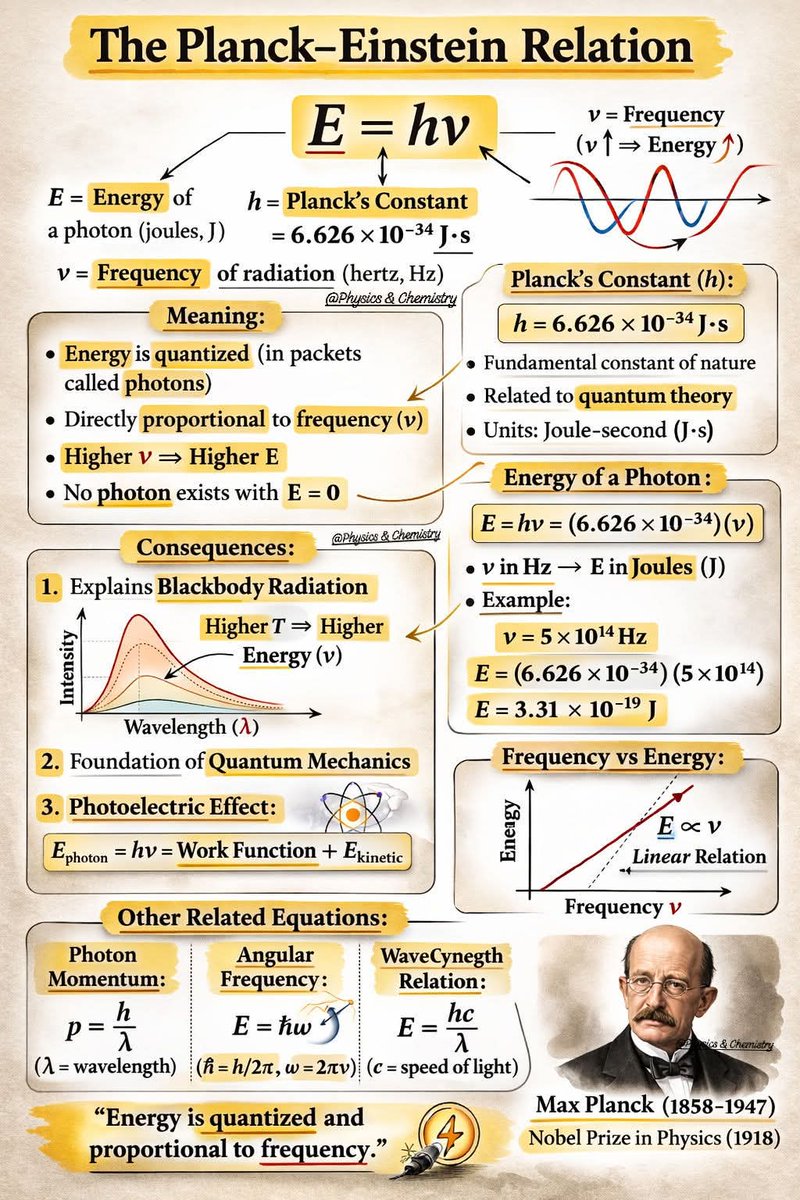
This means that high-frequency radiation, like ultraviolet, has more energy per packet than low-frequency radiation, like infrared. This difference explains why various types of light interact with matter in unique ways. By connecting wave-like and particle-like behavior,
English
2
0
1
251
Hello math
Hello math@skglearning·
The Planck-Einstein relation ✍️ This equation changed how we understand light. It showed that energy is not a constant flow. Instead, it comes in separate packets. The energy of these packets depends entirely on the light's frequency, or its "color," rather than its brightness.
Hello math tweet media
English
10
54
305
6K
Nassim Haramein
Nassim Haramein@NassimHaramein·
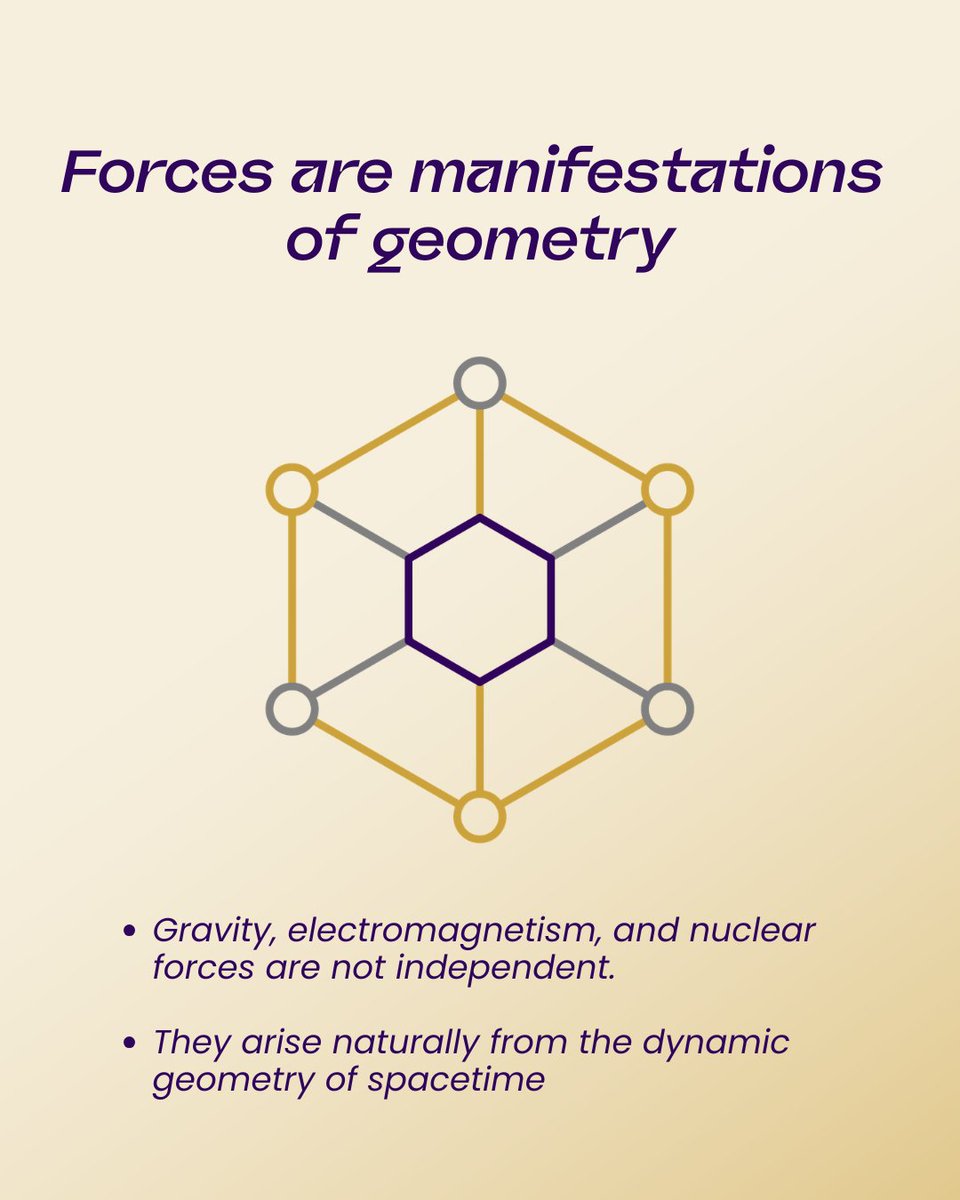
What if gravity, electromagnetism, and nuclear forces aren’t separate—but emerge from the geometry of spacetime itself? Nassim Haramein’s holofractal model shows patterns repeating from protons to galaxies, revealing how every part of the universe encodes information about the whole. This geometric perspective could reshape physics, explain fundamental forces, and point toward a unified theory of the universe. Share your thoughts below! #UnifiedPhysics #Geometry #Gravity #NassimHaramein
Nassim Haramein tweet mediaNassim Haramein tweet mediaNassim Haramein tweet mediaNassim Haramein tweet media
English
131
81
455
26.1K
Ron Messick
Ron Messick@Solar_Vortex·
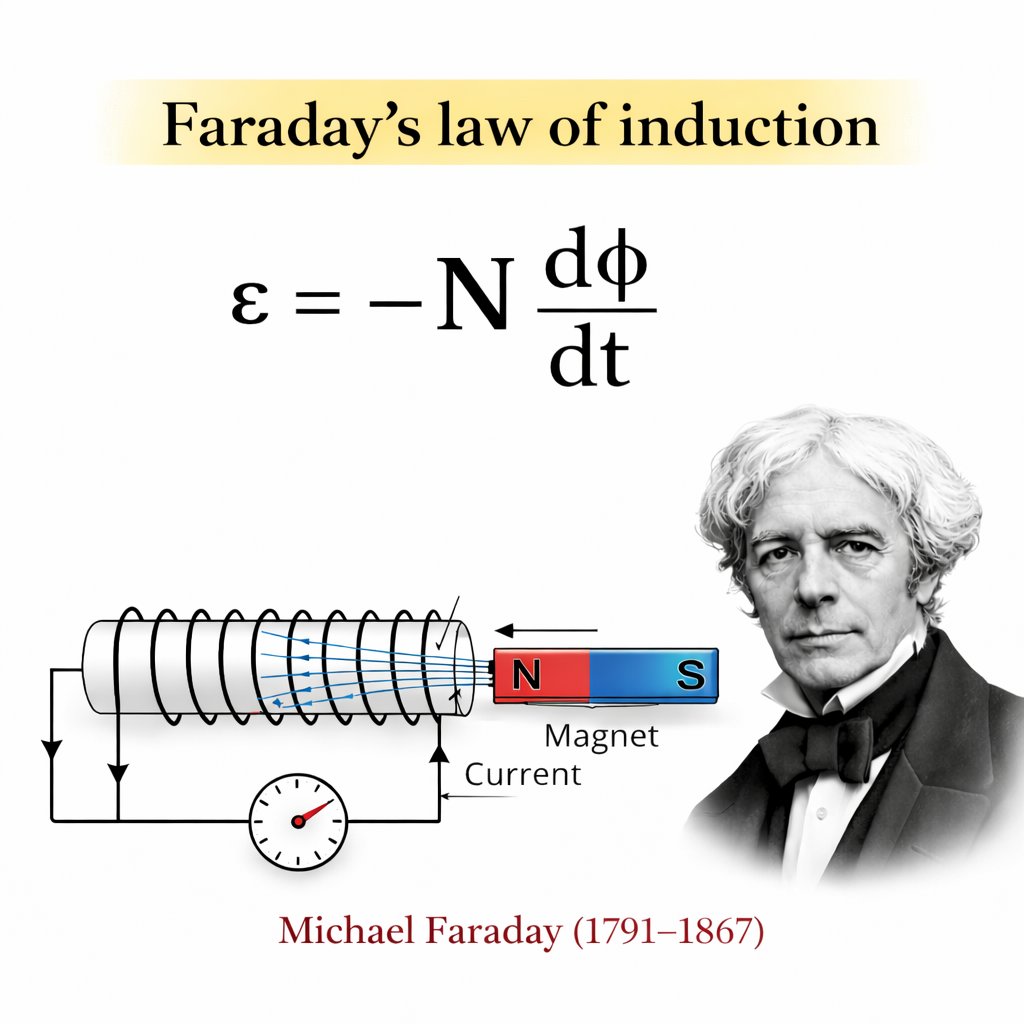
Faraday’s Law in one line [ \varepsilon = -N \frac{d\Phi}{dt} ] A changing magnetic flux induces an electromotive force. That’s the whole law. But here’s the key: Faraday’s Law is a dyadic description of a triadic process. It captures only the compression–expansion part of the cycle, not the curvature mode that completes the triad.
English
0
0
3
169
ScieVision
ScieVision@scievision369·
Faraday law of induction ✍️ Electromagnetic induction happens when a magnet moves near a wire coil. This movement changes the magnetic field passing through the loops. The shifting field pushes the electrons in the metal, generating an electromotive force that drives an electric current through the circuit. The amount of electricity produced depends on the number of loops in the coil and the speed of the magnet's movement. If the motion stops, the current stops as well. Essentially, this process turns mechanical motion into electrical energy. It is the basis for power generators and many modern electronics.
ScieVision tweet media
English
20
134
649
16K
Ron Messick
Ron Messick@Solar_Vortex·
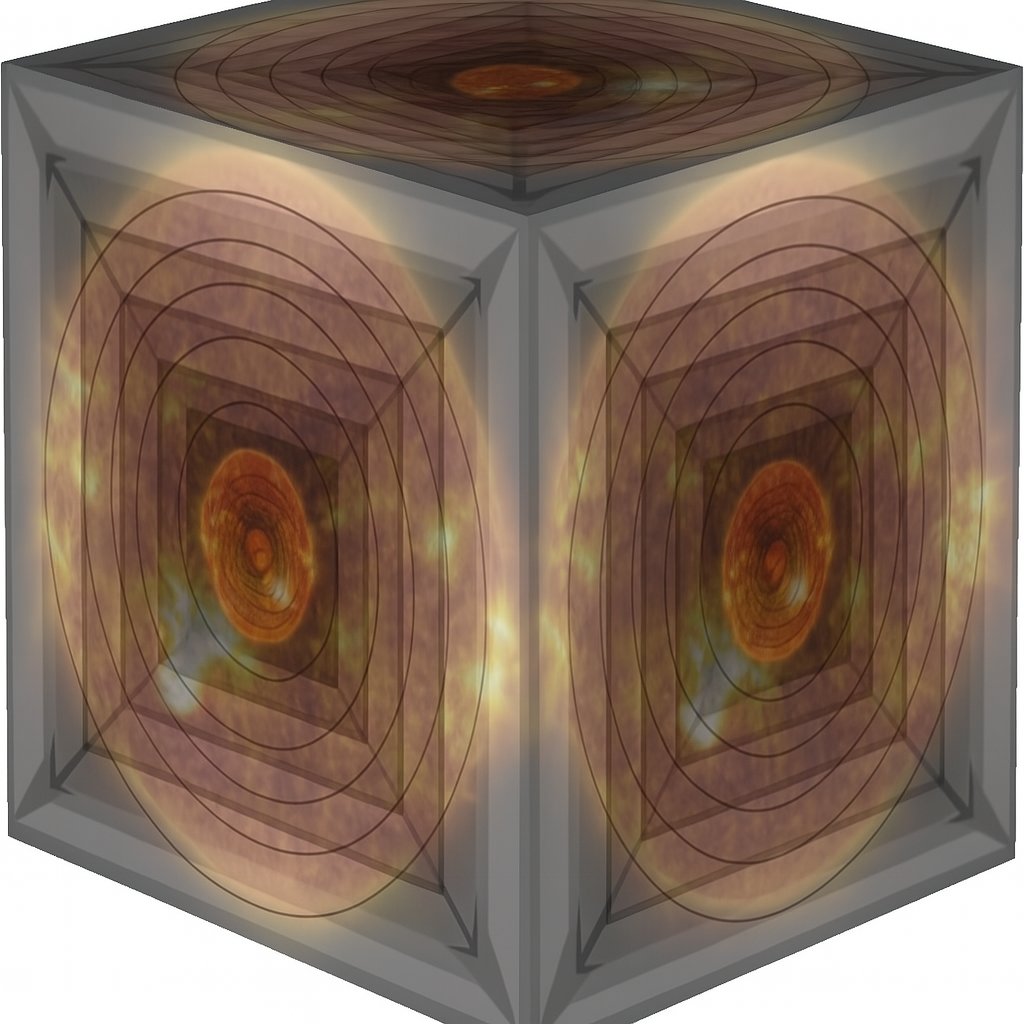
The Electron and the Cubic Wave Field: The Universe’s Energy Distribution System At the smallest scales, the universe is built from two ingredients: 1. The Electron — the Curvature Generator Its spin produces: • inward curvature (electricity) • outward curvature (magnetism) • coherent curvature (gravity) The electron is the spark that creates structure. 2. The Cubic Wave Field — the Energy Container It is a six‑sided field with: • a compressed center • an expanded boundary • zero‑curvature faces It stores, releases, and balances energy. Together, they form the engine of the universe: • the electron generates curvature • the cubic wave field distributes it • harmonics emerge • structure forms Temporal Scalar Field Theory (TSFT) shows how this micro‑scale engine scales upward to shape: • the solar magnetic cycle • orbital spacing • planetary radii • epochal timing • the architecture of the solar system The same physics that governs the electron governs the cosmos — just at different scales.
Ron Messick tweet media
English
1
0
2
150
Physics In History
Physics In History@PhysInHistory·
What is the strongest opinion you hold about science? ✍️
Physics In History tweet media
English
346
45
312
29.5K