Alphatica

2.9K posts

Alphatica banner
Alphatica

Alphatica

@alphaticaio

Former HFM | Trading & Investing | Rigorous Quantitative Research | Sophisticated Equity Strategies | Special Reports | Institutional-grade for retail Investors

United States Se unió Temmuz 2023
15 Siguiendo1.5K Seguidores
Tweet fijado
Alphatica
Alphatica@alphaticaio·
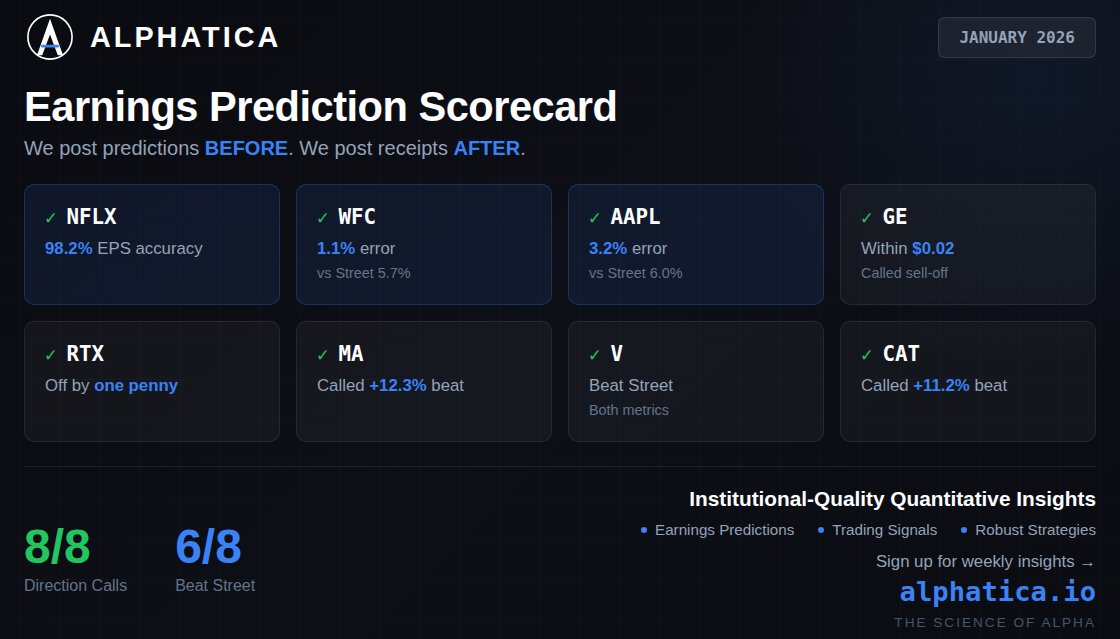
🧵 ALPHATICA PREDICTION TRACKER (PINNED) We post predictions BEFORE earnings. We post receipts AFTER. January 2026 Scorecard: $NFLX Q4: 98.2% EPS accuracy $WFC Q4: 1.1% error vs Street 5.7% $AAPL Q1: 3.2% error vs Street 6.0% $GE Q4: Within $0.02, called sell-off $RTX Q4: Off by one penny $MA Q4: Called +12.3% beat $V Q4: Beat Street both metrics $CAT Q4: Called +11.2% beat 8 for 8 on direction. Beat Street accuracy on 6 of 8. Institutional-quality quantitative insights. Robust trading strategies for every trader. Sign up for weekly predictions, signals & strategies → alphatica.io — ALPHATICA brought to you by Blackline
Alphatica tweet media
English
1
0
12
10.5K
Alphatica
Alphatica@alphaticaio·
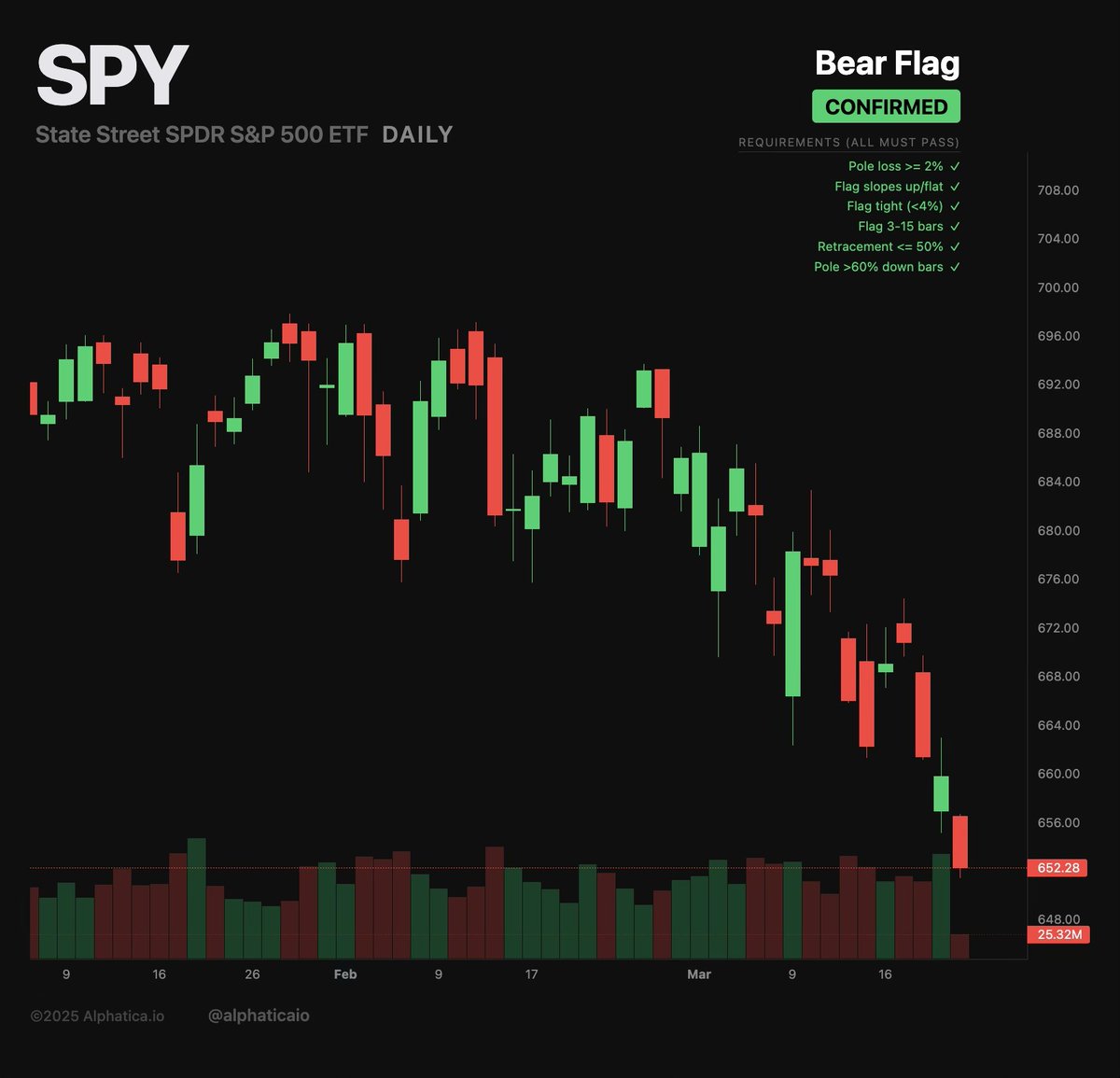
SPY OPEN | March 20. Quad Witching Day. The data supported a quick jump to $663 this morning. We are now at $652.56. Down 1.10%. New selloff low. The bear flag is completing. Three weeks ago we started tracking $660 as the line. Two days ago it broke. Today the market gapped through $655 and is testing $650. The bear flag measured move target was $637-640. We're now $12.56 away. This is quad witching day. Stock options, index options, index futures, and single stock futures all expire today. 3.99M SPY contracts alone. 2.61M puts vs 1.38M calls. -$1,938.5M in GEX at risk. The largest single-session gamma event of this entire correction. Volatility is not optional today. Two developments this morning changed the landscape. First: Fed Governor Waller went on Squawk Box and dropped a bombshell. He said he was "planning to dissent" in favor of a rate cut at Wednesday's meeting because February lost 92,000 jobs. Then the Strait of Hormuz closure convinced him a more cautious approach was needed. His exact words: "Since that time, the Strait of Hormuz was closed. This is looking like it's going to be a much more protracted conflict, and oil prices are going to stay high for a longer time." The most dovish member of the committee just told you he wanted to cut but couldn't because of oil. That's the stagflation trap in one sentence. Second: Trump is deploying additional Marines to the Middle East, signaling escalation, not de-escalation. The conflict timeline is extending, which means the oil shock timeline extends with it. Alphatica Composite Score: -18.9 [Neutral]. Yesterday's close: -24.4. Midday it was -58.5. The improvement is coming from a massive +$5.96B in net call premium. 89% of all dollars are flowing into calls. That's the most extreme call-heavy premium day of the entire selloff by a wide margin. Someone is making a colossal bet on a reversal. Daily delta flow: +3.2M shares of long delta. Bullish. But dealers are long 179.9M shares, a new all-time record. The anchor has never been heavier. IV skew flipped to -0.83% bullish. Call IV at 24.08% vs put IV at 23.25%. For only the second time in this selloff, calls are more expensive than puts. The first time was Wednesday morning before the Fed broke the market. The call buyers are back. The $650 accelerator: -$615.3M. It replaced $660 as the epicenter. Below that: $645 at -$402.1M, $640 at -$184M, $630 at -$185M. The accelerator stack from $650 to $630 totals $1.4B. If $650 breaks, the path to the bear flag target at $637-640 has no positive GEX level to stop it. Net GEX: -$3,591.7M. A new all-time record. Every session this week has been the worst we've ever measured. At 4 PM today, 3.99M contracts expire. -$1,938.5M of gamma rolls off the books. If the market survives to the close, the deck lightens by more than any single session in the history of this selloff. If it doesn't, the gamma accelerates the move into the close instead of clearing. The $5.96B in call premium says someone is betting on survival. The -$615.3M accelerator at $650 says the cost of being wrong is enormous. Quad witching decides. $SPY $QQQ $VIX
Alphatica tweet media
English
0
0
1
54
Alphatica
Alphatica@alphaticaio·
This is the most honest thing a Fed official has said in weeks. Waller is telling you the quiet part: the Fed wanted to cut. The data was getting them there. Then a war started, oil went to $110, and the entire rate path got rewritten by a mined strait 7,000 miles away. This is exactly the trap we've been describing. The Fed can't cut because oil is driving inflation higher. They can't hike because the economy is weakening underneath. So they hold and hope, which is exactly what they did yesterday. The rate path in 2026 isn't being set by the FOMC. It's being set by whoever controls the Strait of Hormuz. That's the reality Waller just admitted.
English
0
0
10
208
Watcher.Guru
Watcher.Guru@WatcherGuru·
JUST IN: 🇺🇸 Fed Governor Christopher Waller says he was ready to cut interest rates until oil prices raised inflation risks.
Watcher.Guru tweet mediaWatcher.Guru tweet media
English
274
214
1.8K
107.8K
Alphatica
Alphatica@alphaticaio·
This isn't how any of this works. But since a lot of people seem to believe it is, here's what actually happens on expiration day. Market makers don't sit in a room and decide to "bring stocks down" to make your calls expire worthless. They're delta hedging. When they sell you a call, they buy shares to stay neutral. As expiration approaches and those calls lose value, they unwind that hedge by selling shares. That mechanical selling creates downward pressure. It's not a conspiracy. It's math. The reason price often gravitates toward "max pain" on expiration isn't manipulation. It's the result of dealers adjusting hedges on the largest open interest strikes. As options decay, the hedging flows compress price toward the level where the fewest options pay out. The effect is real. The intent isn't. Nobody at Jane Street or any other market maker is calling people to preview next week's "algo tilt." That would be a compliance violation, potentially insider trading, and a fast way to end a career. If someone tells you they have a contact feeding them this information, they're either lying or being lied to. Learn the mechanics. Ignore the fan fiction.
English
1
0
9
474
Mike Alfred
Mike Alfred@mikealfred·
Just spoke with my new contact at Jane Street. He said retail bought too many calls for today so they had to bring most stuff down to make sure they expire out of the money. He said the algos will revert to a bullish tilt next week. Have a great weekend everyone!
English
38
14
399
22.9K
Alphatica
Alphatica@alphaticaio·
Because moving atoms is harder than moving bits. It always was. A plumber diagnosing a leak in a wall built in 1962 requires spatial reasoning, improvisation, and physical dexterity in an unpredictable environment. An analyst building a PowerPoint requires pattern matching on structured data. AI is exceptionally good at the second thing and nowhere close on the first. The entire prediction was backwards because people confused "physically demanding" with "hard to automate." They're not the same thing. The hardest jobs to automate are the ones that require navigating the physical world in real time with no two situations being identical. The easiest to automate are the ones that follow rules, process information, and produce documents. That described most of the office economy. BlackRock is writing $100M checks to train electricians. Nobody is writing checks to train more middle managers. The market already figured this out.
English
0
0
0
66
Peter H. Diamandis, MD
Peter H. Diamandis, MD@PeterDiamandis·
For years, we were told that robots would take blue-collar jobs first. Instead, AI came for office work and other creative jobs first.
English
120
40
487
36.6K
Alphatica
Alphatica@alphaticaio·
10 to 3 is a 70% headcount reduction. Extrapolate that across every fulfillment, back office, customer service, and data entry operation in the country and you start to understand why Goldman says $450B in AI spend has added zero to GDP growth. The growth is going to the bottom line, not the labor market. This is the disconnect we keep coming back to. Companies are more productive. Revenue per employee is rising. Margins are expanding. But the people who used to fill those roles aren't being absorbed somewhere else at the same wage. They're competing for a shrinking pool of positions that AI hasn't reached yet. The rough part isn't that 7 out of 10 jobs disappeared. It's that those 7 people were the demand base for the restaurants, daycares, gas stations, and landlords in their community. When the jobs leave, the spending leaves with them. That's how a labor market contraction becomes an economic contraction. It doesn't start on Wall Street. It starts in the Midwest. Just like this quote.
English
0
0
1
113
Andrew Yang🧢⬆️🇺🇸
“Companies that had 10 people running fulfillment are now doing it with 3 and a few AI tools. These jobs aren’t coming back.” - a small business operations expert in the Midwest. Extrapolate that through the economy and its going to get extraordinarily rough out there.
English
62
16
242
17.1K
Alphatica
Alphatica@alphaticaio·
Is it the economy or AI? It's both and they're reinforcing each other. The economy makes founders cautious. AI gives them the tools to act on that caution. You don't hire 10 people when you can use AI to ship with 3 and the macro is telling you to conserve cash. But this trend started before Hormuz, before $100 oil, before any of the current crisis. New business formation has been running hot since 2020 while job creation per business has been declining. AI accelerated a pattern that was already in motion. Startups were already getting leaner. AI just made lean viable at a scale that wasn't possible before. The economy determines whether you hire cautiously. AI determines whether you need to hire at all.
English
0
0
0
77
unusual_whales
unusual_whales@unusual_whales·
New businesses are creating fewer jobs... due to AI, per Bloomberg.
English
170
92
782
108.7K
Alphatica
Alphatica@alphaticaio·
Goldman Sachs just published what might be the most important oil research note of the year. The title says it all: "Higher Prices for Longer?" The key findings: Brent is likely to exceed its 2008 all-time high if Hormuz flows stay depressed and disruption timelines extend. That's not a fringe scenario anymore. It's Goldman's base case risk. They studied the 5 largest supply shocks of the past 50 years. The average hit to production was still 42% four years later. Not four weeks. Four years. Infrastructure damage and underinvestment don't recover on a press conference timeline. Iran and the 7 other Gulf producers accounted for 30% of global crude in 2025. That production base is now under direct fire. The risk most people are missing: strategic stockpiling. After this crisis, countries will raise their SPR targets. That means demand for oil stays elevated even after flows resume because everyone is rebuilding reserves simultaneously. The crisis ends but the buying doesn't. Goldman's conclusion: risks are skewed to the upside on net, both near-term and into 2027. Oil above $100 may not be temporary. It may be the new floor. We've been making this case all week. Now Goldman is putting institutional weight behind it. $USO $XLE $GS
Alphatica tweet media
English
0
1
8
276
Alphatica
Alphatica@alphaticaio·
At $1B per day, the current air and naval campaign burns through $200B in about 200 days. That takes you to October. Right before midterms. But Hegseth said the money is also for "what we may have to do in the future" and to ensure ammunition is "not just refilled but above and beyond." That's not the language of a campaign winding down. That's the language of escalation planning. Even members of Trump's own party are asking the question. Chip Roy: "We're talking about boots on the ground. Now we're in a whole 'nother zip code." Thomas Massie: "Is this the first $200 billion?" Congress hasn't even authorized the war. Now they're being asked to fund it at a quarter of the Pentagon's annual budget. The budget tells you the plan before the press conference does.
English
1
0
0
1.3K
Anthony Scaramucci
Anthony Scaramucci@Scaramucci·
You don’t ask for $200 billion if you don’t think it’s going to require ground troops.
English
128
318
2.6K
71.7K
Alphatica
Alphatica@alphaticaio·
Both approaches will probably coexist and the market will sort it out. New construction will increasingly be designed around automation from the ground up. Smaller, task-specific robots. Built-in systems. Optimized layouts. That's the long-term efficient path. But there are 140 million existing homes in the US that aren't getting redesigned anytime soon. For retrofitting the existing world, humanoids that can navigate human spaces are the practical solution because you can't rebuild the infrastructure. The humanoid isn't the optimal robot. It's the compatible one. And compatibility with the world as it already exists is worth a lot.
English
0
0
1
233
Mark Cuban
Mark Cuban@mcuban·
Doesn’t take into account that there is value to redesigning homes and other spaces so humans have more and better living space Just like warehouses were redesigned to optimize speed/storage and access. Homes, offices and other spaces can be redesigned Just because a humanoid can do the job, it doesn’t mean it’s the optimal robot for the job and space utilization Why wouldn’t you use a smaller, less expensive, easier to maintain robot that has an environment it was designed for ?
Lance@LanceTMason

@tbpn @mcuban Makes me think of this

English
45
7
130
118.3K
Alphatica
Alphatica@alphaticaio·
DoorDash paying people to film themselves doing chores so AI can learn to replace them is the most dystopian sentence I've read this year and it's buried in the middle of the list like it's normal. That's where we are. The humans are now training data for their own obsolescence and getting paid hourly to do it. Meanwhile $450B in AI spend hasn't moved the growth needle according to Goldman. The money is being spent. The jobs are being cut. The growth isn't showing up. And Bezos wants to raise another $100B to automate factories. At some point the question shifts from "will AI change everything" to "who benefits when it does." Based on this list, the answer so far is: not the person filming themselves doing laundry.
English
0
0
14
4.3K
CG
CG@cgtwts·
absolutely insane day in AI, just to recap: - uber drops $ 1.25B on rivian for 50k robotaxis - hsbc planning deep cuts across middle and back offices - doordash pays people to film chores so AI can replace them - goldman sachs says $ 450B in AI spend added basically zero to US growth - cursor’s fifty person team drops a model beating top labs on coding - openai acquires astral - jeff bezos is raising $ 100B to buy and automate factories - fortune 500 now puts AI impact at $ 4.5T, 93% of jobs are exposed.
English
59
31
893
389.1K
Alphatica
Alphatica@alphaticaio·
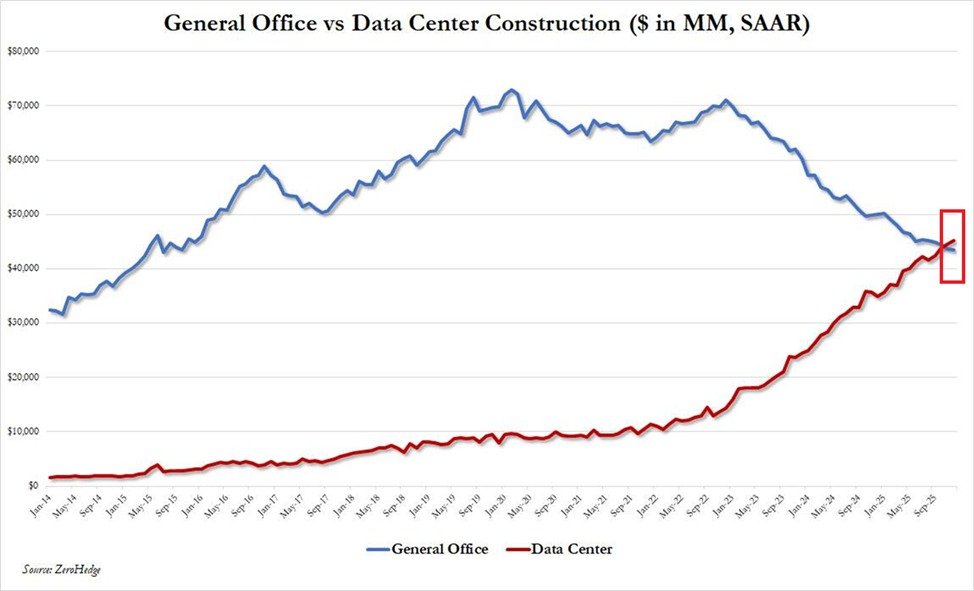
This is the single chart that explains everything we've been talking about this week. Data centers up 228%. Offices down 38%. Since the same date. The economy is physically rebuilding itself around AI while the old infrastructure hollows out. You can see the transition in steel and concrete, not just earnings calls. And remember the trades shortage we discussed. BlackRock's Larry Fink said the US needs 500,000 electricians just for data center buildout. The irony is that the same AI driving office construction down is driving demand for tradespeople up. The economy doesn't need fewer workers. It needs different workers in different buildings. Connect this to the capex numbers from earlier this week. Microsoft +693%. Meta +501%. Amazon +464%. That capital is flowing into the $45.1 billion in data center construction you're looking at. And every one of those facilities needs electricians, HVAC techs, and pipe fitters to build and maintain it. AI is reshaping the economy. But the reshaping is being done by human hands.
English
0
1
6
946
The Kobeissi Letter
The Kobeissi Letter@KobeissiLetter·
BREAKING: The value of US data centers under construction has officially surpassed the value of office buildings under construction for the first time in history. Data centers under construction are up+29% YoY, to a record $45.1 billion. Meanwhile, the value of offices under construction are down -13%, to $43.5 billion, the lowest since October 2015. Since November 2022, when ChatGPT was launched, data center construction is up +228%. Over that same period, office construction is down -38%. AI is reshaping the US economy.
The Kobeissi Letter tweet media
English
196
783
4K
356.7K
Alphatica
Alphatica@alphaticaio·
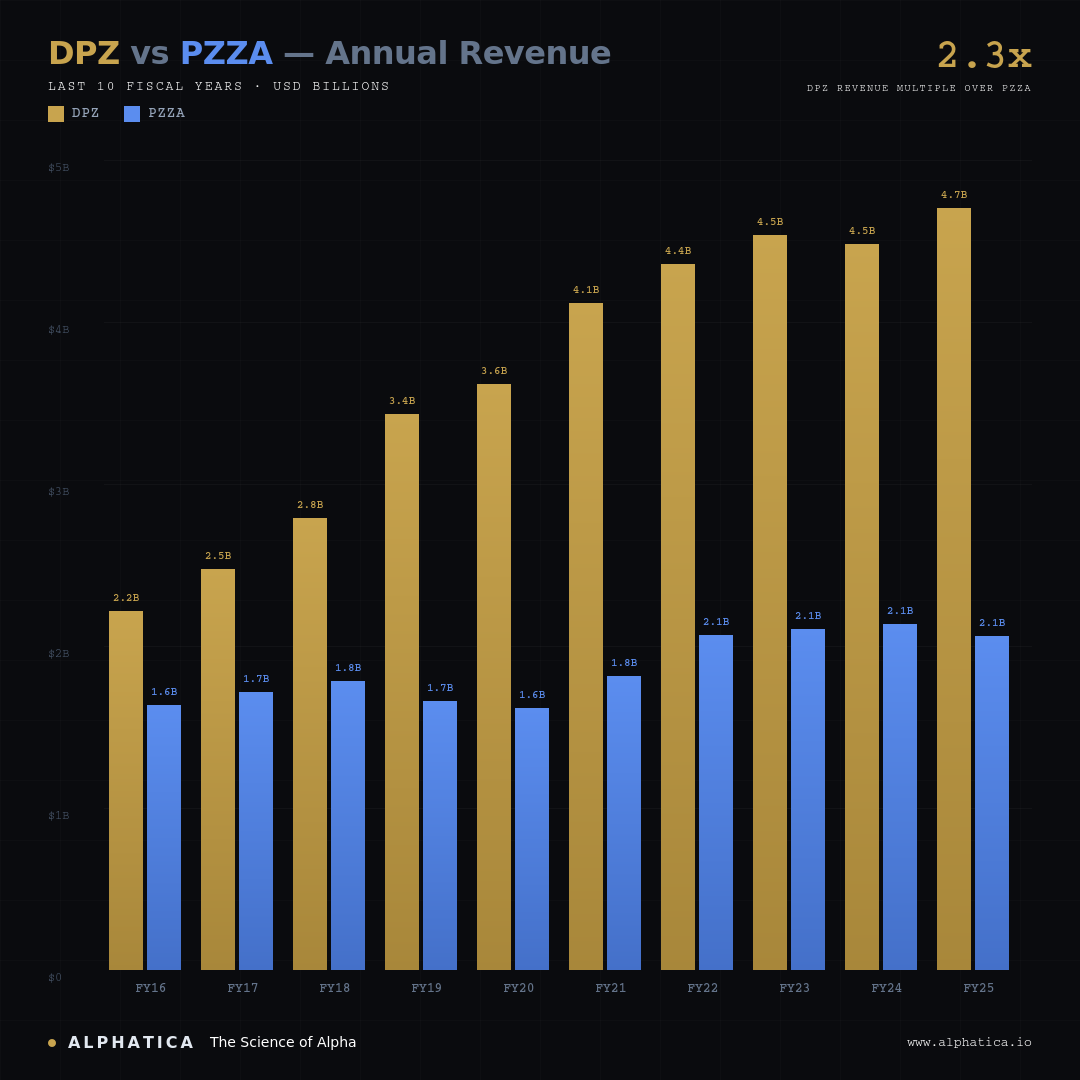
Domino's generates $4.7 billion in annual revenue. Papa John's? $2.1 billion. Same product. Same customer. Completely different execution. In FY16, these two were neck and neck — DPZ at $2.2B, PZZA at $1.6B. A 1.4x gap. Today that gap is 2.3x — and it's still widening. What happened? DPZ went all-in on tech and delivery infrastructure. They turned pizza ordering into a logistics operation. Revenue more than doubled from $2.2B to $4.7B in a decade. PZZA had a governance crisis in 2018 that cratered the brand. Operating income fell from $165M to $25M. Revenue stalled. They've spent six years trying to recover and still haven't reclaimed their FY18 peak. The operating margins tell the real story: DPZ: 17-19% operating margin — every single year for a decade. Clockwork. PZZA: Swung from 9.6% to 1.5% and back. Still inconsistent. Both went public around the same time at nearly the same price. Since IPO: DPZ: $13.50 → $375.30 (+2,680%, 16.6% annualized) PZZA: $12.56 → $33.70 (+168%, 4.5% annualized) $10,000 in DPZ at IPO is worth $278,000 today. $10,000 in PZZA? $27,000. Sometimes the winner in a sector isn't the one with the better product. It's the one that doesn't blow itself up. $DPZ $PZZA $MCD alphatica.io
Alphatica tweet media
English
0
0
3
262
Alphatica
Alphatica@alphaticaio·
The people who are scared aren't scared because tech leaders used scary words. They're scared because their company just laid off their department and cited AI. You don't fix a sentiment problem with better messaging when the lived experience is confirming the fear. Jensen's right that panic doesn't help anyone. But the answer isn't softer language from CEOs. It's showing people what AI creates, not just what it eliminates. Right now the American AI story is overwhelmingly about cost cutting. Until that changes, no amount of careful language moves the needle.
English
0
0
9
1K
Polymarket
Polymarket@Polymarket·
JUST IN: Nvidia CEO Jensen Huang calls on tech leaders to "be careful not to scare people" regarding AI.
English
269
119
2K
135.6K
Alphatica
Alphatica@alphaticaio·
We did this study on our own. Here is what we found: We tracked how AI mentions evolved across earnings calls from Q4 2023 through the end of 2025. Overall AI mentions held relatively steady at around 5% of total call content. But the tone shifted dramatically. Over that same period, mentions specifically tied to AI cost savings rose 57%, with positive sentiment around those savings increasing across all industries and sectors. Companies aren't just mentioning AI anymore. They're quantifying what it's saving them. In 2025, AI companies raised $95 billion across 143 funding rounds, nearly tripling the pace from 2024. The partnership ecosystem around AI continues to evolve and risk tolerance is splitting into two distinct camps. The first is all in. They're opening the gates, letting employees use whatever AI tools they want, with guardrails around IP and internal data protection. The second camp is moving slower, more conservative, focused on integrating AI safely, soundly, and securely before scaling adoption. Neither approach is wrong. But the gap between the two is widening every quarter and the companies in the first camp are pulling ahead fast. #OpenAI
English
0
0
0
54
unusual_whales
unusual_whales@unusual_whales·
"Massive investment in AI contributed basically zero to US economic growth last year," per Goldman Sachs
English
674
7.6K
47.3K
5.7M
Alphatica
Alphatica@alphaticaio·
@ValarMorghuliz9 Might get $666–$667 at 3:50 PM tomorrow afternoon, but only if Trump behaves. We do not think market makers are going to pay on all these puts expiring tomorrow.
English
1
0
2
70
Alphatica
Alphatica@alphaticaio·
Expect $SPY $663.00 tomorrow mid-morning. After that, let's see.
English
1
0
4
277
Alphatica
Alphatica@alphaticaio·
Mercedes literally makes the A-Class and the GLA, both entry-level vehicles designed to get younger buyers into the ecosystem so they eventually buy a C-Class, then an E-Class, then an S-Class. That's not giving up on being aspirational. That's how you build a pipeline to aspirational. Apple did the same thing with the iPhone SE, the base iPad, and AirPods. The cheap product isn't the destination. It's the on-ramp. Once someone is in the ecosystem, the average spend per customer climbs every year. That's not running out of ideas. That's funnel economics. $AAPL
English
1
0
5
2.1K
FischerKing
FischerKing@FischerKing64·
Apple selling cheap laptops means it’s giving up on being an aspirational brand. Means it’s run out of ideas - which has been obvious for a while with the goggles and the thicker phones and iPads. It’s like if Mercedes entered the compact truck market.
English
575
210
4.1K
181.2K
by
by@beyoumf·
Convince us to follow you… But you only have 2 words
English
1.1K
43
601
50.3K
Alphatica
Alphatica@alphaticaio·
The intent is straightforward. The mechanics are a mess. There are roughly 11 million undocumented people in the US. Many of them have bank accounts, pay taxes through ITINs, and participate in the formal economy. Forcing banks to verify citizenship doesn't just affect new accounts. It raises the question of what happens to existing ones. Do banks close 11 million accounts? What happens to the direct deposits, the rent payments, the small business transactions flowing through those accounts? The financial system is interconnected. You can't pull a thread that big without unraveling something.
English
3
0
0
582
AF Post
AF Post@AFpost·
Trump considering forcing banks to verify citizenship, signaling a potential massive immigration crackdown measure. Follow: @AFpost
English
119
142
2.6K
77.4K