Chai Bandlamudi

56 posts

Chai Bandlamudi

Chai Bandlamudi

@chaiband

Assistant Member @MSKPathology | Computational Oncology | Translational Biomarker Discovery | Cancer Genomics | Germline Predisposition to Cancer

New York, NY Se unió Aralık 2012
299 Siguiendo241 Seguidores
Tweet fijado
Chai Bandlamudi
Chai Bandlamudi@chaiband·
Thrilled to share our recent work in @CellCellPress ✨ We study the extent to which tumor suppressor genes in cancer adhere to Knudson's ‘two-hit’ hypothesis, and their clinical implications. 🧵👇 Also a detailed 🧵 by @EdReznik below: @MSKPathology @MSKCancerCenter
Ed Reznik@EdReznik

A culmination of ~5 years of work, today our work on biallelic alterations across tumor suppressor genes is published in @CellCellPress. With Mark Zucker, Maria Perry, and Chai Bandlamudi cell.com/cell/fulltext/…

English
2
10
21
5.4K
Chai Bandlamudi retuiteado
Dennis Gong
Dennis Gong@GongDennis·
Excited to share my analysis of the Cancer Dependency Map! My goal was to systematically identify biomarker - dependency relationships in order to identify new anti-cancer targets and understand how to stratify patients to make those targets clinically useful.
Dennis Gong tweet media
bioRxiv Cancer Bio@biorxiv_cancer

Pan-Cancer Biomarker Analysis from the Cancer Dependency Map: A Blueprint for Precision Oncology biorxiv.org/content/10.110… #biorxiv_cancer

English
7
25
141
46.6K
Chai Bandlamudi retuiteado
Vinod BalachandranMD
Vinod BalachandranMD@TheVinodLab·
1. Tertiary Lymphoid Structures (TLSs) – on demand lymphoid aggregates that assemble in inflamed tissues/cancer to regulate immunity   But how? What molecule triggers? What cells induce?   TODAY in @Nature nature.com/articles/s4158…   Long-term #PDAC survivor PART4 – TLSs   🧵1/25
English
6
62
215
27.5K
Chai Bandlamudi retuiteado
Arvind Narayanan
Arvind Narayanan@random_walker·
Something I've observed in academia but I suspect is true in industry as well: as you become more senior, you'll find that you can be much more productive if you spend all your time being a manager and letting junior people do all the real work. But after a few years of this, you're likely to lose your skill at doing the work yourself, the opportunity to practice that skill, and the gratification of doing so that drew you to your chosen profession in the first place. And you'll probably also get worse at being a manager as you lose touch with the actual work. Avoiding managerdom is hard. You have to give up substantial short-term productivity gains. If you're in academia in a tenure track, you risk not getting tenure by being less productive. And personally I find that switching between thinker mode (deep work with no distractions for a whole day) and manager mode (a thousand quick but urgent tasks) to be highly unpleasant. When I'm in thinker mode, it kills me that people have to wait a day (often a lot more) for a 1-minute response from me that could unblock them on what they're stuck on and save them hours of work. When I'm in manager mode, it kills me that I have all these creative ideas sloshing around in my brain that I'm not able to execute on. So it's extremely tempting to perpetually be in just one mode or the other. When you have a team, not managing them is not an option, but being a pure manager is an option. That makes a constant struggle to carve out time for your own work and not give in to the temptation. Note: I think this is only tangentially related to Founder Mode vs Manager Mode. It's much more related to another Paul Graham essay, Maker's Schedule vs Manager's Schedule. And Deep Work by Cal Newport is very relevant.
English
48
177
1.5K
170.2K
Chai Bandlamudi retuiteado
Maria A Perry
Maria A Perry@MariaAPerry·
So happy to finally share this work! Thank you @AnnaVarghese4 @chaiband @EileenMOReilly @MFBerger1 @nikolausschultz for all of your guidance & insight 🧬 Research Briefing: doi.org/10.1038/s41591…
Chai Bandlamudi@chaiband

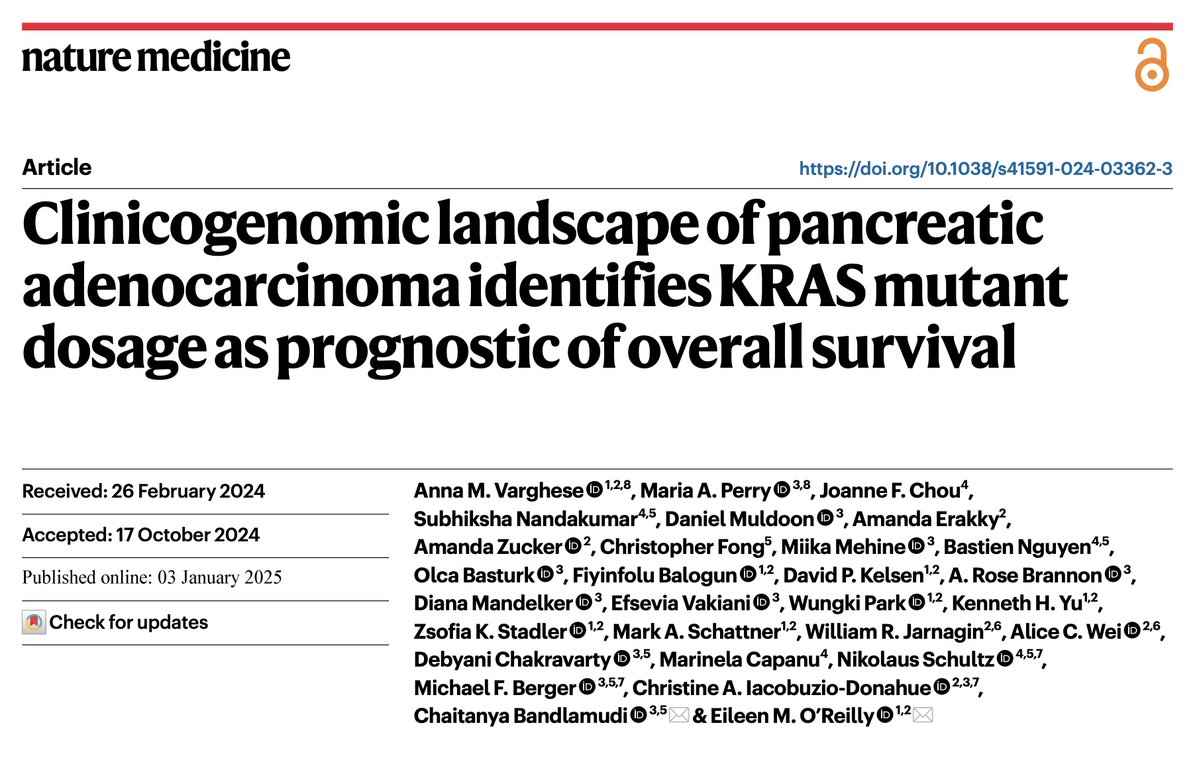
Excited to share our latest in @NatureMedicine✨ We present a detailed clinico-genomic landscape of pancreatic adenocarcinomas With important implications for RAS 🎯 therapies Expertly co-led by @AnnaVarghese4 and @MariaAPerry. w/@EileenMOReilly & colleagues @MSKCancerCenter

English
0
4
12
1.6K
Chai Bandlamudi
Chai Bandlamudi@chaiband·
Amazing work by co-first authors Mark Zucker and Maria Perry. And an absolute pleasure and joy to work and think alongside the brilliant @EdReznik. /10
English
1
0
1
98
Chai Bandlamudi
Chai Bandlamudi@chaiband·
Thrilled to share our recent work in @CellCellPress ✨ We study the extent to which tumor suppressor genes in cancer adhere to Knudson's ‘two-hit’ hypothesis, and their clinical implications. 🧵👇 Also a detailed 🧵 by @EdReznik below: @MSKPathology @MSKCancerCenter
Ed Reznik@EdReznik

A culmination of ~5 years of work, today our work on biallelic alterations across tumor suppressor genes is published in @CellCellPress. With Mark Zucker, Maria Perry, and Chai Bandlamudi cell.com/cell/fulltext/…

English
2
10
21
5.4K
Chai Bandlamudi
Chai Bandlamudi@chaiband·
and, (2) clear need for development of high quality biomarkers for HRD in routine prospective clinical sequencing (and molecular) assays to better understand (1). An important ongoing initiative for us @MFBerger1 @ARoseBrannon @YoninaMG @alexdrilon. 5/5
English
0
0
3
0
Chai Bandlamudi
Chai Bandlamudi@chaiband·
Important implications for gBRCA1/2 tumors in cancers beyond canonical BRCA-histologies (breast/ovar./panc./prostate). (1) ~1.5% of all other cancers (incl. ~2% in lung) are gBRCA1/2. Unclear what % of them are BRCA-dependent and potentially benefit from platinum/PARPi. 4/5
English
1
0
3
0