Debprotim Roy

987 posts

Debprotim Roy banner
Debprotim Roy

Debprotim Roy

@debprotimroy

https://t.co/zbfupxCIc9, Canvs Club, Entrepreneur, Product Designer

Mumbai, India Se unió Mayıs 2014
1.4K Siguiendo157 Seguidores
Debprotim Roy retuiteado
Emil Kowalski
Emil Kowalski@emilkowalski·
This vocabulary is a side-effect of domain expertise. Having domain expertise makes you way better at getting what you actually want from AI relative to other people. So learn how to code, learn design, all the fundamentals. It’s incredibly revelant, and it will stay relevant.
Emil Kowalski@emilkowalski

To get good animations from an AI you need to get good at telling it what you want: - "stagger this list of items" - "make this animation direction-aware" - "spacial consistency", "crossfade", "layout animation", I made a motion vocabulary for this: animations.dev/vocabulary

English
25
84
1.2K
68.7K
Debprotim Roy retuiteado
Skyroot Aerospace
Skyroot Aerospace@SkyrootA·
Vikram-1 had to be big enough to carry the fuel to reach orbit, and smart enough to shed that weight along the way. Nearly as tall as a 7-storey building, getting something that size to orbit demands precision engineering at every stage of the climb, as much as it demands raw power. This episode is about how the team broke out of that loop and the systems that make it possible. #JourneyToOrbit #Vikram1
English
10
101
614
24K
Debprotim Roy retuiteado
hardmaru
hardmaru@hardmaru·
For over a decade, we’ve accepted that end-to-end backprop is the only way to train deep networks. But holding the entire network in memory all at once is why AI training is hitting a resource wall. We found a new way to break the network into blocks and train them independently. The trick? Treating the network’s forward pass like a diffusion model denoising a signal. This reinterpretation slashes the memory needed to train deep models. In our #ICLR2026 paper (arxiv.org/abs/2506.14202), we matched end-to-end performance across ViTs, DiTs, and LLMs. We did this while training just one isolated block at a time.
Sakana AI@SakanaAILabs

Introducing DiffusionBlocks: Block-wise Neural Network Training via Diffusion Interpretation pub.sakana.ai/diffusionblocks What if we didn’t have to hold an entire neural network in memory to train it? Standard neural net training optimizes all parameters jointly. As a result, the memory required during training grows linearly with the depth of the network. In our #ICLR2026 paper, we propose DiffusionBlocks, a principled framework to train networks one block at a time, drastically reducing memory requirements while matching end-to-end performance. With DiffusionBlocks, we split the network into blocks and train them one at a time, so you only need memory for a single block. How? We explicitly assign each block a role: to move the representation a little closer to the target than the block before it did. That role turns out to be precisely what a diffusion model does, step by step. Each block only needs to optimize its own objective and can be trained independently. We validated this across five different architectures: • ViT • DiT • Masked diffusion • Autoregressive transformers • Recurrent-depth transformers In each case, performance is competitive with end-to-end training while using a fraction of the memory. This perspective also extends naturally to recurrent-depth (Looped) transformers, which apply the same network iteratively and normally require expensive backpropagation through time (BPTT). Viewed through DiffusionBlocks, we can replace those multiple iterations with a single forward pass during training. Read our paper and code, to learn more. Paper: arxiv.org/abs/2506.14202 GitHub: github.com/SakanaAI/Diffu… 🐟

English
152
647
5.7K
733.1K
Debprotim Roy
Debprotim Roy@debprotimroy·
It was hilarious to see our work being presented to ourselves except completely broken. But yeah naturally infuriating and disappointing.
English
0
0
1
15
Debprotim Roy
Debprotim Roy@debprotimroy·
Design studios and designers in our ecosystem literally don’t understand intellectual property rights. Recently the DS work we did for a bank got stolen by another agency of theirs, slapped into another component library file, new name slapped on top of frames. Bingo, new DS.
Daryl Ginn@darylginn

At this point, I genuinely feel for the Indian designers doing great work. A huge amount of design theft I come across traces back to accounts based in India. Must suck for the legit ones.

English
1
0
1
59
Debprotim Roy
Debprotim Roy@debprotimroy·
So so proud of my spouse Bhumika make the cut ♥️
Patrick Collison@patrickc

Tyler and I just published a list of the recipients of the New Aesthetics grants: newaesthetics.art/grants. Thank you very much to all who applied. There were far more applications than we expected. We funded 28 grantees and are excited to see what they create. My reflections on the whole thing: • Though there are clearly selection dynamics afoot, figuring out some route beyond the current aesthetic moment seems to be of wider interest in the art community than I would have guessed. Many applicants described their dissatisfaction with the status quo, some in strong terms. We had to close applications after a few weeks because there were so many. • It's too early to call it, but it seems that both beauty as an unapologetic goal (contra much that is in modernist and contemporary approaches), and ways to channel pre-modern styles into something new for the present era, are of growing interest. • The awards made me reflect on the perhaps obvious issue of how hard it must be for an artist to persistently do something new: schools, galleries, buyers, etc., all have structurally embedded preferences as well. These individual awards made me wonder what form supporting new clusters could take. • Architecture seems to me like the discipline most ripe for new ideas. One correspondent observed: "American architects are somewhat constrained by the association with the academy, in addition to the well known regulation issues. There is a tendency to overthink things so that the designs are formally interesting to someone deep in the conversation, but lacking poetry and magic. There are more firms in Europe, South America and beyond that “just do things” (especially in places where it is easier to build)." This was evident in the submissions. • AI seems to be making people rethink things in a quite fundamental way, just as urbanization/industrialization/popularization of photography did at the end of the 19th century. For some that will mean interesting new forms of AI-augmented art, but the effects of the rethinking will likely be wider. • Arts funding is clearly as precarious and scarce as ever. That's unfortunate, but it probably also means that individual actors can have meaningful impact, and I encourage others to get involved if interested. • There's a lot to know that is not written down, and I'm very grateful to those who have helped and advised me along the way.


English
1
0
1
49
Debprotim Roy retuiteado
Patrick Collison
Patrick Collison@patrickc·
Tyler and I just published a list of the recipients of the New Aesthetics grants: newaesthetics.art/grants. Thank you very much to all who applied. There were far more applications than we expected. We funded 28 grantees and are excited to see what they create. My reflections on the whole thing: • Though there are clearly selection dynamics afoot, figuring out some route beyond the current aesthetic moment seems to be of wider interest in the art community than I would have guessed. Many applicants described their dissatisfaction with the status quo, some in strong terms. We had to close applications after a few weeks because there were so many. • It's too early to call it, but it seems that both beauty as an unapologetic goal (contra much that is in modernist and contemporary approaches), and ways to channel pre-modern styles into something new for the present era, are of growing interest. • The awards made me reflect on the perhaps obvious issue of how hard it must be for an artist to persistently do something new: schools, galleries, buyers, etc., all have structurally embedded preferences as well. These individual awards made me wonder what form supporting new clusters could take. • Architecture seems to me like the discipline most ripe for new ideas. One correspondent observed: "American architects are somewhat constrained by the association with the academy, in addition to the well known regulation issues. There is a tendency to overthink things so that the designs are formally interesting to someone deep in the conversation, but lacking poetry and magic. There are more firms in Europe, South America and beyond that “just do things” (especially in places where it is easier to build)." This was evident in the submissions. • AI seems to be making people rethink things in a quite fundamental way, just as urbanization/industrialization/popularization of photography did at the end of the 19th century. For some that will mean interesting new forms of AI-augmented art, but the effects of the rethinking will likely be wider. • Arts funding is clearly as precarious and scarce as ever. That's unfortunate, but it probably also means that individual actors can have meaningful impact, and I encourage others to get involved if interested. • There's a lot to know that is not written down, and I'm very grateful to those who have helped and advised me along the way.

English
82
116
1K
361.5K
Debprotim Roy retuiteado
Canvs
Canvs@CanvsClub·
"Visual Optimism <=> Good vibes" We want to build an inherently optimistic brand for Canvs. Optimism is difficult to sustain, but it's incredibly powerful for both growth and sustainability. Hope keeps us going. But sometimes it needs hard work to be hopeful. Over the course of working on the visual identity, one thing became clear early on: how it felt mattered as much as how it looked. There’s a version of this brand that could have gone darker. We kept seeing that direction everywhere: in dark backgrounds, deeper tones, and a visual language many well-made digital products speak in. It works for some, but it didn’t feel like something we wanted to stay with. We’ve always leaned towards a certain kind of optimism in how we think and work. Although we spend most of our time building with technology, we find it exciting rather than foreboding. The future we want to be a part of is less stark techno-utopia, and more a future where tech assists and exists hand-in-hand with everyday life. So, in a conscious choice, what drew us was something lighter, more open. Visuals that felt fresh, simple, and a little more playful. We wanted the brand to carry that feeling of optimism in a way that’s easy to be around and holds up over time. Colour was important in conveying this. Orange has always been central to how we see things, but the way it’s used changes what it conveys. On darker surfaces, it becomes sharper, more intense. On lighter ones, it feels warmer, closer to a natural glow. That’s what we leaned into. White and light greys gave the system room to breathe, while orange brought in warmth and energy without taking over. The result is a visual language that feels simple and light, playful and warm, yet sophisticated.
English
0
1
2
40
Debprotim Roy retuiteado
Mira Murati
Mira Murati@miramurati·
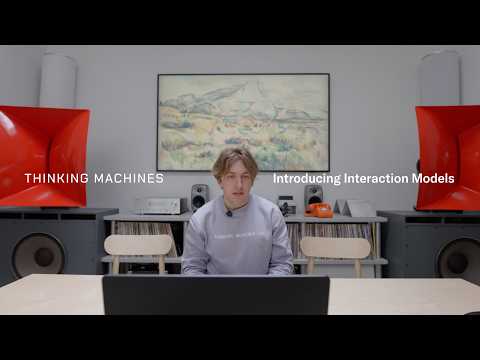
Today we're sharing our work on interaction models. A new class of model trained from scratch to handle real-time interaction natively, instead of gluing it onto a turn-based one. youtu.be/A12AVongNN4
YouTube video
YouTube
English
331
937
9K
1.2M
Debprotim Roy retuiteado
Canvs
Canvs@CanvsClub·
Harleen Chatha and Abin Rajan, Senior Design Managers at Canvs, have a conversation about why design-led management makes better business sense and what DMs bring to the table. Their conversation includes insights on: - What actually changes when the DM is a practicing designer, and how it differentiates from a PM or creative manager who's not hands-on in design. - How design managers help the economics of a project for the client. - How DMs make things easier for clients by becoming a single point of contact. - The knowledge and discipline it takes to keep products coherent between the brief and the final product. Read the piece here: canvs.in/blog/why-desig…
Canvs tweet media
English
0
1
1
27
Debprotim Roy retuiteado
Canvs
Canvs@CanvsClub·
ICICI Direct is one of India's most established investment platforms. It has grown to meet a wide range of investor needs. But as the ecosystem evolved, so did its complexity: more features, more asset classes, more user types, all sitting inside the same experience. The question was no longer what to build, but where should it go from here. Canvs was brought in to answer that. We approached it as a full case study. It included primary research with 20+ investors, a complete product audit, and benchmarking against the broader ecosystem. We presented our research, insights, and high fidelity prototypes to ICICI Direct’s leadership across multiple sessions, framing them as a business case that set the direction for the app’s future. Read the full case study here: canvs.in/projects/icici…
Canvs tweet media
English
0
2
4
60
Debprotim Roy retuiteado
Anthropic
Anthropic@AnthropicAI·
New Anthropic research: Natural Language Autoencoders. Models like Claude talk in words but think in numbers. The numbers—called activations—encode Claude’s thoughts, but not in a language we can read. Here, we train Claude to translate its activations into human-readable text.
English
595
1.7K
16.4K
2.5M
Debprotim Roy retuiteado
Canvs
Canvs@CanvsClub·
For a studio that works in the digital, a surprising amount of what shapes our visual sensibilities at Canvs comes from the objects and experiences around us. From surfaces, materials, textures and the kind of objects you can almost feel, even when you’re looking at them on a screen. We found ourselves drawn to natural forms like rocks and flowers, and textures that felt tactile and real. There’s a kind of simplicity to them, a solidity and dependability that sits well with how we see ourselves. They are what they are. And that way of being feels close to how we think about our work and how we communicate. They are also less metaphors, and more simply, things we instinctively relate to, and want to work with. It is only natural that these elements found their way into how we were building the brand.
English
0
3
5
81