
Patrick Collison

10.2K posts

Patrick Collison banner
Patrick Collison

Patrick Collison

@patrickc

@Stripe CEO, @ArcInstitute cofounder.

[email protected] Katılım Nisan 2007
34 Takip Edilen1.1M Takipçiler
Sabitlenmiş Tweet
Patrick Collison
Patrick Collison@patrickc·
Tyler and I just published a list of the recipients of the New Aesthetics grants: newaesthetics.art/grants. Thank you very much to all who applied. There were far more applications than we expected. We funded 28 grantees and are excited to see what they create. My reflections on the whole thing: • Though there are clearly selection dynamics afoot, figuring out some route beyond the current aesthetic moment seems to be of wider interest in the art community than I would have guessed. Many applicants described their dissatisfaction with the status quo, some in strong terms. We had to close applications after a few weeks because there were so many. • It's too early to call it, but it seems that both beauty as an unapologetic goal (contra much that is in modernist and contemporary approaches), and ways to channel pre-modern styles into something new for the present era, are of growing interest. • The awards made me reflect on the perhaps obvious issue of how hard it must be for an artist to persistently do something new: schools, galleries, buyers, etc., all have structurally embedded preferences as well. These individual awards made me wonder what form supporting new clusters could take. • Architecture seems to me like the discipline most ripe for new ideas. One correspondent observed: "American architects are somewhat constrained by the association with the academy, in addition to the well known regulation issues. There is a tendency to overthink things so that the designs are formally interesting to someone deep in the conversation, but lacking poetry and magic. There are more firms in Europe, South America and beyond that “just do things” (especially in places where it is easier to build)." This was evident in the submissions. • AI seems to be making people rethink things in a quite fundamental way, just as urbanization/industrialization/popularization of photography did at the end of the 19th century. For some that will mean interesting new forms of AI-augmented art, but the effects of the rethinking will likely be wider. • Arts funding is clearly as precarious and scarce as ever. That's unfortunate, but it probably also means that individual actors can have meaningful impact, and I encourage others to get involved if interested. • There's a lot to know that is not written down, and I'm very grateful to those who have helped and advised me along the way.
English
107
163
1.1K
382.1K
Patrick Collison
Patrick Collison@patrickc·
@Beuysaunt I agree with this and should have noted it. Much of the center felt like a museum to me; much more so than 20 years ago.
English
3
1
23
2.1K
Wolfgang Hammer
Wolfgang Hammer@Beuysaunt·
Great post. The problem here is that looking like a museum and becoming one are two different things. Fewer and fewer people live in central Paris (I did in my teens). I continue to be stunned by the number of new hotels, and short term rentals. The change has accelerated in the past few years. Entire streets are investment property, their lights dark at night. Modernism isn’t the only thing that kills cities
English
3
0
29
2.4K
Patrick Collison
Patrick Collison@patrickc·
I just visited Paris. The city seemed to be in particularly radiant shape this time. • It got me thinking about how many of the nicest built environments in the world standardize materials rather than form. Jerusalem's stone regulation makes it much prettier than Tel Aviv. Similarly, rules in the Charleston, the Cotswolds, and Sea Ranch leave a lot of flexibility in shape, but tightly restrict materials in a way that yields cohesion. In Paris's case, there are of course also some rules around form, but the consistency of the limestone (and zinc) is very pleasant. • I hadn’t before internalized that central Paris is unique for the fraction of its building stock that is traditional. There are of course some modern buildings, such as Centre Pompidou and the new facade at La Samaritaine, but they are rare and typically dramatic. Most pleasant old cities (such as London) contain more of a mixture. • Relatedly, is Haussmannian Paris the finest example of the central planning that Scott decries? "By 1870 one-fifth of the streets in central Paris were his creation." And is the late 19th century the last time you could have done this well, immediately before the corruptions of modernism? I guess Chicago was later, but Paris certainly comes close. • From a book I picked up: In a letter of 1886 to the Ministry of Public Works, Charles Garnier, architect of the neo-Baroque Paris Opéra, wrote, “The Metropolitan Railroad, in the eyes of most Parisians, will only be excused if it rejects absolutely all industrial character so as to be completely a work of art. Paris must not be made into a factory, it must stay a museum.” Are there elites anywhere in the world today who would reject something in the physical world unless it was a work of art? One artist recently commented to me that late 19th century France had the most educated visual culture among its elites in human history. This observation struck me a few times as I traveled around. • I am curious what those who defend modern architecture say about central Paris. Do they think that one could in principle have a place built of modern architecture that people would find as attractive and that would bring joy to so many? Do they think that such a place exists in actuality today? If not, why not? Or is the goal of having somewhere pretty and attractive in their eyes itself ignoble and saccharine? To me Paris feels like a challenge of the whole project. • Walking past the Louvre at night, I was struck by its austerity and severity. It made me reflect on how Parisians in 1700 might have felt as they took it in, and the subjugation that has been associated with social structures of prior eras. (Maybe this is on my mind partly as a result of reading Charles Taylor.) It made me wonder if I should be slightly more sympathetic to modernism for embodying a sense of individual freedom and joy. The Hilma af Klint exhibition at the Grand Palais was quite a contrast. • Perhaps heretical, but Notre Dame is just not especially impressive as a cathedral, especially inside, though the restoration seems to have been excellently done, and is a terrific achievement. Overall, Lincoln cathedral (say) is much more attractive in my view. Maybe I need to read Hugo to appreciate it better. (Hugo apparently was responsible for much of the resurgence of interest in Gothic architecture. A good example, I guess, of art driving life.) • The Renoir exhibition at the Musée d’Orsay was interesting for its emphasis on egalitarian and open relations between men and women, not something observed everywhere in the world at the time. "At the same time delicate and modest – neither moralising nor Dionysian." I thought of @_alice_evans and her work. • There are now so many bikes in Paris. It means you have to pay very active attention as a pedestrian, but is overall a big improvement. Rue de Rivoli is now dominated by the pleasant whirr of bicycles. I mostly got around this way. • The Musée Quai Branly is very interesting – it’s the best tour of the world in a single compressed space that I know of. Most of the works are not impressive as such, but the concentrated breadth is great. The Ethiopian illustrated Gospels were very charming. • Maybe my imagination, but there seemed to me to be a third fewer brasseries than on prior trips. Overall, the food was good, but not better than what you get at good restaurants in the US. The median in Paris is definitely still better, though. • The Matisse exhibition at the Grand Palais was pleasant. It mostly reminded me of the observation that it is difficult to rank artists but easy to rank the work of a given artist. The Blue Nudes and The Sheaf are just very obviously among Matisse’s best work. • The Michelangelo x Rodin exhibition at the Louvre was excellent, most of all for making clear how direct the artistic lineage is. Given the 300 year interlude, we should probably be more optimistic about the prospects for revival of the best of the visual arts. I hadn't before realized that Michelangelo's career spanned 74 years. It’s easy to focus on youth and prodigious genius, but maybe enduring genius should be more central. May we all aim to be useful and productive for a large majority of a century! In this vein, David Hockney, RIP, also just cleared the 70 year career mark. • The Louvre is quite hot; far hotter than an American museum would be. Presumably because of EU/French air conditioning laws? (26 degree regulatory minima, supposedly.) • Overall, central Paris feels like it's in very good shape. Things are generally quite clean and well-maintained. Not too much graffiti (though some buildings, such as the Louvre, are very overdue for power washing.) Nowhere felt unsafe. (Given that it’s been ruled continuously by socialists since 2001, one wonders why it has fared better than many coastal cities in America. The LLMs claim that it's because much of the funding is central and because the police report centrally, not to the mayor.) Overall, is central Paris the greatest single artistic achievement in the world? That is what I came away wondering. Pictured: Ethiopian prayer scroll; Iranian qalamkari; Renoir; af Klint.
Patrick Collison tweet mediaPatrick Collison tweet mediaPatrick Collison tweet mediaPatrick Collison tweet media
English
77
77
1.1K
104.8K
Patrick Collison
Patrick Collison@patrickc·
Being comically maladapted to sunny climes, I have in endless and often unsuccessful pursuit of self-defense experimented with a sprawling battery of different sunscreens. This one is by far the best I’ve found: int.eucerin.com/products/sun-p…. (You need to illicitly procure the non-US version; the FDA valiantly shields us from its benefits due to their restrictive and seldom-updated set of permissible sunscreen ingredients.)
English
60
23
756
96.8K
Patrick Collison retweetledi
Mark Pennington
Mark Pennington@Kaleidicworld·
Works In Progress is a beacon of light in what often feels to me like a hopeless intellectual and political scene. If only academia was even half as good.
Ben Southwood@bswud

The entire modern world, including capitalism and industrialisation, happened because we beat NIMBYism and vetocracy in 18th-century England. Today, the vetocracy, the stakeholder state, the NIMBYs stop us building the nuclear power plants, railways, houses, towers, bridges, roads, gas turbines, solar panels, and powerlines that we need for growth. Then, they stopped people from consolidating their land, transporting goods freely, investing in irrigation, and mortgaging their property to invest. The events that led to their downfall are called the Glorious Revolution. I think we can repeat what they did and have another Glorious Revolution of our own. worksinprogress.co/issue/how-abol… Early modern Europe was sclerotic, stifled by NIMBYs of its own: the aristocrats, guilds, and clergy who stood against the reforms that were necessary for 18th-century progress. Everyone knew that inheritance rules split land up too much, everyone knew that common land was overgrazed, everyone knew that property rights restricted making best use of land, labour, and capital. Each one of them decided the answer was consolidating power in an absolute monarch. Each one of them failed completely. They didn't crush the NIMBYs: the NIMBYs crushed them. One country launched itself into rapid growth, creating the industrial modernity we live under today: England. It did this, as everyone agreed was necessary, by overriding the tangle of landowner property rights that prevented best use of land. But it tried something almost unbelievable: to get the landowner NIMBYs to crush themselves. England did not attempt to set up an absolutist state: quite the opposite. It gave landowners supreme power, and they used it to crush their fellows: the minority of landowners who were opposed to progress. There are lessons for today. Many modern reformers think that the answer to NIMBYs is demonising them, trying to build an angry coalition of forces who hate homeowners or boomers or Republicans or environmentalists. But many of the most successful reform schemes operating around the world today try a different tack: bring a majority of homeowners onside, and it is much, much easier to crush the remaining NIMBYs. We can still learn from England's Glorious Revolution. Read my latest article, with historian Kara Dimitruk, in @WorksInProgMag.

English
3
8
87
28K
Patrick Collison
Patrick Collison@patrickc·
The @Tempo mainnet launched 93 days ago. Quick summary of the current state: • Run rate payment volume is around $3 billion. There's a long way to go, but it's cool to see real usage already emerging. (It took Stripe a lot longer than 93 days to get to $3 billion.) • As a blockchain, we obviously don't know about all the different use-cases. (Please tell us if you're doing something cool with Tempo!) Larger companies using Tempo include @Deel, which is using Tempo to pay out to their vast network of contractors, and @Meta, which is using it via @Link for global payouts. There are a bunch of other large companies working on Tempo integrations that'll be announced soon. • Internally, developing on Tempo has been fun, and Tempo is now Stripe's default blockchain for new features. • On the AI side of things, there appear to be around 1,000 active services selling to agents via the Machine Payments Protocol (@mpp). There's a useful directory of available services at mppscan.com. 570 unique agents, for example, seem to have purchased from @ExaAILabs, and 332 from @openweather. I don't know how long it'll take for this use-case to become big, but it seems all-but inevitable that it will within a few years. • Today, @Stripe, @Visa, and @StanChart are running Tempo validators. Validation will become more decentralized over time. • The Tempo team is building a lot of new protocol functionality. For example, privacy zones, receive policies, and virtual addresses. (Details for all on the Tempo blog: tempo.xyz/blog.) In general, our belief is that there's a lot of functionality to be built at the blockchain level to make higher-level applications easy and performant. The original thesis behind Tempo was that both AI and stablecoins would stretch blockchains in new ways, with need for privacy, fees denominated/payable in stablecoins, batch transactions, microtransactions, faster confirmations, and so forth. Overall, this still seems like the right set of bets, and the agentic stuff is happening somewhat faster than I was expecting. "1M stablecoin TPS, with the vast majority from agents" still seems like the right north star.
English
56
66
582
153.5K
Patrick Collison retweetledi
Nous Research
Nous Research@NousResearch·
In partnership with @stripe, Hermes Agent now supports a full suite of Stripe skills. Your agent can buy things, pay per-call APIs, and provision its own SaaS, with configurable safety limits on every action.
Nous Research tweet media
English
197
364
4.7K
436K
Patrick Collison
Patrick Collison@patrickc·
Very much enjoyed this piece in the latest @WorksInProgMag about how Alberta became a rat-free sanctuary and the only significant human-inhabited place on earth that is free of them. Excellent "you can just do things" energy. "William Lobay, a crop protection supervisor at the Alberta Department of Agriculture, came up with the idea of a buffer zone focused on the area of prairie and parkland that was most vulnerable to penetration. In late 1950, Albertan officials approved his Rat Control Zone, a roughly 600-by-29-kilometer strip along the part of its eastern border with Saskatchewan. In the zone, William Lobay and his colleagues surveyed cargo and vehicles that entered the province, and inspected vulnerable sites like farms, grain elevators, feed stacks, barns, sheds, and abandoned buildings, where food and shelter made rat establishment most likely." worksinprogress.co/issue/albertas…
English
21
19
162
40.1K
Patrick Collison retweetledi
Sam Bowman
Sam Bowman@s8mb·
Almost every single person on Earth lives with rats. Only 5 million people out of 8 billion live rat free. They are the Albertans. Alberta is the only significantly human-inhabited place on Earth that is rat free. It achieved this in the 1950s as rats invaded from the East, by introducing a rodent surveillance state, obliging every citizen of the province to report them and terminating any sightings with extreme prejudice. They laid 63,000 kg of arsenic across a 600-kilometre-long, 29-kilometre-wide Rat Control Zone along the province's Eastern border. Back then, rats were so unfamiliar in Alberta that officials distributed preserved rat corpses to teach people what the enemy looked like. One pest-control officer held public meetings at which he ate warfarin-soaked oatmeal to show it was safe. And it worked! They held rats off and numbers remained so low that the surveillance and eradication system could keep numbers at essentially zero for years, at extremely low costs – Alberta spends about 11 cents per resident on rat control measures, much less than neighbouring provinces that are infested. Today, Albertans have grown so unfamiliar with rats that they frequently mistake squirrels, gophers, and other small animals for them: of 875 reported sightings in 2025, only 47 turned out to be actual rats. Pet rats are banned, vehicles entering Alberta are checked, and sightings are responded to with overwhelming force. Could the rest of the world manage it? Probably not. The secret was to stop them before they could establish themselves. For the rest of us, we probably need gene drives. Read the story of how Alberta won the war on rats at Works in Progress now. worksinprogress.co/issue/albertas…
English
53
133
871
305.7K
Patrick Collison
Patrick Collison@patrickc·
Congratulations to @eoghan, @destraynor, and the whole Fin team!
Eoghan McCabe@eoghan

We’re excited to share that we just signed an agreement for @salesforce to acquire @fin_ai for ~$3.6B. The transaction is expected to close in the fourth quarter of Salesforce’s fiscal year 2027. Fin started as Intercom 15 years ago. We changed our name to cap our transformation just weeks ago. We were a darling of the SaaS era and invented so many of the patterns you see in software today. Nearly four years ago, in need of a reboot, we jumped on weeks-old modern LLMs to create and define the category we know as Customer Agents today. Salesforce invented modern software and SaaS. And @benioff is like the final boss of tech founder CEOs. In seat for 27 years, he’s one of the last of his era. Still pushing, pivoting, placing big bets. It’s a privilege for @destraynor and I to get to partner with him and join forces with Salesforce upon close at this most fascinating time. And will be very fun to get their help bringing Fin to magnitudes more consumers. To our customers: Over the past few years we’ve been shipping intensely. Including recently our groundbreaking model, Apex, and our paradigm-defining internal agent, Operator. With the resources of Salesforce this will only accelerate. And yet little will practically change. I’ll still be CEO, Des will still be running R&D, we’ll both still be committed to continuing to lead this category. Thank you very sincerely and deeply for your belief in us. To all of our friends, our families, and our employees, past and present: While this is not the end, it is a major, pivotal, special, and emotional moment for us. From the bottom of our hearts, thank you. For everything. To my cofounders, my exec team: Look what we built. Four young lads with a dream and nothing to lose. And a home grown exec team who pulled off the greatest and arguably only late stage software company pivot to AI, and invented one of the most important categories in AI. Thank you for sticking through all of this with me. And now, time to get back to work. See you at our next product launch in a couple weeks. (:

English
16
3
493
74.9K
Patrick Collison
Patrick Collison@patrickc·
I want some kind of LLM workflow tool. • Ability to manage a set of input files (Markdown or similar), plus other general-purpose context. • With real-time collaboration. (And maybe some concept of snapshots or VCS integration.) • And the ability to create/manage a inference workflows and a stored set of prompts. • Access to general-purpose coding agents (and not just chat models). • Some concept of compiled outputs/inference results (which ideally can be shared externally). Many projects have this feeling: "there is all this stuff, which I want to process/compute over in this iterated way, with some build artifacts being important/worth saving." GNU Autotools x Notion or something. Is anyone building this?
English
444
109
2.5K
560.2K
Patrick Collison retweetledi
Simon Grimm
Simon Grimm@Simon__Grimm·
I’m excited to share that I’ve joined @WorksInProgMag as an editor, where I’ll be focusing on AI and European progress. At Works in Progress, I’ll focus on a topic that is both important and underrated: how Europe should grapple with the changes brought by artificial intelligence. Europe is in a challenging position. But I also believe it is crucial that Europe remains able to influence how the coming years and decades play out. It is one of the world's most liberal regions, and has been central for the world's moral progress. Right now, the number of people working on European AI policy is really low. Many things need to happen for the continent to be adequately equipped for what's to come: data center construction, ensuring frontier AI adoption in governments, better risk-tracking across European capitals, and a broader policy agenda that ensures Europe can capture more of AI’s surplus. I’ve recently started writing up my thoughts on AI in Europe at simongrimm.substack.com, with a much larger piece coming out soon. Works in Progress is an amazing home for this type of work. It has published many canonical pieces on big challenges of our time, economic stagnation first among them. But it has also covered lead elimination, far-UVC for pandemic prevention, organ donation, and many other important ideas. If one wants to paint a picture of how Europe can succeed in the age of AI, Works in Progress is the ideal place to do so. (If you haven't subscribed yet, do it; you'll be in great company.) Joining Works in Progress also means leaving the US, and the project I’ve spent the past three years working on: the Nucleic Acid Observatory, now SecureBio Detection. At MIT and SecureBio, we built a pathogen early warning system that I’m incredibly proud of. The people I was lucky to work with in Cambridge were among the smartest, most mission-driven, and most focused people I’ve ever spent time with. The impact SecureBio is having on biosecurity is immense, and we are all safer for it. I’m proud to be joining Works in Progress as the next step in my career, and I’m looking forward to working with such talented colleagues during such a turbulent, fast-moving time.
Simon Grimm tweet media
English
32
18
262
47K
Patrick Collison retweetledi
Ruxandra Teslo 🧬
Ruxandra Teslo 🧬@RuxandraTeslo·
China is winning the drug discovery race. There's no better example of this than multiple myeloma. worksinprogress.co/issue/the-bloo… It's one of the most painful cancers, destroying bone from within. For decades, patients endured cycles of brutal treatment and relapse. Then came Carvytki: a one-time CAR-T infusion that appears to cure some patients who have failed multiple treatments. Its development story, beginning in 2016, was an early signal of a shift now making headlines: the US is losing biotech dominance to China. Though the foundational science was largely American, a nimble Chinese company moved faster with a better molecular engineering idea. Unless the US addresses clinical-trial bottlenecks slowing early in-human data, more breakthroughs will be developed elsewhere, weakening the ecosystem American biopharma depends on. Some key points from my article for @WorksInProgMag, with my friend Amol Punjabi, of @EvidenceOpen: 1) Multiple myeloma is not only extremely painful in and of itself, but also one of the most brutal cancers to treat. As first-line therapy, patients endure four drugs simultaneously, then a stem cell transplant, followed by continuous maintenance therapy. And most still relapse, with each treatment round carrying worse chances. 2) A drug called Carvykti, approved in 2022, is changing the treatment landscape. Carvytki acts as a single, one-time infusion. It's a CAR-T therapy, part of a new wave of transformative immunotherapies: made from the patient's own immune cells and reprogrammed to hunt cancer. In patients who had already failed 4+ other treatments, 33% were still disease-free after 5 years. The results as earlier line therapy look even more promising. 3) Most of the foundational science was American. Decades of CAR-T research, and in 2013 the NCI showed BCMA-targeted CAR-T cells could kill myeloma in the lab. 4) But the drug that ultimately changed myeloma, Carvytki, originates from China. Carvytki beats Abecma (the American CAR-T for myeloma) by a wide margin: 36 months of progression free survival in heavily pre-treated patients versus Abecma's 9 months. 5) In 2016, Legend Biotech was just beginning clinical trials. This was the same year the American team was publishing their first-in-human results. Legend started later, but moved faster. Clever engineering and China's ability to get drugs into humans quickly gave them the edge. Large American biopharma J&J ended up striking a deal with Legend and developing the therapy. 6) Never underestimate the llama: US-developed Abecma used mouse antibody fragments to target BCMA. Chinese startup Legend used llama nanobodies instead. These are smaller, more stable and bind more cleanly to BCMA. The usage of llama as opposed to mice antibodies is what is believed to lead to Carvytki's superior efficacy. 7) In retrospect, Carvytki should have been an early warning. China is winning the drug discovery race through deliberate policy. Their first-in-human clinical trials can launch in 6 months vs 18+ months in the US, letting them iterate faster between lab and clinic. The @nytimes recently reported that ~50 percent of major drug deals this year involve Chinese-origin drugs, up from nearly zero a decade ago. 8) The US still leads in late-stage development, as shown, but the pipeline feeding it is increasingly Chinese. The worry is that this will mirror what happened in solar, batteries, and EVs, where early-stage dominance eventually became control of the entire chain. 9) A proposal to streamline early stage trial regulatory requirements to keep the US competitive has made it into the President's 2027 budget for the FDA. But Congress has to act to make it a reality.
Ruxandra Teslo 🧬 tweet media
English
38
135
532
150.9K
Patrick Collison retweetledi
deel
deel@deel·
For millions of contractors, a paycheck travels through exchanges they didn't choose, at rates they didn't set. Every stop costs something. That ends today. Introducing the Deel stablecoin wallet — hold earnings in DLUSD, be eligible to earn rewards, spend anywhere. All inside the Deel mobile app. Get paid. Hold. Earn. Spend. Launching today in Latin America, starting with early access in Argentina — APAC, MENA, and Africa to follow. Thanks @Stablecoin, @privy_io, @tempo, @Morpho and @SentoraHQ for making this possible!
English
24
33
319
60.4K
Patrick Collison
Patrick Collison@patrickc·
Sad to hear that Ada's Technical Books in Seattle is closing this week -- it's a wonderful bookstore. I always found something obscure but interesting when I visited. adasbooks.com
English
34
13
399
69.7K
Joe Lonsdale
Joe Lonsdale@JTLonsdale·
1/ US biotech is in crisis, right before AI should be saving millions. China is stealing away our industry and has surpassed the US in blockbuster pharma deals. The next FDA Commissioner must be a fighter, and have a plan to overhaul the agency, beat China, and unleash cures.
Joe Lonsdale tweet media
English
99
200
1.4K
268.5K
Patrick Collison
Patrick Collison@patrickc·
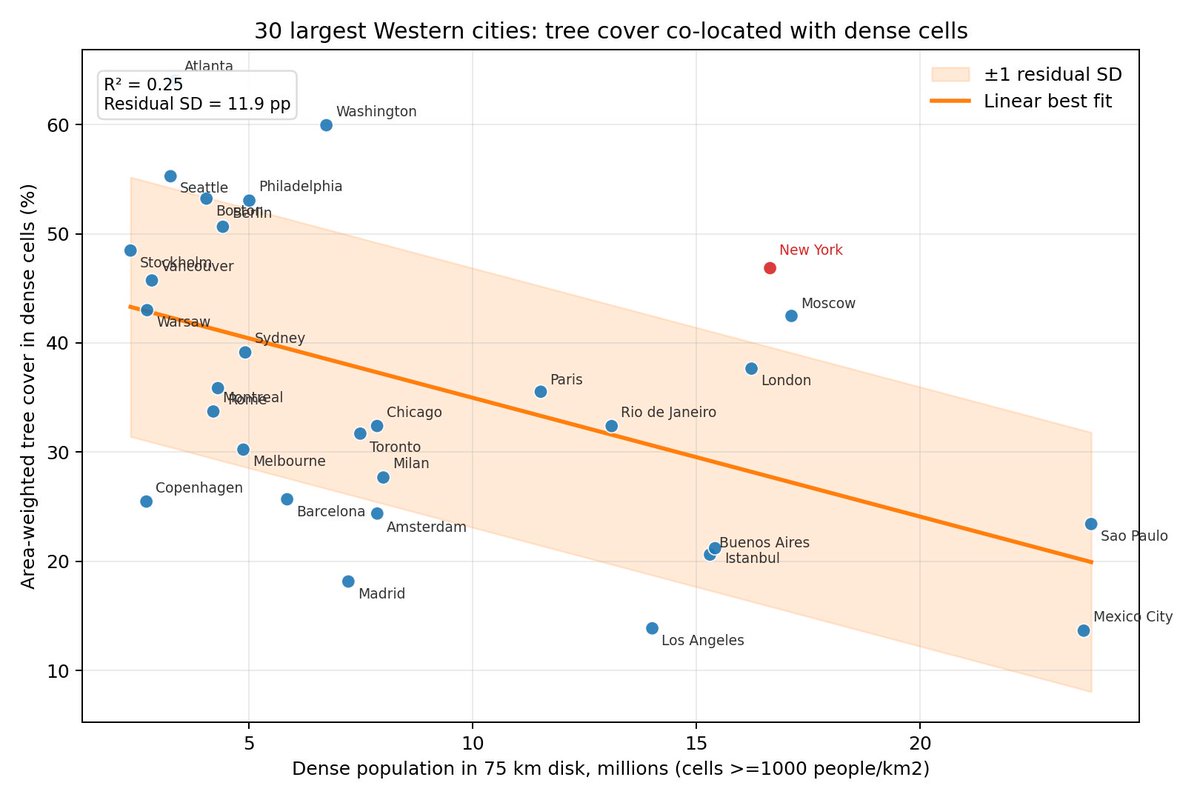
Every time I fly to New York, I'm struck by how many trees there are in the densely-populated areas around the city. (Coming from the West Coast, one arrives over the Garden State, and the suitability of the sobriquet is quite apparent from the air.) It feels like this degree of tree cover in highly populated areas is atypical (the environs of places like Paris, London, Los Angeles, Melbourne, Tokyo, etc., look very different), so I asked the LLM to investigate. It found GHSL 2020 population and ESA WorldCover 2021 10m land-cover data, and concluded that New York is in fact quite unusual. As far as I can tell, it's because of some combination of: * A very favorable climate. (Trees grow quickly without irrigation.) * Marginal farmland. (Readily outcompeted by the Midwest in the 19th century.) * Together yielding reforestation before the advent of suburbs. * And a preference for development patterns that include trees. (Japan's climate is very hospitable, but one sees far fewer trees in the populated areas around the major cities -- forest and habitation are more disjoint.)
Patrick Collison tweet media
English
66
66
987
231K
Patrick Collison
Patrick Collison@patrickc·
I’ve been struck by this phenomenon in much of the discussion around Hormuz. Who exactly should one listen to for systems as complex and reflexive as energy? (Evidently not IEA.) Is it even possible to make meaningful predictions for out-of-distribution shocks like strait closure given all of the second-order effects that one has to model? Are all forecasts fatally conceited?
Luis Garicano 🇪🇺🇺🇦@lugaricano

And again, and again, and again, the market proves to be more flexible and adaptable than the engineers, extrapolating, with their calculators expect. When prices change, behaviour changes. Believe in substitution, in elasticity, in human ingenuity, that is, in the market, and you will get a closer approximation than all doom-mongers. For this of course, a market must exist (e.g., does not apply to the fertility collapse).

English
80
35
626
296.5K