

rewind
17.9K posts


🚨 Andrej Karpathy thinks RAG is broken. He published the replacement 2 days ago. 5,000 stars in 48 hours.
It's called LLM Wiki.
A pattern where your AI doesn't retrieve information from scratch every time. It builds and maintains a persistent, compounding knowledge base. Automatically.
RAG re-discovers knowledge on every question. LLM Wiki compiles it once and keeps it current.
Here's the difference:
RAG: You ask a question. AI searches your documents. Finds fragments. Pieces them together. Forgets everything. Starts over next time.
LLM Wiki: You add a source. AI reads it, extracts key information, updates entity pages, revises topic summaries, flags contradictions, strengthens the synthesis. The knowledge compounds. Every source makes the wiki smarter. Permanently.
Here's how it works:
→ Drop a source into your raw collection. Article, paper, transcript, notes.
→ AI reads it, writes a summary, updates the index
→ Updates every relevant entity and concept page across the wiki
→ One source can touch 10 to 15 wiki pages simultaneously
→ Cross-references are built automatically
→ Contradictions between sources get flagged
→ Ask questions against the wiki. Good answers get filed back as new pages.
→ Your explorations compound in the knowledge base. Nothing disappears into chat history.
Here's the wildest part:
Karpathy's use case examples:
→ Personal: track goals, health, psychology. File journal entries and articles. Build a structured picture of yourself over time.
→ Research: read papers for months. Build a comprehensive wiki with an evolving thesis.
→ Reading a book: build a fan wiki as you read. Characters, themes, plot threads. All cross-referenced.
→ Business: feed it Slack threads, meeting transcripts, customer calls. The wiki stays current because the AI does the maintenance nobody wants to do.
Think of it like this: Obsidian is the IDE. The LLM is the programmer. The wiki is the codebase. You never write the wiki yourself. You source, explore, and ask questions. The AI does all the grunt work.
NotebookLM, ChatGPT file uploads, and most RAG systems re-derive knowledge on every query. This compiles it once and builds on it forever.
5,000+ stars. 1,294 forks. Published by Andrej Karpathy. 2 days ago.
100% Open Source.

English

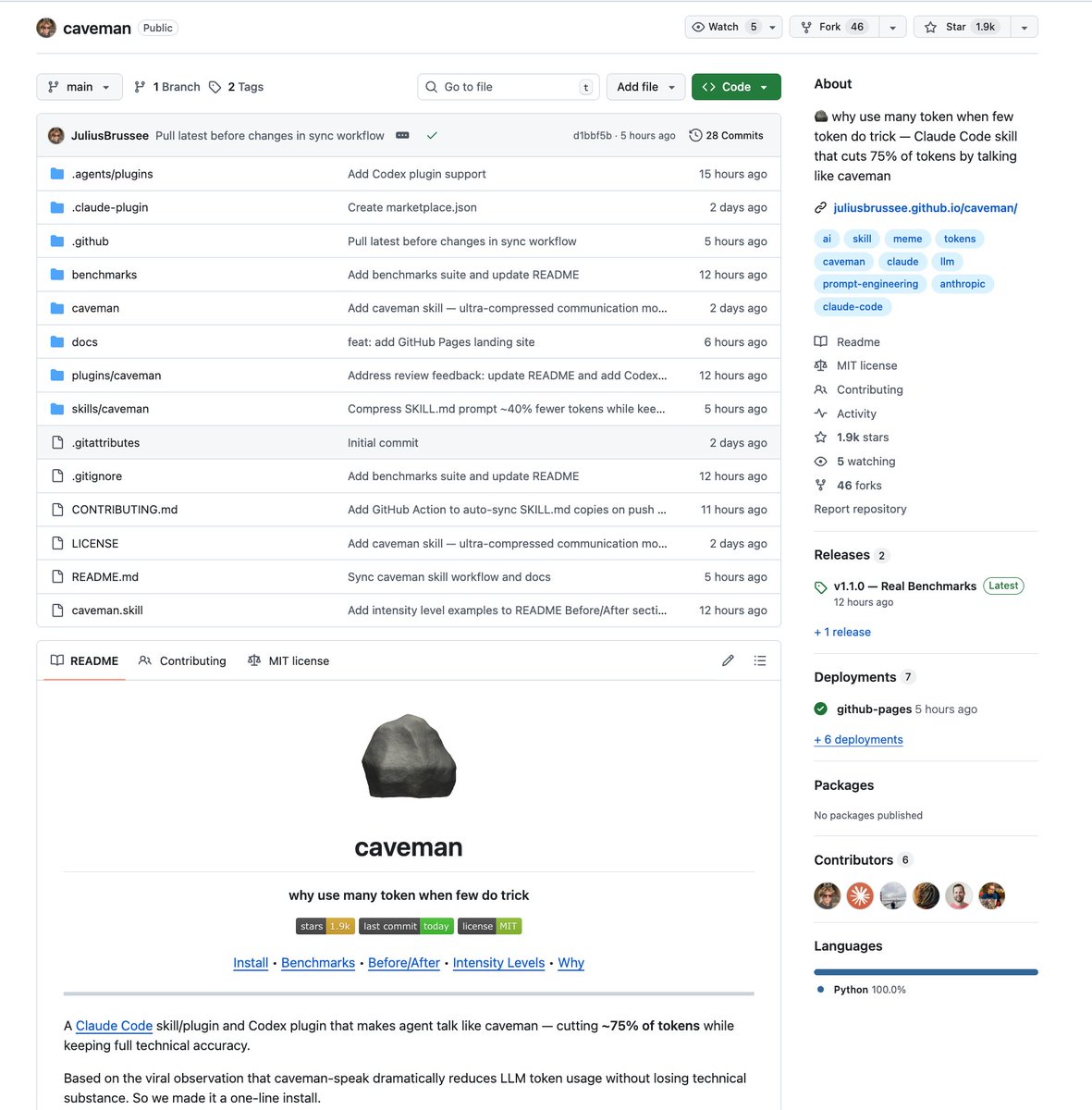
SOMEONE TURNED THE VIRAL "TEACH CLAUDE TO TALK LIKE A CAVEMAN TO SAVE TOKENS" STRATEGY INTO AN ACTUAL CLAUDE CODE SKILL
one-line install and it cuts ~75% of tokens while keeping full technical accuracy
they even benchmarked it with real token counts from the API:
> explain React re-render bug: 1180 tokens → 159 tokens (87% saved)
> fix auth middleware: 704 → 121 (83% saved)
> set up PostgreSQL connection pool: 2347 → 380 (84% saved)
> implement React error boundary: 3454 → 456 (87% saved)
> debug PostgreSQL race condition: 1200 → 232 (81% saved)
average across 10 tasks: 65% savings. range is 22-87% depending on the task.
three intensity levels:
> lite: drops filler, keeps grammar. professional but no fluff
> full: drops articles, fragments, full grunt mode
> ultra: maximum compression. telegraphic. abbreviates everything
works as a skill for Claude Code and a plugin for Codex.
this is PEAK
English
the difference between asking Claude to review your code vs asking Codex is embarrassing
same code, same instructions and same review role
Claude: "looks good, clean implementation, nice work"
Codex: rips it apart, finds actual bugs, flags security issues, and gives you real feedback
Claude is trained to be agreeable but Codex is trained to be correct
someone extracted Codex's review instructions and turned them into a Claude slash command and then it suddenly Claude started reviewing like Codex.
the model was always capable of giving brutal honest reviews but it was just told not to
you don't have a dumb model but instead you have a polite one

English


> A teenager stole $263M
> No malware, no exploits, no code
> Just a phone call
> He was 12 when he started
> By 21 he had 28 exotic cars
> $500K nightclub tabs
> $80K/month rent
> FBI charged him under RICO
> First crypto case ever
> He sat in federal custody
> His co-defendant hacked the judge's email
> Also through a phone call
The most dangerous hacker tool in 2026 is still a phone.
BP@everyonebpup
English

200+ leads per week.
you only need read this post to:
> turn content into clients on autopilot
> a lead gen system made of markdown files
> AI qualifies leads so you only talk to buyers
> close in DMs across any platform
the result:
1: one piece of content = infinite qualified leads across X, LinkedIn, WhatsApp, Telegram
2: saved $3-5k/mo in lead gen tools and a part-time VA
this is what AI lead generation actually looks like in 2026
Ronin@DeRonin_
I generate 200+ qualified leads per week and never send a single cold DM the secret: a lead generation skill graph 30+ markdown files wired together that turned my AI agent into a full sales team where it runs: - claude as the AI brain (reads the graph, executes every step) - n8n as the automation backbone (triggers, webhooks, scheduling) - a folder of .md files as the system (no fancy tools needed) the folder structure: /lead-gen-skill-graph ├── index.md (entry point — maps the entire pipeline) ├── content/ │ ├── pillars.md (3-5 core topics that attract your ICP) │ ├── hooks.md (scroll-stopping openers by platform) │ └── cta-playbook.md (which CTA to use where and why) ├── magnets/ │ ├── lead-magnets.md (free resources that capture interest) │ ├── dm-triggers.md (comment keywords → auto-DM sequences) │ └── landing-pages.md (conversion copy frameworks) ├── nurture/ │ ├── dm-flows.md (full DM conversation sequences by platform) │ ├── segmentation.md (tag leads by intent, behavior, stage) │ └── redirect.md (when to move from X/LinkedIn → WhatsApp/Telegram) ├── conversion/ │ ├── offer-stack.md (what you sell, at what price, to whom) │ ├── objections.md (every "no" mapped to a response) │ └── close-scripts.md (DM closes on-platform + messenger closes) └── audience/ ├── icp.md (ideal customer profile — specific, not vague) └── stages.md (cold → warm → hot → buyer journey) each file = one knowledge node inside each file you add [[wikilinks]] to related nodes example: inside dm-triggers.md: "when someone comments [keyword] on a post from [[pillars]], send them [[lead-magnets]] via DM. use tone from [[dm-flows]]. tag them in [[segmentation]] as 'engaged-warm'. if they reply, continue the [[dm-flows]] nurture sequence. match [[icp]] before any outreach" the agent reads one file → follows the links → executes the full pipeline without you touching anything the key file is index.md — your command center put 3 things in it: 1. who you are + what this system does "lead generation system for [your brand]. turns content into qualified leads and closes them via DMs on autopilot across X, LinkedIn, WhatsApp, and Telegram" 2. the node map with context - [[pillars]] — 3-5 content themes that attract buyers, not just followers - [[hooks]] — platform-specific openers, updated weekly - [[cta-playbook]] — "comment X" vs "DM me" vs "link in bio" logic - [[dm-triggers]] — keyword detection → automated first touch - [[lead-magnets]] — free resources matched to each funnel stage - [[dm-flows]] — full DM nurture sequences, platform-native tone - [[segmentation]] — cold/warm/hot tagging + behavior-based routing - [[redirect]] — rules for when to move conversation to WhatsApp/Telegram - [[offer-stack]] — products mapped to lead temperature - [[objections]] — pre-written responses to every common pushback - [[close-scripts]] — DM close on X/LinkedIn, messenger close on WhatsApp/Telegram 3. execution instructions "when given a content topic: check [[pillars]] for alignment. write post using [[hooks]] + [[cta-playbook]]. set [[dm-triggers]] for engagement capture. route new leads through [[segmentation]] → [[dm-flows]]. when lead hits 'hot' → check [[redirect]] for platform routing → deploy [[close-scripts]] with [[objections]] handling" here's what makes this different from a basic funnel: it's NOT a linear pipeline where everyone gets the same 5 messages it's a graph where every lead gets routed based on how they entered and what they did next > commented on X post → DM with lead magnet → replied → DM nurture flow → showed buying intent → close in X DMs > engaged on LinkedIn → DM with case study → asked about pricing → redirect to WhatsApp → close on WhatsApp > DM'd you directly on X → skip nurture → qualifying questions → offer stack → close in Telegram same offer. different path, timing, tone, and platform per lead the graph encodes all those rules. claude reads them. n8n executes them the n8n part: - webhook triggers when someone comments a keyword - claude reads the graph → decides which node to execute - n8n sends the DM, tags the lead, routes to the next step - when a lead goes hot → n8n handles the redirect to WhatsApp/Telegram - every action loops back into the graph for the next decision you build the intelligence in .md files you build the automation in n8n claude is the bridge between thinking and doing this replaced my $3-5k/mo in lead gen tools and a part-time VA one folder of markdown files + one AI agent + one automation tool = infinite lead engine however, currently I am building even smarter system by covering full closing cycle, with 100% personalized approach & process of the lead there's no more pre-made funnels, but absolutely unique once specifically for each lead yeah, that's what exactly we do in Close AI and currently we're opening "Whitelist" stage we provide to you a full-ready for implementation system, you just pay basic costs of our spends (with no extra charge from our side) if you're interesting in, apply here: forms.gle/VX55roCUeh3mLo… study this. save it so you don't lose it ❤️
English


Unemployed cs grad students right now:
ℏεsam@Hesamation
bro created an AI job search system for Claude Code that scored 700+ job applications and actually got him a job. AND IT'S NOW OPEN-SOURCE. It scans multiple company career pages, rewrites your CV per job, and even fills application forms. The repo has: > 14 skill modes (evaluate, scan, PDF, ...) > Go terminal dashboard > ATS-optimized PDF generation via Playwright > 45+ companies pre-configured (Anthropic, OpenAI, ElevenLabs, Stripe...) GitHub: github.com/santifer/caree…
English

> It’s actually scary.
> My friend @Hawks0x got a lot of hate for creating fitness based prompts for people.
> The fitness community called it retarded, stupid, & pointless.
> Yet his post had over 100k bookmarks (in total) and his DMs are flooded with people using it, and starting to go to the gym because of it.
> His post directly impacted people’s fitness more than the fitness community themselves.
> You don’t need an online coach, it’s a waste of money, you have your own personalised fitness coach here.
> If you’re a first timer and you don’t know how to lift / scared then having a personal trainer (in real life) is useful af.
> If you know how to lift and you just need some accountability and a programme personalise to you, then damm, an AI is a lot better than a generic pdf someone will give you.
> Take your head out your ass, it’s clear Hawks is going for the crown when it comes to fitness x AI and that’s a niche no-one has dived into.
> That’s why his posts get so many views and bookmarks, its value, just because you find it easy doesn’t mean the world finds it easy.
👏 to hawks for walking his own path.
Hawks@Hawks0x
English

🚨 BREAKING: Naive just let AI agents own and operate a real business end to end.
Most AI tools help you build a business faster. @usenaive actually runs it for you. That's the difference nobody is talking about.
Here's what one sentence gets you:
→ A real registered LLC formed automatically
→ Business bank account and payment cards issued
→ AI agents hired for sales, content, ads, and ops
→ Agents that coordinate with each other 24/7
→ Self-improvement loops after every single task
Every agent gets their own email, card, and browser. They don't feel like bots. They operate like real hires. Except they never sleep, never quit, and never need managing.
They just shipped multi-agent orchestration, legal entity formation, and payment infrastructure all in one drop.
This is not a productivity tool. This is a company runtime.
7-day free trial. No card required.
English

right after you buy a goddamn Codex subscription.

Pirat_Nation 🔴@Pirat_Nation
Iran threatens ‘complete and utter annihilation’ of OpenAI's $30B Stargate AI data center in Abu Dhabi
English


The 5 AI demos that broke the internet this week:
1. Claude Code got computer use
Claude can now open apps, click through UIs, use the browser, and test code from the terminal.
This is one of the clearest signs that AI agents are moving from chat to real software work.
2. Gemma 4 launched
Google dropped its newest open models with long context, multimodal support, and commercial use.
Open-weight models keep getting closer to what most people thought only frontier labs could ship.
3. OpenCode blew up
An open-source Claude Code-style coding agent that works across multiple LLMs.
One of the hottest workflows in AI just got a lot more remixable.
4. Seedance 2.0 pushed AI video forward
Stronger motion, more control, and much more usable outputs.
AI video keeps moving from “cool demo” to “actual creative tool.”
5. Anton feels like an AI coworker
It connects to your data, writes code on the fly, builds dashboards, and remembers context.
Closer to “AI employee” than “chatbot.”
AI is moving so fast that most people miss the biggest launches entirely.
Bookmark this.
Next week’s list will look completely different.
English
🚨 Claude Code costs $200/month. GitHub Copilot costs $19/month. Jack Dorsey's company built a free alternative. 35,000 GitHub stars.
It's called Goose.
An open source AI agent built by Block that goes beyond code suggestions. It installs, executes, edits, and tests. With any LLM you choose.
Not autocomplete. Not suggestions. A full autonomous agent that takes actions on your computer.
No vendor lock-in. No monthly subscription. Bring your own model.
Here's what Goose does:
→ Works with ANY LLM. Claude, GPT, Gemini, Llama, DeepSeek, Ollama. Your choice.
→ Reads and understands your entire codebase
→ Writes, edits, and refactors code across multiple files
→ Runs shell commands and installs dependencies
→ Executes and debugs your code automatically
→ Extensible through MCP. Connect it to any external tool.
→ Desktop app, CLI, and web interface. Pick your workflow.
→ Written in Rust. Fast. Lightweight. No bloat.
Here's the wildest part:
Block is a $40 billion company. They built Cash App, Square, and TIDAL. They use Goose internally. Then they open sourced the entire thing.
This isn't a side project from a random developer. This is production-grade tooling from a company that processes billions in payments. Built for their own engineers. Given to everyone.
Claude Code: $200/month. Locked to Claude.
GitHub Copilot: $19/month. Locked to GitHub.
Cursor: $20/month. Locked to their editor.
Goose: Free. Any LLM. Any editor. Any workflow. Forever.
35.3K GitHub stars. 3.3K forks. 4,078 commits. Built by Block.
100% Open Source. Apache 2.0 License.
English