Willis Wee
36.8K posts

Willis Wee
@williswee
https://t.co/BHx6F1BmTJ YC W15

Singapore Se unió Mart 2009
486 Siguiendo3.7K Seguidores

After 16 years of building @techinasia, it’s officially time for me to graduate. My last day will be March 31.
The integration with SPH is moving into its next ops phase, which means it’s the perfect time for me to get out of the way.
English
Willis Wee retuiteado

Wow, senior citizens in China are installing AI agents (with help). AI diffusion!!
At @techbuzzchina we are writing a piece on AI agents in China (and the impact on the listed securities of course) for 4/10 publication date. A few pieces on AI incoming
Tencent AI@TencentAI_News
The charm of #OpenClaw! 🌟 Tencent's public setup service event drew in 60+ year-olds incredible enthusiasm! From retired aviation technical engineer to librarian, they’re looking forward to embrace AI agents. Stay curious, stay digital!
English

I enjoyed this book by @bgurley . Ty!
It makes me reflect on what worked and why and the areas I could do better. It comes down to working very hard, but it feels effortless if you picked the right work. That addiction to work becomes your competitive advantage.

English
Willis Wee retuiteado

I have written my first book! A passion project of almost 10 years, Runnin' Down a Dream aims to give people both the motivation & the methods for thriving in a career they actually love. Put a lot of heart and soul into this - hope you ❤️ it. Pre-order: a.co/d/5APYleb
English
Willis Wee retuiteado

I'm Boris and I created Claude Code. Lots of people have asked how I use Claude Code, so I wanted to show off my setup a bit.
My setup might be surprisingly vanilla! Claude Code works great out of the box, so I personally don't customize it much. There is no one correct way to use Claude Code: we intentionally build it in a way that you can use it, customize it, and hack it however you like. Each person on the Claude Code team uses it very differently.
So, here goes.
English

The Agentic AI Handbook: Production-Ready Patterns nibzard.com/agentic-handbo…
English
Willis Wee retuiteado

Not surprising. Lesson for helicopter parents?
Brad Stulberg@BStulberg
A massive new study on peak performance included 34,000 international top performers: Nobel laureates, renowned classical music composers, Olympic champs, and the world’s best chess players. It shows early specialization is a trap, and the road to greatness is long and varied.

English
Willis Wee retuiteado

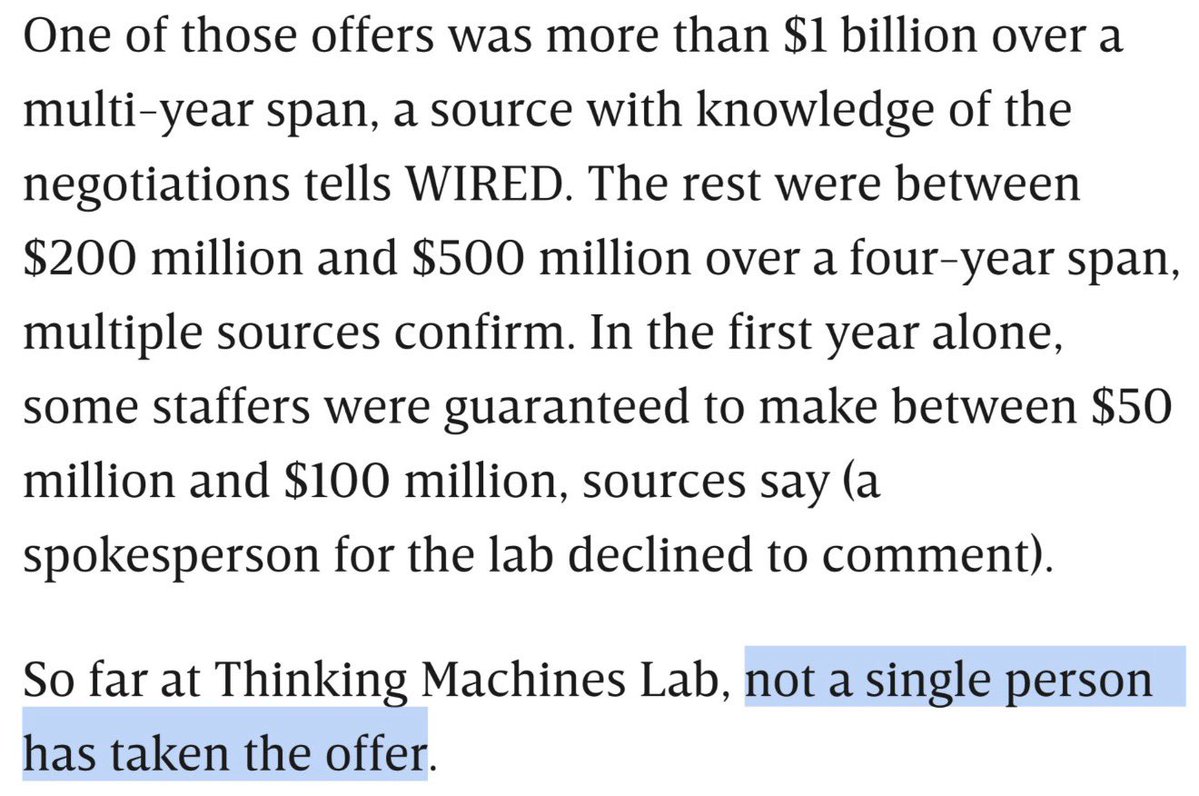
i work at meta. hr systems. mostly comp processing. quiet job. stable. sometimes i daydream about retiring in portugal.
today a package hit my queue. base + bonus + equity. looks normal at first glance. then i open the details.
$1,000,000,000
over four years.
plus signing.
plus year 1 minimum: $100m.
i stare at it like it’s a typo. check the name. triple check the level. researcher.
coolcoolcool. so now i have to enter this into workday.
i paste the first number, field throws an error.“value must be below $99,999,999.”
lol. okay. i try splitting it. base in one bucket, equity in another. nope. i try scientific notation. it rounds it down.
the system can’t HANDLE a billion dollars.
i call someone on payroll infra. tell them i’ve got a 10-digit comp packet. they think i’m joking. i forward the req. they go quiet.
“we’re gonna need to escalate this,” someone mutters.
“to who?” i ask.
“god, maybe.”
next thing i know zuck’s chief of staff is in the thread. now i’m in a thread with zuck. because of a number.
then i find out the guy declined the offer.
just said no. no negotiation. no counter. just… no.
i’ve been maxing out my 401k for 11 years & this man said no to a billion dollars like he was skipping dessert.
i close the ticket. delete the draft.
go for a walk.
& then i rethink everything.

English
Willis Wee retuiteado

Try to be the best version of you
Too many young founders are desperate to be someone else
Reads with Ravi@readswithravi
“You escape competition through authenticity.” - @naval

English
Willis Wee retuiteado

Announcing a new Coursera course: Retrieval Augmented Generation (RAG)
You'll learn to build high performance, production-ready RAG systems in this hands-on, in-depth course created by DeepLearning.AI and taught by @ZainHasan6, experienced AI and ML engineer, researcher, and educator.
RAG is a critical component today of many LLM-based applications in customer support, internal company Q&A systems, even many of the leading chatbots that use web search to answer your questions. This course teaches you in-depth how to make RAG work well.
LLMs can produce generic or outdated responses, especially when asked specialized questions not covered in its training data. RAG is the most widely used technique for addressing this. It brings in data from new data sources, such as internal documents or recent news, to give the LLM the relevant context to private, recent, or specialized information. This lets it generate more grounded and accurate responses.
In this course, you’ll learn to design and implement every part of a RAG system, from retrievers to vector databases to generation to evals. You’ll learn about the fundamental principles behind RAG and how to optimize it at both the component and whole-system levels.
As AI evolves, RAG is evolving too. New models can handle longer context windows, reason more effectively, and can be parts of complex agentic workflows. One exciting growth area is Agentic RAG, in which an AI agent at runtime (rather than it being hardcoded at development time) autonomously decides what data to retrieve, and when/how to go deeper. Even with this evolution, access to high-quality data at runtime is essential, which is why RAG is a key part of so many applications.
You'll learn via hands-on experiences to:
- Build a RAG system with retrieval and prompt augmentation
- Compare retrieval methods like BM25, semantic search, and Reciprocal Rank Fusion
- Chunk, index, and retrieve documents using a Weaviate vector database and a news dataset
- Develop a chatbot, using open-source LLMs hosted by Together AI, for a fictional store that answers product and FAQ questions
- Use evals to drive improving reliability, and incorporate multi-modal data
RAG is an important foundational technique. Become good at it through this course!
Please sign up here: coursera.org/learn/retrieva…
English
Willis Wee retuiteado

After 12+ years, 25 batches, and the privilege of advising >1,000+ startups, I’m transitioning to Partner Emeritus at Y Combinator.
YC changed my life. I’m grateful to the thousands of founders who trusted me with their journeys, my fellow YC partners and teammates, and to Paul, Jessica, Trevor, and Robert for creating this extraordinary institution.
Standard Capital is name of the AI-native Series A firm I’m co-founding with two of my favorite people: Paul Buchheit, my longtime colleague at YC, and Bryan Berg, the CTO of my previous startups.
AI is reshaping every aspect of our world. We aim to embed AI in every part of our business and back the AI disruptors of tomorrow.
Follow us at @Standard_Cap, you’ll be hearing more from us soon!
English
Willis Wee retuiteado

In the age of AI, large corporations — not just startups — can move fast. I often speak with large companies’ C-suite and Boards about AI strategy and implementation, and would like to share some ideas that are applicable to big companies. One key is to create an environment where small, scrappy teams don’t need permission to innovate. Let me explain.
Large companies are slower than startups for many reasons. But why are even 3-person, scrappy teams within large companies slower than startups of a similar size? One major reason is that large companies have more to lose, and cannot afford for a small team to build and ship a feature that leaks sensitive information, damages the company brand, hurts revenue, invites regulatory scrutiny, or otherwise damages an important part of the business. To prevent these outcomes, I have seen companies require privacy review, marketing review, financial review, legal review, and so on before a team can ship anything. But if engineers need sign-off from 5 vice presidents before they’re even allowed to launch an MVP (minimum viable product) to run an experiment, how can they ever discover what customers want, iterate quickly, or invent any meaningful new product?
Thanks to AI-assisted coding, the world now has a capability to build software prototypes really fast. But many large companies’ processes – designed to protect against legitimate downside risks – make them unable to take advantage of this capability. In contrast, in small startups with no revenue, no customers, and no brand reputation the downside is limited. In fact, going out of business is a very real possibility anyway, so moving fast makes a superior tradeoff to moving slowly to protect against downside risk. In the worst case, it might invent a new way to go out of business, but in a good case, it might become very valuable.
Fortunately, large companies have a way out of this conundrum. They can create a sandbox environment for teams to experiment in a way that strictly limits the downside risk. Then those teams can go much faster and not have to slow down to get anyone’s permission.
The sandbox environment can be a set of written policies, not necessarily a software implementation of a sandbox. For example, it may permit a team to test the nascent product only on employees of the company and perhaps alpha testers who have signed an NDA, and give no access to sensitive information. It may be allowed to launch product experiments only under newly created brands not tied directly to the company. Perhaps it must operate within a pre-allocated budget for compute.
Within this sandbox, there can be broad scope for experimentation, and — importantly — a team is free to experiment without frequently needing to ask for permission, because the downside they can create is limited. Further, when a prototype shows sufficient promise to bring it to scale, the company can then invest in making sure the software is reliable, secure, treats sensitive information appropriately, is consistent with the company’s brand, and so on.
Under this framework, it is easier to build a company culture that encourages learning, building, and experimentation and celebrates even the inevitable failures that now come with modest cost. Dozens or hundreds of prototypes can be built and quickly discarded as part of the price of finding one or two ideas that turn out to be home runs. This also lets teams move quickly as they churn through those dozens of prototypes needed to get to the valuable ones.
I often speak with large companies about AI strategy and implementation. My quick checklist of things to consider is people, process, and platform. This letter has addressed only part of processes, with an emphasis on moving fast. I’m bullish about what both startups and large companies can do with AI, and I will write about the roles of people and platforms in future letters.
[Original text: deeplearning.ai/the-batch/issu… ]
English