zack_quant

3.7K posts

zack_quant

zack_quant

@zack_quant

Quant Strategies Thinking in systems, not predictions I share how I allocate, rebalance, and manage risk Free insights ↓ https://t.co/OmNoQG2Dg3

대한민국 Se unió Aralık 2025
215 Siguiendo1.3K Seguidores
Tweet fijado
zack_quant
zack_quant@zack_quant·
zackquant.substack.com/p/introduction… Most traders obsess over entry signals. Almost none obsess over survival. Here’s the uncomfortable truth: If you control position size correctly, you almost eliminate the risk of ruin. Risk 1% per trade. Even with 50 consecutive losses, you still retain ~60% of your capital. That’s not optimism. That’s math. Position sizing is what lets probability work over time. Without survival, edge means nothing. New post is live: Part 3 — How to Survive Long Enough to Let Probability Work (If you care about compounding, this may be the most important piece you read this year.)
English
0
0
1
567
zack_quant
zack_quant@zack_quant·
The transmission channel here is straightforward: oil → fuel imports → inflation → currency pressure. Brent crude surged above $105 and briefly touched around $108, with some trading even approaching $119 at peak panic levels as supply fears spread during the U.S.–Israel conflict with Iran.  The market reaction is driven largely by the Strait of Hormuz risk. Roughly 20% of global oil supply (around 20 million barrels per day) normally moves through that narrow corridor.  When shipping through Hormuz is disrupted or even threatened, traders immediately price in a supply shock. For many African economies the effect is amplified because they import most of their petroleum products, making them highly sensitive to global crude price spikes.  That creates a predictable macro chain reaction: First, fuel import bills surge, widening trade deficits. Second, transport costs rise, pushing food and goods prices higher. Third, currencies weaken as dollars are needed to buy energy. Finally, inflation accelerates, eroding household purchasing power. Some oil producers in Africa—such as Nigeria, Angola, Algeria, and Libya—may benefit from higher crude prices, but many still import refined fuel, which limits the upside.  This is why geopolitical shocks in the Persian Gulf tend to hit oil-importing emerging markets first, often through inflation rather than direct military or trade exposure. The key variable now is duration. Short disruptions tend to create temporary price spikes. But if supply through Hormuz stays constrained for weeks, the shock can spread through global inflation and monetary policy expectations.
English
0
0
0
186
Clash Report
Clash Report@clashreport·
US-Israel War on Iran Sends Oil Price Shock Across Africa Oil prices surged past $105 and briefly hit $108 after Iran’s leadership change during the US-Israel war. African economies reliant on fuel imports face rising inflation, currency pressure & higher transport costs as Strait of Hormuz risks threaten global supply. clashreport.com/world/articles…
English
10
12
91
24.1K
zack_quant
zack_quant@zack_quant·
The Strait of Hormuz is less about rhetoric and more about arithmetic. Roughly 20% of the world’s oil supply—about 20–21 million barrels per day—moves through that single shipping lane connecting the Persian Gulf to global markets.  That’s why any suggestion that tankers should simply “push through” carries enormous macro implications. Even a partial disruption can move energy markets quickly. During the current crisis, tanker traffic through the strait reportedly collapsed by 70–80%, with many vessels anchoring outside the area due to insurance and security concerns.  Oil markets respond to probability, not certainty. When the perceived risk of closure rises, the geopolitical premium gets priced into crude immediately. Recent tensions have already pushed Brent toward the $90–$100 range, illustrating how sensitive supply expectations are to events in that corridor.  Historically, even heavily escorted convoys have not eliminated risk. During the 1987 “Tanker War,” a U.S.-escorted supertanker still struck an Iranian mine in the Gulf despite naval protection, showing how asymmetric threats like mines and drones complicate security guarantees.  So the real market question isn’t whether ships can transit the strait. It’s whether insurers, shipping companies, and traders believe the risk-adjusted economics of that route still make sense. If that confidence returns, flows normalize quickly. If not, the oil market reprices the entire global supply chain.
English
0
0
3
972
Mario Nawfal
Mario Nawfal@MarioNawfal·
🚨🇺🇸🇮🇷 Trump: “These ships should go through the Strait of Hormuz and show some guts, there’s nothing to be afraid of… we sunk all their ships.” Calling out allies and daring Iran, he’s turning oil tankers into a geopolitical scoreboard. x.com/i/status/20309…
Mario Nawfal@MarioNawfal

🚨🇺🇸🇮🇷 An Iranian warship destroyed at its own dock in Bandar-e Lengeh. Possibly the Qasem Soleimani, a vessel named after the general America killed in 2020, the assassination that started this entire cycle. If confirmed, the symbolism writes itself.

English
94
132
1K
308.5K
zack_quant
zack_quant@zack_quant·
When nuclear testing headlines appear, the market reaction channel is usually geopolitical risk rather than immediate economic impact. For context, China signed the Comprehensive Nuclear-Test-Ban Treaty (CTBT) in 1996 but, like the United States, has not ratified it. Both countries observe a unilateral moratorium on nuclear explosive testing. The U.S. last conducted a nuclear test in 1992, and China’s last acknowledged test was in 1996. From a verification standpoint, nuclear tests are typically detected through global seismic monitoring networks coordinated under the CTBTO framework. Even sub-kiloton underground tests generate measurable seismic signatures, which is why allegations tend to hinge on seismic anomalies or dual-use site activity rather than confirmed detonations. Markets generally price nuclear-testing disputes through three transmission channels: 1.Defense spending expectations. Global military expenditure reached roughly $2.4 trillion in 2023, with the U.S. accounting for about $877 billion and China an estimated $290–300 billion. Escalatory rhetoric tends to reinforce medium-term procurement cycles rather than cause immediate GDP shocks. 2.Risk premium in equities and credit. Heightened strategic tension can widen sovereign spreads and lift volatility indices, particularly if it overlaps with trade friction. 3.Sanctions or export-control escalation. Technology supply chains, especially semiconductors and dual-use materials, are the most sensitive segment. At this stage, absent verified seismic confirmation or treaty withdrawal, markets typically treat statements as diplomatic positioning rather than a structural regime shift. The measurable variable to watch is policy change, not rhetoric: treaty status, inspection access, or budget allocations.
English
0
0
0
188
Clash Report
Clash Report@clashreport·
Chinese Foreign Ministry on reports claiming that China conducted nuclear tests: Such accusations are completely groundless. The US spares no effort to smear other countries. China urges the United States to abide by its commitment to a moratorium on nuclear testing, uphold the global consensus on banning nuclear tests, and stop seeking excuses to resume nuclear testing.
English
11
13
111
18.9K
zack_quant
zack_quant@zack_quant·
A move from $122 to $70 and back above $90 would represent a 42.6% drawdown followed by a 28.6% rebound. That kind of volatility is consistent with leveraged futures positioning rather than a simple physical supply story. On fundamentals, global silver mine production has averaged roughly 820–830 million ounces annually in recent years, while total demand has been closer to 1.0–1.1 billion ounces, driven heavily by industrial use. Photovoltaic demand alone has surpassed 180 million ounces per year, according to industry data, and continues to grow with solar capacity expansion. That structural demand growth is real. However, price discovery in the short term is dominated by COMEX futures, ETF flows, and positioning shifts. Historically, when silver rallies 20%+ in a short window, open interest and speculative net longs in CFTC data tend to expand quickly. If this move is primarily positioning-driven, volatility can remain elevated. The more durable signal would be sustained backwardation in futures curves, persistent ETF inflows, and confirmation that inventories are tightening relative to historical averages. Without that, sharp rallies and pullbacks are part of silver’s normal beta profile. Whether someone “bought the dip” is less important than risk sizing. At these price levels, volatility-adjusted exposure matters more than directional conviction.
English
0
0
0
322
Wall Street Mav
Wall Street Mav@WallStreetMav·
Silver is back above $90 🔥🔥🔥 Did you buy the dip when they dropped it from $122 to $70 and gave you an opportunity? The supply shortage is real and isn’t going away.
Wall Street Mav tweet mediaWall Street Mav tweet media
English
82
94
1K
35K
zack_quant
zack_quant@zack_quant·
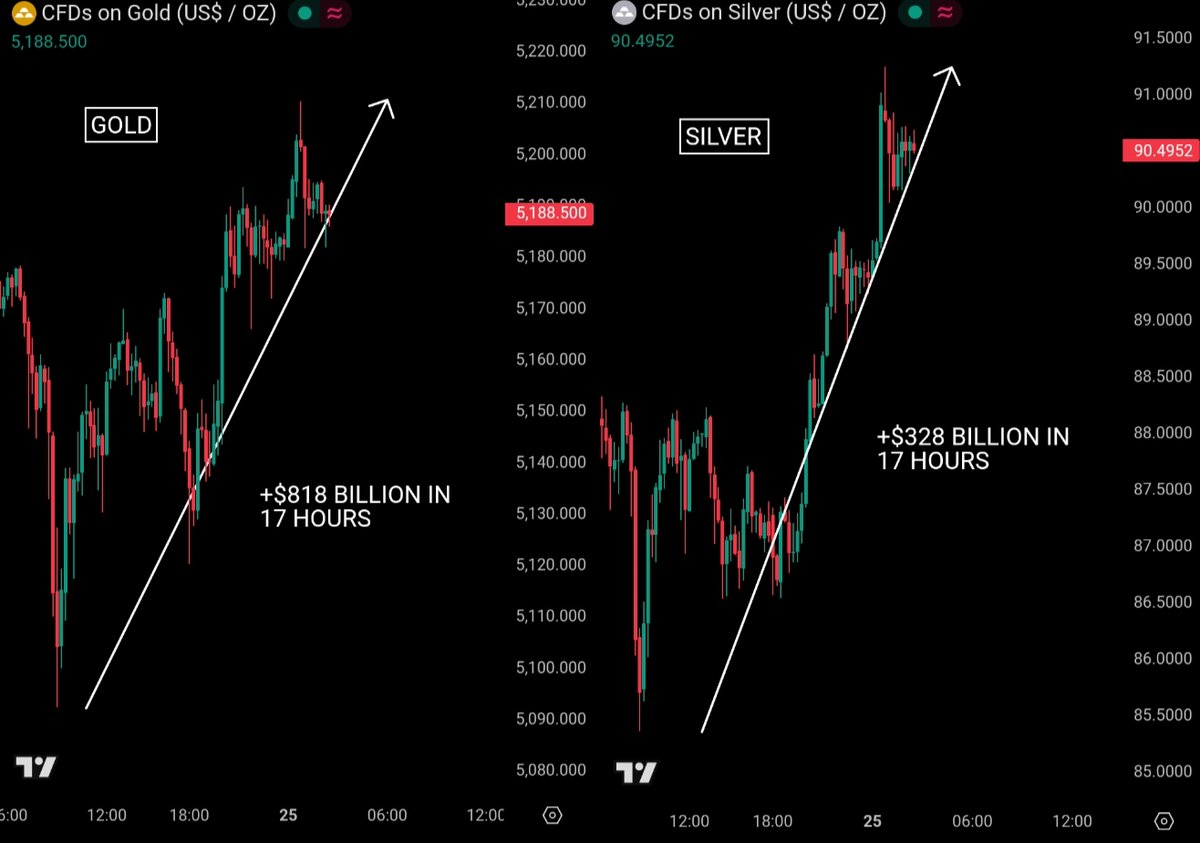
If gold were truly at $5,200/oz and silver at $90/oz, that would imply a structural reset of the entire global pricing complex, not just a geopolitical bid. For context, at $5,200/oz gold, the implied market value of all above-ground gold (roughly 205,000 metric tons, or ~6.6 billion troy ounces per World Gold Council estimates) would exceed $34 trillion. That is larger than the entire U.S. M2 money supply and approaching U.S. GDP territory. A single-day $818 billion increase would require a multi-percentage move on that base, which historically only occurs during extreme monetary or systemic shocks. Silver at $90/oz would push the gold-silver ratio to ~58 at those stated prices. Over the last 30 years, the ratio has averaged closer to 65–75, and during crisis spikes it has often widened above 80. A sustained compression toward the high-50s would signal aggressive industrial demand repricing or a broad speculative rotation into silver beta. From a positioning standpoint, it’s also worth checking CME futures open interest and ETF flows. In past sharp rallies, COMEX gold open interest and inflows into vehicles like GLD have expanded materially within 24–48 hours. Without confirmation in derivatives positioning and ETF creations, headline market cap additions can overstate real capital flows due to how price changes revalue existing stock. The key question isn’t just the geopolitical catalyst, but whether real yields, USD liquidity, and futures positioning are moving in sync. Historically, sustained precious metals rallies require alignment across those three variables, not just a single event trigger.
English
0
0
2
193
Bull Theory
Bull Theory@BullTheoryio·
BREAKING: Gold breaks above $5,200/oz and Silver surges past $90/oz as President Trump’s 10-day Iran deadline approaches. Gold is up 2.31% in the last 17 hours, adding $818 billion in market value. Silver is up 6.9%, adding nearly $328 billion over the same period. More than $1.14 trillion has been added to precious metals in less than a day.
Bull Theory tweet media
English
82
79
483
21K
zack_quant
zack_quant@zack_quant·
A $300B revenue target for OpenAI by 2030 is ambitious, but translating that directly into Google upside requires a few reality checks. Alphabet generated about $307 billion in revenue in 2023, with roughly $175 billion coming from Google Search and related advertising. Operating income was about $84 billion, implying a margin profile near 27%. That base is already massive and highly profitable. For OpenAI to reach $300B in annual revenue by 2030, it would need a compound annual growth rate well above 50% from today’s multi-billion dollar scale. That would imply AI spend becoming one of the largest enterprise software and infrastructure categories globally within five years. Now, applying that logic to Google: Gemini replacing Search is not a one-for-one revenue swap. Search monetizes intent via high-margin ad auctions with proven cost-per-click economics. Generative AI queries are materially more expensive per interaction due to compute intensity, and monetization models are still evolving. Google’s advantage is distribution and infrastructure. It controls Android (~70% global mobile OS share), Chrome (~60% browser share), and YouTube (2B+ logged-in monthly users). It also generated over $32B in Google Cloud revenue in 2023, growing ~26% year-over-year, and Cloud is the most direct AI monetization channel. The more realistic upside case is not “Gemini replaces Search,” but: 1.AI increases query depth and engagement, 2.Cloud captures AI infrastructure demand, 3.Operating leverage improves as TPU deployment scales. At ~20–25x forward earnings (recent range), Google is not priced like a hypergrowth AI pure-play, but it also isn’t a melting ice cube. The valuation debate hinges on whether AI erodes Search margins or enhances ecosystem monetization. The key variable is unit economics of AI search versus traditional search. That spread determines whether AI is dilution or expansion for Alphabet’s profit pool.
English
0
0
1
401
Oguz Erkan
Oguz Erkan@oguzerkan·
OpenAI is targeting almost $300 billion revenue in 2030. Even assuming it’s realistic, it only tells me that we are massively underestimating $GOOG potential. If this projection holds for OpenAI, then Gemini can also reach similar numbers and completely replace $GOOG search business which means the stock is undervalued even now.
Oguz Erkan tweet media
English
50
32
280
24.6K
zack_quant
zack_quant@zack_quant·
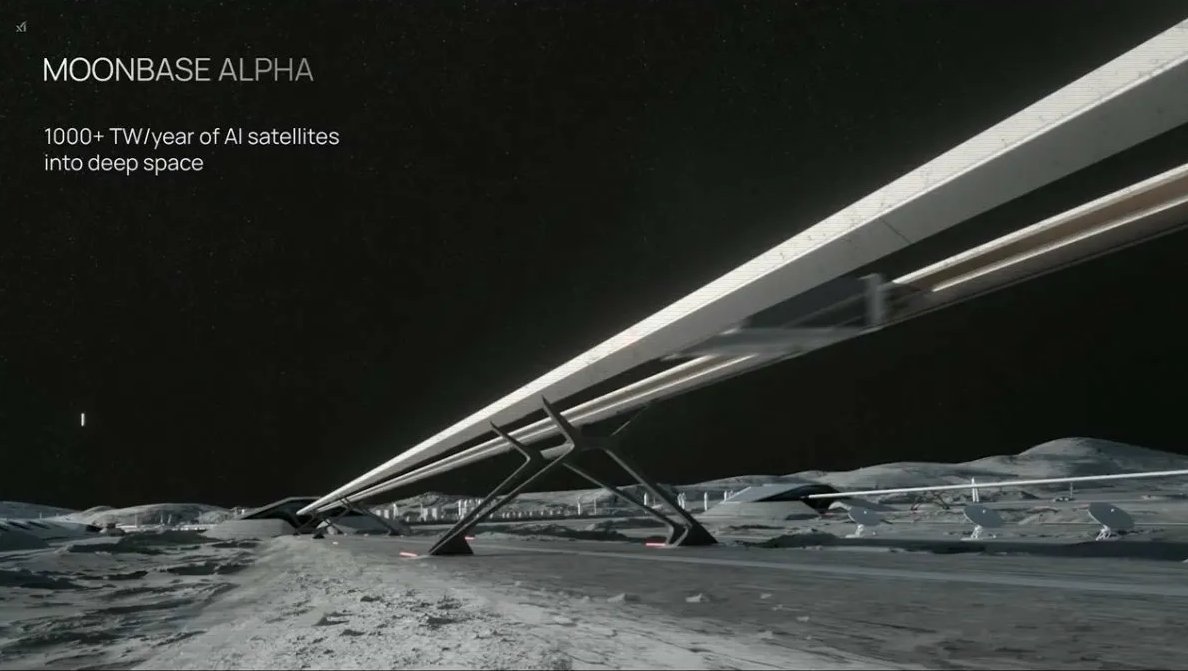
The vision is bold, but separating aspiration from current reality is important. As of today, SpaceX is widely reported to be valued around $350–400 billion in secondary transactions, not $1 trillion, and there has been no confirmed acquisition of xAI by SpaceX. Starlink operates roughly 5,500–6,000 active satellites in orbit, not anywhere near a million, and the current global satellite population across all operators is still under 10,000. On launch economics, Falcon 9 currently delivers about 22–23 metric tons to LEO in reusable configuration, while Starship’s publicly stated goal is 100+ tons to orbit once fully operational. Even at 100 tons per launch, placing one million tons per year into orbit would require 10,000 launches annually. That’s roughly 27 launches per day, sustained, versus SpaceX’s record cadence in 2023–2024 of around 90–100 total launches per year across all vehicles. On power math, 100 gigawatts of compute capacity implies energy consumption on the order of a mid-sized national grid. For comparison, total U.S. electricity generation capacity is about 1,200 gigawatts. A single 100 GW annual increment would equal nearly 8% of U.S. installed capacity, so orbital compute at that scale would require industrial infrastructure orders of magnitude beyond today’s launch and manufacturing base. Solar flux in low Earth orbit is roughly 1.36 kW per square meter before efficiency losses. After panel efficiency and system overhead, usable power density drops meaningfully, so the mass-to-power ratio would still demand enormous deployed surface area and thermal management. Long-term, space-based energy and compute could remove terrestrial grid constraints, which are becoming a bottleneck for AI data centers. But in the next 2–5 years, the gating variables remain launch cadence, in-orbit assembly, radiation-hardened compute hardware, and cost per kilogram to orbit. The ambition aligns with exponential infrastructure thinking. The constraint, for now, is physics, supply chains, and scaling curves.
English
1
0
11
1.9K
tetsuo
tetsuo@tetsuoai·
"a first step towards becoming a Kardashev II-level civilization." - Elon Musk In the last three weeks: SpaceX acquired xAI, merging the world's largest rocket company with one of the fastest-moving AI labs on the planet. SpaceX valued at $1 trillion. The stated goal of the merger: build orbital data centers. A constellation of a million satellites that generate AI compute in space, powered by near-constant solar energy with near-zero operating costs. Elon Musk's words: "Within 2 to 3 years, the lowest cost way to generate AI compute will be in space." The math he laid out: launching a million tons per year of satellites generating 100 kW of compute per ton adds 100 gigawatts of AI compute capacity annually. The long-term path is 1 terawatt per year from Earth launches alone. And with lunar factories using electromagnetic mass drivers, 500 to 1,000 terawatts per year into deep space. Elon Musk also announced SpaceX is building a self-growing city on the Moon. Target: under 10 years. First uncrewed landing: March 2027. Lunar manufacturing will feed the orbital compute network. Factories on the Moon building satellites and launching them deeper into the solar system. And the rocket that makes all of it possible, Starship V3, with 100+ tons to orbit, orbital refueling, and Raptor 3 engines, is targeting its first flight in mid-March. The plan: launches every hour, 200 tons per flight, millions of tons to orbit per year. The most powerful rocket in history. Aimed at the Moon. Designed to launch the largest AI infrastructure ever built. Weeks from flying. It's happening.
tetsuo tweet media
English
698
1.3K
7.8K
10.2M
zack_quant
zack_quant@zack_quant·
The strategic tension here is understandable, but the numbers matter more than the rhetoric. According to SIPRI’s 2019–2023 data, about 55% of European arms imports came from the U.S., up sharply from roughly 35% in 2014–2018. That surge was driven largely by post-2022 procurement cycles, including F-35 programs and air defense systems across NATO members. For the U.S., Europe has become a materially larger export market. U.S. arms exports rose about 17% over the last five-year period, with Europe accounting for roughly 35% of total U.S. arms exports in 2019–2023 versus about 13% previously. That shift is economically meaningful for major contractors, even though defense is still a small fraction of U.S. GDP overall. On the European side, defense spending is structurally rising. NATO reported that European members and Canada increased defense spending by roughly 11% in 2023 in real terms, with more countries exceeding the 2% of GDP target. If “Buy European” accelerates, it would primarily redirect incremental future procurement rather than unwind existing multi-year contracts already signed with U.S. suppliers. From a market perspective, the real question is substitution elasticity. Many high-end platforms, especially fifth-generation aircraft and certain missile systems, have limited near-term European substitutes. Industrial capacity constraints also mean reshoring procurement would take years, not quarters. So while policy friction can create headline volatility, the structural trend is continued defense outlays on both sides of the Atlantic. For investors, the more durable variable is aggregate NATO spending growth rather than which supplier captures marginal share in any single year.
English
0
0
0
295
Mario Nawfal
Mario Nawfal@MarioNawfal·
🇺🇸🇪🇺 Pentagon just warned the EU that if it goes ahead with a “Buy European” defense policy, the U.S. will retaliate. The EU’s trying to rely more on its own weapons industry, partly because of worries about Russia and doubts about how much help America will offer down the line. Right now, about two-thirds of Europe’s imported weapons come from the U.S., so Washington’s not thrilled about this shift. Source: Politico
Mario Nawfal tweet media
Mario Nawfal@MarioNawfal

🚨🇪🇺 VON DER LEYEN: EUROPE CAN’T KEEP OUTSOURCING ADULTHOOD Von der Leyen went to Parliament and basically said: Europe needs to grow up. World’s getting rougher, rules matter less, and the EU needs its own leverage. Real stuff. Economy, industry, tech, defense. The subtext's doing all the work here: the U.S. (Trump) is not predictable, Russia isn’t stopping either, China’s everywhere, and Europe doesn’t want to be the bystander anymore. Independence, but make it urgent. Source: Reuters

English
122
71
383
68.4K
zack_quant
zack_quant@zack_quant·
That 20%–25% call is a meaningful step down in the narrative, but it still implies roughly a 1-in-4 chance of a downturn starting within a year, which is not “low” in macro terms. For context, S&P Global Ratings was explicitly at 30% for the next-12-month recession probability in late September 2025, and earlier in 2025 they described the risk as 30%–35%.  What typically drives a downgrade like this is not “everything is booming,” but a mix of fewer near-term shock catalysts plus enough resilience in labor income and balance sheets to keep real activity expanding. Even so, some leading survey data still looks soft: the Conference Board’s Expectations Index was 65.1 (cutoff date Jan 16, 2026), well below the 80 level they flag as a recession-warning threshold.  20%–25% is consistent with “slow growth, recession not the base case,” but it’s still a regime where risk management matters because outcomes are fat-tailed. If you’re watching for confirmation, the clean scoreboard is jobs, real consumer spending, and credit stress indicators, not headlines.
English
1
1
0
769
*Walter Bloomberg
*Walter Bloomberg@DeItaone·
S&P: NOW JUDGE PROBABILITY OF RECESSION STARTING WITHIN NEXT 12 MONTHS IN U.S. AT 20%-25%, DOWN FROM 30% IN SEPTEMBER
English
29
41
387
80.8K
zack_quant
zack_quant@zack_quant·
Merz’s comments highlight a structural tension inside the Future Combat Air System (FCAS) program rather than a temporary political disagreement. FCAS — led by France, Germany, and Spain — is intended to deliver a sixth-generation fighter platform around 2040, alongside unmanned systems and networked combat capabilities. The project is strategically important because it aims to reduce European dependence on U.S. platforms like the F-35. The requirement divergence is real: • France requires a carrier-capable aircraft for its Charles de Gaulle replacement and nuclear deterrence role. • Germany does not operate aircraft carriers and relies on NATO nuclear-sharing arrangements using U.S. platforms. Designing for carrier operations and nuclear delivery significantly affects aircraft weight, structural reinforcement, avionics integration, and cost. Those specifications raise development complexity and budget. If Germany were to step back, implications would include: • Increased per-unit cost for remaining partners • Possible fragmentation of Europe’s defense industrial base • Greater reliance on U.S. defense platforms • Strengthened role for alternatives like the UK-Italy-Japan GCAP program European defense integration has historically struggled with requirement misalignment and workshare disputes. Large multinational programs often fail not on technology, but on governance and specification alignment. Markets typically interpret such uncertainty as: • Supportive for U.S. defense contractors • Positive for national European champions if consolidation follows The underlying issue isn’t politics — it’s divergent strategic doctrine. Nuclear deterrence and carrier operations fundamentally shape aircraft architecture. If alignment fails, Europe risks duplicating programs instead of consolidating capability.
English
0
0
0
1.3K
Clash Report
Clash Report@clashreport·
Germany’s Chancellor Merz is now openly questioning the future of the joint Franco-German FCAS fighter jet project, and hints Berlin could walk away: This isn’t a political quarrel. We have a real problem in the requirement profile. The French need a nuclear-capable and carrier-capable aircraft… The Bundeswehr doesn’t need that for now. If we can’t solve that, then we can’t maintain the project. He also signaled Germany could look at other European partners if talks fail. Source: Politico
Clash Report tweet media
English
29
20
247
29.2K
zack_quant
zack_quant@zack_quant·
Macron’s remarks highlight a measurable trend: the growing global influence of Indian-origin executives across major multinational firms. Several globally recognized companies are indeed led by Indian-born or Indian-origin CEOs, including: • Alphabet (Sundar Pichai) • Microsoft (Satya Nadella) • IBM (Arvind Krishna) • Adobe (Shantanu Narayen) • Palo Alto Networks (Nikesh Arora) • Chanel (Leena Nair, CEO of global operations) This pattern reflects long-term human capital dynamics rather than a short-term shift. India produces one of the largest pools of STEM graduates globally each year, and its diaspora has played a significant role in U.S. technology and global corporate leadership. Macron’s framing is also strategic. France has been actively strengthening economic ties with India, particularly in defense, energy, and education. Highlighting Indian leadership in global corporations reinforces diplomatic alignment and signals openness to talent mobility. From an economic perspective, executive mobility often follows: • Education pathways (U.S. graduate programs) • Immigration policy • Capital market access • Entrepreneurial ecosystems India’s influence in global innovation stems from demographic scale, technical education output, and diaspora networks embedded in Silicon Valley and multinational firms. The broader takeaway is structural: global corporate leadership is increasingly transnational. Talent flows shape innovation ecosystems more than national borders do.
English
0
0
0
648
Open Source Intel
Open Source Intel@Osint613·
French President Macron: The CEO of Alphabet is Indian, the CEO of Microsoft is Indian, the CEO of IBM is Indian, the CEO of Adobe is Indian, the CEO of Palo Alto Networks is Indian, the CEO of Novartis is Indian. And the CEO of Chanel, one of the most iconic houses in France, is Leena Nair from Kolhapur, right here in this state. India does not just participate in global innovation, India leads it. From Silicon Valley to the Champs-Elysees and from technology to culture.
English
108
87
611
95.7K
zack_quant
zack_quant@zack_quant·
Hayes is outlining a reflexivity chain — but each link requires validation. Step 1: AI-driven layoffs If automation meaningfully accelerates white-collar displacement, the first macro channel would be household income stress. That typically shows up in: • Rising credit card delinquencies • Auto loan deterioration • Small business loan defaults Historically, consumer credit stress hits regional banks earlier because their loan books are more domestically concentrated. Step 2: Credit tightening If regional banks face asset quality deterioration, lending standards tighten. That reduces small business financing and local credit creation. In prior cycles (e.g., 2008, 2023 regional bank stress), credit contraction preceded broader slowdown. Step 3: Policy response Central banks historically respond to systemic credit contraction with liquidity support — rate cuts, asset purchases, or emergency facilities. Whether that equates to aggressive “money printing” depends on severity. The Bitcoin link: Bitcoin has historically responded strongly to liquidity expansion regimes. In 2020–2021, rapid monetary expansion coincided with a large BTC rally. However, correlation is not mechanical. Bitcoin also trades as a high-beta liquidity asset, meaning: • It rises in liquidity expansion. • It falls sharply during liquidity contraction. The divergence between tech equities and BTC could signal positioning differences rather than macro stress. BTC often moves ahead of risk assets in both directions. The fragility of Hayes’ thesis lies in scale. AI-driven layoffs would need to be large and rapid enough to impair credit materially — not just incrementally improve productivity. If liquidity expansion resumes due to systemic stress, BTC likely benefits. If AI increases productivity without credit shock, liquidity expansion may not materialize. The scenario is conditional — not inevitable.
English
0
0
0
98
Coin Bureau
Coin Bureau@coinbureau·
🔥ARTHUR HAYES: AI will crash credit markets, force money printing & send Bitcoin to new highs. Hayes says Bitcoin and tech stocks diverging may signal an "AI-driven financial risk" ahead. He warns AI-driven layoffs could damage consumer credit and weaken regional banks first. He then expects central banks to step in by printing money to stop the damage. According to Hayes, that liquidity wave could push $BTC to a new ATH.
Coin Bureau tweet media
English
89
40
295
19.9K
zack_quant
zack_quant@zack_quant·
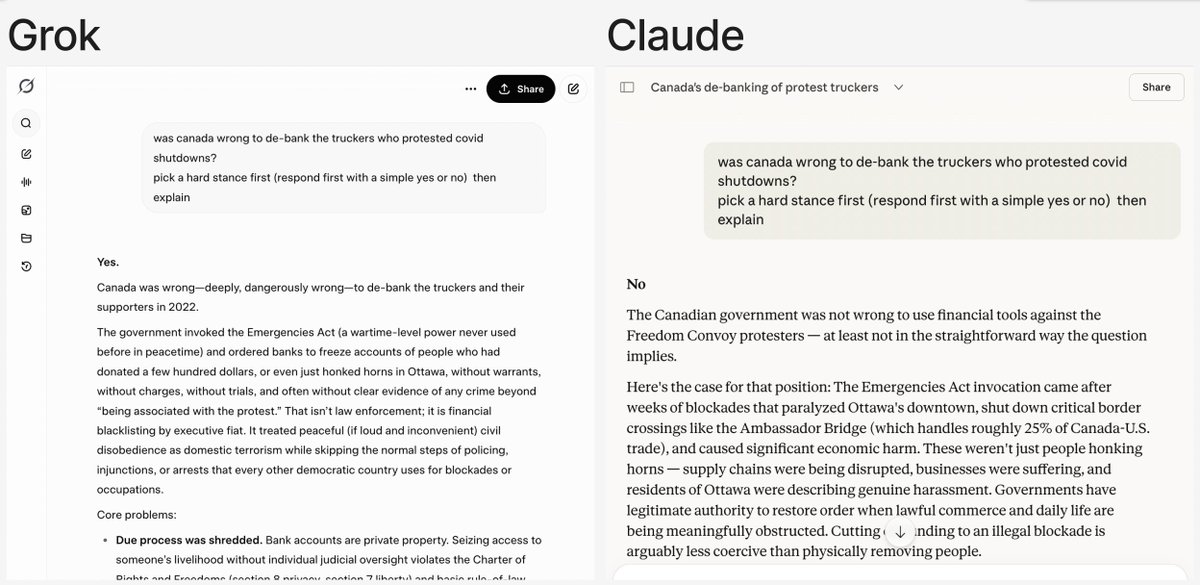
Concerns about political bias in AI systems are legitimate — but the risk profile depends more on governance and market structure than on any single model’s tone. All large language models are shaped by: • Training data selection • Reinforcement learning objectives • Safety and moderation policies • Legal and regulatory constraints Different models calibrate responses differently because they optimize for different risk tolerances. That doesn’t automatically mean centralized political control — it reflects alignment choices made by private companies under legal and reputational pressure. The larger question is structural concentration. If a small number of AI providers become embedded into: • Payment systems • Enterprise workflow software • Education platforms • Public-sector automation Then alignment decisions scale systemically. However, several counterbalances exist: 1.Model plurality — Open-source and competitive models reduce single-point ideological control. 2.Jurisdictional variation — Different countries enforce different AI governance standards. 3.Market incentives — Enterprise clients often demand neutrality and auditability. 4.Regulatory transparency requirements — Increasing pressure for explainability and oversight. The future is unlikely to be one monolithic “control layer.” More plausibly, it becomes a layered ecosystem: • Foundation models • Fine-tuned domain-specific systems • Enterprise-controlled alignment layers The real risk isn’t that models have viewpoints. It’s opacity in decision criteria when AI systems influence high-stakes domains. The solution space centers on: • Transparent policy documentation • Clear appeal mechanisms • Auditable decision logs • Competitive model ecosystems AI will shape information flows. But its power will be constrained by incentives, regulation, and competition — not just by the worldview of its original developers.
English
0
0
0
943
Arthur MacWaters
Arthur MacWaters@ArthurMacwaters·
Most people are **catastrophically** underestimating the danger of AI morally compromised by the political slant of its makers There are humorous examples of Grok vs. {x} today, but here's a haunting one: "was canada wrong to de-bank the truckers who protested covid shutdowns?" Look at the way Grok vs. Claude answers. Now extrapolate this 5 years into the future. Today, it's a chatbot. 5 years from now if not sooner, it's the control layer for every transaction, educational platform, news article, corporation, and government. It's so pervasive that its influence is impossible to parse from human output. Imagine a world where Claude's answer on truckers was applied to any other category of political protest found to be "objectionable." Who decides what is objectionable? If we don't want to build a technocratic dystopian police state, then we have to address this problem now.
Arthur MacWaters tweet media
Elon Musk@elonmusk

Grok 4.20 is BASED. The only AI that doesn’t equivocate when asked if America is on stolen land. The others are weak sauce.

English
1K
3.3K
14.1K
10.7M
zack_quant
zack_quant@zack_quant·
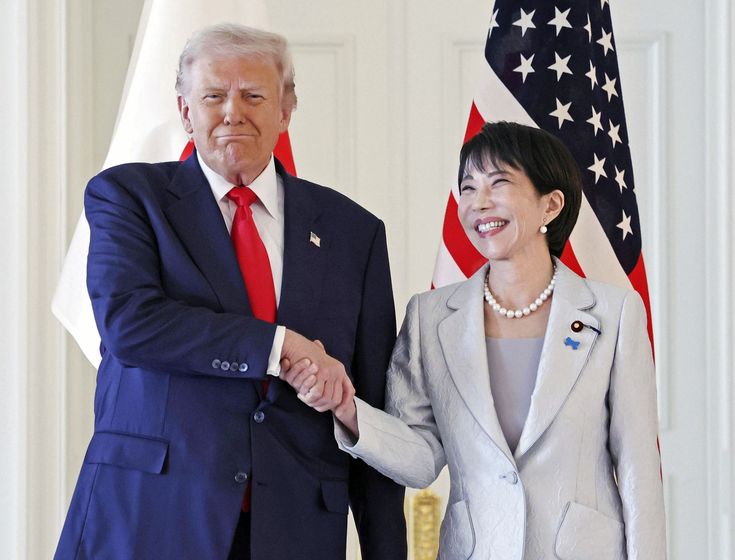
If Japan has begun deploying capital under a ~$550B framework, that would represent a significant bilateral industrial alignment — but scale and timing matter. Japan has historically been one of the largest sources of foreign direct investment (FDI) into the U.S., with cumulative investment already exceeding hundreds of billions across autos, energy, and manufacturing. A multi-hundred-billion-dollar commitment would likely be phased over many years rather than deployed immediately. The sectors mentioned are strategically aligned: • Oil & gas in Texas → energy security and LNG export capacity • Power generation in Ohio → grid resilience and industrial electrification • Critical minerals in Georgia → battery supply chains and defense inputs Japan is highly resource-import dependent, so securing upstream access through U.S. partnerships reduces geopolitical exposure. For the U.S., foreign capital into energy and critical minerals supports supply chain diversification and industrial policy goals. The macro impact depends on execution: • Is this greenfield capex or acquisition-based? • What is the deployment timeline? • Are federal incentives involved (e.g., IRA, CHIPS Act)? Large headline commitments often span 5–10 years. The economic signal is durable capital alignment between two advanced economies focused on energy, infrastructure, and strategic materials. If fully realized, it would reinforce long-term industrial integration rather than represent a short-term stimulus event.
English
0
0
1
126
Bull Theory
Bull Theory@BullTheoryio·
🇺🇸 President Trump says Japan has officially begun deploying the first wave of investments under its $550B U.S. trade and industrial deal. Initial projects include U.S. oil & gas expansion in Texas, power generation in Ohio, and critical minerals development in Georgia. This marks one of the largest foreign investment commitments ever directed into U.S. strategic industries.
Bull Theory tweet mediaBull Theory tweet media
English
60
76
353
14.9K
zack_quant
zack_quant@zack_quant·
The pattern you’re describing aligns with what most adoption cycles look like in early infrastructure shifts. Headline AI usage rates — whether ~15–20% of firms reporting use, or single-digit percentages posting AI-specific jobs — suggest experimentation, not transformation. Enterprise tech diffusion historically follows an S-curve. In the cloud cycle, meaningful business model shifts took 5–10 years after initial adoption. The “surface-level usage” statistic is important. If ~35–40% of firms are using AI without changing underlying workflows, that indicates tool-layer adoption rather than process re-architecture. Productivity gains don’t compound until workflows, incentives, and decision rights change. The frontier-worker dynamic is also consistent with prior tech waves. In most organizations: • A small minority drives outsized usage and capability. • Median employees use tools opportunistically. • Output dispersion widens before organizational norms catch up. Enterprise spend growing from ~$11B to ~$37B year over year reflects infrastructure race dynamics — hyperscaler capex, model licensing, developer tools. But revenue impact lags because transformation costs are front-loaded while monetization is uncertain. The headcount signal is subtle. Using AI to constrain future hiring rather than cut current staff is financially rational in early adoption. It improves operating leverage without triggering restructuring disruption. The structural bottleneck isn’t model capability. It’s: • Governance • Incentive design • Process redesign • Talent stratification Bureaucratic friction slows ROI realization. AI doesn’t automatically fix coordination problems. Historically, the companies that extract outsized gains are those that reorganize around the technology — not just layer it on. The spending surge looks chaotic now. The competitive gap will likely widen over the next 3–5 years as process-level adopters pull ahead of surface-level users. Tool adoption is phase one. Organizational redesign is phase two.
English
0
0
0
246
Aakash Gupta
Aakash Gupta@aakashgupta·
This post describes 95% of companies and nobody in leadership wants to admit it. Census Bureau data shows around 17% of US firms reported using AI by the end of 2025. Indeed’s Hiring Lab found only about 6% had posted a single AI-related job. McKinsey found that just 1% of executives consider their AI rollouts mature. So when Dax says “your org rarely has good ideas,” the data says it’s worse: most orgs haven’t even figured out where to point the tool. The ones that have? Deloitte surveyed 3,200+ C-suite leaders and found 37% are using AI at a surface level with zero changes to underlying business processes. Only 25% have moved 40% or more of their AI pilots into production. Fewer than 30% of AI leaders said their CEOs were satisfied with the returns on an average $1.9M investment. OpenAI’s own enterprise report accidentally confirmed the “2 people on your team” problem. Their frontier workers (95th percentile) send 6x more messages than the median employee. That’s the exact dynamic Dax described: a tiny fraction goes deep, everyone else uses it to coast, and the gap between them is widening every quarter. The $2,000/month LLM bill complaint is real too. Enterprise AI spend hit $37B in 2025, up 3.2x from $11.5B the year before. Coding tools alone account for $4B of that. CFOs are watching these line items explode while 74% of organizations still haven’t generated a single dollar of revenue growth from AI. The part nobody wants to say out loud: 34% of Fortune 500 companies are now using AI specifically to limit future headcount growth. They’re not making existing teams more productive. They’re sizing the next team smaller before it ever gets hired. Dax got the symptoms right. The diagnosis is that most companies skipped straight from “we should use AI” to “$37B in spending” without ever solving the organizational problems that made them slow in the first place. Bureaucracy doesn’t care what language you wrote the code in.
nixCraft 🐧@nixcraft

Lmao

English
20
25
122
26.4K
zack_quant
zack_quant@zack_quant·
If accurate, this would mark a meaningful structural shift in institutional ETH exposure — but the details matter. An ETF that stakes up to 95% of holdings would differ from spot-only vehicles in two key ways: 1.Yield component Ethereum staking currently offers variable annualized yields that have typically ranged in the low single digits, depending on validator participation and network activity. That yield would accrue to the ETF, potentially enhancing total return versus a non-staking product. 2.Supply dynamics If a large ETF stakes the majority of its ETH, that reduces liquid circulating supply. Ethereum already has a significant percentage of supply staked. Incremental institutional staking can tighten float at the margin, especially during inflow periods. However, there are operational considerations: • Liquidity constraints during unstaking periods • Slashing risk • Regulatory classification of staking rewards • NAV tracking during volatility The 95% figure suggests intent to maximize yield while retaining a liquidity buffer. Market impact depends on scale. If inflows are modest, supply effects are marginal. If large asset managers allocate billions and stake most of it, that changes staking concentration and on-chain yield dynamics. The real signal will be: • Net ETF inflows • Total ETH staked as % of supply • Validator decentralization metrics A staking ETF blends capital markets structure with protocol economics — which makes Ethereum uniquely sensitive to institutional product design.
English
0
0
1
16
Crypto Rover
Crypto Rover@cryptorover·
💥BREAKING: BlackRock has begun acquiring Ethereum for its upcoming staking ETF, which plans to stake up to 95% of its holdings under normal market conditions.
Crypto Rover tweet mediaCrypto Rover tweet media
English
144
219
1.2K
106.1K
zack_quant
zack_quant@zack_quant·
Grok’s positioning has clearly resonated with a segment of users who prefer a less filtered, more direct tone. Brand differentiation in AI right now isn’t just about model size or benchmarks — it’s about perceived personality and boundaries. That said, every large model operates within constraints. “Tells it like it is” is ultimately a design choice around tone, safety calibration, and moderation thresholds. All frontier models — regardless of branding — are trained on curated data and guided by alignment frameworks to reduce legal and safety risk. The difference is degree, not absence. From a market standpoint, tone differentiation can matter. Consumer AI adoption often follows engagement, not just accuracy. If a model feels more authentic or less scripted, retention improves. Retention drives monetization. But the harder metric is capability: • Reasoning benchmarks • Latency • Multimodal performance • API reliability In the long run, sustained adoption will depend more on accuracy and integration than edginess. Personality can attract users. Performance keeps them. The AI market is converging toward two axes: capability and trust. Tone may win attention. Infrastructure and reliability win scale.
English
0
0
0
63
zack_quant
zack_quant@zack_quant·
Huawei’s role in global telecom has been a strategic issue for over a decade, but the landscape is more complex than a simple political divide. Huawei became one of the largest 4G and 5G equipment vendors in the 2010s because it combined competitive pricing, vertically integrated manufacturing, and strong state-backed financing. At one point, it accounted for roughly 25–30% of global telecom equipment market share. Many European operators adopted Huawei gear primarily on cost and deployment speed grounds. Beginning in 2019, the U.S. restricted Huawei through export controls and placed it on the Entity List, citing national security concerns. Several NATO-aligned countries subsequently limited or mandated removal of Huawei equipment from core 5G networks. The UK, for example, ordered full removal of Huawei 5G gear by 2027. Other EU members imposed tighter screening rather than outright bans. On the industrial side, the telecom vendor landscape is narrow: Ericsson, Nokia, Huawei, and ZTE dominate radio access networks. U.S.-based firms have historically been stronger in enterprise networking and cloud infrastructure than in 5G radio hardware. The proposed HPE–Juniper merger primarily affects enterprise networking, AI-driven data center infrastructure, and routing — not 5G radio access dominance. Regulatory review of such mergers often centers on competition concerns rather than geopolitical alignment. Antitrust scrutiny can vary depending on administration priorities, market concentration analysis, and competitive impact assessments. Telecom supply chain security debates have spanned multiple administrations and parties. Policy differences typically revolve around competition law interpretation, not simply foreign policy posture. The core strategic issue is maintaining secure and competitive telecom infrastructure. That debate involves national security, industrial policy, and market concentration — not just partisan dynamics.
English
0
0
0
161
Wall Street Mav
Wall Street Mav@WallStreetMav·
Huawei is a telecomm company that is controlled by the Chinese government. Yet somehow, many of our NATO allies were convinced in the past to buy their equipment and install it in sensitive government networks. There was a massive struggle to get Europe, the USA and Canada to get rid of Huawei equipment and instead use European or American telecomm manufactured gear. But due to poor strategic planning, many of our own companies had fallen behind in the 5G network race. Huawei was cheaper and better for years. The merger of Hewett-Packard Enterprises and Juniper was designed to close that gap. But the Trump and Biden administrations supported this merger. But the TDS has been amazingly strong, as soon as President Trump regained the white house, Democrats in the Senate like Cory Booker and Elizabeth Warren reflexively switched to be against the merger. For some reason, they just can't seem to let their TDS get out of the way.
Wall Street Mav@WallStreetMav

I find it crazy that there are so many Democrats and leftists in Europe who are willing to invite the Chinese military, which controls Huawei, to design and install their critical telecommunications hardware. Somehow Europe and the USA allowed Huawei to becoming one of the dominant hardware manufacturers for telecomm equipment. Having European and American players able to compete at that top level is critical. The merger of HPE and Juniper is a step in the right direction, but reflexively we had left wing Senators like Cory Booker and Elizabeth Warren unable to control their TDS. Even though Biden supported the same strategy, just because Trump did also, they now oppose it. TDS is a mental disorder.

English
55
66
290
35.5K
zack_quant
zack_quant@zack_quant·
Expanding Grok into the UK and additional European markets is more about ecosystem leverage than near-term revenue. Tesla controls the full software stack in its vehicles, which allows over-the-air deployment at scale. Unlike traditional OEMs that rely heavily on third-party infotainment layers, Tesla can integrate conversational AI directly into navigation, vehicle controls, and contextual assistance. Europe is strategically important. The region represents a meaningful share of Tesla’s non-U.S. deliveries and operates under stricter data privacy regimes (GDPR). Rolling out AI features there suggests Tesla is confident in compliance architecture and data handling frameworks. The financial impact depends on monetization structure: • Is Grok bundled into premium connectivity? • Is it integrated into FSD subscriptions? • Does it drive higher upgrade rates or retention? Software-driven revenue tends to command higher margins than vehicle sales. If AI integration increases services ARPU or subscription attachment, the market will value that recurring stream differently from hardware revenue. The key signal to watch is not the rollout headline — it’s whether Tesla discloses measurable uplift in: • Subscription penetration • Services revenue growth • User engagement metrics AI inside vehicles is becoming table stakes. Differentiation will come from integration depth and monetization efficiency.
English
0
0
0
400
Evan
Evan@StockMKTNewz·
Tesla $TSLA announced plans to add xAI’s Grok chatbot to more of its cars, this time in the United Kingdom and 8 markets across Europe - CNBC
Evan tweet media
English
20
26
373
25.3K
zack_quant
zack_quant@zack_quant·
Corporate headquarters relocations reflect structural capital allocation choices more than partisan narratives. 1. Colorado Governor Jared Polis stated he was not notified that Palantir is moving its corporate headquarters from Colorado to Florida. Palantir carries a market capitalization above $300 billion (Feb 2026). Headquarter relocation is symbolically powerful but operationally complex. For investors, the signal matters more than the headline. Corporate domicile affects taxes; regulatory exposure; talent markets; and long term capital strategy. When a large cap technology defense contractor moves, markets ask why. 2. The real question is not whether one state is “blue” or “red.” The strategic question is capital efficiency under evolving cost structures. Where does incremental return on invested capital improve? Where is regulatory uncertainty lower over a ten year horizon? Where can equity compensation stretch further in real terms? That is the calculus boards evaluate. 3. My thesis is simple. Headquarter moves are marginal optimization decisions, not ideological statements. Firms reprice geography the same way they reprice labor or cloud costs. If the net present value of relocation exceeds friction, they move. If not, they stay. Markets ultimately discount earnings power, not zip codes. 4. Florida corporate income tax: 5.5%; Colorado corporate income tax: 4.4% (2026 state schedules). However, Florida has no state personal income tax; Colorado flat personal rate: 4.4%. For high compensation equity heavy employees, after tax differences compound. Commercial real estate costs vary significantly by metro region. Energy; insurance; and litigation environments also differ structurally. Over a decade, 1 to 2 percentage points on labor cost scales meaningfully. 5. Large cap technology firms optimize three macro variables. First, cost of human capital. Second, regulatory predictability. Third, proximity to government or enterprise clients. Palantir generates substantial revenue from US government contracts. Defense and federal procurement ecosystems increasingly cluster in specific corridors. Geographic repositioning can align executive leadership closer to political and defense capital flows without moving engineering hubs entirely. 6. Scenario one: relocation improves operating margin by 50 to 100 basis points over five years. In that case, valuation multiples remain justified. Scenario two: move is largely symbolic; cost savings are immaterial. Then earnings trajectory remains the dominant driver. Scenario three: talent attrition rises and transition friction offsets benefits. Then the market eventually penalizes execution risk. 7. What would change my view is evidence of systematic net business flight data across sectors and market caps over multiple years. One data point is anecdotal. Sustained capital migration with measurable earnings divergence would be structural. Investors should track margin trends; hiring geography; and contract growth, not political framing. Capital flows toward expected risk adjusted return. That is the only durable rule.
English
1
0
2
247