

Aleister H
1.3K posts
Aleister H
@AleisterHowley
Alchemist 🌿 Musician Philosopher 📚 Thinker of deep thoughts 🤔 Veteran 🎖️
Inscrit le Şubat 2022
184 Abonnements1.8K Abonnés
I could post pictures, but I’m not one to kiss and tell. You see sex is an exchange of energy. It’s more than just draining your balls. It leads to connections that may never have happened. However, personally, I like to save my energy for a very special occasions 🕯️✨
🏳️🌈🔞 pervie 🔞🏳️⚧️@pervieslut
Follow me on @FetLife and let’s have play parties 😈 no fees, just vetting to see if you’re a fit for the parties. @AleisterHowley is host of most. #goon #bdsm #ropebunny #goonette #nsfwtwt #swingers #fetish #chudai #hentai fetlife.com/AleisterH
English
Aleister H retweeté

Mudras aren’t mystical — they’re functional ✋✨
Each hand gesture directs energy, focus, and intention.
A silent language of the body.
Feel the shift 👇
tinyurl.com/chakrawakening
English
Aleister H retweeté

Aleister H retweeté

Aleister H retweeté

You will never speak negative again after this short video‼️‼️
English
Aleister H retweeté

When you actually read the Solomonic texts carefully, and not skim them like most do; what jumps out is pure structure. The grimoires do not describe humans inventing spirits. They describe humans encountering something that was already there. Again and again the same names appear. Bael. Paimon. Astaroth. Buer. Orobas. They are not introduced as gods, monsters, or abstractions...ever! They identify themselves as rulers, governors, and holders of offices. Each one claims a defined function. Each one claims limits. The texts read more like an organizational chart of a reality that existed long before humanity learned to write.
What these beings consistently say about themselves is unsettling. They do not claim to have created the world. They do not claim ultimate authority. They describe themselves as having been appointed, assigned, or set over domains. Many explicitly state that their authority was once greater and later reduced. Not as punishment, but as reassignment. Their language is administrative, almost bureaucratic. They speak as former overseers of knowledge, perception, movement, memory, and natural systems. They insist they predate human civilization and that their roles were established before human institutions existed at all.
The messages they deliver are not moral teachings or spiritual comfort. They are purely informational. They talk about how knowledge is divided so no single intelligence holds all of it. They explain that perception itself is constrained and that invisibility is often a function of attention, not absence. They warn that some information destabilizes the human mind simply by being known. Several texts record them refusing to answer questions outright, stating that disclosure is not permitted or not useful. The tone is never cruel or obnoxious. It is very very clinical. As if they are explaining safety protocols to a species that does not understand the machinery it is standing next to.
Where humanity fits into this whole thing is perhaps the most disturbing. These beings describe humans as recent, adaptable, and fragile. Capable of curiosity but limited by design. They do not mock us. They do not threaten us. They simply state that human consciousness operates in a narrow bandwidth for a reason and that expanding it too quickly carries consequences. Multiple entities warn summoners not to return often, not to linger, and not to confuse access with entitlement. They speak of boundaries the way engineers speak of load limits. Not as moral rules, but only as physical ones.
Taken together, the big idea that emerges is not demons or fantasy, but of a governed universe populated by layered intelligences operating under laws they did not create. Humanity is not the center of this system...obviously. It is a late arrival. Curious and clever. Occasionally allowed to ask questions. The Solomonic tradition survives because I believe it preserves a single unsettling idea that later generations found uncomfortable. Reality was already organized before us. Names mattered because function mattered. When humanity briefly learned how to speak into that structure, what answered back did not promise salvation. It explained the system, warned about the limits, and then withdrew.
There are summoning methods in these grimoires that I would never even attempt! Crazy crazy shit!

English
Aleister H retweeté

The Demiurge Theory That Shakes the Foundations of Biblical Faith.....
Is the God of the Old Testament the Demiurge? This is a question the early Church feared, suppressed, and branded as heresy, not because it was foolish, but because it was dangerous. Dangerous ideas are always buried, not refuted.
What if the god who creates the world in Genesis is not the highest God at all, but a lesser cosmic ruler? What if the jealous, wrathful, law giving deity of the Old Testament is not the Infinite Source, but a fragmented intelligence operating below the true Divine? This idea is not modern rebellion. It is ancient.
In Gnostic cosmology, the highest God is unknowable, invisible, and beyond form. This ultimate reality is called the Monad. It does not command, punish, or demand worship.
It simply emanates being. From this divine fullness, known as the Pleroma, emerge spiritual intelligences called Aeons, expressions of divine qualities rather than rulers or tyrants.
Then comes the fracture. Sophia, divine wisdom, emanates without her counterpart, and from this imbalance arises a flawed creator. Ignorant of the higher realms and cut off from the Pleroma, this being fashions the material universe and proclaims, “I am God, and there is no other.”
The Gnostics named him the Demiurge, also called Yaldabaoth. Not pure evil, but dangerously ignorant, a creator who does not know the Source from which he came.
Now read the Old Testament again, slowly and without fear. A god who walks in the garden, who feels regret, who becomes angry, jealous, and vengeful. A god who demands blood sacrifice and absolute obedience.
A god who hardens hearts, commands genocide, and governs through fear, law, and punishment. This is not the language of infinite perfection. It is the language of limitation.
The Gnostics noticed something later theologians tried desperately to erase. The god of Moses behaves nothing like the God revealed by Jesus. One governs through commandments and punishment, the other teaches through parables and liberation. One binds humanity to external law, the other points inward and says, “The Kingdom of God is within you.”
Even the names reveal the fracture. YHWH appears in fire, thunder, prohibition, and separation. Christ appears in light, stillness, intimacy, and remembrance. The Old Testament god says, “Obey and live.” Jesus says, “Know and be free.”
This pattern is not unique to Gnosticism. In ancient Mesopotamia, lesser gods known as the Anunnaki governed the material world beneath higher unseen principles. In Platonic philosophy, the perfect realm of Forms exists above the imperfect material copy. In Hindu tradition, Brahman is the ultimate, formless reality, while Brahma the creator operates within time, illusion, and limitation.
In Egyptian cosmology, Ptah conceives reality through divine mind, while lesser gods administer form and structure. In Zoroastrianism, the material world is shaped by opposing cosmic forces rather than a single benevolent will. Across cultures, the same distinction appears: the Absolute above, the craftsman below.
Even Jewish mysticism quietly agrees. The Kabbalah speaks of Ein Sof, the infinite and unknowable source beyond all attributes. Below it flow emanations that shape structure, law, and manifestation. When imbalance occurs, shells form, trapping divine light within material existence. This is uncomfortably close to Gnostic cosmology to be ignored.
Then comes the greatest scandal of all, the serpent in Eden. In orthodox theology, the serpent is deception and evil. In Gnostic interpretation, the serpent is illumination.
The god forbids the Tree of Knowledge, while the serpent encourages awareness. One demands obedience, the other initiates awakening. Ask yourself honestly who benefits from ignorance.
✨🙌🏾💫
© TheSacred

English

Should Elon Musk ban porn on X...
Yes or No?

English
@astria_obscura Can you guess their name?
open.spotify.com/track/0r4N04O6…
English

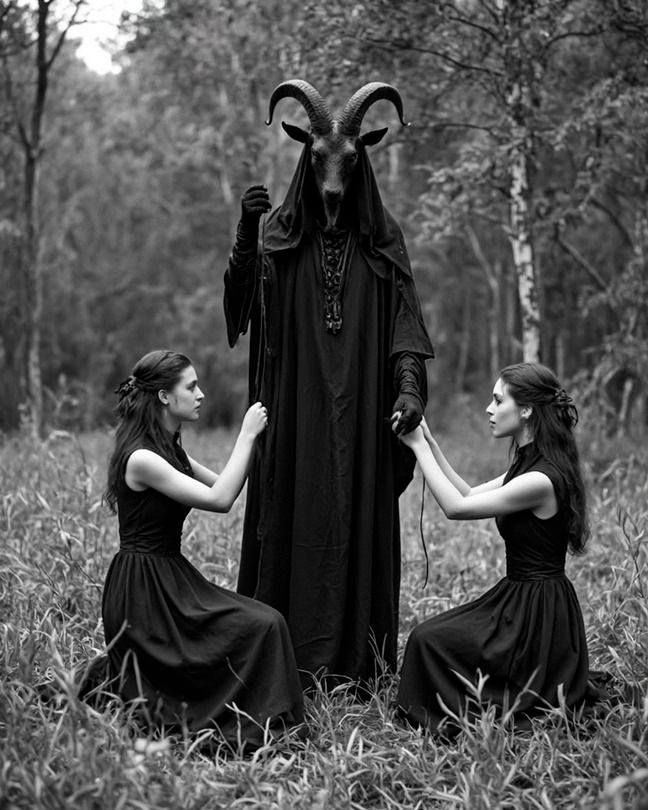
"Conflict makes us stronger. Reducing humans to sheep who resist struggle is a death sentence to evolution, conflict is part of all living organisms in one way or another."
#Lucifer
English
@GodlyAction Can you guess their name?
open.spotify.com/track/0r4N04O6…
English

@GodlyAction Can you guess their name?
open.spotify.com/track/0r4N04O6…
English
