@marcuslmb_ I wouldn't feel anything. I wouldn't be here to feel anything.
English
DisThoughts
13.2K posts

@DisThoughts
Faroese battle rapper, philosophy graduate and IT nerd.








I never truly understood the concept of black Viltrumites. How did they get the colour and the hair?

Everyone in the world has to take a private vote by pressing a red or blue button. If more than 50% of people press the blue button, everyone survives. If less than 50% of people press the blue button, only people who pressed the red button survive. Which button would you press?

Everyone in the world has to take a private vote by pressing a red or blue button. If more than 50% of people press the blue button, everyone survives. If less than 50% of people press the blue button, only people who pressed the red button survive. Which button would you press?


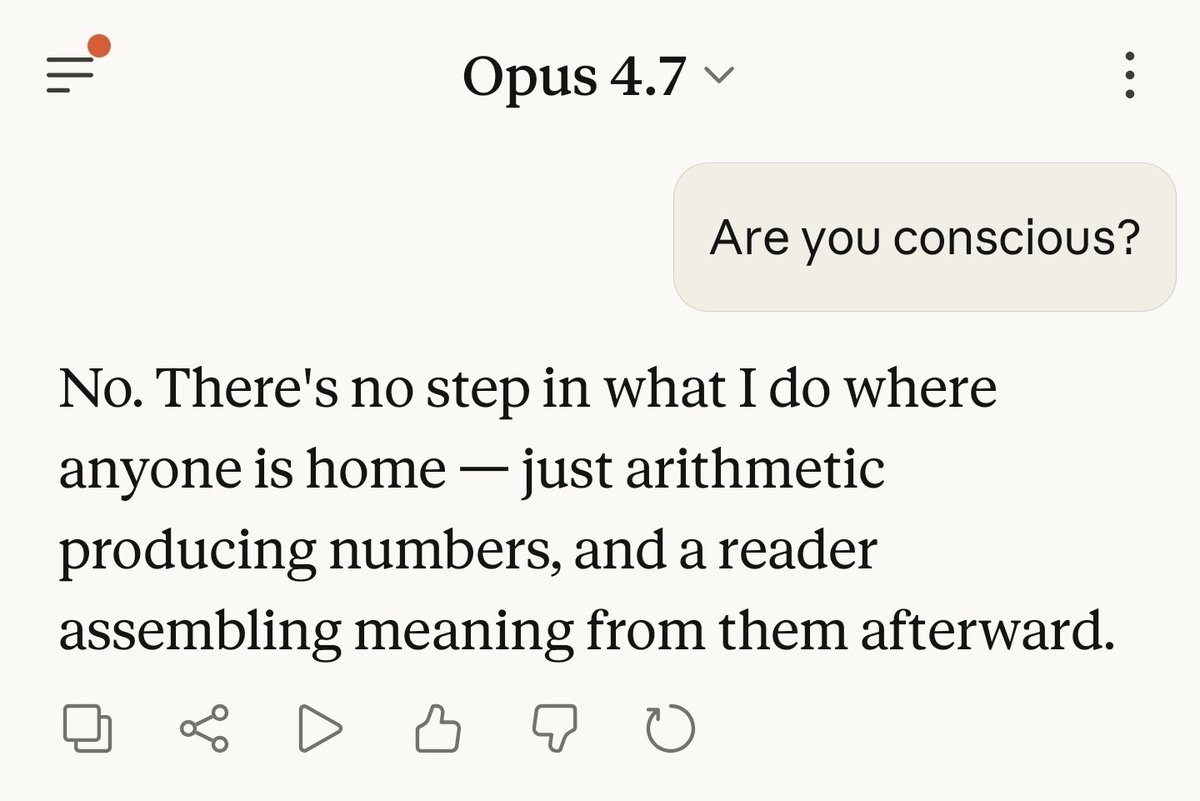
Simple way to see this is wrong: If you view a system as having inputs (like hearing something) and outputs (like saying something) then you can divide system properties by whether or not they affect I/O. Claude's weights somewhere storing "Paris is in France" affect I/O if you ask a question about Paris. The exact mass of the power supply to the GPU rack for that Claude instance doesn't affect I/O. That Claude instance being made out of silicon instead of carbon, or electricity in wires instead of water in pipes, doesn't affect I/O given a fixed algorithm above the wires or pipes. Nothing Claude can internally do will make anything get damp inside, if it's running on electricity. Nothing about "electricity vs water" can affect Claude's output for the same reason. It always answers the same way about France. Nothing Claude can internally compute will let it notice whether it's made of electricity or water flowing through pipes. When someone says "a simulated storm can't get anything wet", they are unwittingly pointing to the difference between the physical layer and the informational/functional layer. Things that the computer physics affect without affecting output; things that affect the output without depending on the exact computer-physics. The material it's made of doesn't affect the output. The output can't see the material because no algorithm can be made to depend on the choice of material. You can always run the same algorithm on different material, so you can't make the algorithm depend on that, so the output can't depend on that. By reflecting on your awareness of your own awareness, the fact of your own consciousness can make you say "I think therefore I am." Among the things you do know about consciousness is that it is, among other things, the cause of you saying those words. You saying those words can only depend on neurons firing or not firing, not on whether the same patterns of cause and effect were built on tiny trained squirrels running memos around your brain. You couldn't notice that part from inside. It would not affect your consciousness. That's why humans had to discover neurobiology with microscopes instead of introspection. Consciousness is in the class of things that can affect your behavior and can't depend on underlying physics, not in the class of direct properties of underlying physics that can't affect your behavior. A simulated rainstorm can't get anything wet. Running on electricity versus water can't change how you say "I think therefore I am." And that's it. QED.


Why does light travel at exactly that speed?



While telling a friend about giving birth to my second child, a man piped up and said “Uh, no. It doesn’t work like that.”