Saved by Grace

5.4K posts

Saved by Grace

Saved by Grace

@Excel_Ant

Minnesota, USA Inscrit le Nisan 2009
401 Abonnements120 Abonnés
Tweet épinglé
Saved by Grace
Saved by Grace@Excel_Ant·
Romans 10:9-10 KJV — That if thou shalt confess with thy mouth the Lord Jesus, and shalt believe in thine heart that God hath raised him from the dead, thou shalt be saved. For with the heart man believeth unto righteousness; and with the mouth confession is made unto salvation.
Saved by Grace tweet mediaSaved by Grace tweet mediaSaved by Grace tweet media
English
0
0
0
10
Saved by Grace retweeté
PaulsCorner-VerseQuest
PaulsCorner-VerseQuest@TNTJohn1717·
New VerseQuest chart: The Gospel - How to Share It and Why It Works. This chart gives a simple KJV road map for witnessing: God loves you, man is a sinner, Christ died for our sins, salvation is by faith, and whosoever calls on the Lord shall be saved. A clear quick-reference tool for sharing Christ with confidence.
PaulsCorner-VerseQuest tweet media
English
1
11
33
705
Saved by Grace retweeté
PaulsCorner-VerseQuest
PaulsCorner-VerseQuest@TNTJohn1717·
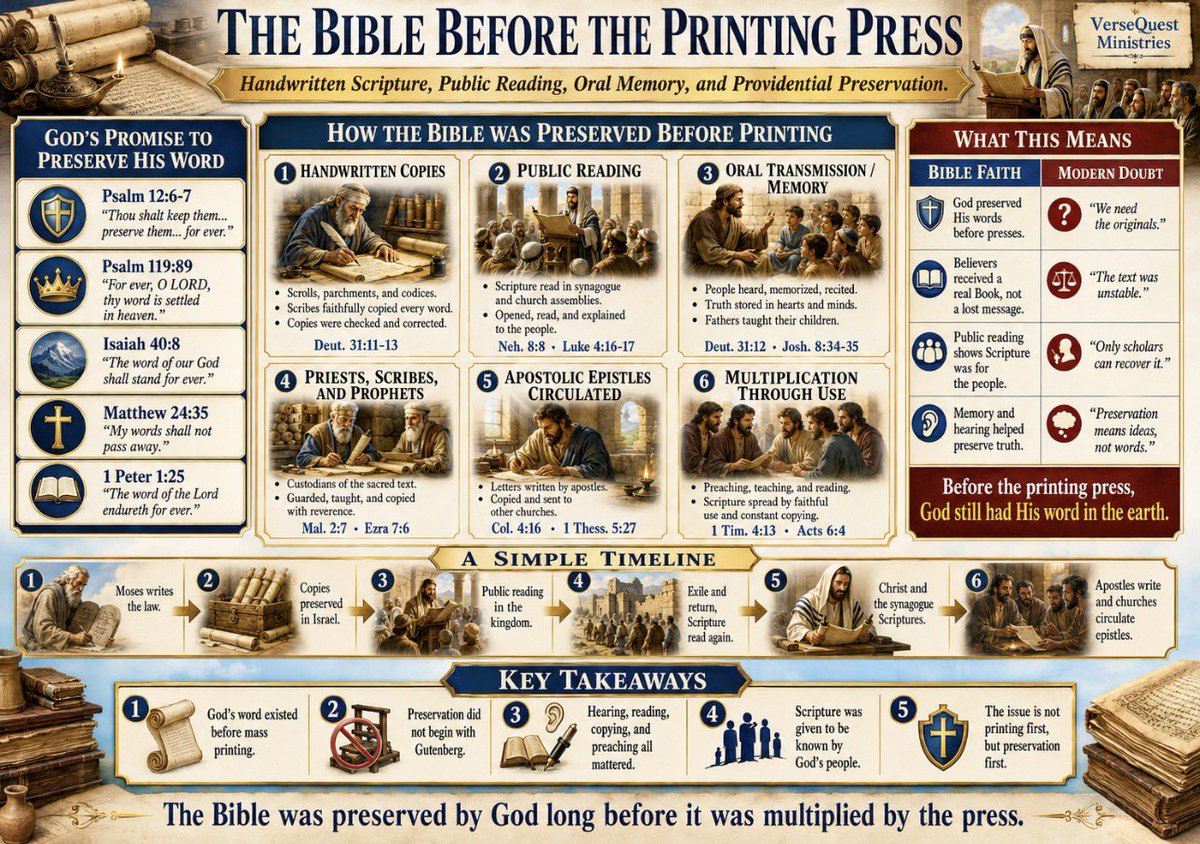
🚨‼️This chart shows that God’s word was preserved long before the printing press ever existed. Before mass printing, Scripture was copied by hand, read publicly, memorized orally, taught in homes, circulated among churches, preached to congregations, and guarded by God’s people. The printing press did not create preservation; it multiplied what God had already preserved. The issue is not technology first, but God’s promise first. Long before Gutenberg, the Lord had already kept His words in the earth.
PaulsCorner-VerseQuest tweet media
English
0
7
21
568
Saved by Grace retweeté
PaulsCorner-VerseQuest
PaulsCorner-VerseQuest@TNTJohn1717·
🚨‼️This chart shows the Bridegroom’s voice breaking through the silence of a sleepy world and calling His Bride upward. The Church may be surrounded by darkness, apostasy, and spiritual drowsiness, but the true Bride still knows the voice of her Beloved. One day that voice will shout, the dead in Christ will rise, the living saints will be changed, and the Bride will meet the Lord in the air.
PaulsCorner-VerseQuest tweet media
English
0
10
25
580
Saved by Grace retweeté
PaulsCorner-VerseQuest
PaulsCorner-VerseQuest@TNTJohn1717·
🚨‼️This chart shows how to guard your heart in a world full of distractions by protecting the gates of the eyes, ears, mind, speech, and influences. The heart directs the life, so it must be kept with Scripture, prayer, wise fellowship, clean affections, disciplined thoughts, and a steady focus on Christ.
PaulsCorner-VerseQuest tweet media
English
1
14
45
1K
Saved by Grace retweeté
PaulsCorner-VerseQuest
PaulsCorner-VerseQuest@TNTJohn1717·
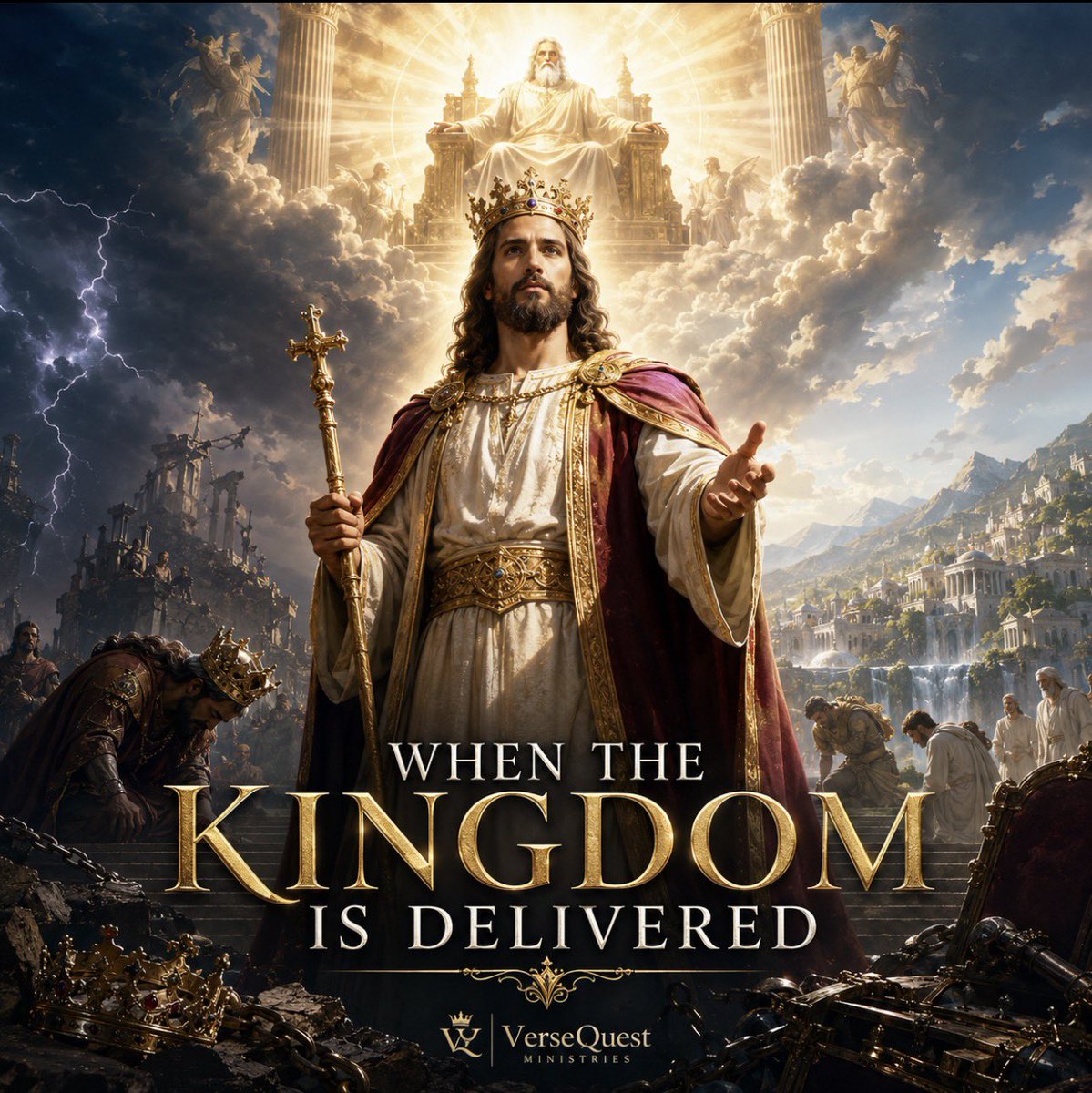
When The Kingdom Is Delivered Key Passage: 1 Corinthians 15:24 “Then cometh the end, when he shall have delivered up the kingdom to God, even the Father; when he shall have put down all rule and all authority and power.” (1 Corinthians 15:24) Introduction First Corinthians 15:24 is one of those verses that pulls the curtain back and lets you see where history is really going. Man thinks history is headed toward his utopia, his peace treaty, his global order, his religious unity, his technological salvation, his political deliverance, or his next empire with a cleaner logo and a better speech writer. The Bible says, “Then cometh the end.” Not man’s end, not Satan’s endgame, not Rome’s dream, not the United Nations’ fantasy, not the philosopher’s fog bank, and not the politician’s plastic kingdom. God has an end already written. Christ rose from the dead, Christ will raise His own, Christ will reign, Christ will put down every rebel power, and then Christ will deliver up the kingdom to God, even the Father. That is not speculation. That is Scripture. Paul is not wandering away from the resurrection when he says this. He is showing what the resurrection leads to. First Corinthians 15 begins with the gospel: Christ died for our sins, was buried, and rose again the third day according to the Scriptures. Then Paul proves Christ was seen alive by witnesses. Then he demolishes resurrection denial by showing that if Christ is not risen, preaching is vain, faith is vain, sins remain, the dead in Christ are perished, and Christians are most miserable. Then the great turn comes: “But now is Christ risen from the dead” (1 Corinthians 15:20). From there Paul moves to order: Christ the firstfruits, afterward they that are Christ’s at His coming, and then the end. Resurrection is not a little doctrine stuck in a corner. It is the opening blast of God’s total victory over sin, death, Satan, and every rebel throne. The kingdom is not delivered as a broken project. The Lord Jesus Christ does not hand the Father a battlefield He failed to secure. He does not hand over a kingdom still crawling with rebels, devils, Antichrists, false priests, corrupt rulers, proud kings, lying prophets, and spiritual wickedness in high places. The verse says the kingdom is delivered “when he shall have put down all rule and all authority and power.” There is the condition. Christ reigns until every rival is subdued. The Son finishes the kingdom work appointed to Him, and the completed kingdom is delivered to God, even the Father. That is victory. That is order. That is the end of every rebel’s dream and the beginning of the final display that God is all in all. Chapter One: The End Is Not Man’s Collapse But God’s Consummation When Paul says, “Then cometh the end,” he is not talking about God running out of ideas. He is not talking about the universe falling apart because heaven lost control of the machinery. He is not talking about the nihilist’s dream where everything ends in blackness and nothing matters. He is talking about the consummation of God’s revealed program. The end in the Bible is not chaos winning. It is God completing what He said He would complete. Men see history as a confused line of wars, elections, famines, revolutions, inventions, scandals, kingdoms, collapses, and graves. God sees the finish from the beginning. That should steady any Bible believer with enough sense to keep one eye on Scripture and the other eye off the panic merchants. The world always looks like it is coming apart because the world is under a curse and under the temporary dominion of the god of this world. Kings rage. Nations imagine vain things. Religious systems pretend they can rule souls. Philosophers keep rewriting unbelief with fancier words. Science builds new towers and calls them salvation. Politicians promise deliverance and then need deliverance from their own promises. But none of that changes the verse. “Then cometh the end.” God’s end is
PaulsCorner-VerseQuest tweet media
English
1
7
14
675
Saved by Grace retweeté
PaulsCorner-VerseQuest
PaulsCorner-VerseQuest@TNTJohn1717·
There Is One Mediator — And It Is Not Mary Passage: 1 Timothy 2:5 - “For there is one God, and one mediator between God and men, the man Christ Jesus.” Introduction First Timothy 2:5 is one of those verses that does not ask permission from Rome before it speaks. It does not whisper. It does not leave a little side door open for a religious system to sneak Mary into the office of Christ. It says, “For there is one God, and one mediator between God and men, the man Christ Jesus.” One God. One Mediator. One Man. Christ Jesus. That is plain enough to make a theologian nervous and simple enough for a child to believe. The verse does not say there is one main Mediator and a softer motherly mediator underneath Him. It does not say there is one official Mediator and then Mary as a mediatrix of all graces. It does not say there is one Mediator in theory, while in practice frightened sinners should run to Mary because Jesus is too holy, too stern, or too far away. It says what it says, and Rome spends a great deal of time trying to make it say less than it says. The issue is not whether Mary was blessed. She was. The issue is not whether Mary was highly favoured. She was. The issue is not whether Mary had a unique place in the incarnation of the Lord Jesus Christ. She did. The issue is whether Scripture ever tells sinners to approach God through Mary. It does not. The issue is whether Scripture gives Mary the office of mediator. It does not. The issue is whether Scripture says Mary hears prayers, dispenses grace, intercedes for souls in heaven, or functions as a motherly channel of access to Christ. It does not. The Roman system gives Mary emotional and devotional functions that Scripture gives to Jesus Christ, then tries to calm everybody down by saying, “We do not worship her.” That is like a man stealing your house, sleeping in your bed, eating your food, wearing your clothes, and then saying, “Do not worry, I have great respect for your property rights.” The practice gives the game away. This essay is written for Catholics who love Mary but have been trained to run to her in a way the Bible never commands. You may have prayed “Hail Mary” since childhood. You may have held a rosary in fear, grief, sickness, or guilt. You may have been told Mary is your mother, your intercessor, your refuge, your helper, your advocate, or the tender heart that leads you to Jesus. But the Bible never tells you to come to Mary. The Bible tells you to come to Christ. Hebrews says we can come boldly unto the throne of grace. Ephesians says we have access by Christ. Romans says we have peace with God through our Lord Jesus Christ. First Timothy says there is one Mediator between God and men. If God gave one Mediator, why did Rome train souls to seek another route? If Christ’s blood opened the way, why are Catholics told to take a Marian detour? The answer is painful, but plain: Rome’s devotion has blurred Christ’s office and placed Mary where the Bible never put her. Chapter One: One Means One, Unless a System Needs It to Mean More The verse says “one mediator.” Not two. Not one and a half. Not one supreme Mediator plus a subordinate mediatrix. Not one necessary Mediator and several helpful assistant mediators. One. Religious systems become experts at making simple words complicated when the simple words threaten the system. When the Bible says “one,” Rome says, “Yes, one, but…” And once that “but” enters the room, the verse gets buried under distinctions, categories, terms, and explanations until the average person no longer hears what God said. That is how false doctrine survives. It does not always deny the verse. It smothers the verse. Paul’s statement in 1 Timothy 2:5 is not a devotional suggestion. It is doctrinal truth. He grounds mediation in the oneness of God and the manhood of Jesus Christ. There is one God, and there is one Mediator between God and men. The one Mediator is not an angel. He is not a priest.
PaulsCorner-VerseQuest tweet media
English
4
7
17
827
Saved by Grace retweeté
PaulsCorner-VerseQuest
PaulsCorner-VerseQuest@TNTJohn1717·
🚨‼️New VerseQuest chart: The Curse of the Law - Galatians 3:10–13. This chart lays out the difference between Law and Grace, showing how the Law exposes sin, condemns the guilty, and leaves every man without excuse, while Jesus Christ redeems the believer through His finished work on the cross. The Law condemns. The Cross redeems. Grace justifies.
PaulsCorner-VerseQuest tweet media
English
0
5
19
589
Saved by Grace retweeté
PaulsCorner-VerseQuest
PaulsCorner-VerseQuest@TNTJohn1717·
🚨‼️I’m sorry, but when someone holds that up and says, “This is Jesus in His full form,” my first thought is, “That looks suspiciously like an oblea from Amigos Foods waiting for caramel glaze.” And that is exactly the problem. Rome can call it “His full form” all day long, but the Bible never tells me to worship a wafer. Jesus said, “It is the spirit that quickeneth; the flesh profiteth nothing” (John 6:63), and Paul said the Lord’s Supper is done “in remembrance” of Him (1 Corinthians 11:24-26). Christ is not trapped in a cracker. Christ is seated at the right hand of God. So no, I am not being dishonest by refusing to call a wafer Jesus. I am being biblical. Rome turned remembrance into ritual magic, and then got offended when Bible believers refused to bow to breakfast food with a halo.
PaulsCorner-VerseQuest tweet media
Uche is a girl@UcheMaryOkoli

Jesus did not come to this world and died for us just to leave us with a symbol. The Eucharist is Jesus. In His Full Form. It is very dishonest to call the Eucharist a symbol.

English
3
4
20
1.5K
Saved by Grace retweeté
PaulsCorner-VerseQuest
PaulsCorner-VerseQuest@TNTJohn1717·
New VerseQuest chart: The Wafer That Replaced the Finished Work. This chart traces how the simple Lord’s Supper became the Roman Catholic Mass, contrasting Catholic doctrine with the finished work of Christ. The Bible says, “It is finished,” not repeated, not continued, not re-sacrificed. The Cross is enough.
PaulsCorner-VerseQuest tweet media
English
0
3
9
567
Saved by Grace retweeté
PaulsCorner-VerseQuest
PaulsCorner-VerseQuest@TNTJohn1717·
🚨‼️This chart gives a full overview of my 50-part series, Mount Shasta: The Mountain of Hidden Spirits, showing how the legends of Shasta, Lemuria, Telos, portals, giants, star people, channelers, and hidden kingdoms all connect to deeper Bible categories. The goal is not paranormal entertainment, but biblical discernment. The chart lays out how the devil often takes fragments of truth, like angels, giants, the flood, unseen realms, and spiritual warfare, then rearranges them into counterfeit spirituality. From a KJV Bible-believing perspective, every claim must be tested by Scripture, every spirit must be tried, and every mystery must be brought under the authority of Jesus Christ. The main takeaway is simple: Christ above every mountain. Truth above every legend. Scripture above every spirit.
PaulsCorner-VerseQuest tweet media
English
0
5
15
726
Saved by Grace retweeté
PaulsCorner-VerseQuest
PaulsCorner-VerseQuest@TNTJohn1717·
🚨‼️This chart shows the plain Bible case for one Mediator: “the man Christ Jesus.” It lays out the verses that give direct access to God through Christ’s blood, His ransom, His priesthood, His advocacy, and His finished work. The Bible never sends sinners to Mary for mediation, prayer, grace, or access. It sends them straight to Jesus Christ. The chart also answers the common Roman claims about Mary’s intercession. Mary was blessed and should be honored biblically, but Scripture never calls her mediatrix, advocate, refuge, or the way to God. Christ alone gave Himself a ransom. Christ alone shed His blood. Christ alone opens the way. The bottom line is simple: the Bible does not send sinners to Mary. It sends them to Jesus Christ.
PaulsCorner-VerseQuest tweet media
English
0
8
16
495
Saved by Grace retweeté
PaulsCorner-VerseQuest
PaulsCorner-VerseQuest@TNTJohn1717·
🚨‼️This chart shows the kingdom transition in 1 Corinthians 15:24. Christ does not deliver a failed kingdom, but a completed and victorious one. He reigns, puts down all rule, all authority, and all power, then delivers the kingdom to God the Father. History is not moving toward man’s utopia or Satan’s victory, but toward Christ’s final triumph and God’s glory.
PaulsCorner-VerseQuest tweet media
English
0
12
32
727
Saved by Grace retweeté
PaulsCorner-VerseQuest
PaulsCorner-VerseQuest@TNTJohn1717·
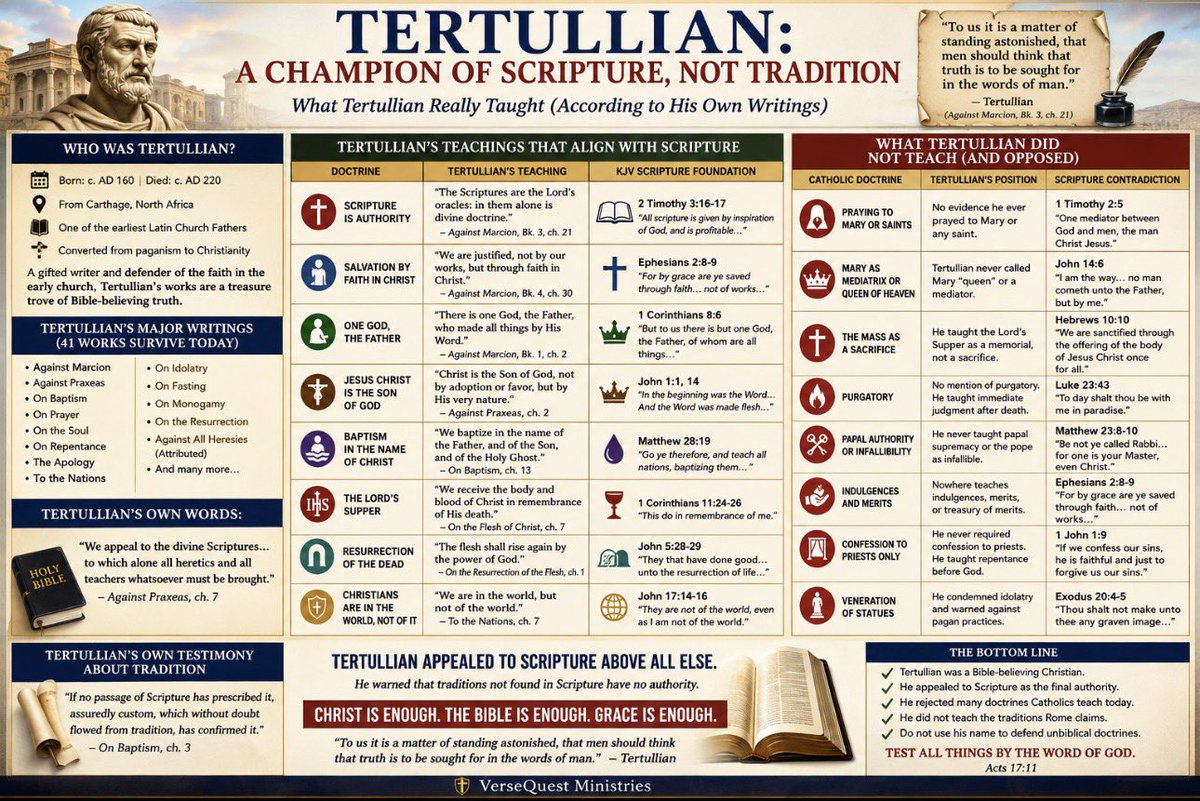
🚨‼️This is a perfect example of how Catholic apologetics works. Take an early writer, extract one tradition from him, then inflate it into “biblical, apostolic, and hell fears it.” That is quite a promotion. Tertullian mentioned tracing the sign, yes. But he also admitted these kinds of practices were not based on a positive Scripture command, but on tradition and custom. So no, quoting Tertullian does not prove the sign of the cross is a biblical spiritual weapon. It proves some early Christians had customs. Big difference. The Bible never says demons flee because someone moves his hand from forehead to chest to shoulder. That sounds less like apostolic warfare and more like Catholic hokey-pokey with incense. And since Catholics love floating early church fathers’ names around as if they settle every argument, maybe it would help to read the rest of Tertullian instead of only the one sentence Rome likes. Tertullian repeatedly appeals to Scripture, argues from Scripture, defends doctrine by Scripture, and says some traditions have no direct Scripture command. That is not exactly the slam dunk Rome thinks it is. The real power is not in hand motions. It is not in tracing a symbol over your body. It is not in ancient custom, church fathers, or religious choreography. The power is in the Lord Jesus Christ, the blood of Christ, the word of God, prayer, faith, and the armour of God. Paul did not say, “Trace the sign slowly and hell will fear it.” He said, “Put on the whole armour of God” (Ephesians 6:11). He said take “the sword of the Spirit, which is the word of God” (Ephesians 6:17). So if someone wants to make the sign of the cross as a personal reminder, that is between them and God. But do not sell it as biblical doctrine or apostolic demon repellent. The apostles preached Christ crucified. They did not teach Christians to fight devils with forehead-hand-shoulder choreography. Here is the chart. Since we are bringing up Tertullian, let’s bring up more than the part Rome wants quoted.
PaulsCorner-VerseQuest tweet media
RosarySon@SkyVirginSon

MOST CATHOLICS DON'T KNOW THIS ABOUT THE SIGN OF THE CROSS Every time you make the Sign of the Cross, you are performing an act of spiritual warfare that demons cannot stand. Most Catholics don't know why, and the enemy would prefer it stay that way. Here is what you are actually doing: ✝️ You are professing the Holy Trinity. “In the name of the Father, and of the Son, and of the Holy Spirit.” Three Divine Persons. One God. The central mystery of the Christian faith. ✝️ You are claiming the victory of Calvary. By tracing the Cross upon your body, you proclaim that Jesus Christ died and rose again for your salvation. You are declaring: “I belong to Christ.” ✝️ You are taking up a powerful spiritual weapon. St. John Chrysostom called the Sign of the Cross “a trophy against the demons and a weapon against sin.” For centuries, Christians have used it in moments of temptation, fear, suffering, and danger. ✝️ You are marking yourself with the sign of God's faithful. Many Church Fathers saw a connection between the cross-shaped “tau” mark in Ezekiel 9:4 and the saving sign of the Cross borne by God's people. ✝️ You are practicing one of Christianity's oldest traditions. Around 200 AD, Tertullian wrote: “At every forward step and movement, at every going in and out, when we put on our clothes and shoes, when we bathe, when we sit at table, when we light the lamps, on couch and seat, in all the ordinary actions of daily life, we trace upon the forehead the sign.” The Sign of the Cross is not superstition. It is biblical, ancient, apostolic, and deeply rooted in Christian tradition. The next time you make the Sign of the Cross, do it slowly. Do it reverently. Do it with faith. Heaven recognizes it. And hell fears what it represe QN: Do you make the Sign of the Cross with full awareness? A) Yes, always with intention B) I rush through it C) I didn't know this depth before D) I will start praying it differently now

English
5
6
22
1.8K
Saved by Grace retweeté
PaulsCorner-VerseQuest
PaulsCorner-VerseQuest@TNTJohn1717·
🚨‼️The problem with this kind of Catholic apologetic is that it laughs at objections instead of actually answering them. It takes the most serious Bible objections to Rome, throws an emoji beside them, and then gives the standard Catholic explanation as if repeating Rome’s claim settles the issue. It doesn’t. Saying “Catholics don’t worship Mary” does not erase the fact that Rome prays to her, crowns her statues, calls her Queen of Heaven, says she is the fastest way to Jesus, and gives her titles and devotion the Bible never gives her. You can rename it “honor” if you want, but when someone is kneeling before an image, praying to Mary, trusting her intercession, and saying “everything happens through her,” that is not New Testament Christianity. Saying statues are just “visual reminders” does not answer the problem either. I have pictures of loved ones in my house. I do not kneel before them, light candles to them, carry them in procession, kiss them, crown them, pray in front of them, or believe grace is connected to them. The cherubim on the Ark were not statues of dead saints being venerated by Israel. They were God-commanded figures connected to the mercy seat, and Israel was never told to pray to them. Saying the pope is biblical because of Matthew 16 is also a leap. Peter was an apostle, but the Bible never calls him pope, never gives him universal jurisdiction over the Church, never says he had successors in Rome, and never says those successors would be infallible. In Galatians 2, Paul withstood Peter to the face because he was to be blamed. That is a strange picture of the first infallible supreme pontiff. Saying Catholics do not believe in works salvation while building a system of sacraments, priestly confession, penance, purgatory, indulgences, mortal sins, venial sins, and final justification is exactly the confusion. The Bible says, “For by grace are ye saved through faith… not of works” (Ephesians 2:8-9). Good works follow salvation. They do not become part of a sacramental treadmill required to keep or regain it. Saying a priest forgives sins because of John 20 ignores the rest of Scripture. The apostles preached remission of sins through Jesus Christ. They did not build confession booths and require Christians to confess private sins into a priest’s ear. First John 1:9 says, “If we confess our sins, he is faithful and just to forgive us our sins.” It points the believer to God, not Rome’s priesthood. Saying purgatory is in 1 Corinthians 3 is another classic stretch. That passage is about a saved man’s works being judged, not his soul being purified after death by suffering. The man is saved, “yet so as by fire.” His works burn. He does not go to a Roman holding chamber until enough Masses, prayers, and indulgences help him out. And saying Rome did not add books to the Bible does not change the fact that the Apocrypha was never treated by Jesus or the apostles as the inspired Old Testament Scripture. Rome leans on 2 Maccabees because purgatory needs help, but doctrine should not be built on books Christ and the apostles never used as final authority. So yes, Rome has answers. The question is whether those answers are biblical or just Roman explanations for Roman additions. Anyone can laugh, add emojis, and say “we don’t do that.” But when the Bible is opened, the issue remains the same: Mary is not the mediator. Statues are not Bible devotion. Peter was not a pope. Grace is not a sacramental treadmill. Priests are not necessary mediators of forgiveness. Purgatory is not the gospel. And the Roman Catholic Church was not the simple New Testament church founded by Jesus Christ. Rome can explain its system all day long. The question is whether the apostles preached it. And they did not.
PaulsCorner-VerseQuest tweet media
♱Faith guard⚔️🛡@Defensofidei

The Most Common Anti-Catholic Arguments and Their Answers 1. “Catholics worship Mary.” 😆 No. Catholics worship God alone. Mary is honored as the Mother of Jesus because God honored her first in the Gospel of Luke (1:48), but worship (latria) belongs only to God. Asking Mary to pray for us is similar to asking a fellow Christian to pray for us, except that Mary is already with Christ in heaven. 2. “Catholics worship statues.” 🙀 No. Statues are visual reminders, just as photographs remind us of loved ones. The honor shown to an image passes to the person it represents, not to the material object itself. God Himself commanded sacred images such as the cherubim on the Ark of the Covenant (Exodus 25:18-20). 3. “The Pope is not biblical.” 😎 Catholics point to Christ giving Peter a unique role among the apostles (Matthew 16:18-19), including the “keys of the kingdom.” The papacy is understood as the continuation of that office in the Church. 4. “Catholics believe they earn salvation by works.” 💀 No. The Catholic Church teaches that salvation is a gift of God’s grace. Good works do not replace grace; they are the fruit of grace working in a believer (Ephesians 2:8-10; James 2:24). 5. “You don’t need a priest to confess sins.” 😳 While God is the source of forgiveness, Catholics believe Christ gave His apostles the authority to forgive sins in His name (John 20:21-23). The priest acts as Christ’s minister, not as a substitute for God. 6. “Purgatory is not in the Bible.” 🤔 Catholics see evidence for purification after death in passages such as 1 Corinthians 3:15 and in the practice of praying for the dead found in 2 Maccabees 12:44-46. 7. “Catholics added books to the Bible.” 😤 Historically, the Catholic Church did not add books. Rather, the books often called the Deuterocanon were part of the Greek Old Testament used by many early Christians and remained in Christian Bibles for centuries. 8. “The Catholic Church was not founded by Jesus.” ⛪️ The Catholic Church was founded by Jesus Christ. Peter was not the founder; he was the first leader appointed by Christ. Just as a king can establish a kingdom and appoint a prime minister, Christ founded the Church and entrusted Peter with a special role within it (Matthew 16:18-19). Do you agree with the Church or do you have your own opinion? Which objection do you hear most often? 👇

English
5
6
21
1.3K
Saved by Grace retweeté
PaulsCorner-VerseQuest
PaulsCorner-VerseQuest@TNTJohn1717·
🚨‼️Catholic Ripley’s Believe It or Not, Episode Seven: The Ghost Nun and the One Hail Mary. So now we have a story about a nun who suffered for years, died, allegedly appeared to another sister in the convent, and said she would gladly return to her diseased body just to say one more Hail Mary because that one prayer would be worth all the suffering again. And the moral of the story? “Never underestimate the power of one Hail Mary.” That is where Rome loses me. A dead nun allegedly appears from the other side, gives a testimony about the power of praying to Mary, and everyone is supposed to treat that as spiritual wisdom. I’m sorry, but that sounds less like Bible Christianity and more like Catholic ghost stories with a rosary attached. The Bible never tells sinners to pray a Hail Mary. The Bible never tells believers to measure grace by Marian devotion. The Bible never tells Christians that repeating a prayer to Mary can move mountains, protect from evil, convert souls, and draw us closer to Jesus. That is exactly the problem. Rome talks about Jesus, then constantly redirects the heart back to Mary. The Bible says, “Whatsoever ye shall ask the Father in my name, he will give it you.” It does not say, “Ask Mary.” It does not say, “Repeat a Hail Mary.” It does not say, “Trust a ghost nun’s convent testimony.” “For there is one God, and one mediator between God and men, the man Christ Jesus.” (1 Timothy 2:5) If a story from beyond the grave teaches you to pray to Mary instead of going directly to God through Jesus Christ, that is not spiritual light. That is religious darkness wearing a veil. Rome gives people ghost stories. Scripture gives people truth. One mediator. Not one Hail Mary hotline.
PaulsCorner-VerseQuest tweet media
Saint Adaugoijele ✝️@JustAdaugoijele

In a quiet convent, there lived a nun who was deeply devoted to the Holy Rosary. For many years, she endured agonizing pain and lay bedridden, offering up her suffering with patience and love. She prayed the Rosary faithfully until the end of her earthly life. After her death, she appeared to one of her sisters in the convent. Her face was radiant, yet filled with a profound longing. She said: “If I were allowed to return to my body, even just to say one single Hail Mary, I would gladly endure all the sufferings of my final illness again. Even if I said it quickly and without great fervor, the merit of that one prayer would be worth it all.” Never underestimate the power of one Hail Mary prayed with a sincere heart. In the eyes of God and Our Blessed Mother, even the smallest prayer offered in faith carries immense grace. It can move mountains, convert souls, protect us from evil, and draw us closer to Jesus. St. Louis de Montfort So the next time you feel too busy, too tired, or too distracted to pray... remember this nun. Just one Hail Mary. It’s more powerful than you think. Hail Mary, full of grace, the Lord is with thee. Blessed art thou among women, and blessed is the fruit of thy womb, Jesus....

English
4
3
12
904
Saved by Grace retweeté
PaulsCorner-VerseQuest
PaulsCorner-VerseQuest@TNTJohn1717·
🚨‼️This chart shows that God’s saving work is not nervous, temporary, or constantly revised. Ephesians 1:13-14 teaches that the believer hears the gospel, believes, is sealed by the Holy Spirit, receives the earnest of the inheritance, and is headed toward the redemption of the purchased possession. God does not save with an eraser in His hand; He saves with purpose, promise, and permanence.
PaulsCorner-VerseQuest tweet media
English
2
9
29
1K
Saved by Grace retweeté
PaulsCorner-VerseQuest
PaulsCorner-VerseQuest@TNTJohn1717·
When Heaven Breaks Four Hundred Years of Silence Passage: Luke 1:5-25 Key Scripture: “And there appeared unto him an angel of the Lord standing on the right side of the altar of incense.” (Luke 1:11) Introduction Luke opens his Gospel with certainty, and then he steps immediately into the temple. That is not accidental. The Holy Ghost does not begin Luke’s record in Rome, Athens, Alexandria, a philosopher’s school, or a religious council with robed men voting on what God should be allowed to say next. He begins in Jerusalem, inside the priestly order, beside the altar of incense, where an old priest is doing what priests had done for generations. The nation has had no open prophetic voice since Malachi. Four hundred years of silence had stretched across Israel like a long, cold night. Then suddenly Heaven moves. God does not ask the Sanhedrin for permission. He does not submit a proposal to a committee. He does not send a pope, a cardinal, a bishop, or some robed religious manager with a ring to kiss. He sends an angel of the Lord into the temple, and that angel stands on the right side of the altar of incense. That is how God starts the New Testament record in Luke. Not with man organizing God, but with God interrupting man. Luke 1:5-25 is one of those passages that looks quiet until you realize the ground is shaking underneath it. On the surface, an elderly priest named Zacharias is burning incense while the people pray outside. It looks routine, ceremonial, old, quiet, and familiar. But Heaven is about to break into that routine like a lightning bolt through stained glass. Zacharias and Elisabeth are righteous before God, walking in all the commandments and ordinances of the Lord blameless, yet they have no child. Their private grief sits inside their public faithfulness. Their prayers appear unanswered. Their bodies are old. Their hope has likely been buried under years of disappointment. Then Gabriel appears and says, “Fear not, Zacharias: for thy prayer is heard.” That sentence alone is enough to preach for a week. God had heard the prayer long before Zacharias saw the answer. The silence of God was not the absence of God. This passage gives us prayer, priesthood, prophecy, unbelief, divine timing, judgment, mercy, and the beginning of a new movement in Israel’s history. Zacharias is serving in an old system that is about to be fulfilled by Christ. His son John will not be a priest like his father in the temple machinery. He will be a prophet in the wilderness. That is God’s way of announcing that something is shifting. The old order is still operating, but God is already preparing the voice that will cry, “Prepare ye the way of the Lord.” Heaven steps into the temple, but the next great preacher will stand outside the temple system, dressed in camel’s hair, eating locusts and wild honey, calling religious leaders vipers. God has a wonderful way of ruining the comfort of religious professionals. Just when they get the machinery polished, He raises up a man in the wilderness who does not know how to bow to their little kingdom. Chapter One: God Begins With a Priest, but Not With the Priesthood’s Permission Luke tells us, “There was in the days of Herod, the king of Judaea, a certain priest named Zacharias.” That sentence puts the scene in history. Herod is on the throne, Rome is in the background, Israel is under Gentile power, and the priesthood is still functioning. God moves in real time, among real people, under real rulers. The Bible is not floating around in a mystical fog. The Holy Ghost gives names, offices, locations, and conditions. Herod may be king politically, but God is about to show that Heaven is not waiting for Herod’s approval. A wicked ruler may sit on an earthly throne, but the Lord still knows where His servants are, what prayers they have prayed, and when to break silence. Zacharias is not presented as a fraud. He is not one of the hypocritical temple
PaulsCorner-VerseQuest tweet media
English
1
9
19
672
Saved by Grace retweeté
PaulsCorner-VerseQuest
PaulsCorner-VerseQuest@TNTJohn1717·
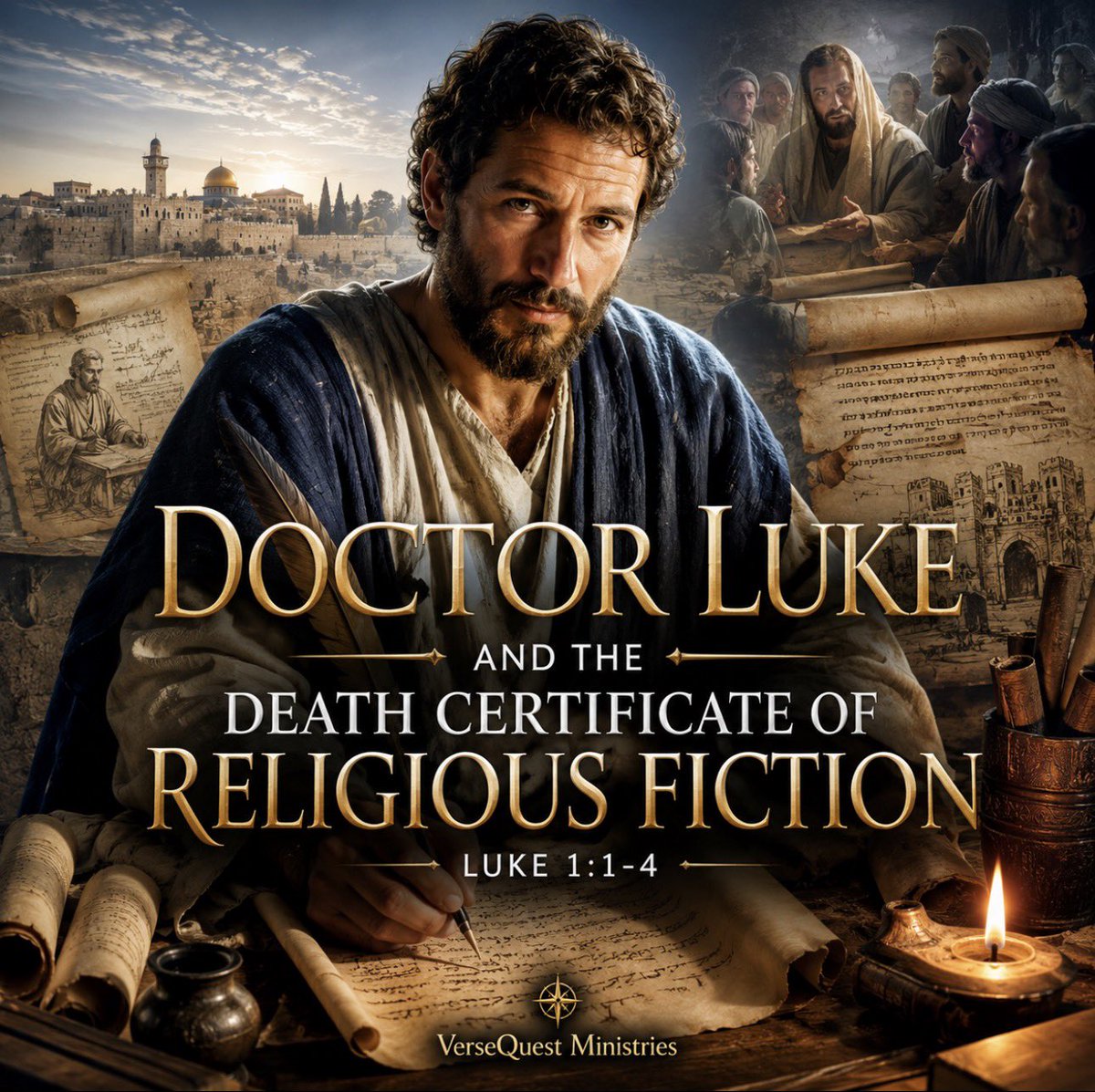
Doctor Luke and the Death Certificate of Religious Fiction Passage: Luke 1:1-4 Key Scripture: “That thou mightest know the certainty of those things, wherein thou hast been instructed.” (Luke 1:4) Introduction Luke does not begin his Gospel like a man sitting in a coffee shop trying to “process his faith journey.” He does not open with “I feel,” “I imagine,” “I suppose,” “tradition says,” or “the community later came to believe.” That is the language of modern religious fog machines, the kind of spiritual cotton candy that melts the moment you put pressure on it. Luke opens like a man assembling a record. He speaks of things “most surely believed,” eyewitnesses, ministers of the word, perfect understanding, order, and certainty. That is not the vocabulary of myth. That is the vocabulary of evidence. The Holy Ghost did not give the church a pile of campfire legends, warmed-over Jewish folklore, or inspirational moral fiction. He gave a written testimony so a man could know what he had been taught was not a religious fairy tale with sandals on it. Luke 1:1-4 is a death certificate for religious fiction. It puts a toe tag on the modern lie that says the Gospels are pious inventions, theological reflections, late community memories, or spiritualized stories produced by religious imagination. Luke says he had “perfect understanding of all things from the very first.” He says he wrote “in order.” He says the purpose was “that thou mightest know the certainty.” Now, you can either believe the Holy Ghost through Luke, or you can believe some scholar with a beard, a German footnote, and a permanently suspicious attitude toward anything supernatural. The choice is not hard. One of them was moved by the Spirit of God. The other is usually moved by tenure, unbelief, and the desperate need to make the Bible look less certain than his own latest journal article. The Bible believer does not need to apologize for treating Luke as history. Luke wrote history. He named rulers, places, customs, events, people, journeys, priestly courses, towns, synagogues, governors, decrees, and public happenings. He did not hide his Gospel in some mystical cave and say, “Only the spiritually elite can understand my symbolic reconstruction.” He wrote so Theophilus could know. That matters. Christianity is not built on private hallucination. It is built on public revelation, fulfilled prophecy, eyewitness testimony, blood, death, burial, resurrection, and a written record preserved by God. “Faith cometh by hearing, and hearing by the word of God” (Romans 10:17). Not by fog. Not by legend. Not by scholarship that starts with unbelief and then congratulates itself for finding what it planted. Chapter One: Luke Writes Like a Witness, Not a Dreamer Luke begins, “Forasmuch as many have taken in hand to set forth in order a declaration of those things which are most surely believed among us.” Notice that phrase, “most surely believed.” Not loosely suspected. Not poetically imagined. Not spiritually reinterpreted by later church communities after several decades of theological development and academic nonsense sprinkled over it like powdered sugar. Luke says these things were believed with certainty among believers. They were not wandering rumors looking for a home. They were known, preached, received, examined, and written. The apostolic message had content. It had facts. It had names. It had dates. It had witnesses. It had a public Christ who was born under Caesar, ministered in Israel, was crucified under Pontius Pilate, and rose again the third day according to the Scriptures. That alone destroys the modern treatment of Christianity as a vague moral atmosphere. The Bible is not a scented candle. It is a sword. Hebrews 4:12 says, “For the word of God is quick, and powerful, and sharper than any twoedged sword.” Luke’s Gospel is not given so a man can sit around and say, “Well, my truth is different from your truth.” No, friend, truth
PaulsCorner-VerseQuest tweet media
English
1
9
17
1K
Saved by Grace retweeté
PaulsCorner-VerseQuest
PaulsCorner-VerseQuest@TNTJohn1717·
🚨‼️Here is the full overview chart for 1 Thessalonians, a powerful little book that gives us a model local church: saved, separated, suffering, steadfast, and waiting for Jesus Christ. This chart walks through the major doctrines, chapter themes, key contrasts, rapture comfort, practical holiness, and the blessed hope found in every chapter. The next five essays will continue from 1 Thessalonians, and tomorrow we will begin five from 2 Thessalonians. This is a great chart to save, study, and share. #VerseQuest #KJV #BibleStudy #RightlyDivided #1Thessalonians #BlessedHope #Rapture #PaulineEpistles
PaulsCorner-VerseQuest tweet media
English
1
8
28
924
Saved by Grace
Saved by Grace@Excel_Ant·
@TF_WOG @TNTJohn1717 John 3:36 KJV — He that believeth on the Son hath everlasting life: and he that believeth not the Son shall not see life; but the wrath of God abideth on him.
English
2
0
0
22
PaulsCorner-VerseQuest
PaulsCorner-VerseQuest@TNTJohn1717·
🚨‼️This chart shows the difference between Mother Teresa’s works of mercy and the gospel of grace in the King James Bible. Her compassion for the poor and dying was real, but the Bible test is not charity, reputation, suffering, or Rome’s saint-making system. Salvation is not found in love-infused works, the Mass, Mary, sacraments, or interfaith kindness. The true gospel is Jesus Christ alone: one Mediator, one finished sacrifice, one Saviour, and salvation by grace through faith.
PaulsCorner-VerseQuest tweet media
English
2
5
19
738